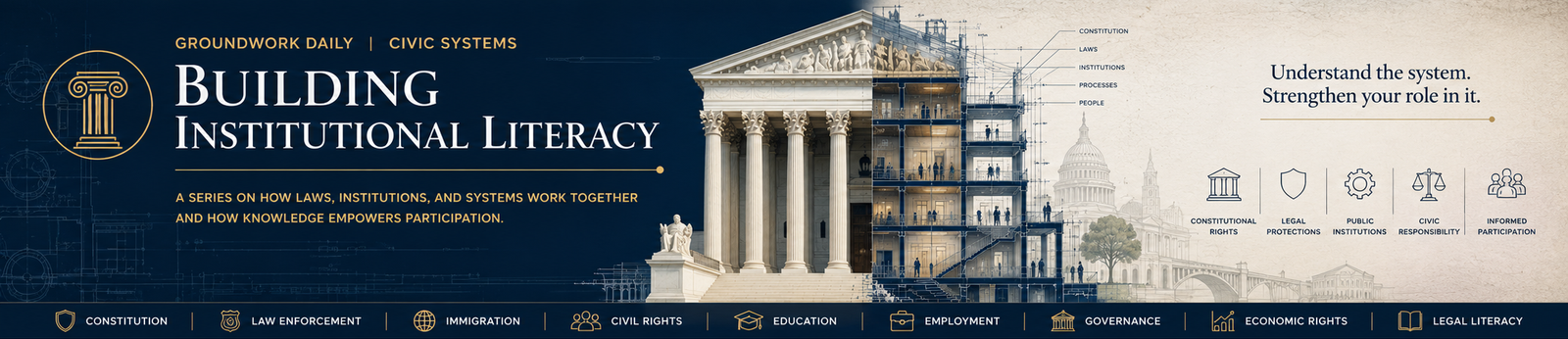
Building Institutional Literacy is the practice of understanding how power moves through institutions before that power reaches your life.
Most people learn institutions too late. They learn courts after a case begins, police procedure during a stop, warrants when someone is already at the door, or administrative systems after a notice arrives.
That leaves people reacting to authority instead of understanding it.
Institutional literacy creates a stronger position. It helps readers identify where government power comes from, what rules govern it, how far that authority reaches, what procedures constrain it, and which institution actually controls the next decision.
This page is the central learning hub for Groundwork Daily’s constitutional and civic systems curriculum. It connects constitutional rights, police encounters, searches, warrants, due process, immigration enforcement, civil rights, administrative law, and institutional power into one structured pathway.
Critical Legal Note
This resource is educational. It is not legal advice. Laws vary by jurisdiction, facts matter, and serious situations require qualified legal counsel.
Where Should You Start?
You do not need to understand the entire constitutional system before one piece becomes useful. Start with the problem you are trying to understand, then move outward into the larger framework.
Police encounters
Were you stopped, questioned, detained, or asked for consent?
Start with the basic structure of police encounters, then move into Terry stops, Miranda, and consent.
Searches
Is your question about your home, property, phone, car, or belongings?
Begin with the Fourth Amendment. Then follow the specific doctrine that controls the search.
Warrants
Are you trying to understand what an official document actually allows?
Start by separating judicial warrants from administrative warrants before analyzing scope.
Constitutional foundations
Do you need the broader map before the specific rule?
Begin with constitutional rights and the structure that determines how public power is limited.
What Institutional Literacy Means
Institutional literacy is the ability to understand how systems exercise power. It is larger than knowing that a right exists. It means understanding how that right operates through police departments, courts, legislatures, administrative agencies, local government, federal authority, written procedures, and judicial review.
A right may exist on paper while procedure determines what happens next. That is why institutional literacy focuses on the structure beneath the visible moment. It asks who has authority, where that authority comes from, what limits it, which facts activate it, and how a person can recognize when the government has moved from one level of authority to another.
During a police encounter, for example, the useful question is not only, “What should I say?” A stronger question is, “What legal authority does the government have right now?” During a proposed search, the question is not simply, “Can they do that?” It is whether officers are relying on consent, reasonable suspicion, probable cause, a judicial warrant, an administrative document, an emergency exception, or another legal doctrine.
The same method applies outside policing. When an agency sends a notice, when a school applies a rule, when an employer invokes federal law, or when a court issues an order, the important questions remain structural. Which institution acted? What authority did it use? What procedure controls the next step?
Core idea: Rights matter, but procedure determines how rights are protected, limited, invoked, challenged, and enforced.
Constitutional Foundations
Before readers can understand warrants, searches, stops, interrogation, or court challenges, they need a basic map of constitutional authority. The Constitution does more than announce rights. It creates a structure that distributes power and places limits on government action.
These foundation guides establish the vocabulary for the rest of the learning path.
Foundation
Constitutional Rights Explained
A broad guide to constitutional rights, public authority, legal limits, and why procedure determines how rights operate in practice.
AvailableSearch & seizure
Fourth Amendment Rights Explained
Explains searches, seizures, privacy, warrants, probable cause, and constitutional limits on government intrusion.
AvailableSilence & due process
Fifth Amendment Rights Explained
Explains self-incrimination, silence, due process, and why government questioning has constitutional boundaries.
AvailableComing in the curriculum
Due Process Clause Explained
Will examine fair procedure, notice, liberty, property, hearings, and how due process operates across public institutions.
Coming SoonPolice Encounters
Police encounters are where many people first experience institutional authority directly. Pressure, speed, and uncertainty make it easy to confuse what officers request with what the law requires.
This part of the curriculum separates voluntary interaction from detention, detention from arrest, questioning from custodial interrogation, and consent from compulsory authority.
Starting point
Your Rights During a Police Stop
Explains basic decision points during a police encounter, including detention, questions, identification, consent, and practical safety.
AvailableInvestigative detention
Terry Stop Rights Explained
Explains reasonable suspicion, temporary investigative detention, and the separate legal basis required for a protective frisk.
AvailableCustodial questioning
Miranda Rights Explained
Explains when Miranda warnings apply, what custodial interrogation means, and how the Fifth Amendment interacts with questioning.
AvailableVoluntary permission
Consent Searches Explained
Explains how voluntary permission can expand government authority and why the scope of consent matters.
AvailablePractical principle: Requests and commands are not the same. Consent and legal authority are not the same. When the difference is unclear, calm and specific questions can help preserve the record.
Searches, Warrants, and Home Entry
This is one of the most developed learning paths inside Building Institutional Literacy because search authority is where constitutional power becomes physical. It can reach homes, cars, devices, records, property, and bodies.
The key mistake is treating every official document, warrant, or police entry as if it carries the same power. It does not. Search authority depends on the legal source, the facts, the location, the purpose, and the scope.
Legal thresholds
Probable Cause vs. Reasonable Suspicion Explained
Explains why different government actions require different levels of constitutional justification.
AvailableWarrant authority
Administrative Warrants vs. Judicial Warrants Explained
Explains why documents issued through administrative systems and warrants issued through courts may carry different legal authority.
AvailableProtected spaces
When Can Police Enter Your Home Without a Warrant?
Explains the warrant requirement and the limited doctrines that may justify entry without one.
AvailableEmergency exception
Exigent Circumstances Explained
Explains when genuine emergencies may justify immediate government action without waiting for a warrant.
AvailableArrest authority
Can Police Search Your Home with an Arrest Warrant?
Explains why authority to arrest a person does not automatically create unlimited authority to search the entire home.
Scheduled · September 3Search authority
Can Police Search Everything with a Search Warrant?
Explains particularity, search warrant scope, where officers may look, what they may seize, and where authority stops.
Scheduled · September 17Follow the Search and Warrant Learning Path
- Fourth Amendment Rights Explained
- Consent Searches Explained
- Probable Cause vs. Reasonable Suspicion Explained
- Administrative Warrants vs. Judicial Warrants Explained
- When Can Police Enter Your Home Without a Warrant?
- Exigent Circumstances Explained
- Next: Arrest-warrant authority, search-warrant scope, plain view, protective sweeps, search incident to arrest, and evidence remedies.
Immigration Enforcement
Immigration enforcement adds another institutional layer because it can involve federal agencies, administrative documents, civil immigration authority, court-issued warrants, detention systems, and constitutional protections at the same time.
This is precisely where institutional literacy matters. A document can be official without carrying the same authority as a judicial warrant. An agency can possess substantial enforcement power while still operating inside legal limits.
The immigration learning path will build directly on the warrant framework already developed in this hub.
Warrant authority
What Kind of Warrant Does ICE Need?
Will examine administrative immigration warrants, judicial warrants, entry authority, and why the issuing institution matters.
Coming SoonImmigration status
Temporary Protected Status Explained
Will explain TPS, temporary protection, institutional authority, eligibility concepts, renewal, and limits.
Coming SoonInstitutional system
How Immigration Enforcement Works in the United States
Will map agencies, enforcement pathways, civil immigration proceedings, courts, detention, and administrative authority.
Coming SoonCivil Rights and Accountability
Constitutional literacy cannot stop at police encounters. Rights also move through workplaces, schools, courts, agencies, housing systems, public employment, and civil litigation.
This learning path will examine how constitutional and statutory protections create mechanisms for challenging discrimination, unequal treatment, official misconduct, and other rights violations.
Constitutional equality
Equal Protection Clause Explained
Will explain unequal treatment, constitutional classifications, government action, and how courts evaluate equal-protection claims.
Coming SoonFair procedure
Due Process Clause Explained
Will examine notice, hearings, liberty, property, and the procedures government must follow before depriving people of protected interests.
Coming SoonFederal protections
How Federal Civil Rights Laws Protect Individual Rights
Will explain the statutory layer of civil-rights protection beyond the constitutional text itself.
Coming SoonGovernment accountability
Section 1983 Explained
Will explain the federal civil cause of action often used to challenge constitutional violations by state and local government actors.
Coming SoonLiability doctrine
Qualified Immunity Explained
Will examine one of the most consequential doctrines affecting constitutional damages claims against government officials.
Coming SoonWorkplace rights
Title VII and Workplace Discrimination
Will connect federal employment protections, discrimination law, administrative complaints, and the role of the EEOC.
Coming SoonInstitutional Power and Government Structure
Police, courts, agencies, legislatures, prosecutors, school systems, regulators, and local governments do not all exercise the same kind of power. Institutional literacy therefore requires more than learning constitutional protections during encounters. Readers also need to understand how public authority is organized.
This part of the curriculum moves from individual rights into the machinery of government itself.
Agency power
Administrative Law Explained
Will explain delegated authority, rulemaking, agency procedure, enforcement, administrative decisions, and judicial review.
Coming SoonFederal institutions
How Federal Agencies Exercise Authority
Will explain how Congress, statutes, regulations, budgets, enforcement capacity, and courts shape agency power.
Coming SoonConstitutional structure
Separation of Powers Explained
Will examine how legislative, executive, and judicial authority are divided and why institutional conflict is built into the system.
Coming SoonShared authority
Federalism Explained
Will explain how power is divided among federal, state, and local governments and why jurisdiction changes the answer to civic questions.
Coming SoonResource Library
Use this library when you already know the question but do not know where it belongs in the constitutional system.
| Reader Question | Start Here | Then Understand |
|---|---|---|
| What are my rights during a police stop? | Police Stop Rights | Terry Stop Rights |
| When do Miranda rights apply? | Miranda Rights Explained | Fifth Amendment Rights |
| Can police search if I give permission? | Consent Searches Explained | Fourth Amendment Rights |
| What is the difference between reasonable suspicion and probable cause? | Probable Cause vs. Reasonable Suspicion | Terry Stop Rights |
| Are all warrants the same? | Administrative vs. Judicial Warrants | Arrest-warrant and search-warrant scope |
| When can police enter a home without a warrant? | Home Entry Without a Warrant | Exigent Circumstances |
| Can an arrest warrant authorize a home search? | Arrest-warrant authority | Scheduled for September 3 |
| Can police search everything after getting a search warrant? | Search-warrant scope | Scheduled for September 17 |
| What authority does an immigration warrant carry? | Administrative vs. Judicial Warrants | ICE warrant guide — coming later in the curriculum |
| How do constitutional rights become enforceable? | Constitutional Rights Explained | Due process, Section 1983, and civil-rights enforcement |
Core Institutional Literacy Principles
Authority Has a Source
Government action should trace back to a source of authority. That source may be the Constitution, a statute, a regulation, a judicial warrant, an administrative process, consent, a court order, or a recognized exception to an ordinary rule.
Authority Has a Scope
Knowing the source is only the beginning. Scope determines how far the authority reaches. A warrant can be valid while still being limited. An agency can possess lawful power without possessing every kind of power.
Rights Depend on Procedure
Rights do not enforce themselves. Procedure determines how rights are invoked, preserved, challenged, reviewed, and sometimes lost. Understanding procedure is therefore part of understanding the right.
Consent Changes Authority
Government officials may sometimes ask for permission precisely because they do not yet possess independent authority to do the same thing. Voluntary consent can therefore change the legal situation.
Documentation Creates Leverage
Many institutional disputes become record disputes. Dates, names, notices, warrants, inventories, screenshots, letters, receipts, emails, and contemporaneous notes can matter because they preserve what happened after memory begins to fade.
Official Does Not Mean Unlimited
A document can be official and still limited. The same is true of an office, agency, warrant, citation, summons, rule, or order. Institutional literacy requires understanding what the authority permits rather than surrendering to the appearance of authority.
Institutional Problems Require Institutional Analysis
Personal discipline can help someone navigate a system, but individual behavior cannot substitute for institutional authority where the individual lacks meaningful leverage. Strong analysis separates what a person can control from what requires legal, organizational, market, community, or governmental action.
When to Seek Legal Counsel
Educational material can help you recognize the structure of a problem. It cannot evaluate a specific case, local procedure, deadline, evidentiary record, criminal charge, immigration consequence, employment dispute, or available remedy.
Qualified legal counsel becomes especially important when liberty, property, immigration status, housing, employment, custody, government benefits, or criminal exposure is at stake.
Useful starting points may include:
- A licensed attorney who practices in the relevant area of law and jurisdiction.
- A public defender office if criminal charges are filed and you qualify for representation.
- Your state or local bar association lawyer-referral service.
- Legal aid organizations serving your jurisdiction.
- Law school clinics, where available.
- Civil-rights organizations when the issue involves constitutional or statutory rights.
- Immigration legal-service organizations for immigration-specific matters.
When possible, preserve the documents connected to the issue. A warrant, notice, citation, inventory, court document, administrative letter, video, photograph, or written timeline can help counsel understand the problem faster.
Critical Reminder
This hub cannot evaluate your facts, jurisdiction, deadlines, charges, immigration consequences, available defenses, or remedies. Use this page to understand the system. Use qualified counsel to evaluate your situation.
FAQ
What is institutional literacy?
Institutional literacy is the ability to understand how systems exercise power through rules, procedures, offices, documents, agencies, courts, budgets, enforcement, and review.
Is institutional literacy the same as knowing your rights?
No. Knowing your rights is part of the framework. Institutional literacy also explains which institution controls the issue, what activates its authority, what procedure follows, and where the authority stops.
Why does procedure matter so much?
Procedure determines how rights move from constitutional language into real institutions. It governs warrants, hearings, appeals, investigations, notices, objections, deadlines, review, and enforcement.
Why are warrants important?
Judicial warrants create a checkpoint between government investigation and private life. However, the type of warrant and its scope matter. An arrest warrant, search warrant, and administrative warrant do not automatically carry the same authority.
Can constitutional rights vary by state?
Federal constitutional protections establish important national rules, but state constitutions, state statutes, court decisions, and local procedures can create additional protections or requirements.
Does knowing my rights mean I should argue with government officials during an encounter?
No. Understanding rights and physically resisting authority are different things. In many situations, the safer and more useful approach is to stay calm, state your position clearly, preserve the record, and challenge disputed conduct through counsel or the proper legal process afterward.
Is this page legal advice?
No. This page is educational. A specific legal problem requires an attorney who can evaluate the facts, jurisdiction, documents, deadlines, and consequences involved.
Continue Building
This hub is the foundation, not the endpoint. Use these pathways according to the part of the civic system you want to understand next.
Foundation
Constitutional Rights Explained
Use this guide when you need the broad constitutional framework beneath the more specific doctrines in this hub.
Go deeper
Fourth Amendment Rights Explained
Continue here if your primary concern is police authority, searches, seizures, warrants, privacy, or probable cause.
Applied institutional analysis
System Updates
Move from evergreen civic education into applied analysis of institutions, policy, implementation, incentives, and public systems.
Category hub
Civic Power & Policy
Explore the wider Groundwork Daily territory covering institutional literacy, System Updates, public authority, governance, and civic systems.
Receipts
This hub is an educational roadmap grounded in constitutional text, public legal resources, court doctrine, and institutional civic education. Individual articles in the series provide more focused source trails for the specific doctrines they explain.