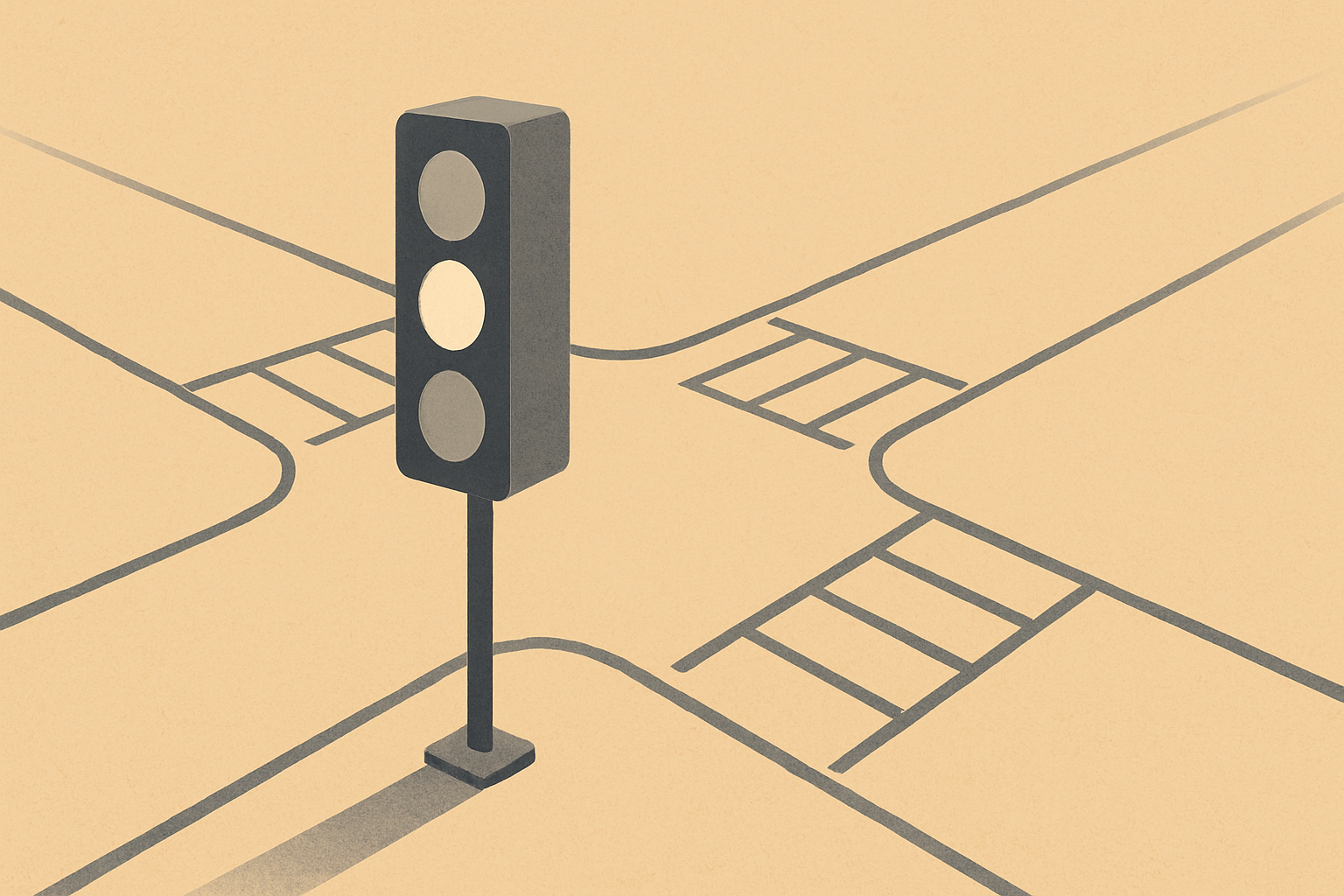
On November 20, 1923, Garrett Augustus Morgan secured United States Patent No. 1,475,024 for a three position traffic signal that introduced a full stop between crossings. The Garrett Morgan traffic signal did not invent traffic control from scratch. It did something more precise. It built time into the system so movement could reset before the next wave of motion began.
Earlier traffic signals were closer to railroad indicators. They flipped from go to stop with no breathing room. As cars multiplied on city streets, that hard switch turned intersections into collision points. Morgan studied the problem the same way he studied sewing machines and safety hoods. He looked for the place where pressure built up, then designed a mechanism that let the system exhale.
From Paris, Kentucky To Cleveland Streets
Garrett Morgan was born in 1877 in Paris, Kentucky, the son of formerly enslaved parents trying to build stability in a country that had barely begun to change. As a teenager he moved north to Ohio and began working in textile factories and repair shops. The work was not glamorous, but it trained his eye. He learned how gears slipped, where fabric snagged, and how small adjustments could keep a system from failing.
Morgan eventually opened his own sewing machine repair business in Cleveland. The shop became his lab. He experimented with lubricants, redesigned machine parts, and later developed a successful hair refining cream. The common thread was discipline. He watched, measured, and tinkered until a smoother pattern of motion appeared.
Rescue Work And The Safety Hood
Before the traffic signal, Morgan was already known locally as the inventor of a safety hood and smoke protection device that allowed workers and firefighters to breathe in toxic environments. The device predated modern gas masks and was put to the test during the 1916 Cleveland Waterworks Tunnel disaster, where Morgan took part in the rescue effort himself.
That experience shaped his view of risk. He had seen what happened when people entered danger without protection or planning. The safety hood protected lungs. The traffic signal would protect people long before the crash or the fire. Both inventions carried the same message. Do not trust pure speed. Build discipline into the system.
The Third Signal That Bought Time
By the early 1920s, Cleveland streets were crowded with cars, streetcars, bicycles, and pedestrians who all believed they were the priority. Basic two position signals were already in use in some cities, including Detroit, but they still behaved like light switches. One direction flowed until it was suddenly forced to stop so the other could move.
Morgan noticed the danger in that instant of reversal. There was no margin for human delay, no space for confusion, no time for the street to fully clear. His answer was the third position, a universal halt that stopped all directions at once. In modern language, it was a reset state. Movement paused, the intersection emptied, and then traffic resumed in a new pattern.
The patent drawing shows a simple mechanical system, not a glowing red yellow green tower. What matters is the logic. Morgan built in a buffer. He took the idea of caution and gave it a structural home inside the device. Most of the world now takes that pause for granted. At the time, it was a quiet redesign of how cities thought about movement and safety.
Patents, Partnerships, And The Cost Of Principle
Morgan sold the rights to his traffic signal to General Electric for a reported forty thousand dollars, a large sum for the period but a fraction of the long term value created by modern traffic control systems. As with many innovators of his era, especially Black inventors, the wealth from his work flowed into corporate and municipal infrastructure more than into his own family line.
The pattern repeated earlier in his career. His safety hood saved lives and influenced later gas mask designs, yet recognition arrived slowly and unevenly. Morgan continued to run businesses, including a newspaper focused on Cleveland’s Black community, and he stayed active in civic life, but his name did not travel as far as his ideas.
Family, Community, And A Quiet Legacy
Garrett Morgan married Mary Hasek, and together they raised a family in Cleveland while he balanced invention, business, and community work. He served in local organizations, advocated for Black civic participation, and used his newspaper to push for better representation and infrastructure in the city.
Morgan died in 1963. For decades, his story lived mostly in local memory and scattered mentions in patent histories. Only later did schools and city governments begin to honor his role in traffic safety and emergency preparedness. That delay is part of the lesson. Systems can run on an invention every day while quietly leaving the inventor out of the story.
The Modern Echo
Every time a light shifts to red in all directions before the next green appears, the logic of the Garrett Morgan traffic signal is at work. The pause is not an accident. It is a designed moment of protection that keeps haste from turning into harm. The same mindset guides air traffic control, elevator systems, even digital networks that throttle activity to prevent overload.

Modern cities now manage dense layers of motion, from delivery fleets to bike lanes and pedestrian plazas. The discipline of building in a reset state remains essential. When policy makers debate signal timing, congestion pricing, or automated driving systems, they are still working inside the frame that Morgan helped create. Safety is not a slogan. It is structure.
The Groundwork
Garrett Morgan did not wait for a title, a budget, or a perfect moment. He watched the flow of real life, found the point where pressure spiked, and inserted a simple structure that protected people he would never meet. That is the work in front of us. In families, in neighborhoods, in money and media and policy, the assignment is the same. Notice where speed is breaking things. Build a pause on purpose. Give everyone just enough time to live.
Further Groundwork
Receipts