
Foundation Innovators
The Elijah McCoy lubricating cup changed industrial reliability by solving a problem that railroads and machine operators had learned to tolerate: equipment often had to stop so moving parts could be lubricated.
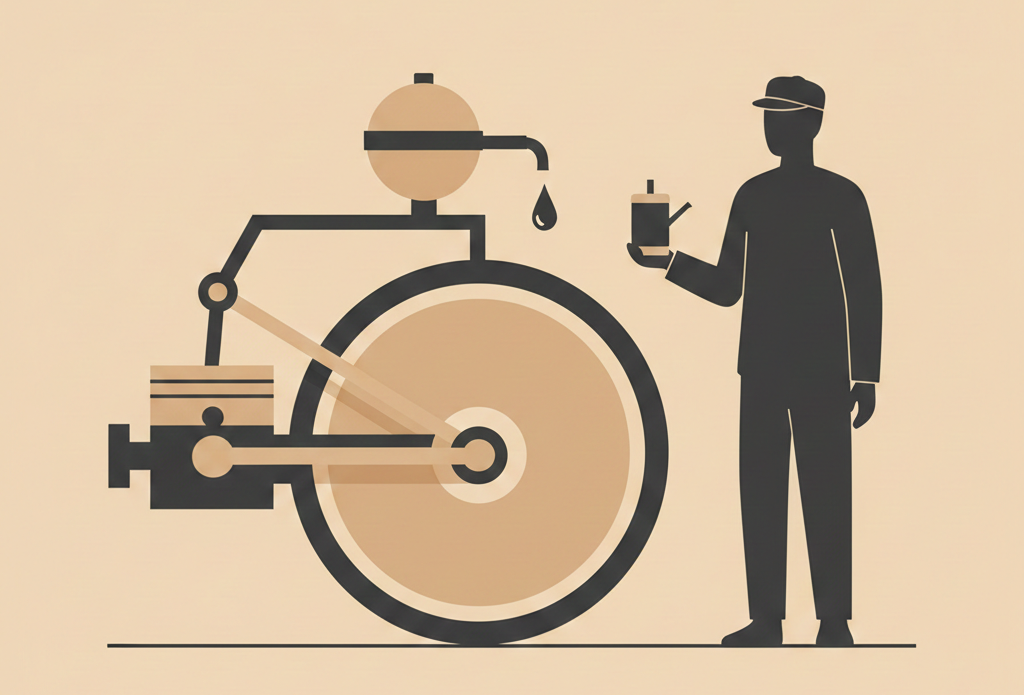
Steam engines created enormous industrial power. However, they also created a relentless maintenance problem. Moving metal produced friction, friction produced heat, and poorly lubricated components wore down quickly.
At the time, the common response was interruption. Workers stopped machinery, applied oil, and then restarted the equipment. As a result, routine maintenance consumed valuable operating time.
McCoy saw another possibility. Instead of accepting repeated shutdowns as normal, he focused on the point where friction and maintenance met.
His automatic lubricating devices supplied oil to moving components while machinery remained in operation. Therefore, the breakthrough was larger than the cup itself. McCoy helped move maintenance from a separate interruption toward a function built into normal operation.
The Problem
Why Friction Became an Industrial Reliability Problem
McCoy worked for the Michigan Central Railroad as a fireman and oiler. Because the job placed him close to locomotives, he saw the practical consequences of friction and inadequate lubrication firsthand.
Steam locomotives depended on regular lubrication. Yet servicing their moving parts could require stopping the engine. Consequently, the maintenance process reduced operating time and created recurring delays.
More importantly, McCoy recognized that the problem repeated in predictable places. Bearings, axles, and other moving components experienced continuous contact and heat.
Instead of asking workers to perform the same maintenance task faster, he changed the engineering question. Could oil reach the necessary parts while the engine continued moving?
The Mechanism
How the Elijah McCoy Lubricating Cup Changed Maintenance
In 1872, McCoy received U.S. Patent No. 129,843 for an improvement in lubricators for steam engines. His automatic engine lubricator became widely known as an oil-drip cup.
The Elijah McCoy lubricating cup addressed a simple but costly operating problem. It supplied lubricant to moving machinery while that machinery remained in use.
Therefore, maintenance no longer had to be treated only as a separate event. A portion of the maintenance process could happen during operation.
McCoy continued to refine lubrication technology throughout his career. Although later devices varied in design and application, the operating logic remained remarkably consistent.
Protect the contact point. Reduce friction. Limit unnecessary interruption. Preserve useful motion.
Because the mechanism addressed a repeating source of strain, a relatively small component could improve the reliability of a much larger machine.
The Builder
McCoy Kept Refining the Lubrication System
McCoy did not treat his first success as a finished answer. Instead, he continued developing and improving lubrication systems for different forms of machinery.
Over time, his patents addressed different methods of controlling and delivering lubricant. Each new design responded to a practical operating need.
That pattern matters because invention is often reduced to a single moment of inspiration. In reality, durable engineering frequently grows through observation, testing, correction, and refinement.
First, a recurring problem becomes visible. Next, a mechanism addresses it. Then real operating conditions expose new limits. Finally, the design evolves.
McCoy’s career followed that cycle repeatedly. As a result, his contribution was not merely one clever object. It was a sustained body of work around industrial lubrication and reliability.
The Modern Echo
From the Elijah McCoy Lubricating Cup to Modern Reliability Systems
Modern industrial equipment is far more advanced than the locomotives McCoy encountered. Nevertheless, the underlying engineering problem remains familiar.
Moving components still create friction. Parts still wear. Heat still accumulates. Therefore, machines still require systems that protect vulnerable contact points before damage becomes failure.
Today, automated lubrication appears in manufacturing equipment, heavy machinery, transportation systems, turbines, and other industrial applications. In addition, modern maintenance systems may use sensors, predictive monitoring, and automated controls.
The tools are more sophisticated now. Yet the operating principle behind the Elijah McCoy lubricating cup remains recognizable: deal with predictable friction while the larger system is still functioning.
Consequently, McCoy’s work offers more than a chapter in invention history. It provides an early example of designing reliability into normal operation.
The Reliability Sequence
Structural Meaning
Why Reliable Systems Build Maintenance Into Operation
Reliability is often described as a quality. However, McCoy’s work shows why it is more useful to understand reliability as architecture.
A reliable machine does not simply avoid trouble by chance. Instead, its design anticipates recurring sources of strain and manages them deliberately.
This distinction matters because fragile systems depend heavily on memory, emergency response, and repeated interruption. Stronger systems distribute more of that responsibility into ordinary operation.
McCoy moved lubrication in that direction. Rather than forcing workers to compensate for the same mechanical burden again and again, his device allowed the machine to carry more of its own maintenance requirement.
Of course, no machine eliminates maintenance entirely. Components still require inspection, repair, and replacement. Still, better maintenance architecture reduces preventable disruption.
That is where the deeper value of McCoy’s invention appears. The lubricating cup did not abolish wear. It changed how the system responded to wear.
Foundation Innovators
The Groundwork
Elijah McCoy’s importance extends beyond one automatic lubricator. His work demonstrates what happens when a builder refuses to treat recurring friction as an unavoidable cost.
He studied where strain accumulated. Then he changed the mechanism surrounding that point.
That is a durability lesson.
Strong systems do not wait for every predictable problem to become an emergency. Instead, they absorb ordinary stress through structure. They preserve capacity through maintenance. In addition, they protect continuity by addressing known points of wear before those points become failure.
McCoy applied that logic to industrial machinery more than a century ago. The result helped equipment operate with fewer unnecessary interruptions while creating a lasting model of practical engineering.
The machine became more reliable because someone redesigned what happened at the point of friction.
Foundation Innovators
The people who built essential parts of modern life deserve more than a footnote. Their work helps us understand how durable systems are actually made.
Further Groundwork
Receipts
→ National Inventors Hall of Fame: Elijah McCoy
Groundwork Architecture
Where This Asset Fits
This Foundation Innovators profile strengthens the Groundwork Daily architecture around durability, structure, maintenance, and long-term system performance.
Core Principle: Build What Holds | Condition: Durability | Category: Foundation Innovators
Build better. Every day.
Groundwork Daily studies the structures beneath everyday life. Get new essays, frameworks, and builder stories delivered directly to you.
From the Groundwork Desk
Documenting the Builders Behind Modern Life
Foundation Innovators preserves the work of people whose ideas, inventions, and systems helped shape modern life. The goal is not simply to remember who built something. Instead, we examine the structural problem they solved, the mechanism they created, and why that work still matters.
Elijah McCoy | Foundation Innovators