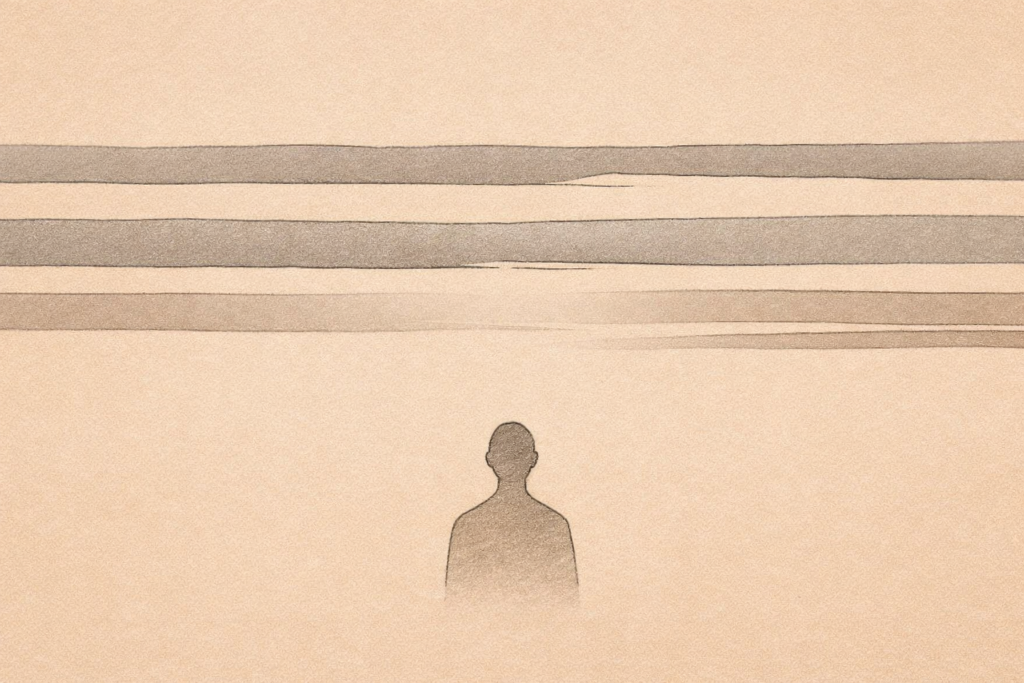
The Soul Weather Report is a Groundwork Daily series about the changing conditions of the inner life. It helps readers notice what is present, understand what may be shaping perception, and respond without mistaking temporary weather for permanent truth.
Some days visibility is poor. On others, the horizon is perfectly clear but there is not enough room to move yet. Pressure can gather quietly. Several demands can converge. A decision can be finished while recovery is still catching up.
The report gives those experiences a language.
That language comes from the Soul Weather Framework ,
the reference model behind the series. Its canonical conditions include Fog, Pressure, Distortion, Drift, Convergence, Overload, Recovery, False Recovery, and Clear.
These are descriptions of conditions, not descriptions of people.
The Central Idea
Read the weather.
Do not become the weather.
Why The Soul Weather Report Exists
Internal conditions influence the way a day looks before they necessarily change the facts of the day.
Under pressure, an ordinary request can feel unusually expensive. In fog, a decision that was manageable yesterday can become difficult to read. During distortion, one conversation can occupy far more space than the conversation itself deserves.
None of this means the experience is imaginary.
It means conditions matter.
The Soul Weather Report creates enough distance to notice those conditions before assigning them too much meaning.
How to Read a Soul Weather Report
Each report moves through four questions. Together, they create a simple practice of observation before reaction.
01 • Condition
What condition is present?
Begin with the weather. Is visibility reduced? Has margin narrowed? Has proportion changed? Are several pressures beginning to converge?
02 • Movement
What has changed?
Weather moves. Notice whether visibility is improving, pressure is building, capacity is returning, or yesterday’s condition is beginning to loosen.
03 • Influence
What is this condition influencing?
A condition may change attention, patience, judgment, timing, communication, proportion, or available capacity. Naming the influence helps separate the weather from the wider truth.
04 • Response
What response fits this environment?
Not every condition needs more effort. Sometimes the right response is action. Sometimes it is margin, information, a boundary, recovery, stillness, or simply more time.
The Person Is Always Larger Than the Weather
The report does not ask readers to become detached from feeling. Nor does it ask them to turn every difficult moment into a lesson.
Some weather hurts.
Some seasons ask more of us than we wanted to give. Some days bring gratitude and grief into the same sky. Sometimes we know what must change before we have the capacity to change it.
The work is not to deny any of that.
The work is to see it clearly enough that a passing condition does not quietly become a permanent conclusion about who we are.
Groundwork Daily Core Principle
Stillness Is Strategy
Stillness is not the absence of movement. Sometimes it is the space that allows us to see what kind of movement the moment actually requires.
False recovery occurs when the system appears stable before structural repair is complete. Visible pressure has eased, but hidden misalignment remains. Function may return, yet reliability is still compromised. This condition often leads people to resume normal activity too early.
Recovery is not stability. It is the early stage of structural re-separation after compression or overload. Spacing begins to return, but not evenly. The system is regaining function, yet clarity and reliability remain incomplete.
System overload occurs when pressure exceeds capacity. Response breaks down, clarity drops, and even simple decisions become difficult. This condition marks the point where accumulated demands can no longer be processed effectively.
Convergence happens when several manageable pressures begin drawing from the same limited capacity. This Soul Weather Report shows how to separate the load, restore margin, and respond before overlap becomes overload.
Incoming systems form before conditions change. Subtle signals indicate approaching pressure, even when the current environment feels stable. Early recognition allows preparation before disruption arrives.
Signals are present, but they are no longer reliable. Distorted signals form when internal feedback becomes inconsistent or misleading. The system still responds, but accuracy begins to break down. What feels true may no longer reflect actual conditions.
Drift conditions develop when the system moves off course without obvious disruption. Nothing feels dramatic, yet alignment weakens over time. The weather remains manageable on the surface, but direction quietly changes underneath. What is ignored does not stay neutral.
Conditions appear stable, but underlying structure has not fully reset. False stability forms when calm is mistaken for readiness. The system looks settled but remains vulnerable to disruption. What appears steady may still be in transition.
A shift has moved beyond balance and continues adjusting past what the system requires. What began as necessary correction now extends into excess. The conditions have already stabilized, but the response has not slowed to match. Overcorrection emerges when adjustment continues without recalibration.