
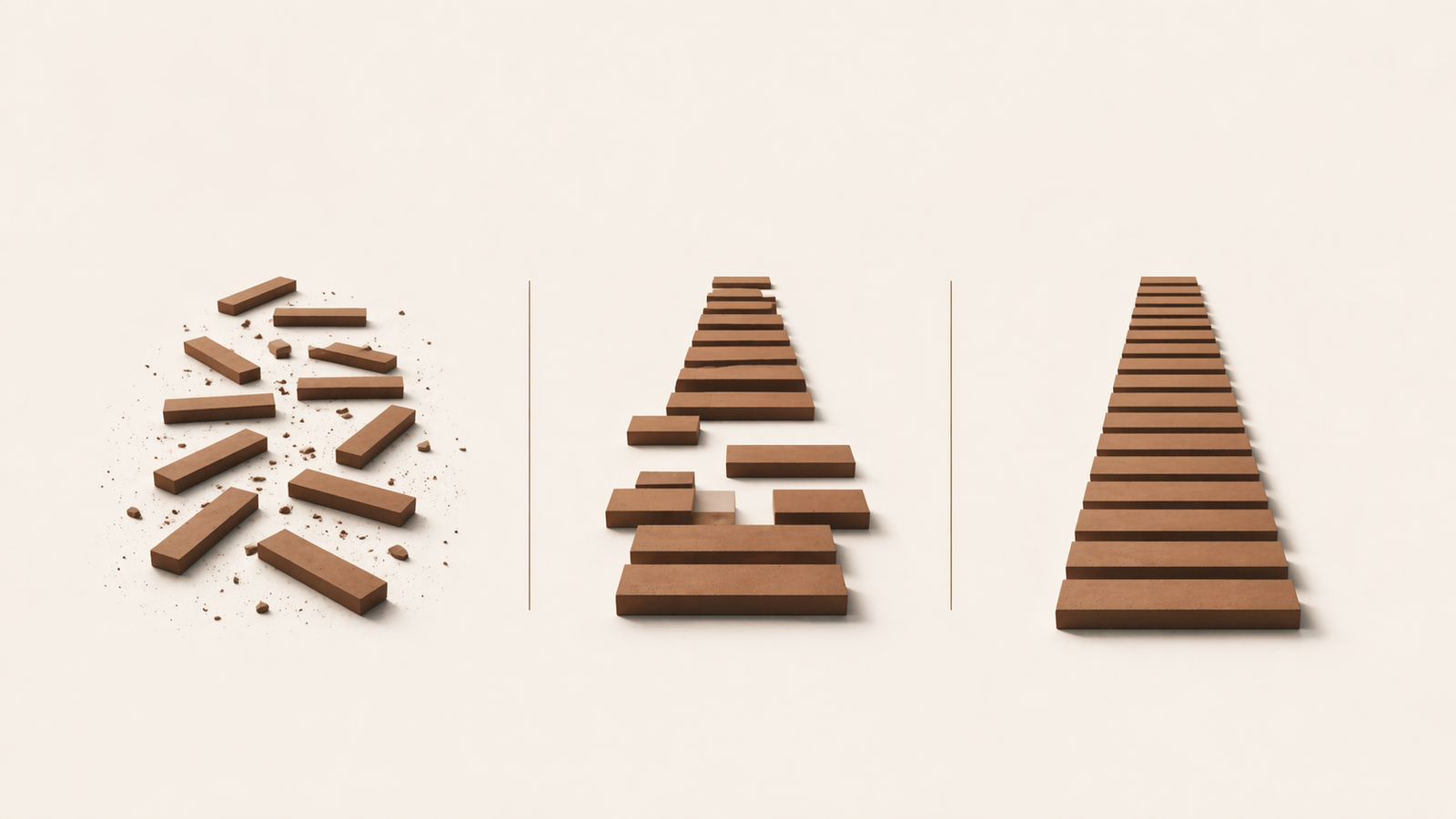
The three stages of accountability are collapse, repair, and structure. This sequence matters because many people misunderstand accountability. They reduce it to consequences, blame, or pressure. That misses the deeper system.
Accountability is not only what happens after something goes wrong. It is the process that restores responsibility after trust has taken damage. A person, team, family, or institution does not become accountable by saying the right words. Proof appears when the system moves from failure to repair, then from repair to stable behavior.
This page explains the progression. Collapse shows where responsibility failed. Repair names what must change. Structure proves whether the correction can last.
For the full system behind this framework, read Accountability System: How Structure, Breakdown, and Repair Work.
Stage One: Collapse
Collapse comes first because accountability usually becomes visible after something breaks.
A deadline slips. A promise fails. Responsibility gets avoided. A pattern repeats after someone promised change. At that point, the system exposes itself.
Still, collapse does not always look dramatic. Often, the breakdown starts quietly.
- A person delays communication.
- A team misses the same handoff again.
- A relationship repeats the same unresolved conflict.
- A habit breaks without review.
- A standard exists, but no one reinforces it.
The mistake is treating collapse as one isolated event. Usually, the event is only the visible symptom. Beneath it sits the structure that allowed the miss to repeat.
At this stage, accountability requires truth. Not drama. Not punishment. Not performance. Truth.
The system must name the failure. It must identify the expectation, the owner, the breakdown point, and the damage that followed.
Without that clarity, collapse turns into confusion. People explain, defend, avoid, or minimize. Then the same issue returns wearing a different outfit.
That is not accountability. That is drift.
Stage Two: Repair
Repair begins when someone acknowledges the failure and makes correction specific.
Unfortunately, many systems fail again here.
Someone apologizes without changing the process. A team holds a meeting without assigning ownership. A family has an emotional conversation without creating a new agreement. An individual feels bad about a habit but never redesigns the environment that keeps defeating the routine.
That is not repair. It is emotional noise.
Real repair has structure. It answers four questions:
- What exactly broke?
- What needs to be restored?
- Who owns the next action?
- How will follow-through be checked?
Repair does not exist to make everyone feel better immediately. Instead, it should make the system more reliable than it was before the breakdown.
That distinction matters.
Some people want repair to mean instant comfort. That is childish. Repair may include discomfort because responsibility has weight. However, discomfort is not the goal. Correction is the goal.
When repair works, responsibility becomes visible again. The next step has a name. The owner is clear. The standard returns. The timeline exists. The review point sits on the calendar.
In other words, accountability moves from reaction to reconstruction.
Stage Three: Structure
Structure proves whether the repair was real.
A correction that works only once is not a system. It is a temporary patch. Structure turns repair into a repeatable pattern.
At this point, accountability becomes durable.
Structure includes clear expectations, visible ownership, consistent follow-through, and a built-in way to catch drift early. As a result, the system no longer depends on constant reminders.
In practical terms, structure sounds like this:
- This is the standard.
- This is who owns it.
- This is when it must happen.
- This is how progress will be checked.
- This is what happens if drift starts again.
That may sound simple. It is not. Many people prefer vague expectations because vague expectations leave escape routes.
Structure closes those gaps.
It does not need constant intensity. It does not require emotional pressure. It does not force one person to become the permanent reminder machine. Instead, it makes responsibility clear enough to hold.
Therefore, the real test is not whether someone can admit fault once. The real test is whether the structure changes enough to reduce the chance of the same failure returning.
How the Three Stages of Accountability Work Together
The three stages of accountability work as a sequence, not as separate ideas.
1. Collapse reveals the breakdown.
2. Repair corrects the damage.
3. Structure prevents the same failure from becoming normal.
If people ignore collapse, repair cannot begin. If repair stays vague, structure cannot form. If structure never appears, the same collapse returns.
For that reason, accountability needs progression. Consequences alone do not build accountability. Apologies alone do not build accountability. Motivation alone does not build accountability.
The work becomes useful when the system can diagnose, correct, and stabilize.
That is the operating model.
What This Looks Like in Real Life
In real life, the three stages of accountability appear anywhere responsibility meets pressure.
At Work
At work, collapse looks like missed deadlines, unclear ownership, repeated reminders, and preventable rework. Repair names the missed expectation, assigns ownership, and clarifies the next deadline. Structure creates a better workflow, visible checkpoints, and cleaner handoffs.
In Relationships
In relationships, collapse looks like repeated hurt, broken agreements, avoidance, or deflection. Repair acknowledges impact and names what needs to change. Structure creates new boundaries, clearer expectations, and behavior that matches the agreement over time.
In Self-Discipline
In self-discipline, collapse looks like drift. A routine breaks. A budget slips. A habit disappears. Repair reviews the failure point without self-deception. Structure redesigns the environment so the next attempt becomes easier to sustain.
Across each setting, the pattern stays consistent. Accountability is not proven by intensity. It is proven by corrected behavior that holds after the emotional moment passes.
The Groundwork
The three stages of accountability give language to a process many people feel but rarely name.
Collapse exposes the weakness. Repair restores responsibility. Structure makes the correction durable.
Without collapse, the problem stays hidden. Without repair, the damage stays active. Without structure, the lesson disappears.
That is why accountability is not punishment. Punishment may create fear, but fear does not always create responsibility. Real accountability creates a system where truth can be named, correction can happen, and trust can grow through repeated behavior.
Structure is not the opposite of freedom. It is what makes repair durable.
Continue Building
This piece supports the larger accountability framework. Continue through the system below.
→ Core Framework: Accountability System: How Structure, Breakdown, and Repair Work
→ Mechanism: Why Accountability Builds Trust
→ Application: What Accountability Looks Like in Real Life
Receipts
→ Harvard Business Review: The Right Way to Hold People Accountable
Frequently Asked Questions
What are the three stages of accountability?
The three stages of accountability are collapse, repair, and structure. Collapse reveals the breakdown. Repair corrects the damage. Structure helps prevent the same failure from repeating.
Why does accountability start with collapse?
Accountability often becomes visible after something breaks. Collapse exposes where expectations, ownership, or follow-through failed.
What does accountability repair mean?
Accountability repair means naming what broke, assigning ownership, correcting the damage, and creating a clear next step.
Why is structure the final stage?
Structure proves whether repair can last. Without structure, correction becomes temporary and the same breakdown usually returns.
Is accountability the same as punishment?
No. Punishment focuses on consequences. Accountability focuses on responsibility, correction, and durable change.
By The Groundwork Perspective | Pillars
