
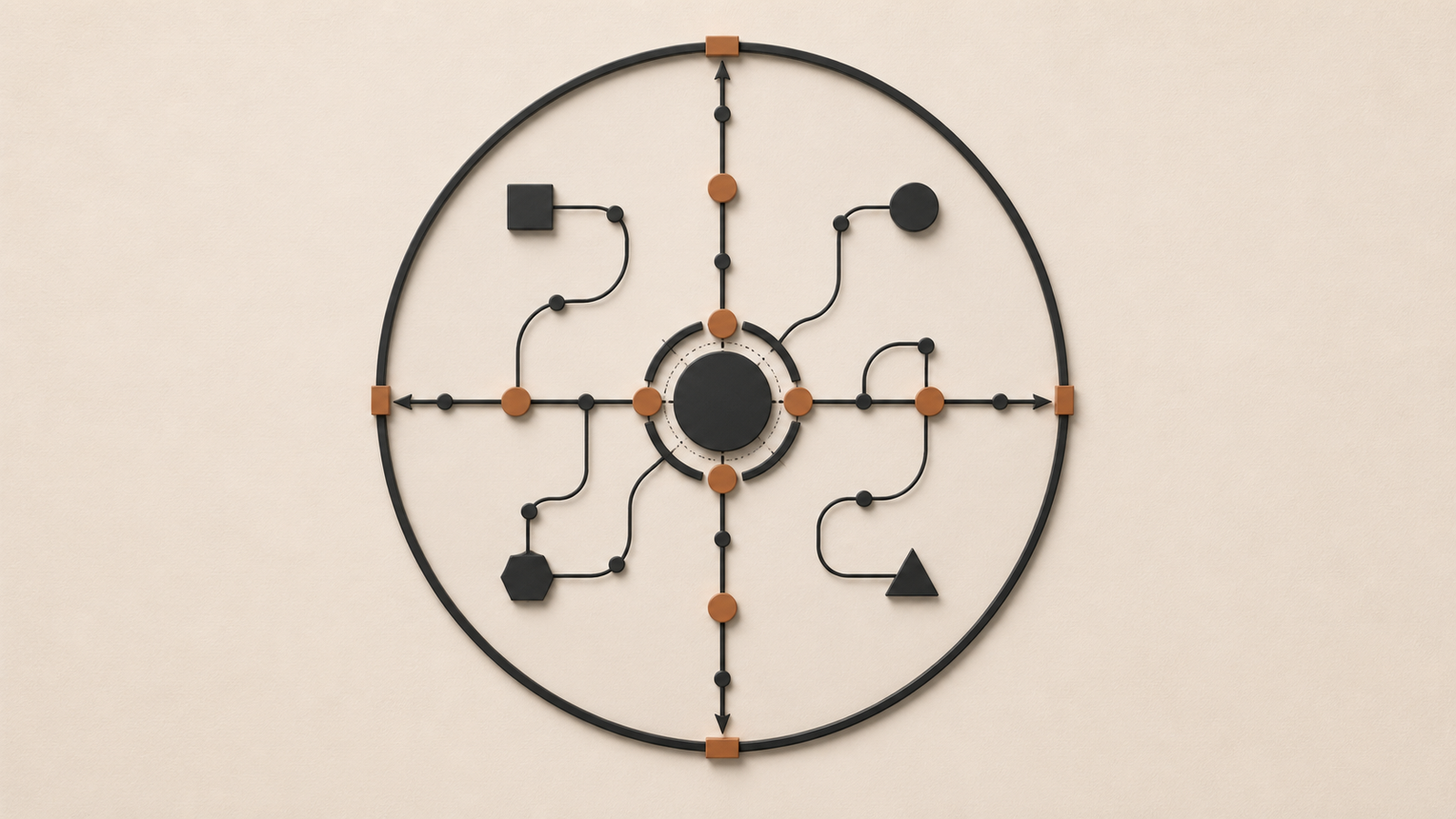
Internal Systems · Groundwork Daily
Internal Systems
Internal systems behavior control begins with the structures that shape thought, emotion, attention, identity, and response before behavior becomes visible.
The control layer behind behavior determines whether a person can maintain clarity, discipline, direction, and consistency when conditions become unstable.
Most breakdowns do not begin externally. They begin before the outcome appears. A lapse in attention, a shift in perception, an emotional acceleration, or a failure in structure can change the result before anyone notices the pattern.
For that reason, this category is not a journaling lane. It is the part of Groundwork Daily that examines the mechanisms beneath behavior.
What This Category Examines
This hub studies the structured mechanisms that govern thinking, perception, emotion, attention, identity, and response. These mechanisms shape how a person interprets events, regulates emotion, and directs attention.
Unlike general reflection, this category treats internal experience as something that can be examined, adjusted, and strengthened.
Clarity is not accidental. Control is not automatic. Both require structure.
Perception shapes interpretation.
Interpretation shapes response.
Response shapes outcome.
Why the Control Layer Matters
External systems can be well designed and still fail if the person operating inside them is unstable.
A person may understand structure yet fail to follow it. They may recognize patterns yet still repeat them. In both cases, the issue is not knowledge alone. The issue is control.
This hub closes that gap. It examines why behavior shifts under pressure and how stability can be maintained.
Without internal stability, external systems drift. However, with a stable control layer, even simple systems become more reliable.
This is where internal systems behavior control becomes measurable. Stability is not assumed. It is engineered.
Core Mechanisms
Thought Patterns
Recurring thoughts influence perception, decision-making, and behavior over time. When thought has no structure, it loops instead of resolving.
Emotional Regulation
Emotions rise, persist, and affect response timing. Regulation does not mean removing emotion. It means controlling when and how emotion becomes action.
Attention Control
Focus determines what is seen, ignored, or prioritized. If attention is unmanaged, the wrong inputs gain power.
Identity and Self-Governance
Standards must hold without external pressure. This is where discipline becomes internal rather than imposed.
Default State
The baseline condition shapes decisions before the decision itself appears. A stable baseline improves judgment before pressure arrives.
Motivation and Friction
Motivation helps start action, but systems sustain action. Friction determines whether the desired behavior is easy enough to repeat.
Each mechanism connects back to the larger Internal Systems framework, where structure—not effort—determines consistency.
System Flow Diagram
This flow shows how behavior forms before it becomes visible. The outcome is not isolated. It moves through a chain.
What enters the system
What receives focus
How input is processed
How response timing shifts
What standard governs action
What becomes visible
Baseline state sits beneath the full chain. If the baseline is unstable, every step above it becomes more vulnerable to distortion.
Use this diagram as a quick diagnostic. If behavior is off, do not start at the end. Move backward through the chain and identify where the structure failed.
Start where your breakdown occurs. If attention fails, begin with input control. If reaction fails, examine timing. If decisions fail, review identity and baseline state.
Where the System Breaks
Breakdowns often appear as inconsistency, distraction, or emotional reactivity. However, those are usually surface-level symptoms.
Underneath, the issue is structural. A missing control mechanism allows thought, emotion, or environment to override intention.
- Uncontrolled attention leads to distraction and drift.
- Unregulated emotion leads to reactive decisions.
- Unstructured thought patterns lead to repeated mistakes.
- Weak identity leads to inconsistent discipline.
- Unstable default state leads to unstable decisions.
- Motivation dependence leads to stop-start behavior.
Each failure point leads back to the same problem: the person is asking effort to do work that structure should be doing.
Internal Systems Diagnostic Framework
When behavior breaks down, the instinct is to blame effort, discipline, or motivation. That instinct is inaccurate.
Behavior does not fail randomly. Instead, it fails at a specific point within the system.
This framework identifies where the failure occurs so correction can be applied precisely.
- If attention is scattered → Inputs are uncontrolled. Reduce exposure and narrow focus.
- If thoughts repeat without resolution → Structure is missing. Define the question and set a decision point.
- If emotion overrides action → Timing is uncontrolled. Introduce delay before response.
- If behavior is inconsistent → Identity is weak or undefined. Reinforce standards.
- If decisions degrade under pressure → Default state is unstable. Improve baseline conditions.
This is the shift:
Stop asking, “Why am I doing this?”
Instead, ask, “Which part of the system failed?”
That question produces better answers because it focuses on structure, not emotion.
System Pressure Scenarios
Internal systems are easiest to understand when they are under pressure. Pressure reveals structure.
Work Environment Breakdown
A person attempts to stay focused but works with open tabs, constant notifications, and shifting priorities.
The core problem is not discipline. The breakdown begins with attention control because too many inputs enter the system at once.
As a result, the correction is not to “focus harder.” The correction is to reduce input.
Emotional Reactivity in Conversations
A conversation becomes tense. Tone shifts. The response becomes immediate and defensive.
In this case, communication skill is not the first failure point. Timing control is.
Emotion accelerates action before evaluation occurs.
Therefore, the correction is to introduce delay. Even a brief pause interrupts the system.
Overthinking and Decision Delay
A decision needs to be made. Instead of resolving it, the mind cycles through possibilities.
This is not always complexity. Often, the problem is unstructured thinking.
The system lacks a defined endpoint.
Because of that, the correction is to define criteria and set a decision point.
Inconsistent Discipline
A person starts strong, then stops, then restarts again later.
The problem is not motivation alone. The deeper issue is identity and system design.
Behavior depends on feeling instead of structure.
So the correction is to reduce friction and reinforce identity-based standards.
These scenarios show the pattern:
Different situations. Same underlying issue.
The system is either structured or it is not.
How This Connects to the Platform
This hub connects directly to The Foundation, Systems, and Behavior Systems.
The Foundation defines principles. Systems explain mechanisms. Behavior Systems show patterns in action. This page explains why those patterns continue, break, or stabilize inside the person.
This is where external understanding becomes internal control.
For additional context, this category aligns with research on executive function and evidence-based models of behavior formation documented in habit formation research.
You do not rise to your intentions. You fall to your systems.
Build from the ground up. Move through each component in sequence to understand how the system operates as a whole.
Article Index
Each article below examines one part of the control layer. Read them as a sequence, not as isolated posts.
Attention Is a Gate, Not a Stream
Attention determines what enters. Control the input and the outcome begins to change.
Emotional Reactivity Is a Timing Failure
Emotion is not the problem. Timing is. Delay response to improve outcomes.
Thought Loops Create False Urgency
Repetition without structure creates urgency that is not real.
Overthinking Is Unstructured Thinking
Thinking without structure creates loops instead of decisions.
Clarity Is a Byproduct of Control
Clarity appears when distortion is removed from the system.
Your Default State Determines Your Decisions
Decisions reflect the baseline condition of the person making them.
Motivation Is Unreliable by Design
Motivation fluctuates. Structure creates continuity.
Self-Control Is a System, Not a Trait
Self-control improves when the system reduces friction and protects decisions.
Internal Conflict Is a Structural Misalignment
Conflict appears when competing systems pull behavior in different directions.
How to Use This Hub
Use this page as a diagnostic map. When a pattern appears, trace it back to the mechanism behind it.
If the issue is distraction, begin with attention. If the issue is reaction, begin with timing. If the issue is repeated mental pressure, begin with thought loops. If the issue is inconsistency, examine identity, motivation, and baseline state.
Then apply structure. Adjust inputs. Regulate response. Interrupt loops. Reinforce standards. Reduce friction.
Over time, this creates consistency. Behavior stabilizes because the unseen structure supporting it becomes more reliable.
What This Category Is Not
This category is not vague reflection. It is not mood tracking, personal venting, or soft self-help language.
It is built for disciplined analysis of internal function. If a piece does not identify a mechanism, it does not belong here.
That boundary keeps the hub useful. It prevents the category from becoming vague, sentimental, or unfocused.
Prefer a faster path? Use the visual index below to identify your issue and jump directly to the relevant system.
Internal Systems Visual Index
Use this index as a navigation map. Each entry points to one mechanism inside the Internal Systems framework. Start with the pattern you recognize, then follow the article that explains the mechanism behind it.
Timing Control
If reactions move faster than judgment, start here.
Emotional Reactivity Is a Timing FailureThinking Structure
If thought circles without resolving, start here.
Overthinking Is Unstructured ThinkingBaseline Control
If decisions change with your state, start here.
Your Default State Determines Your DecisionsSelf-Control Design
If willpower keeps failing, redesign the system.
Self-Control Is a System, Not a TraitAlignment Control
If competing priorities pull you apart, start here.
Internal Conflict Is a Structural MisalignmentFAQ
What are internal systems?
They are the structures that shape how a person thinks, feels, decides, and acts.
Why do they matter?
They matter because behavior is an output. If the structure producing the behavior is unstable, the behavior will be unstable too.
Can these systems be changed?
Yes. They can be changed by controlling inputs, regulating emotions, interrupting thought loops, strengthening identity, and stabilizing the default state.
What is the fastest way to improve behavior?
Improve the structure behind the behavior. Reduce friction, control inputs, and make the desired action easier to repeat.
The Groundwork
Internal systems behavior control is the work of understanding what happens before behavior becomes visible.
When attention is controlled, emotion is regulated, thought is structured, and identity is anchored, behavior becomes more reliable.
That is the purpose of this hub: to make the unseen mechanisms of behavior visible, adjustable, and repeatable.