Foundation Innovators
Architects of Modern Life
Black Innovation as Infrastructure
Black inventors helped shape modern life not only by creating objects, but by changing the systems through which people move, communicate, work, heal, build, manufacture, stay safe, and create economic opportunity.
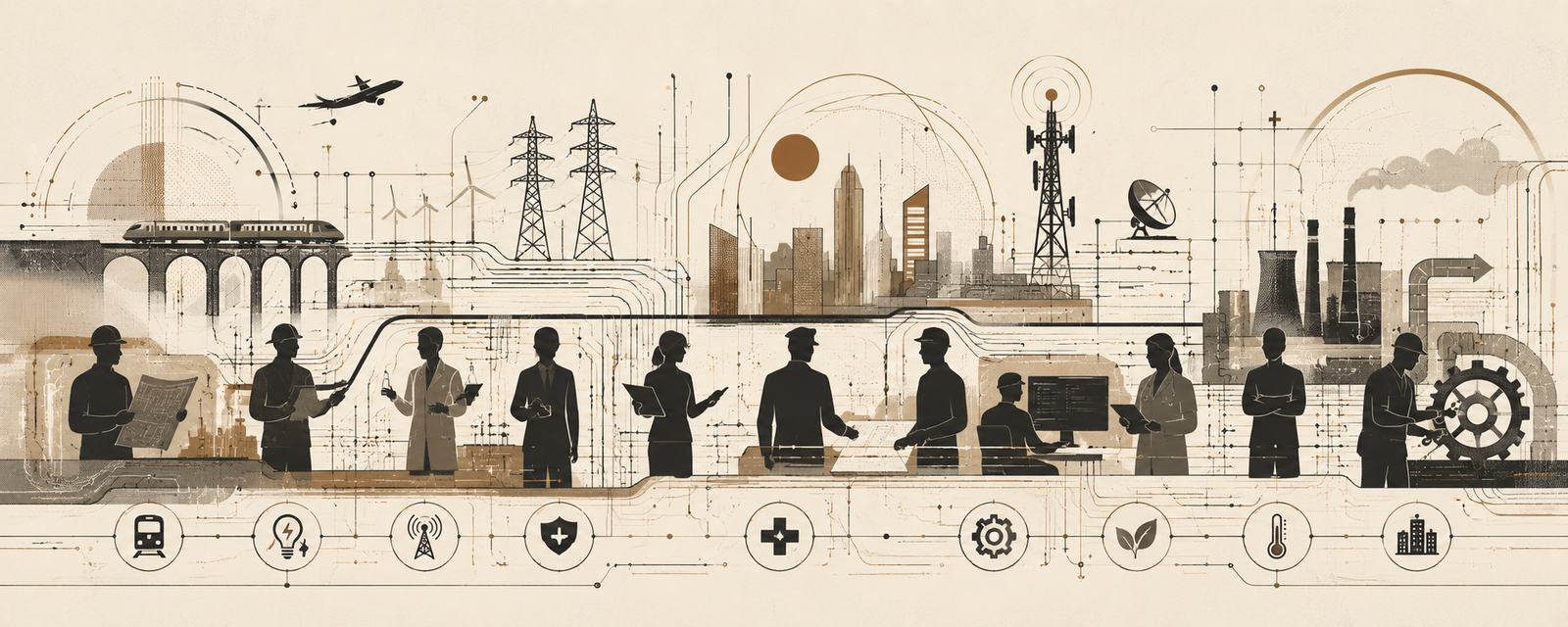
Architects of Modern Life studies Black innovation as systems architecture: the transformation of recurring problems into mechanisms, processes, technologies, institutions, and infrastructure that other people can continue using long after the original breakthrough.
The Groundwork Archive DefinitionTraditional history often compresses invention into a name and an object.
Garrett Morgan becomes “the traffic-light inventor.” Lewis Latimer becomes “the light-bulb inventor.” Elijah McCoy becomes “the lubrication inventor.”
That shorthand is memorable.
It is also incomplete.
The deeper question is not merely what someone patented.
It is what problem the invention solved, what system it entered, what behavior it changed, what resistance surrounded its adoption, and what part of its logic still survives.
That is the job of this archive: move Black innovation out of trivia and back into the architecture of modern life.
01 / Infrastructure Hides Its Origins
Why Black Inventors Matter to Modern Infrastructure
Infrastructure is larger than roads, bridges, tunnels, buildings, and power lines.
It includes repeatable systems that help society coordinate movement, reduce risk, distribute resources, control environments, maintain machines, transmit information, and organize work at scale.
A traffic-control system organizes movement.
A heating system regulates an indoor environment.
Railway signaling coordinates speed, location, communication, and safety.
A lubrication system reduces mechanical friction so industrial equipment can operate more reliably.
These systems matter precisely because people eventually stop thinking about them.
Successful infrastructure becomes ordinary.
Once something becomes dependable, the user often experiences only the benefit. The mechanism disappears into routine.
Historical memory can disappear the same way.
When an invention becomes absorbed into larger technical systems, its original inventor can become less visible even while the underlying contribution remains consequential.
Architects of Modern Life exists to restore that missing systems layer.
02 / The Groundwork Innovation Architecture
Every Profile Follows the System, Not Just the Biography
A biography tells us who someone was.
This archive also asks what changed because that person built.
The Groundwork Innovation Architecture
Each stage asks a different historical question. Together, they move the reader from invention as artifact to innovation as infrastructure.
01 / Pressure
What condition made change necessary?
Congestion, danger, inefficiency, heat loss, machine wear, communication gaps, medical need, exclusion, or economic constraint often creates the pressure under which innovation becomes useful.
02 / Problem
What specific failure needed solving?
Good invention stories become clearer when the actual operating problem is defined before the invention is celebrated.
03 / Invention
What mechanism changed the condition?
This is where patents, technical drawings, prototypes, processes, methods, products, and documented innovations enter the story.
04 / Adoption
Did the invention enter practical use?
Innovation matters differently when it becomes manufactured, commercialized, licensed, imitated, institutionalized, or incorporated into another system.
05 / System
What larger infrastructure changed?
Transportation, lighting, industry, medicine, communications, environmental control, ownership, and safety are larger than the individual invention.
06 / Scale
What happened when the logic traveled?
Scale may come through industry standards, new businesses, later engineering, public adoption, training networks, institutions, or technological descendants.
07 / Modern Echo
Where does the underlying logic still live?
The Modern Echo identifies the present-day system that carries forward part of the original operating principle without pretending modern technology is identical to the historical invention.
Archive Standard
Recognition is not enough.
Every profile must explain the mechanism, system impact, historical context, and modern relevance well enough that the reader understands what was actually built.
03 / Innovation Across Generations
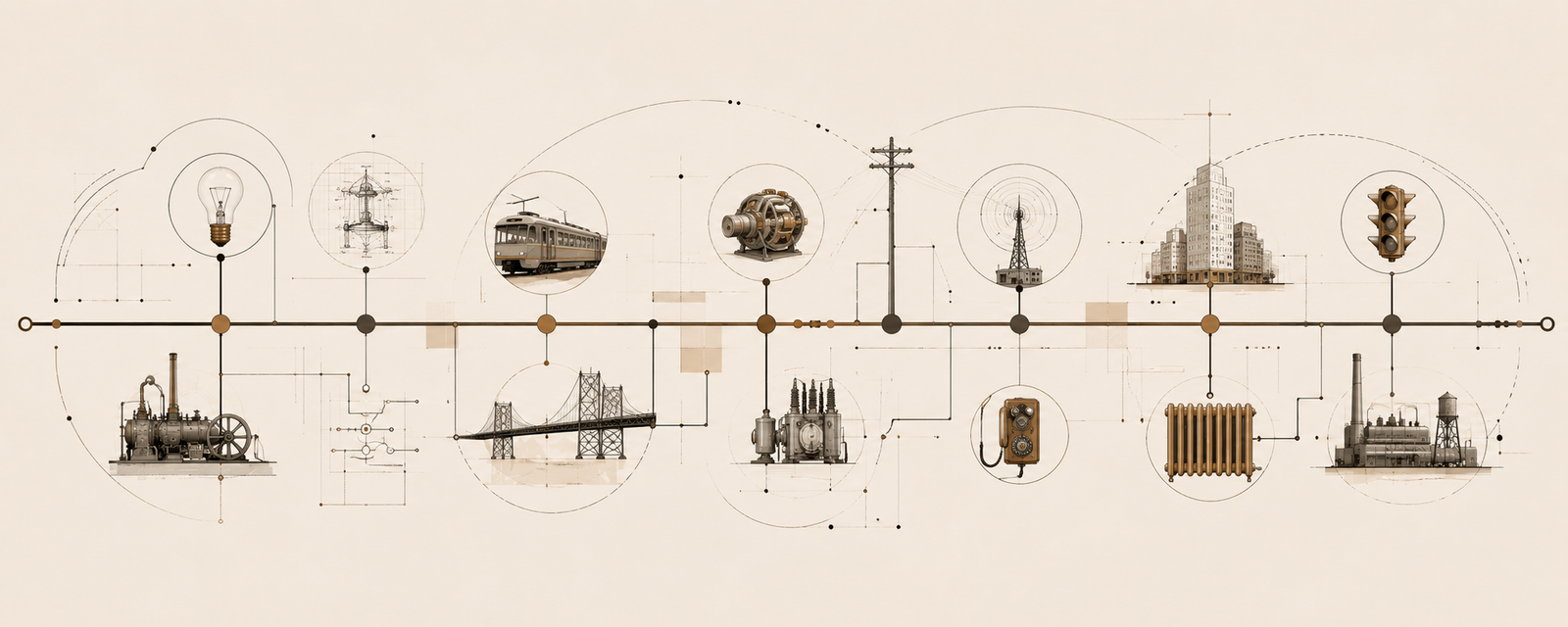
A Timeline of Black Innovation and Systems Building
Black technological innovation does not belong to one decade, one industry, or one type of invention.
The archive spans industrialization, electrification, urbanization, modern medicine, computing, transportation, entrepreneurship, and contemporary technical systems.
| Period | Systems Context | Archive Lens |
|---|---|---|
| 1800s | Steam, manufacturing, rail, navigation, mechanical systems, industrialization | How Black builders participated in and improved systems expanding across a rapidly industrializing nation. |
| 1870s–1900 | Electric lighting, communications, railway coordination, machine reliability | Technical improvements increasingly shaped networked industries and urban growth. |
| 1900s–1930s | Automobiles, urban safety, environmental control, manufacturing, enterprise | Innovation responded to denser cities, new machines, expanded consumer markets, and growing technical complexity. |
| 1930s–1970s | Medicine, computing, aerospace, electronics, institutional science | Technical leadership increasingly operated through laboratories, universities, hospitals, corporations, and public institutions. |
| Late 20th Century–Today | Digital systems, telecommunications, advanced medicine, software, logistics, network infrastructure | The archive follows the expansion from mechanical invention into complex technological and institutional systems. |
04 / Featured Systems Builders
Black Inventors Who Helped Shape Modern Life
Each profile begins with a person but ends with a system.
The archive asks what the inventor changed, what later systems inherited, and what evidence supports the connection.
Garrett Morgan
Known for: Safety hood and patented traffic-control signal.
Morgan’s 1923 traffic-signal patent introduced an all-direction stop interval before traffic flow changed, addressing safety problems in increasingly crowded streets.
Lewis Latimer
Known for: Improved production of durable carbon filaments and technical drafting.
Latimer’s work helped improve incandescent-light technology and later included the installation and development of electric-lighting systems.
Profile ComingAlice H. Parker
Known for: 1919 gas-fired heating-furnace patent.
Parker’s patent described independently controllable heating units and separate hot-air ducts serving different parts of a building, offering an early systems approach to distributed heating control.
Profile ComingGranville T. Woods
Known for: Electrical and railway communication innovations.
Woods developed technologies related to railway communication, signaling, electric systems, and safer coordination of trains.
Profile ComingElijah McCoy
Known for: Automatic lubrication technology.
McCoy’s lubrication inventions addressed friction and maintenance in moving machinery, linking invention directly to reliability and industrial uptime.
Profile ComingMadam C.J. Walker
Known for: Beauty enterprise, distribution, training, and sales networks.
Walker belongs in this archive because modern life is shaped by organizational systems as well as machines. Her enterprise created scalable commercial and training infrastructure around Black women’s economic participation.
Profile Coming05 / Explore by System
Systems Black Inventors Helped Change
Organizing the archive by infrastructure makes the history easier to understand because it shows how separate inventions participate in larger systems.
Transportation
Movement Requires Coordination
Traffic control, railway communication, signaling, mechanical reliability, routing, and safety all shape how people and goods move through shared systems.
Public Safety
Risk Can Be Designed Down
Protective equipment, controlled movement, emergency systems, medical response, and safer operating processes reduce the cost of failure.
Electrical Infrastructure
Power Becomes Useful Through Systems
Lighting technology, electrical drafting, installation, distribution, communication, and technical standardization helped make electrical systems more usable at scale.
Environmental Control
Comfort Is Engineered
Heating, ventilation, air distribution, temperature control, and building systems turn climate management into infrastructure.
Industrial Reliability
Uptime Is a Systems Problem
Lubrication, reduced friction, maintenance, equipment life, and operational continuity influence how reliably industrial systems perform.
Communication
Coordination Requires Information
Rail systems, telegraphy, electrical communication, signaling, computing, and telecommunications depend on information arriving where it is needed.
Medicine
Health Care Is Also Infrastructure
Medical research, diagnostics, treatment, blood systems, surgical technology, public health, and clinical institutions all rely on technical architecture.
Ownership
Economic Mobility Requires Systems Too
Manufacturing, sales, training, distribution, finance, intellectual property, and enterprise design create pathways through which innovation becomes economic power.
Archive Lens
Follow the system, not just the object.
The archive becomes more useful when readers can see where separate innovations intersect inside the same infrastructure.
06 / Signature Series Lens
The Modern Echo: Where the Original Logic Still Lives
The Modern Echo is not a claim that a historical patent directly became every later technology in the same field.
That would be sloppy history.
Instead, the Modern Echo identifies continuity in the operating problem or systems logic.
Garrett Morgan
Controlled Transition
Morgan’s traffic-control design used an interval in which traffic was stopped before the directional right-of-way changed. The modern echo is the broader safety logic of staged traffic movements and protected transition intervals.
Alice H. Parker
Distributed Heating Control
Parker’s patent described multiple independently controlled heating units and separate ducts. The modern echo is the continuing systems problem of directing heat differently across spaces.
Elijah McCoy
Reliability Through Continuous Maintenance
McCoy’s lubrication work addressed friction while machinery remained in operation. The modern echo is the broader industrial principle that reliability improves when maintenance is designed into operation rather than treated only as emergency repair.
07 / Why the Archive Exists
Historical Recognition Is Not Enough Without Structural Understanding
Black innovation is often taught through commemorative lists.
The format has value. It introduces names that traditional narratives may overlook.
But lists have a ceiling.
They can tell readers that someone invented or improved something without explaining why the invention mattered, whether it entered widespread use, how the surrounding technology evolved, or what larger system the innovation belonged to.
That is where history becomes easy to flatten.
The person becomes trivia.
The invention becomes mythology.
And the actual technical contribution gets harder to see.
The purpose of this archive is not simply to recover names. It is to recover the relationship between people, problems, inventions, institutions, systems, and the modern world.
The Architects of Modern Life Archive StandardThat means being willing to complicate familiar stories.
An inventor may have improved an existing technology rather than creating it from nothing.
A patent may have been historically important without becoming the direct ancestor of every modern system that resembles it.
A business builder may belong beside a mechanical inventor because commercial infrastructure can transform who gets access to capital, training, distribution, and ownership.
Accuracy makes the history stronger, not smaller.
08 / Core Principle Connection
Infrastructure Is What Happens When an Idea Becomes Durable
Build What Holds
An invention becomes historically important for more than novelty.
Its value grows when it solves a recurring problem well enough to be used, adapted, maintained, taught, manufactured, institutionalized, or built upon.
That is durability.
Architects of Modern Life studies Black innovation through that lens.
The archive asks not only whether a person created something new, but whether the work helped a larger system carry load more safely, reliably, efficiently, intelligently, or equitably.
The strongest innovation does not merely attract attention in its own time. It leaves behind structure that other people can continue using.
09 / Start Here
Recommended Entry Points Into the Archive
Start with a system you already depend on. Then trace the historical problem backward.
Public Safety
Garrett Morgan and the Architecture of Public Safety
Begin with traffic movement, safety intervals, emergency equipment, and the question of how design reduces risk in increasingly complex systems.
Electrical Systems
Lewis Latimer and the Systems of Light
Explore durable carbon filaments, drafting, electric-light installation, and the systems required to make illumination practical at scale.
Coming SoonEnvironmental Control
Alice H. Parker and the Logic of Warmth
Examine a 1919 heating patent through distributed control, indoor comfort, building systems, and the technical problem of delivering heat where it is needed.
Coming SoonRailway Communication
Granville T. Woods and the Signal Systems of Motion
Follow communication, signaling, electrical systems, train coordination, and the engineering problem of movement across distance.
Coming SoonIndustrial Reliability
Elijah McCoy and the Architecture of Uptime
Study lubrication, mechanical friction, maintenance, reliability, and the industrial value of keeping machines working.
Coming SoonOwnership
Madam C.J. Walker and the Infrastructure of Ownership
Examine manufacturing, sales networks, agent training, distribution, entrepreneurship, and the architecture required to scale ownership.
Coming Soon10 / Archive Roadmap
Builders the Archive Will Continue to Study
The archive will continue expanding across invention, medicine, computing, enterprise, engineering, and technical institutions.
Charles Drew
Blood banking, transfusion systems, medical logistics, and the institutional infrastructure required to preserve and distribute blood safely.
Solomon Carter Fuller
Neurology, Alzheimer’s research, medical knowledge systems, and the history of Black participation in American clinical science.
Patricia Bath
Ophthalmology, laser cataract treatment, surgical technology, and systems of access within medical innovation.
Roy Clay Sr.
Computing, semiconductor systems, Silicon Valley technical leadership, and the institutional architecture of the digital era.
11 / Research Standard
Receipts
Architects of Modern Life should privilege primary and institutional sources whenever possible.
Patent records establish what was actually claimed. Museums and archives help establish context, surviving objects, biographies, and historical interpretation. Later scholarship helps establish adoption, influence, and technical continuity.
Groundwork research rule:
Do not convert a historically important improvement into an unsupported claim that someone invented an entire modern system. Precision protects both the inventor and the credibility of the archive.
12 / Questions About Black Innovation
Frequently Asked Questions About Black Inventors
Who are some important Black inventors who shaped modern life?
Important Black inventors and innovators include Garrett Morgan, Lewis Latimer, Elijah McCoy, Granville T. Woods, Alice H. Parker, Norbert Rillieux, Jan Ernst Matzeliger, Patricia Bath, Charles Drew, and many others whose work contributed to transportation, lighting, industry, medicine, communication, manufacturing, safety, and other systems.
What did Garrett Morgan invent?
Garrett Morgan developed several inventions, including a safety hood and a patented traffic-control signal. His 1923 traffic-signal design used an all-direction stop interval before traffic flow changed, helping address safety problems in increasingly crowded streets.
Did Garrett Morgan invent the traffic light?
Not the first traffic signal. Traffic-control devices already existed before Morgan’s 1923 patent. His contribution was a particular traffic-control design that introduced an intermediate all-stop interval before movement changed direction.
What did Lewis Latimer invent?
Lewis Latimer patented a process for manufacturing more durable carbon filaments for incandescent electric lamps. He was also an accomplished technical draftsman and later worked on the installation and development of electric-lighting systems.
What did Alice H. Parker invent?
Alice H. Parker received a 1919 patent for a gas-fired heating furnace designed with multiple heating units that could be independently controlled and connected to separate hot-air ducts serving different parts of a building.
How did Black inventors influence transportation?
Black inventors contributed to transportation through traffic control, railway communication, electrical signaling, mechanical reliability, safety technology, and other systems that affected how people and machines moved.
Why does this archive focus on systems instead of only inventions?
Systems analysis helps explain what an invention changed after the object itself was created. It connects the original problem, technical mechanism, adoption, infrastructure impact, and modern relevance instead of reducing historical innovation to a list of names and products.
What does Modern Echo mean?
Modern Echo is Groundwork Daily’s method for identifying where the underlying systems logic of a historical innovation still appears in contemporary infrastructure. It does not claim that every modern technology directly descends from the historical patent.
Were Black inventors able to receive patents in the United States?
Some Black inventors obtained U.S. patents, but the history is complicated by slavery, discrimination, unequal access to capital, education, manufacturing, legal protection, and markets. Patent records therefore capture only part of the larger history of Black technological innovation.
13 / Continue Building
Continue Through The Foundation
→ Core Principle: Build What Holds
→ Core Principle: Structure Builds Freedom
→ System Thinking: Systems
→ Foundation: The Foundation
The Groundwork
Restore the Builder to the Structure
Names matter.
Patents matter.
Recognition matters.
But understanding requires another step.
What pressure existed?
What failed?
What mechanism changed the condition?
What larger system absorbed the innovation?
What survived after the inventor left the room?
Modern life is full of invisible architecture.
This archive puts the builders back into the blueprint.
Build better. Every day.