
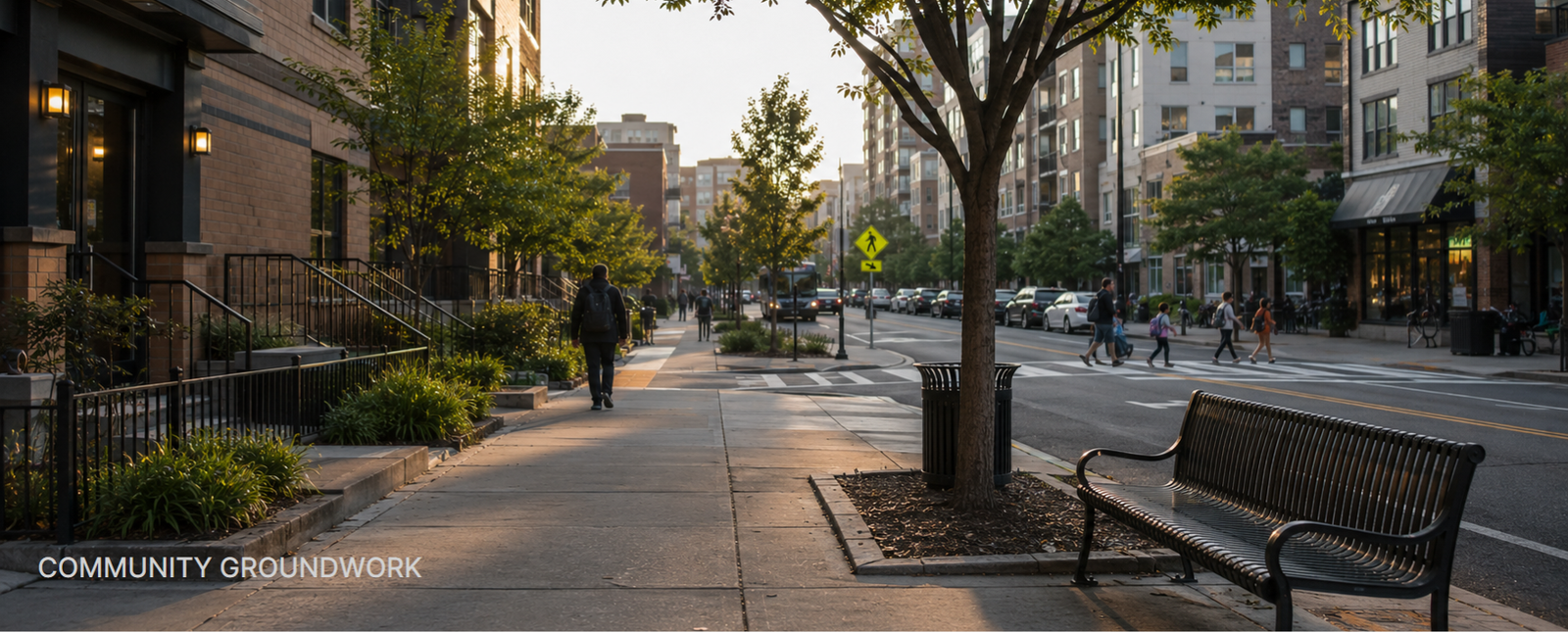
Community Groundwork studies how community systems become stronger, drift, adapt, and endure through the behavior of people who share them.
Most of those systems are easy to overlook because their work appears ordinary. A hallway gets cleaned, somebody reports the broken light, a volunteer list fills, or a longtime employee teaches somebody else how the place actually works.
Although none of those moments looks dramatic, each one reveals something important. It shows whether responsibility is visible, whether participation still has value, and whether the system can function without constant rescue.
For that reason, Community Groundwork begins with what people can see. Then it follows the behavior into the structure underneath it.
Community is a system before it is a sentiment.
People can care deeply about the same place and still allow it to weaken. Durable community therefore requires concern to become visible through participation, maintenance, correction, stewardship, contribution, and repeated responsibility.
What Community Systems Reveal
Community Groundwork owns the study of shared systems at human scale.
That territory includes households, apartment buildings, neighborhood blocks, public spaces, community institutions, local businesses, schools, informal networks, and shared resources.
However, an article does not belong here simply because it uses the word “community.” The central problem has to involve how people participate in, maintain, adapt to, benefit from, or weaken a system they share.
Who carries what?
Responsibility can be assigned, assumed, avoided, concentrated, or left unclear. Each version produces a different system.
Who keeps showing up?
Participation reveals contribution, withdrawal, volunteer fatigue, free riding, trust, reintegration, and the cost of continued engagement.
Who keeps it usable?
Quiet maintenance prevents buildings, public spaces, institutions, households, and shared resources from degrading.
What do people actually do?
Observable behavior shows how incentives, informal rules, standards, pressure, correction, and consequences operate in practice.
What survives repetition?
A durable system keeps working after novelty fades, attention moves elsewhere, or one dependable person leaves.
What becomes normal?
Small exceptions can become patterns. Once those patterns repeat, they begin changing what the community expects.
Do not begin with what the community says it values.
Instead, watch what people repeatedly maintain, tolerate, reward, ignore, correct, and leave for somebody else.
Three Lenses for Reading Community Systems
Community problems do not all come from the same mechanism. As a result, Community Groundwork uses distinct recurring lenses rather than forcing every question into one Series.
Community Systems and the Commons
Cultivating the Commons
Shared environments depend on people who rarely own the environment alone. Therefore, this Series follows maintenance, stewardship, shared resources, responsibility diffusion, visible standards, and the small acts that keep common spaces usable.
Governing question: Why do shared environments succeed or collapse?
Community Systems and Participation
Community Participation
Participation becomes a system problem when contribution disappears, dependable people absorb excess burden, or people keep receiving benefits while fewer participants produce the conditions everyone relies on.
Governing question: What keeps people participating, and what makes them stop?
Community Systems Under Real Incentives
Block Logic
Block Logic starts with behavior. In particular, it examines informal rules, incentives, local standards, correction, enforcement, friction, status, and what people do when a stated rule meets a real consequence.
Governing question: What do people actually do when incentives are real?
Start Here: How Community Systems Lose Participation
If this territory is new to you, start where strain becomes easiest to see: who contributes, who benefits, and who begins carrying more than their share.
From there, the sequence moves from distributed responsibility toward contribution failure, free riding, invisible effort, burden concentration, and eventually maintenance without ownership.
Communities Become Stable When Responsibility Stays Distributed
Begin with the operating requirement underneath durable community. Enough responsibility has to remain distributed for stability to hold.
Community Systems Fail When Contribution Stops
Next, follow what happens when fewer people contribute while the shared system continues serving everyone.
The Free Rider Problem Is Not Theory. It Is Practice.
Then examine how benefit begins separating from responsibility and why that imbalance changes contributor behavior.
Contribution Must Be Visible or It Disappears
From there, see why effort becomes harder to sustain when a system stops making contribution legible.
Reliability Should Not Become a Job Title
As burden concentrates, dependable people can stop strengthening the system and quietly become the system.
Maintenance Without Ownership
Finally, move into the commons and examine what happens when many people benefit while responsibility remains unclear.
How Community Systems Become Stronger or Weaker
Most community outcomes do not begin with crisis. Instead, they begin with ordinary behavior repeated long enough to change expectations.
Consider a shared space that stays maintained. People notice the care, and that care establishes a visible standard. In turn, the standard changes what behavior feels acceptable. Predictability rises, while participation becomes easier because contributors can see that effort is not disappearing into disorder.
The reverse can happen just as quietly. A problem goes uncorrected, someone adapts to the lower standard, and another person learns that the exception carries no consequence.
Eventually, participation becomes less rewarding. Reliable people then absorb more of the burden, and some begin to withdraw.
By the time decline looks sudden, the underlying pattern may have been developing for months or years.
This sequence is not a new Groundwork Core Principle, Condition, or proprietary framework. Rather, it is the observational path this Category uses to follow visible behavior toward structural consequence.
Community Systems Map: Find the Right Lens
The most useful starting point is the governing question. Once that question is clear, the editorial lane usually becomes clear as well.
| Question | Best Lens | What It Reveals |
|---|---|---|
| Who maintains what everyone uses? | Cultivating the Commons | Stewardship, maintenance, shared environments, responsibility diffusion |
| Who contributes, and who carries the excess load? | Community Participation | Contribution, reliability, free riding, burden concentration, participation |
| What do people actually do when a standard is tested? | Block Logic | Incentives, informal rules, correction, enforcement, public behavior |
| Why does a stable community begin to drift? | Community Groundwork | Maintenance loss, participation decline, trust erosion, adaptation |
| Why does an institution weaken after attention moves elsewhere? | Community Groundwork | Institutional maintenance, memory, succession, stewardship, durability |
| How does someone return after disruption or exclusion? | Community Groundwork | Reintegration, pathways, trust, contribution, local infrastructure |
Some Community Systems Stand Outside a Series
Community Groundwork is larger than its recurring Series. That distinction protects the Category from becoming artificially narrow.
For example, an article should not be pushed into Cultivating the Commons, Community Participation, or Block Logic merely because Cyrus wrote it or because the subject sits nearby.
Instead, some problems belong directly to the Category. Institutional continuity, neighborhood economics, reintegration systems, local food infrastructure, organizational maintenance, and other community mechanisms may stand alone when the Category clearly owns the central problem.
The Category owns shared-system territory. A Series earns a narrower recurring question inside that territory.
Consequently, the archive stays coherent without turning a useful Series into a container for everything associated with one Builder.
Community Systems in Practice
The strongest work in this territory starts with something observable. After that, the article traces what the behavior reveals about the system underneath it.
Your Trash Has a Family Tree
Household waste becomes evidence about routines, purchasing, visibility, maintenance, and how private behavior reaches the commons.
The Quiet Work That Keeps Institutions Alive
Institutional durability becomes visible through maintenance that continues after public attention moves elsewhere.
Community Reintegration Requires More Than a Second Chance
Reentry becomes a community systems problem when return depends on pathways, trust, opportunity, and usable local infrastructure.
Why Neighborhood Order Beats Big Promises
Local order becomes visible through what people maintain, tolerate, correct, and enforce before any major intervention arrives.
Questions About Community Systems We Build Around
Rather than treating community as an abstract ideal, this Category is organized around questions that can be observed in actual systems.
Why do communities become unstable?
What causes people to stop contributing?
When does maintenance begin disappearing?
How does free riding spread?
What makes shared responsibility work?
Which conditions make community trust durable?
How do small problems become normal disorder?
When does correction require enforcement?
What causes institutions to weaken without maintenance?
How do communities reintegrate people successfully?
What keeps public space usable?
Why does visible contribution matter?
How Cyrus Mbeki Reads Community Systems

Cyrus Mbeki
Community Groundwork
Cyrus Mbeki examines how shared systems behave under ordinary pressure. His work starts with what people can see: the broken light nobody reports, the volunteer list that keeps shrinking, the person who always cleans up, the cart left in the parking space, or the rule everybody knows but nobody enforces.
From there, Mbeki follows the pattern into the system underneath it. His work focuses on participation, stewardship, maintenance, incentives, contribution, public behavior, institutional durability, and the small behaviors that reveal whether a community is strengthening or quietly becoming more fragile.
Watch the behavior long enough and the system usually tells you what it rewards.
Cultivating the Commons | Community Participation | Block Logic
Strong Community Systems Become Visible Before Failure Does
A community is not only what people say they value. More importantly, its operating structure becomes visible through repeated behavior.
Look at who still contributes after the excitement fades. Then notice whether the shared space stays usable when nobody important is visiting.
Pay attention to whether correction happens before disorder becomes normal. Also watch whether reliable people can step away without taking the system down with them.
Those details are not secondary. Together, they reveal whether community systems are distributing responsibility or quietly concentrating it.
Durable shared life develops when care becomes repeatable, responsibility remains visible, contribution stays broad enough to carry the load, and institutions receive maintenance before failure makes that work impossible to ignore.
Community Groundwork studies that structure while it is still ordinary enough to miss.