
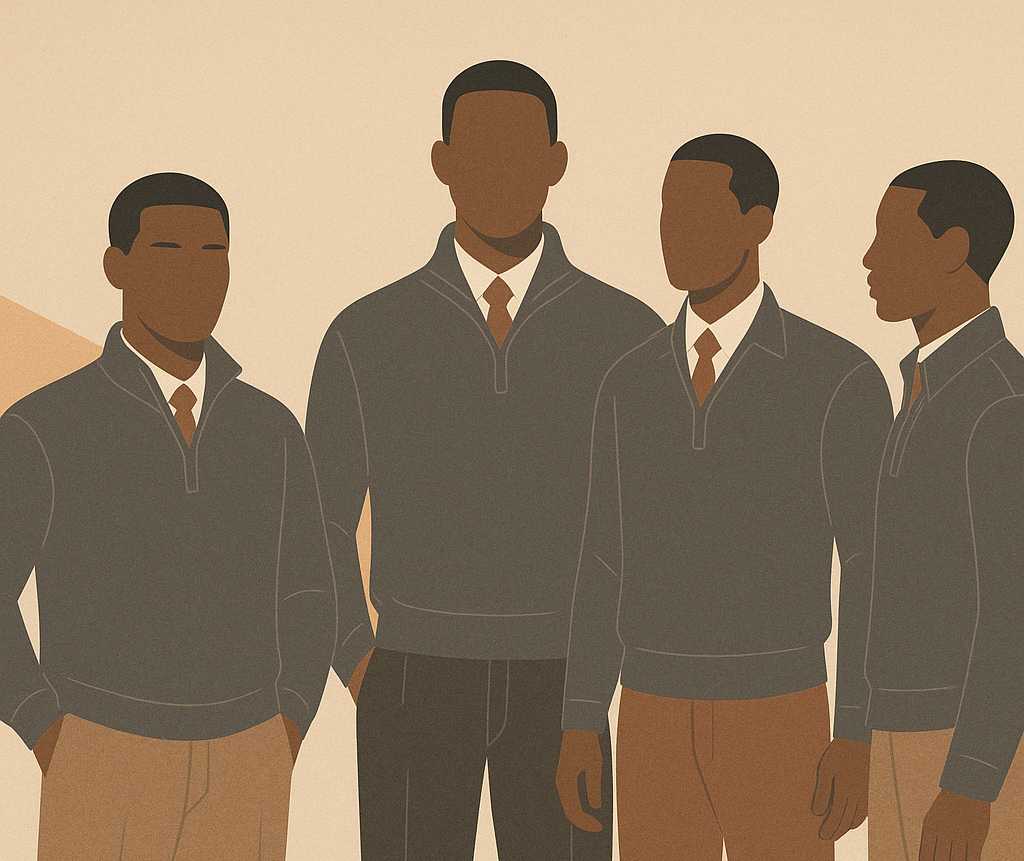
Codes change when the cost of keeping them gets too high.
The YN to YG Shift in Plain Language
The first post in this cluster, Why Softness Became Armor , explained why softness had to become tactical. This piece looks at the next layer: the actual YN to YG shift. The question is not just why young Black men are changing how they dress, but what it means to retire the old code and adopt a new one.
For a long time, the YN posture ran the script. Hard silhouettes, visible edge, ready energy. Now a different posture is stepping forward. The YG, or Young Gentleman, still knows the old code, but he is choosing something else: calmer motion, fewer crashes, more structure. The clothes are the visible part. The code underneath is the real story.
The Old Code: What YN Was Designed To Do
The old code did not appear out of thin air. It was built inside neighborhoods where being underestimated could get you hurt and being seen as soft could get you exploited. The YN stance made sense in environments where you needed people to think twice before disrespecting you.
The uniform supported the script. Hoodies up. Nike Tech zipped. Face unbothered. Voice loud enough to carry, tone sharp enough to cut. The logic was simple: if the world already suspects you, lean into the image and make it useful. Better to be read as dangerous than as prey.
Underneath that, the old code did a few specific jobs:
- Protection: Project enough edge that casual disrespect feels expensive.
- Credibility: Signal you understand the rules of the street, even if you are not deep in them.
- Belonging: Show you are not out of touch with the people you grew up around.
In that sense, the old code was a survival algorithm. It translated fear and instability into visible toughness. The problem is that algorithms built for short term protection often age badly in long term life.
Where the Old Code Started to Crack
As time went on, the cost of the old code became harder to ignore. The same silhouette that kept some people from testing you also kept some doors from opening. Security followed you in stores. Police slowed when they saw you on a corner. Front desks stiffened when you walked into a lobby.
The more data people collected on their own lives, the clearer the tradeoff looked. The old code protected you in some situations, but it taxed you in others: hiring calls, financial spaces, travel, classrooms, even dates. Quietly, a lot of men started asking a different question. Not “Does this code make me look strong?” but “Is this code still worth the bill it sends me?”
That is where the YN to YG shift really started. Not on TikTok, but in private cost benefit math. Once the math changed, the wardrobe was going to follow.
A Side by Side Look at the Shift
To see the shift clearly, it helps to put the old and new codes next to each other. The point is not to shame the old posture, but to show how the incentives moved.
| Layer | Old Code (YN) | New Code (YG) |
|---|---|---|
| Silhouette | Hard lines, hood up, wide stance. | Soft knit, layered shirt and tie, relaxed posture. |
| Energy | Loud, reactive, ready to escalate. | Calm, measured, willing to disengage. |
| Currency | Fear, reputation, fast money. | Trust, predictability, credit and contracts. |
| Goal | Do not get played. Do not look weak. | Do not crash out. Build something that lasts. |
| Default Question | “Who is trying me?” | “Is this worth my time, energy, or record?” |
The clothes are the front end of this table, but they are not the main event. The YN to YG shift is really the move from fear based reputation management to stability based identity building.
How the New Code Actually Plays Out
In practice, the new code looks less dramatic than people expect. It is not a sermon. It is a series of small daily decisions:
- Leaving ten minutes earlier so you do not have to sprint and argue with security.
- Keeping headphones low enough to hear what is happening around you.
- Choosing documentable income over side money that can disappear overnight.
- Stepping away from arguments that only prove you can shout, not that you can think.
The quarter zip, the button up, and the tie support that script. They say, “I am on my way somewhere specific. I am not here for chaos.” The point is not to impress strangers. The point is to keep your own life from constantly being pulled off course.
What the Old Code Still Gets Right
None of this means the old code had no value. There are lessons inside it that the new posture should keep. Reading people quickly, noticing danger early, knowing when energy is about to change in a room. These are not street only skills. They are life skills.
The risk is pretending that new clothes erase old realities. They do not. The men making this shift are not naive. They are choosing to hold on to the awareness of the old code while refusing to let it define their entire identity. They are trying to keep the wisdom and leave the performance.

The Groundwork
The YN to YG shift is not just about becoming more polite or more acceptable. It is about becoming more free. When you move from a code built on constant reaction to a code built on structure, you get back time, money, and nervous system space. That is the kind of shift that can change a life, not just a look.
Clothing can support that move, but it cannot replace it. To make the new code real, it has to sit on top of disciplined choices about money, work, and home. That is why this cluster keeps pointing back to the deeper frameworks that hold a life together, not just the sweaters that sit on top of it.
The Groundwork Desk
Further Groundwork
Connect this post to the pillars beneath the Quarter Zip Movement:
- Why Softness Became Armor — Post One of the cluster, on softness as tactical protection.
- Discipline Before Dollars — why a new code has to be backed by disciplined financial structure.
- The Family Stability Framework — how predictable homes and clear roles shape the men these codes belong to.
- Signals of Safety: The Quarter Zip Rebrand — the full cluster overview, glossary, and cultural timeline.