
How government power works in the United States depends on more than who holds office. Public authority comes from law, is distributed among institutions and governments, becomes action through specific mechanisms, encounters legal limits and competing authority, and can be reviewed or changed only through institutions and processes with power to do so.
American government is therefore not one machine with one control panel. Instead, it is a constitutional system composed of institutions with different sources of authority, different jurisdictions, different mechanisms, and different limits.
Public discussion often begins with the visible result. Congress passes a law, a President issues a directive, an agency adopts a rule, a state enacts a policy, a city acts, or a court resolves a dispute.
Yet the visible actor may represent only one point in a longer authority chain. Understanding the system requires tracing that chain rather than assuming that visibility and control are the same thing.
Core Principle
Government power is distributed through a structure. To understand an outcome, trace the authority that produced it rather than stopping with the institution that announced it.
Definition Lock
Government power is lawful public authority assigned to institutions and exercised through constitutionally or legally recognized mechanisms, jurisdictions, procedures, and relationships.
System Map, Not the Governing Method
This page maps the system through which government authority operates. It does not replace the analytical method used throughout Civic Education.
The system map follows authority through source, allocation, delegation, implementation, conflict, review, and change. By contrast, the Civic Power Trace is the six-part method readers use to analyze a specific action inside that system.
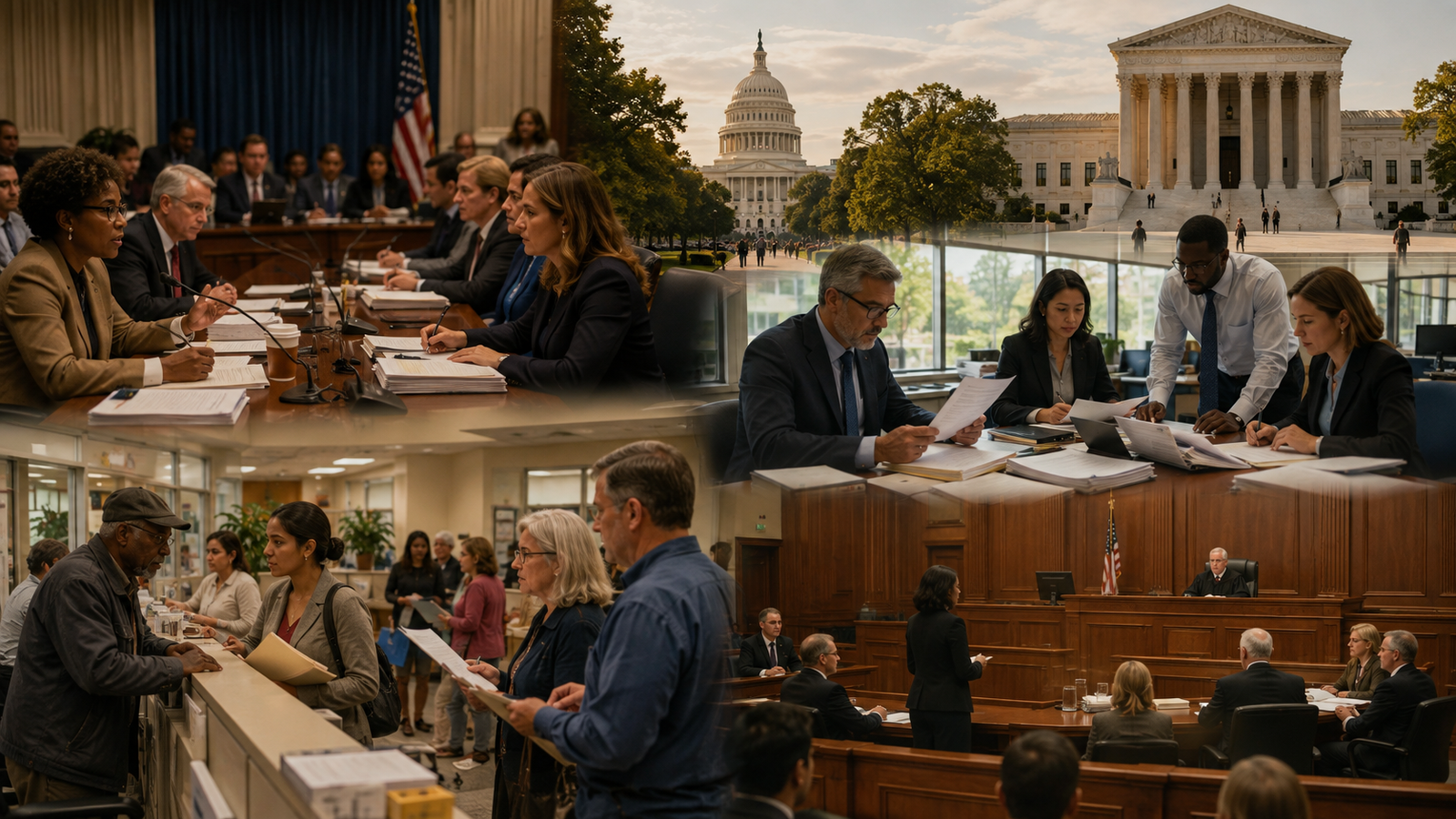
Keep the institutional vocabulary close: this system map depends on authority, jurisdiction, delegation, federalism, preemption, executive action, administrative rulemaking, limits, judicial review, and constitutional change. Use the Civic Education Glossary as the controlled reference layer.
Premium Reference Artifact
The Government Power System Map
The clearest way to understand how government power works is to separate several institutional functions that public discussion often compresses into one event.
These functions do not form a mandatory chronological sequence. A particular dispute may begin at almost any point, involve several functions simultaneously, or return to an earlier stage after review.
Instead, the map identifies recurring parts of the governing system.
Government Power System Map
Source → Allocation → Delegation → Implementation → Conflict → Review → Change
| System Function | Institutional Question | Examples |
|---|---|---|
| Source | Where does the claimed authority come from? | Constitution, statute, charter, regulation, lawful delegation |
| Allocation | Which institution or government possesses the relevant power? | Congress, President, courts, states, municipalities, agencies |
| Delegation | Has lawful responsibility been assigned to another institution or official? | Congressional delegation to an agency; executive assignment within lawful authority |
| Implementation | How does legal authority become government action? | Administration, rulemaking, enforcement, funding, executive direction |
| Conflict | What happens when authorities, rules, or jurisdictions intersect? | Federalism, preemption, state-local conflict, statutory disputes |
| Review | Which institution can examine legality, procedure, administration, or implementation? | Courts, legislatures, administrative review, inspectors general, other lawful oversight |
| Change | Which mechanism can lawfully alter the governing result? | Legislation, rulemaking, executive change, judicial development, elections, constitutional amendment |
The Map Describes Functions, Not a Fixed Timeline
For example, a dispute may begin with a state rule that already exists. A later federal statute might then create a preemption question, while litigation introduces judicial review.
In another case, Congress may enact a statute first, an agency may later implement it, and a reviewing court may address whether the agency remained within lawful authority.
Therefore, the value of the map lies in separating the functions, not in pretending that government always moves through them in one order.
Visible Action Is Not Always the Source of Power
The institution that announces a decision may not be the institution that created its governing authority.
An agency rule, for instance, may depend on a statute enacted years earlier. Similarly, a presidential directive may operate within authority supplied partly by legislation. A local policy may exist because state law permits local institutions to act.
Consequently, a serious civic analysis follows the authority chain rather than assigning the entire outcome to the most visible actor.
Stage One
Where Government Power Comes From
Holding public office does not create unlimited authority. Instead, government power must be tied to a legal source.
Federal Power Begins With Constitutional Authority
At the federal level, the Constitution establishes the national government’s basic structure, creates institutions, distributes powers, and imposes limits.
Within that framework, Congress may enact statutes using constitutional authority available to the federal government.
Federal statutes can then establish programs, impose duties, authorize spending, protect rights, create regulatory frameworks, and assign responsibilities to executive departments or administrative agencies.
States Possess Their Own Governing Institutions
States operate within the federal constitutional system. At the same time, they exercise authority through their own constitutions, statutes, courts, executives, agencies, and other institutions.
As a result, the existence of federal authority does not automatically erase state governing authority across the same policy environment.
Local Authority Comes Through State Legal Structure
Local governments occupy a different position. Municipalities, counties, school districts, and similar governmental bodies generally exercise authority through state-created legal frameworks rather than possessing an independent constitutional status equivalent to the states.
Accordingly, a city-state authority dispute is structurally different from a federal-state dispute.
Ask for the Legal Source, Not Just the Office
“Who is in charge?” is often too broad to answer usefully.
A stronger question is: What legal source gives this institution authority over this particular function?
That discipline is developed more fully in Civic Education: Institutional Literacy and Structural Power and Level 1 — Authority Foundations .

Stage Two
How Government Power Is Distributed
American constitutional structure divides authority rather than placing every governing function in one institution.
Separation of Powers Divides Federal Functions
At the national level, separation of powers distributes federal responsibilities among Congress, the executive branch, and the judiciary.
Those institutions participate in the same constitutional system, but they do not possess identical powers.
Consequently, an institution’s importance within government does not give it general authority to perform every governmental function.
Federalism Divides Authority Between Governments
Federalism creates another structural division by organizing authority between the national government and the states.
State governments, meanwhile, operate through their own legislatures, governors, courts, agencies, municipalities, counties, school districts, and other public bodies.
Shared Policy Space Does Not Mean Shared Control
Several governments can therefore possess legitimate authority within the same policy environment without possessing identical authority over the same function.
Public education illustrates the point. State institutions occupy a central structural role in governing public schools, while local districts exercise state-created authority.
Federal law can also impose requirements within constitutionally authorized federal programs or protections. Funding, administration, civil-rights enforcement, curriculum authority, personnel rules, disability protections, and judicial review need not reside in the same institution.
Explore those relationships in What Is Federalism? and Who Actually Controls Public Schools? .
Stage Three
Delegation Connects Legal Authority to Governing Responsibility
Government institutions frequently operate through lawful assignments of responsibility.
Congress Can Assign Administrative Responsibility
Congress may enact a statutory framework and assign an executive agency responsibility for administering specified provisions.
That arrangement helps explain why a citizen may encounter an agency rule or administrative decision even though the relevant authority ultimately traces back to legislation.
Delegation Does Not Create Unlimited Power
Importantly, the institution carrying out a government function does not thereby gain free-standing authority to do whatever it chooses.
A delegation must be traced back to the law supporting it. The delegated actor remains subject to the scope and limits of that legal framework.
Therefore, implementation authority should not be mistaken for unlimited authorship of public policy.
Stage Four
How Government Power Becomes Real-World Action
Laws do not administer themselves. Once authority exists, institutions must translate it into decisions, procedures, programs, funding choices, enforcement, directives, and—in appropriate circumstances—administrative rules.
Executive Direction Is One Implementation Mechanism
Presidents, governors, mayors, and other executive officials operate within authority supplied by the constitutional, statutory, charter, and other legal frameworks governing their offices.
At the federal level, an executive order is a formal presidential directive. However, its legal significance depends on the constitutional or statutory authority supporting the particular action.
The label executive order, by itself, does not create new presidential legislative authority.
Administrative Rulemaking Is Another Mechanism
Federal agencies can exercise rulemaking authority when governing law authorizes them to do so.
For many federal rules, Section 553 of the Administrative Procedure Act provides the familiar notice-and-comment process. When that framework applies, notice generally identifies the proposed action and its legal authority, while interested persons receive an opportunity to participate.
After considering the relevant material, the agency generally explains the basis and purpose of the final rule.
Not Every Agency Action Uses Notice-and-Comment
Notice-and-comment is important, but it is not universal.
Section 553 itself contains exceptions, and other statutes can prescribe specialized procedures. In addition, not every form of agency action is the same kind of rulemaking.
Consequently, the proper question is not merely whether an agency acted. It is: What kind of agency action occurred, what authority supports it, and what procedure governs it?
Follow these mechanisms through What Is an Executive Order? and What Is Administrative Rulemaking? .

Stage Five
What Happens When Government Powers Conflict
Distributed authority creates the possibility of overlap. In turn, overlap can produce disputes about jurisdiction, statutory meaning, supremacy, preemption, constitutional boundaries, or the scope of delegated power.
Those disputes do not all use the same legal rule.
Federal-State Conflict Has Its Own Structure
Valid federal law can displace state law in circumstances governed by federal preemption doctrine.
Still, federal supremacy, preemption, and anti-commandeering answer related but different questions.
Supremacy establishes the controlling status of valid federal law within its constitutional sphere. Preemption asks whether federal law displaces the particular state rule.
Anti-commandeering, by contrast, addresses constitutional limits on federal commands directed at state governments themselves.
State-Local Conflict Is Structurally Different
A city-state dispute should not automatically be analyzed as federalism between constitutional sovereigns.
Local governments ordinarily receive authority through state legal systems. Therefore, state constitutions, statutes, charters, home-rule provisions, and state preemption law can become central to the analysis.
“Higher Government Wins” Is Not the Rule
The useful question is more precise: Which institution possesses valid authority over the function at issue, and does that authority legally displace the competing rule?
Continue with What Is Preemption? , Can a State Ignore Federal Law? , and Can a Mayor Override State Law? .
Stage Six
What Limits and Reviews Government Power
Government authority becomes intelligible only when its boundaries are visible.
Different Institutions Face Different Legal Limits
Constitutions constrain institutions. Statutes can constrain executive officials and administrative agencies. Jurisdiction determines which institution can decide which matter.
Administrative procedures can also govern how agencies act. Courts, meanwhile, can review properly presented legal disputes within their jurisdiction.
Legislatures possess still other tools, including oversight and the power to revise governing statutes through the legislative process.
Checks and Balances Are Institution Specific
“Checks and balances” should not be understood as a general power allowing every institution to stop every other institution whenever disagreement exists.
Instead, each checking mechanism has its own source, scope, procedure, and limit.
Elections Change Officials, Not Every Legal Rule
Elections provide political accountability by allowing voters to choose many public officials.
Nevertheless, an election by itself does not automatically repeal a statute, erase a judicial judgment, amend constitutional text, or transfer legal authority between institutions.
The analytical rule is therefore more precise: identify the limit, then identify the institution or process legally capable of enforcing, reviewing, or changing it.
Groundwork Daily develops the larger structural condition in Boundaries →
Stage Seven
How Government Power and Government Outcomes Can Change
Different government outcomes require different mechanisms for change.
Statutes Change Through Legislative Processes
A federal statute generally changes through the federal legislative process.
Similarly, state statutes ordinarily change through state legislative processes, while local ordinances change through institutions and procedures authorized by state and local law.
Administrative Rules Have Administrative Change Pathways
An agency regulation may be amended or repealed through administrative action consistent with the agency’s authority and applicable procedures.
Executive policy can likewise change through lawful executive action within the governing legal framework.
Judicial and Constitutional Change Follow Different Rules
Judicial precedent can develop as courts decide later cases under the doctrines governing precedent and judicial authority.
Constitutional text, by contrast, changes through the amendment process prescribed by Article V.
The Change Mechanism Must Match the Legal Object
This distinction creates one of the most useful habits in institutional literacy.
Before demanding that an institution “change the rule,” first identify what the rule actually is.
A statute, regulation, executive directive, constitutional provision, judicial precedent, local ordinance, and administrative decision do not necessarily share the same change pathway.
For constitutional change, continue with How Constitutional Amendments Actually Work .
For changes involving Supreme Court decisions and precedent, see Can the Supreme Court Be Overruled? .
The Governing Method
Use the Civic Power Trace Inside the System Map
The seven-stage Government Power System Map describes recurring functions inside American government.
The Civic Power Trace performs a different job. It gives readers a repeatable way to analyze a particular action, dispute, institution, or policy inside that larger system.
Civic Power Trace
Institution → Authority → Jurisdiction → Mechanism → Limits → Review / Change
- Institution: Which legislature, executive office, agency, court, state, municipality, district, or other public body is acting?
- Authority: What constitutional provision, statute, charter, regulation, judicial rule, or lawful delegation supplies the power?
- Jurisdiction: Does that authority reach the issue, person, territory, institution, program, or conduct involved?
- Mechanism: How is the authority being exercised — legislation, executive direction, administration, rulemaking, funding, enforcement, adjudication, or another lawful process?
- Limits: What constitutional, statutory, procedural, jurisdictional, or institutional boundaries constrain the action?
- Review / Change: Which institution or lawful process can review, revise, block, displace, reverse, repeal, amend, or replace the result?
Learn the method in full: What Is Civic Education? Institutional Literacy Explained . Use the Civic Education Glossary when an institutional term needs a concise reference definition.
Why the System Is Easy to Misread
Why Government Power Often Looks More Centralized Than It Is
Public communication rewards simplicity. Institutional structure does not.
Headlines Usually Emphasize the Visible Actor
A headline may describe a President as changing a policy, a court as controlling an issue, a governor as blocking a rule, or a mayor as deciding a local controversy.
Sometimes that shorthand is useful. Structurally, however, it can hide the authority chain.
The Visible Actor May Depend on Earlier Authority
A President may be administering authority Congress previously supplied. An agency may perform the implementation.
Later, a court may review the legality of the action. Meanwhile, state institutions may retain authority over related questions.
As a result, the public-facing moment can be only one point in a much longer institutional process.
Political Commitment and Legal Authority Are Different
Public officials can also advocate for outcomes that require action by another institution.
Consequently, a political promise, public demand, policy preference, or institutional recommendation should not automatically be treated as evidence that the speaker possesses unilateral legal authority to produce the result.
Institutional literacy separates those questions.
Structure Before Blame
Understanding How Government Power Works Improves Accountability
Civic accountability weakens when citizens direct demands toward institutions that do not possess authority to produce the requested result.
The Correct Institution Depends on the Governing Object
If the disputed rule is a state statute, a mayor may not possess the mechanism needed to repeal it.
By contrast, if the issue involves a federal regulation, the relevant institutions may include the administering agency, Congress, or a reviewing court depending on the change sought and the legal posture.
Likewise, if the barrier is constitutional text, ordinary legislation cannot simply substitute for the constitutional amendment process.
Authority Mapping Narrows the Problem
Once the authority chain becomes visible, several very different situations can be separated.
An official may possess authority and decline to exercise it. Another official may want to act but lack the necessary legal power.
Elsewhere, a governing institution may possess authority but face a procedural limit. In still another case, a different institution may control the change mechanism entirely.
Institutional Literacy Does Not Supply the Political Judgment
These distinctions do not tell citizens which political position to hold.
Instead, they identify where the governing decision actually lives.
Institutional Literacy Test
When Government Acts, Can You Trace:
- which institution is acting;
- where its authority comes from;
- whether its jurisdiction reaches the issue;
- which mechanism turns that authority into action;
- which legal or institutional limits apply; and
- which institution or lawful process can review or change the result?
The Groundwork
American government becomes easier to understand when public power is treated as an institutional system rather than a contest among visible personalities.
First, authority has a source. Next, that authority is allocated to particular institutions. Some responsibilities may then be lawfully delegated.
From there, executive officials and agencies can implement governing law within their respective powers. Different authorities may overlap or conflict, while review mechanisms operate within their own jurisdictions.
Finally, different legal objects require different mechanisms for change.
None of those functions should be collapsed into the single question, “Who is in charge?”
The stronger civic question is: Which institution has authority over this function, where did that authority come from, how is it being exercised, what limits apply, and who can lawfully review or change the result?
That is how a headline becomes an authority map.
Do not stop with the visible actor. Trace the system that makes the action possible.
Continue the Civic Education System
Enter the complete Civic Education property:
Civic Education: How Public Power Actually Works
— use the canonical Series Hub to navigate the curriculum, method, applied cases, and reference system.
Learn the governing method:
What Is Civic Education? Institutional Literacy Explained
— learn the Civic Power Trace used throughout this system map.
Begin with legal authority:
Level 1 — Authority Foundations
— answer the foundational question: who can legally do this?
Follow authority in operation:
Level 2 — Power Mechanics
— trace how authority interacts, conflicts, becomes government action, and reaches review or change.
Use the reference layer:
Civic Education Glossary: How Public Power Works
— reference the institutional vocabulary behind the system.
Continue into the core mechanism lessons:
Federalism
·
Preemption
·
Executive Orders
·
Administrative Rulemaking
Groundwork Daily Newsletter
Follow the Authority Behind the Headline.
Receive Civic Education lessons and Groundwork Daily analysis on institutions, public authority, policy mechanics, and the structures that determine how government action actually happens.
The principle and condition beneath this system map
Government power becomes legible when authority is traced through the structure that creates, distributes, implements, limits, reviews, and changes it.
Structure Builds Freedom
Citizens gain greater civic agency when they can distinguish the institution announcing a decision from the institutions and mechanisms that legally produced it.
Boundaries
Public authority operates inside constitutional, statutory, jurisdictional, procedural, and institutional boundaries. Those boundaries reveal where one institution’s power ends and another institution or review process begins.
Receipts
Primary and authoritative sources supporting the constitutional structure, federalism, executive authority, federal-state conflict, administrative rulemaking, judicial review, and institutional relationships described in this system map.
- Constitution Annotated — Constitution of the United States and Constitutional Interpretation — provides constitutional text and congressional legal analysis concerning federal institutions, separation of powers, federalism, executive authority, judicial authority, and constitutional limits.
- Constitution Annotated — Separation of Powers Under the Constitution — explains the constitutional allocation of federal governmental authority among separate institutions.
- Constitution Annotated — Federalism and the Constitution — explains the constitutional distribution of authority between the national government and the states.
- Supreme Court of the United States — Murphy v. NCAA, 584 U.S. 453 (2018) — explains the distinction between federal preemption and unconstitutional federal commands directed to state governments.
- U.S. Code — 5 U.S.C. § 553: Rule Making — provides the federal notice-and-comment framework, public-participation provisions, and statutory exceptions.
- Federal Register — Executive Orders — provides federal publication and access to presidential executive orders.
- Congress.gov — provides official federal legislative information, including bills, laws, congressional actions, and legislative records.
- GovInfo — provides authenticated publications from the federal government, including statutes, congressional materials, regulations, and judicial publications.
- Supreme Court of the United States — Opinions — provides official opinions of the Court for examining judicial decisions and constitutional or statutory interpretation.
Government authority is source, jurisdiction, and mechanism specific. The existence of a public office, federal interest, executive directive, agency action, state law, local policy, or court decision does not by itself establish the scope of lawful power. The relevant constitutional provision, statute, governing rule, jurisdiction, procedure, and review mechanism must be traced for the particular question.