
What is an executive order? An executive order is a formal presidential directive used to manage the executive branch or exercise presidential authority grounded in the Constitution, federal statutes, or both.
Importantly, the title itself does not create the power. An executive order is lawful only to the extent the President already possesses authority to direct the action it requires.
That authority may come from Article II, from powers Congress has assigned or delegated through statute, or from a combination of constitutional and statutory sources.
In practice, executive orders can produce significant government action. They may direct agencies, organize executive responsibilities, establish administrative priorities, or instruct officials how to use discretion already available under law.
Even so, an executive order is not a blank check. Presidential directives remain bounded by the Constitution, statutes, appropriations, agency authority, administrative procedure, judicial rulings, and the separation of powers.
Applied Civic Literacy
Executive orders reveal the difference between possessing authority and operationalizing authority. A President can direct executive action, but the strength and durability of that directive depend on the legal power supporting it and the institutions that must implement it.
Definition Lock
An executive order is a presidential directive that exercises constitutional or statutory executive authority. It can direct federal officers and agencies and may have significant legal effects within its lawful scope, but it cannot create presidential authority that the Constitution or federal law does not provide.
Institutional Power Index
Keep the institutional vocabulary close: this lesson depends on distinctions among executive authority, delegated authority, executive orders, administrative rulemaking, appropriations, jurisdiction, mechanisms, limits, and judicial review. Use the Civic Education Glossary as the reference layer while tracing how presidential direction becomes government action.
Executive Action Chain
Legal Authority → Presidential Directive → Executive Institution → Administrative Action → Legal / Procedural Constraint → Review or Change
The presidential signature is often the most visible moment. However, the order is usually one stage in a longer institutional process.
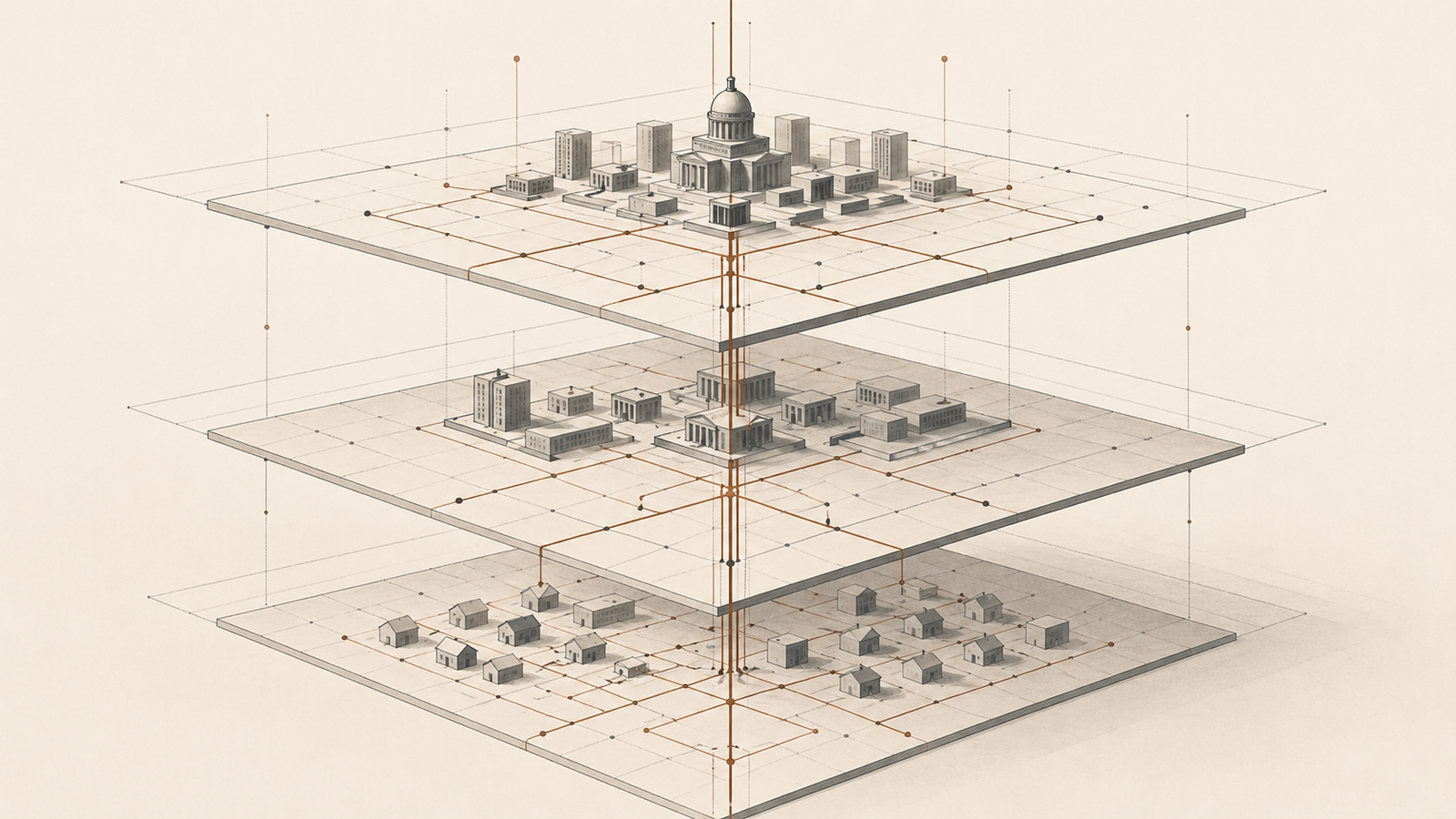
Follow the Movement of Power
An Executive Order Is Usually One Stage in a Longer Government Process
Executive orders are often described as though the presidential signature itself produces the entire policy outcome.
Sometimes the immediate effect is substantial. More often, though, an order also depends on departments, agencies, officers, funding, procedures, regulations, or later implementation decisions.
Stage 1: Legal Authority
First, the process begins with legal authority.
A constitutional provision, federal statute, or combination of authorities must support the presidential action.
Stage 2: Presidential Directive
Next, the President issues instructions concerning how executive authority should be used.
For example, the order may direct agencies to coordinate, review policy, use delegated discretion, establish priorities, or take other actions permitted by law.
Stage 3: Executive Institution
Departments, agencies, and federal officers then receive and interpret the directive within their own legal responsibilities.
Even at this stage, an agency must operate within the authority assigned to it by law.
Stage 4: Administrative Action
Actual implementation may require grants, enforcement decisions, internal procedures, contracts, guidance, regulatory action, or other administrative steps.
Consequently, implementation may look quite different from the concise language of the presidential order.
Stage 5: Legal and Procedural Constraint
Meanwhile, statutes, appropriations, existing regulations, administrative procedure, constitutional protections, and judicial decisions can limit what officials may do.
Those limits can affect both the speed and the substance of implementation.
Stage 6: Review or Change
Finally, a later President, Congress, an agency, or a court may have authority to change part of the resulting policy.
Which institution matters depends on which part of the chain must change.
Execution Is Not Legislation
An Executive Order Is Not the Same Thing as a Federal Statute
Congress exercises legislative power through the constitutional lawmaking process.
By contrast, executive orders arise from presidential authority and operate through the executive branch.
Both can have important legal consequences, but they do not come from the same institution or the same source of power.
Congress Creates Statutory Authority
A statute can create federal programs, authorize spending, establish duties, define rights, impose obligations, and delegate discretion to agencies or executive officers.
In that sense, legislation often establishes the legal environment in which later executive administration occurs.
The President Directs Executive Authority
An executive order may then tell federal officers how presidential or delegated authority should be exercised within that legal framework.
Accordingly, the President does not become Congress merely because an executive order changes federal policy.
Execution Insight
An executive order does not gain legal authority because it is called an executive order. Its force depends on the lawful presidential or statutory authority supporting the action it directs.
From Directive to Administration
An Executive Order Does Not Necessarily Execute Itself
The presidential signature is highly visible.
Implementation, however, often occurs afterward through departments, agencies, and officers across the executive branch.
Agencies May Have to Translate the Directive
Federal officials may need to determine how the order applies to existing programs, regulations, enforcement practices, contracts, grants, or internal procedures.
Some changes can occur quickly because the relevant discretion is already available.
Other changes, by comparison, require additional legal steps.
The Order May Start a Process Rather Than Finish One
A presidential directive can instruct an agency to review a rule, reconsider a policy, coordinate with another department, or begin a regulatory process.
Therefore, the directive may be important without itself being the final legally operative action.
Formal Executive Orders Have Their Own Document Process
Formal executive orders are also prepared and processed within an institutional framework.
The federal preparation process requires proposed executive orders to identify the authority under which they are issued and provides for review, presentation, filing, and publication.
As a result, even the presidential document itself is part of a governed institutional process rather than an isolated personal instruction.
Different Executive Tools
Executive Orders and Administrative Rules Are Not the Same Thing
An executive order and an administrative regulation are different legal instruments.
Executive orders originate with the President. Regulations, meanwhile, are issued by federal agencies under legal authority and may be governed by statutory procedural requirements.
A President Can Direct an Agency Without Completing Rulemaking
A President may instruct an agency to consider revising policy or using delegated authority differently.
If the desired change requires amendment of a regulation, however, the agency may still need to complete the legally required rulemaking process.
Procedure Can Determine Timing and Durability
Notice-and-comment requirements, statutory findings, administrative records, or other procedural duties may shape how quickly an executive policy becomes final agency action.
Consequently, the order may begin the movement of power while administrative law governs the next stage.
Continue that mechanism in What Is Administrative Rulemaking? →
Presidential Power in Relation to Congress
The Youngstown Framework Helps Test Executive Power
One of the most important Supreme Court decisions for understanding presidential power is Youngstown Sheet & Tube Co. v. Sawyer.
During the Korean War, President Harry Truman directed the Secretary of Commerce to seize and operate steel mills in an effort to prevent a labor dispute from disrupting steel production.
The Supreme Court concluded that the President lacked lawful authority for the seizure.
Justice Jackson Supplied an Enduring Framework
Justice Robert Jackson’s concurrence organized presidential power according to the relationship between presidential action and congressional authority.
The Supreme Court has subsequently used that framework in later presidential-power disputes.
The Framework Focuses on Institutional Position
Instead of treating presidential power as a fixed quantity, the framework asks how executive action relates to Congress.
That relationship can strengthen, complicate, or weaken the President’s legal position.
| Youngstown Position | Relationship to Congress | Institutional Meaning |
|---|---|---|
| Congress Supports the Action | Presidential action rests on executive authority together with authority Congress has supplied. | Presidential power is generally at its strongest. |
| Congress Has Not Clearly Spoken | Presidential authority may depend on independent constitutional power, statutory structure, practice, and surrounding circumstances. | The legal position is more uncertain and context dependent. |
| President Acts Against Congress | Presidential policy conflicts with Congress’s expressed or implied position. | Presidential authority is generally at its weakest and must rest on sufficiently strong independent constitutional power. |
The Framework Is Better Than Calling an Order “Strong” or “Weak”
The legal footing of an executive order depends heavily on the relationship between presidential authority and congressional law.
For example, an order supported by a statute presents a different structural problem from an order issued against Congress’s expressed policy.
Institutional Literacy
Use the Civic Power Trace to Analyze an Executive Order
Before judging an executive order as powerful, weak, lawful, unlawful, temporary, or durable, trace the institutions and authorities behind it.
Civic Power Trace
Trace Executive Action in Six Steps
- Institution: Which institution is acting — the President, an executive department, a federal agency, Congress, or another body?
- Authority: What constitutional provision or federal statute supports the action?
- Jurisdiction: What program, agency, official function, federal property, enforcement responsibility, or subject falls within that authority?
- Mechanism: What does the executive order actually direct, and what administrative instrument must carry the directive into effect?
- Limits: What statutes, appropriations, regulations, procedures, constitutional rules, or court decisions constrain the action?
- Review / Change: Can the result be changed by a later President, Congress, an agency process, or judicial review?
Use the method across Civic Education: learn the Civic Power Trace or use the Civic Education Glossary when you need a concise reference for executive authority, delegated authority, jurisdiction, executive orders, rulemaking, appropriations, limits, or judicial review.
The Order Is Only One Point in the Trace
The President may supply the directive.
Congress, however, may have supplied the statutory authority. Meanwhile, an agency may supply the implementation, and a court may later determine whether the resulting action is lawful.
For that reason, an executive-order analysis should trace the full institutional chain.
Presidential Direction Has Boundaries
What an Executive Order Cannot Lawfully Do
An executive order cannot make presidential authority unlimited.
It Cannot Override the Constitution
Presidential directives remain subject to constitutional limits.
Accordingly, an executive order cannot make unconstitutional action lawful merely because the President has signed it.
It Cannot Simply Override a Controlling Statute
When Congress has lawfully enacted a statute within its constitutional authority, the President cannot generally disregard that law merely because the administration prefers another policy.
The precise analysis may depend on the subject and the constitutional powers involved. Even so, the executive order itself does not place the President above federal statutes.
It Cannot Give an Agency Powers the Agency Does Not Have
Agencies exercise authority assigned by law.
Therefore, a presidential directive cannot automatically expand an agency’s statutory jurisdiction beyond the authority Congress has supplied.
Appropriations Can Constrain Implementation
Federal officials generally require lawful spending authority to obligate or spend federal funds.
As a result, presidential policy may be constrained by congressional appropriations even when other legal authority exists.
Procedure Can Also Constrain Implementation
When administrative law requires notice-and-comment rulemaking or another formal process, an executive order does not automatically eliminate that obligation.
Consequently, a lawful presidential directive may require additional institutional steps before the desired policy is fully implemented.
Courts Review Legal Claims
Executive Orders and Their Implementation Can Be Reviewed in Court
Presidential directives and resulting agency actions can become the subject of litigation.
Courts, however, do not invalidate executive orders merely because litigants disagree with presidential policy.
A Proper Legal Dispute Must Exist
Judicial review depends on a case that satisfies the legal requirements for federal court review.
Depending on the dispute, a challenge may concern presidential power, statutory authority, administrative procedure, constitutional rights, or agency action.
The Scope of the Judicial Ruling Matters
If a court concludes that executive action exceeds lawful authority, the court may block or invalidate the challenged action within the scope of the case and available remedy.
In other words, the court is reviewing legality rather than simply substituting its preferred policy.
Who Can Change the Result?
An Executive Order Can Have More Than One Change Pathway
The relevant institution depends on which part of the authority chain must change.
| Institution | Potential Role | Key Limitation |
|---|---|---|
| President | May revoke, amend, replace, or issue a new directive within lawful presidential authority. | A successor remains bound by the Constitution, statutes, judgments, and applicable administrative requirements. |
| Congress | May amend statutes, change delegations, establish new requirements, or alter appropriations within constitutional limits. | Congressional power depends on the subject and cannot simply erase independent constitutional presidential authority where that authority controls. |
| Federal Agencies | May revise rules, guidance, enforcement policies, or implementation decisions through lawful administrative processes. | Agencies remain bound by statutes, regulations, procedural requirements, and judicial decisions. |
| Federal Courts | May review properly presented legal challenges to presidential or agency action. | Courts require a justiciable case and review legal authority rather than policy preference. |
A Later President Can Often Reverse Executive Policy
Many executive orders can be revoked, amended, or replaced by a later President.
Nevertheless, reversal of the presidential document does not always reverse every downstream administrative action immediately.
For example, a regulation, contract, grant arrangement, court judgment, or other legal consequence may require its own change process.
Congress Can Change the Legal Environment
When an order depends on statutory authority, Congress may be able to narrow, expand, revise, or eliminate the statutory basis for executive action.
Congress may also affect implementation through appropriations.
The Source of Authority Determines the Response
A directive based mainly on authority Congress delegated presents a different institutional problem from presidential action resting on independent constitutional power.
Accordingly, citizens should not assume that every executive order can be changed in exactly the same way.
Executive Power Inside a Federal System
Executive Orders Operate Inside Federalism
Executive orders direct federal executive authority.
They do not, however, transform the President into a governor of the states.
Federal Policy Can Still Affect States
Presidential directives can affect states when the federal government administers programs, enforces federal law, manages federal activity, implements valid federal statutes, or uses lawful federal funding mechanisms.
Thus, state governments can experience significant effects from executive policy even though presidential authority remains federal in character.
Federalism Still Sets Boundaries
Supremacy, preemption, statutory limits, spending rules, and anti-commandeering principles can shape the relationship between presidential policy and state institutions.
Therefore, an executive order affecting states should still be analyzed within the broader federalism framework.
Build that structure through What Is Federalism? → and What Is Preemption? →
Misconception / Reality
Common Mistakes About Executive Orders
An executive order gives the President power simply because it is an executive order.
Instead, the order depends on constitutional or statutory authority that already exists.
An executive order is the same thing as a federal statute.
By contrast, statutes come through Congress’s lawmaking power, while executive orders direct the exercise of executive authority.
Every executive order instantly changes every agency rule necessary to implement it.
Agencies may still need to complete legally required administrative procedures before downstream policy changes become effective.
A later President can erase every consequence of a prior order with a single signature.
A successor may often revoke the order. However, regulations, legal obligations, contracts, judgments, or other downstream actions may require separate change mechanisms.
Level 2: Power Mechanics
Executive Orders Show How Authority Becomes Government Action
Level 1 asks whether an institution possesses authority.
Level 2, by contrast, asks how that authority moves.
The President Supplies Direction
A presidential directive can convert available legal authority into an instruction for the executive branch.
Yet direction alone may not complete the policy.
Agencies Supply Implementation
Federal departments and agencies then interpret and carry out the directive within their own lawful powers.
Consequently, administrative capacity and legal procedure can shape the result.
Other Institutions Supply Constraints
Congress shapes the statutory and appropriations environment. Meanwhile, administrative law can govern procedures, and courts can resolve legal disputes.
The final policy is therefore not simply “the President acting.”
It is an authority chain moving through executive institutions.
Institutional Literacy Test
Before Reacting to an Executive Order, Ask These Questions
- What constitutional or statutory authority supports the action?
- What exactly does the order direct federal officials to do?
- Which agency, department, or officer must implement it?
- Does implementation require rulemaking or another administrative procedure?
- What statute, appropriation, regulation, judgment, or constitutional rule limits the action?
- Which institution can lawfully revise, block, replace, or review the resulting policy?
The Groundwork
What is an executive order? It is a formal presidential directive used to exercise and organize lawful executive authority.
That makes executive orders important, but it does not make them freestanding presidential legislation.
Authority Comes Before the Order
The President must begin with constitutional or statutory power.
In other words, the document itself does not create authority that does not otherwise exist.
The Signature May Begin Rather Than Complete the Policy
Agencies and departments often have to translate the directive into administrative action.
As a result, regulations, funding rules, existing statutes, procedural requirements, and institutional capacity can shape what happens next.
Congress and Courts Remain Part of the Structure
Congress can change statutes, delegations, and appropriations within its constitutional authority.
Meanwhile, courts can review properly presented disputes over executive legality.
The Civic Skill Is to Trace the Chain
Do not stop at the presidential signature.
Instead, ask where the authority came from, what the order directs, which institution must implement it, what procedure applies, what limits constrain it, and who can change the resulting policy.
Executive orders matter because they move lawful authority into action. Understanding them requires tracing the entire institutional chain, not treating the presidential signature as the whole government.
Continue the Civic Education System
Enter the Level 2 curriculum:
Civic Education Power Mechanics: How Authority Moves
— follow the mechanisms through which legal authority becomes operational government action.
Follow executive direction into agency action:
What Is Administrative Rulemaking?
— see what changes when a presidential directive requires an agency to use delegated rulemaking authority.
Place executive power inside the federal system:
What Is Federalism?
— trace the constitutional relationship between federal executive authority and the states.
Trace federal-state displacement:
What Is Preemption?
— distinguish federal supremacy from the scope of a particular federal rule.
Use the reference layer:
Civic Education Glossary: How Public Power Works
— return to concise definitions of executive orders, delegated authority, administrative agencies, appropriations, jurisdiction, rulemaking, limits, and review.
Return to the analytical method:
What Is Civic Education? Institutional Literacy Explained
— use the Civic Power Trace whenever public action moves through several institutions.
Explore the full Civic Education system:
Civic Education: How Public Power Actually Works
Groundwork Daily Newsletter
Learn How Public Power Becomes Government Action.
Receive Civic Education lessons and Groundwork Daily analysis on executive power, institutions, federalism, administrative government, and the mechanisms that convert legal authority into public action.
The principle and condition beneath this article
Executive orders illustrate how concentrated presidential direction still operates inside a larger constitutional structure of delegated authority, institutional roles, procedures, and legal constraints.
Structure Builds Freedom
Presidential direction can move government quickly because authority is organized through executive institutions. At the same time, that authority remains legible and contestable because it operates within constitutional and statutory structure.
Boundaries
Executive power depends on boundaries: presidential authority, congressional statutes, delegated agency jurisdiction, appropriations, administrative procedure, federalism, and judicial review all determine how far an executive order can lawfully reach.
Receipts
Primary and authoritative sources supporting the presidential-power, executive-order, Youngstown, implementation, and institutional-limit framework discussed above.
- Constitution Annotated — Article II — provides the constitutional text governing the executive branch and presidential authority.
- Constitution Annotated — Article II, Executive Branch — provides constitutional analysis of presidential powers and executive functions.
- Constitution Annotated — Presidential Power and the Youngstown Framework — explains Youngstown Sheet & Tube Co. v. Sawyer, Justice Jackson’s framework, and its use in evaluating presidential power in relation to Congress.
- Federal Register — Executive Orders — provides the federal publication and public-access system for executive orders.
- National Archives — Executive Order 11030: Preparation, Presentation, Filing, and Publication of Executive Orders — documents the formal process for preparing, reviewing, presenting, filing, and publishing executive orders and requires proposed orders to cite the authority under which they are issued.
Executive-order analysis is context dependent. The legal force of a particular order depends on the constitutional and statutory authority supporting it, the institutions charged with implementation, and the legal constraints applicable to the action directed.