
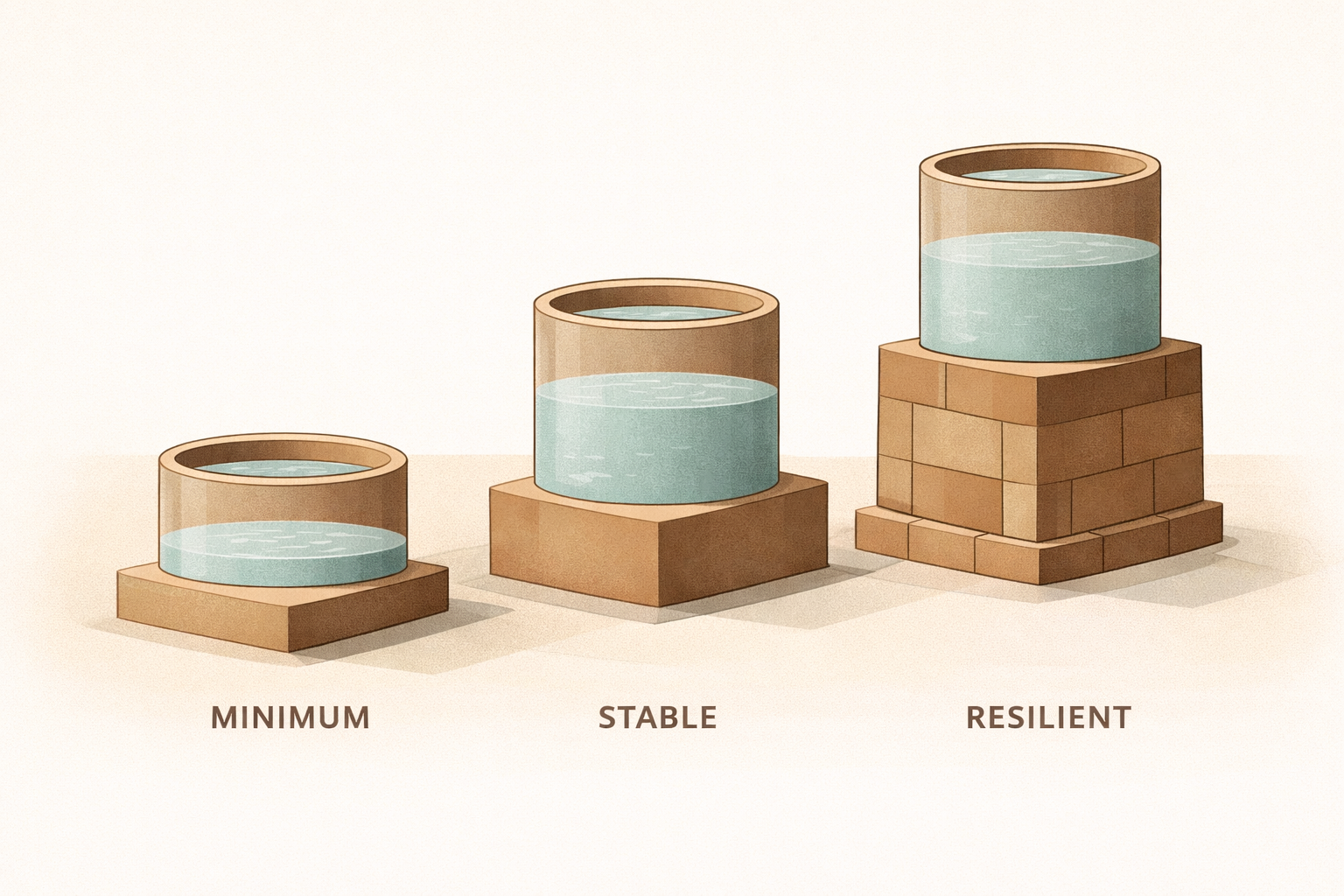
The emergency fund system is not about saving money. It is about building protection that holds under pressure.
Most people treat an emergency fund like a number. That is the wrong frame.
An emergency fund is a system. It must be built, sized, stored, used, and rebuilt correctly. If one part fails, the entire structure weakens.
If no system exists, the outcome is predictable. Disruption turns into debt, stress, or forced decisions.
This page gives you the full system in one place.
- Build the fund with small, repeatable transfers
- Size the fund based on real risk, not generic advice
- Store it in a protected, separate account
- Use it only when stability is at risk
- Rebuild it immediately after use
If no transfer is scheduled and no target is defined, the system is not active.
What the emergency fund system actually does
The system absorbs disruption before disruption becomes damage.
Without it, a setback becomes debt or panic. With it, the same event becomes manageable.
This is not a savings habit. It is a stability structure.
The five parts of the emergency fund system
- Build it — start the reserve with controlled contributions
- Size it — match protection to exposure
- Store it — keep it separate, liquid, and protected
- Use it — define boundaries before pressure arrives
- Rebuild it — restore protection immediately after use
Each part supports the others. Weakness in one creates weakness in all.
Emergency fund starting point calculator
If you are starting from zero, do not guess. Use a controlled entry point.
Starter Rule
- Save $25 to $50 per week, or
- Save 1% to 3% of your income
Example
If income is $3,000 per month:
- 1% = $30 per month
- 3% = $90 per month
The goal is not size. The goal is activation.
Emergency fund size calculator
How much protection you need depends on your exposure.
Step 1: Calculate essential monthly expenses
- housing
- utilities
- food
- insurance
- transportation
- minimum debt payments
Step 2: Match the level to your risk
- Minimum protection: 1 month
- Stable reserve: 3 months
- Resilient reserve: 6+ months
Example
If expenses are $3,000 per month:
- Minimum = $3,000
- Stable = $9,000
- Resilient = $18,000+
If no number is defined, protection is undefined.
Where the money should live
The best setup is a separate high-yield savings account.
The fund should be:
- accessible
- protected
- separate from daily spending
Too accessible leads to misuse. Too restricted leads to failure during urgency.
What counts as a real emergency
An emergency threatens stability and cannot wait.
Valid uses:
- income disruption
- medical necessity
- essential repairs
- safety-related costs
Invalid uses:
- planned purchases
- sales or discounts
- lifestyle upgrades
- emotional spending
If it relieves discomfort but does not protect stability, it is not an emergency.
Emergency fund rebuild timeline calculator
After using the fund, calculate the recovery.
Step 1: Define the rebuild target
Example: $6,000 remaining
Step 2: Set monthly contribution
Example: $500 per month
Step 3: Calculate timeline
- $6,000 ÷ $500 = 12 months
Faster rebuild example
- $6,000 ÷ $1,000 = 6 months
If no timeline exists, the rebuild is not defined.
The full emergency fund sequence
Follow the system in order:
FAQ: Emergency fund system
What is the best way to start an emergency fund?
Start with a small automated transfer. Structure matters more than size.
How much emergency fund should most people have?
At least three months of expenses, adjusted upward based on risk.
Where should an emergency fund be stored?
In a separate, liquid savings account outside the daily spending flow.
When should an emergency fund be used?
Only when stability is at risk and the expense cannot wait.
What happens after using the fund?
The rebuild begins immediately. The system is not complete until protection is restored.
The Bottom Line
The emergency fund system is not about having money set aside. It is about having a structure that holds under pressure.
Build it. Size it. Store it. Use it carefully. Rebuild it immediately.
That is how financial stability becomes operational.
