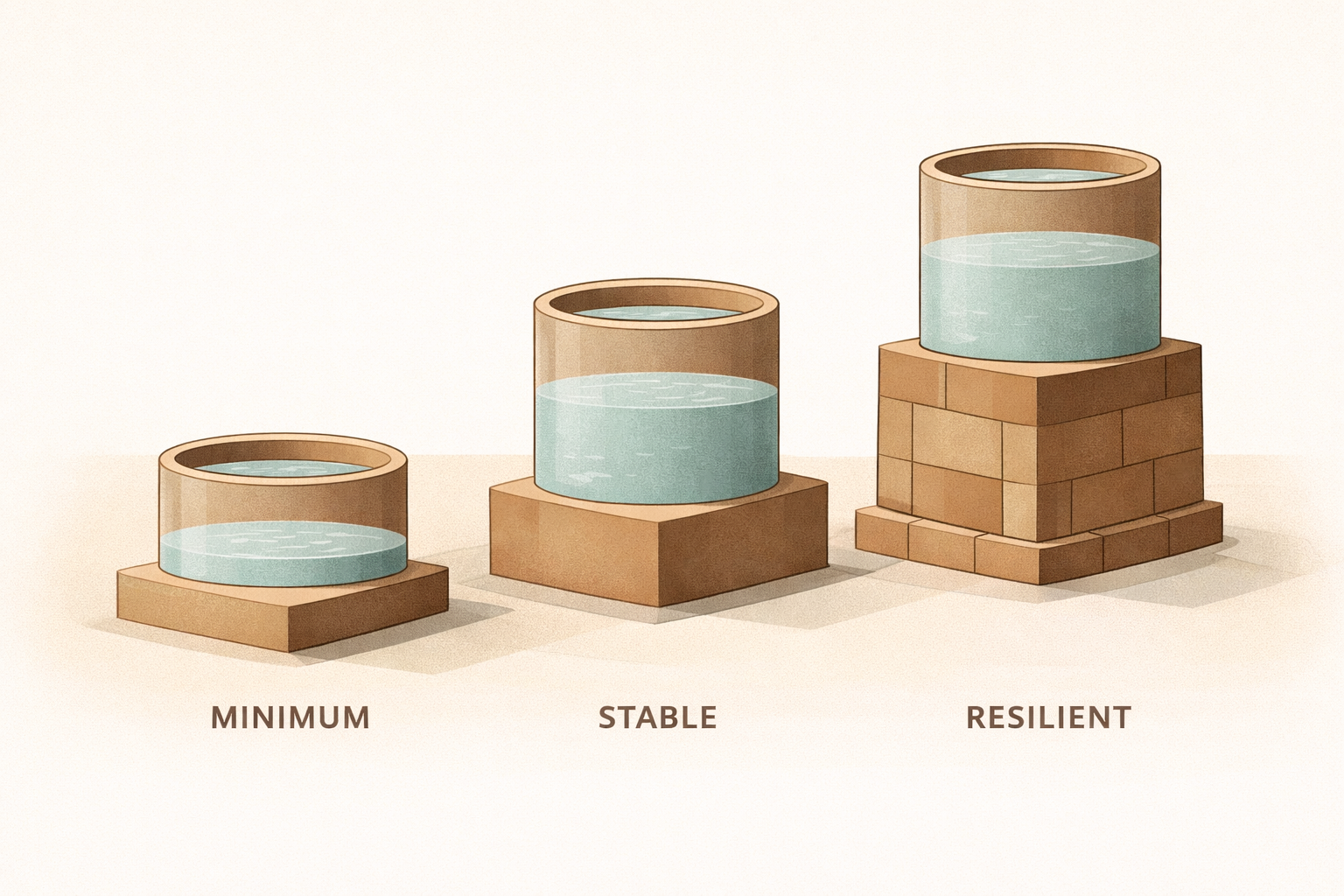
The emergency fund system turns savings into a structured layer of financial protection that can absorb disruption before one problem creates several more.
Money Monday · Financial Protection System
Why the Emergency Fund System Is More Than a Savings Goal
Most people are taught to think about emergency savings as a target balance. However, the balance is only one part of the structure.
A working reserve also needs a funding rule, a target tied to household risk, a safe place to live, clear rules for use, and a process for rebuilding after money leaves the account.
Therefore, the real question is not simply whether money has been saved. The better question is whether the protection system can still function when pressure arrives.
The job of an emergency fund is to keep one disruption from becoming several.
Quick Answer
- Build: activate the reserve with a repeatable contribution.
- Size: match protection to real household exposure.
- Store: keep emergency money liquid, separate, and low risk.
- Use: establish boundaries before urgency arrives.
- Rebuild: restore the reserve after a legitimate emergency.
Purpose
What the Emergency Fund System Actually Does
At its core, an emergency reserve creates financial containment.
A car repair, medical cost, income interruption, or urgent home repair may still be stressful. With cash protection available, however, the household has another option besides immediately reaching for new debt.
As a result, the original disruption has a better chance of remaining one problem instead of becoming a chain of financial problems.
Emergency Savings Buy Response Time
Money cannot remove every emergency. Instead, a reserve gives the household time to respond without making every decision from a position of immediate financial pressure.
That additional room matters because rushed decisions are often expensive decisions.
Green Beam · Protection
A reserve buys response time. Consequently, its value is not limited to the account balance. The reserve also protects the quality of the decisions made under pressure.
Protection Comes Before Expansion
This framework follows directly from Discipline Before Dollars. First, money receives structure. Next, the household creates protection against disruption.
Once those layers are working, ownership and long-term investment can sit on a stronger foundation.
System Map
Five Stages of the Emergency Fund System
Each stage solves a different problem. Together, they turn a savings balance into an operating protection system.
Stage 01 · Build
Build the Emergency Fund System With a Funding Rule
A reserve becomes active when contributions stop depending on memory or leftover money.
Therefore, the first objective is not reaching a dramatic balance. The first objective is creating a funding mechanism that can repeat.
Choose a Contribution Method
Fixed Amount
Use a Set Transfer
For example, move $25, $50, or another sustainable amount every week or pay period.
Percentage Rule
Save a Share of Income
Alternatively, direct a sustainable percentage of each paycheck into the reserve before discretionary spending begins.
Activation Comes Before Optimization
Starting small is acceptable. In fact, a modest transfer that continues is more useful than an aggressive target abandoned after two pay periods.
As cash flow improves, the contribution can then be increased.
Stage 02 · Size
Size the Emergency Fund System Around Real Exposure
No single reserve target fits every household.
For example, two stable incomes with low fixed expenses create a different risk profile from one irregular income supporting children, a mortgage, and significant health costs.
Calculate Essential Monthly Expenses
Include expenses required to keep the household operating:
- housing
- utilities
- basic food
- insurance
- essential transportation
- minimum required debt payments
- necessary medication or recurring health costs
- essential dependent-care expenses
Adjust the Target for Risk
After essential expenses are known, household exposure determines how much protection may be appropriate.
Higher Exposure
A single income, irregular employment, high fixed costs, dependents, health exposure, or difficult income replacement may justify more protection.
Lower Exposure
Multiple stable incomes, lower essential costs, strong insurance coverage, and easier income replacement may reduce the required buffer.
Use the Reserve Formula
Planning Formula
Essential Monthly Expenses × Protection Period = Reserve Target
For example: $3,000 in essential expenses × 3 months = $9,000.
However, the protection period should reflect household exposure rather than a generic milestone.
Stage 03 · Store
Store the Emergency Fund System for Access and Protection
Emergency money has a specific job. Consequently, the storage method should protect that job rather than chase maximum return.
In general, reserves should remain liquid, low risk, separate from everyday spending, and accessible enough for a legitimate emergency.
Three Storage Requirements
Keep It Liquid
The money needs to be available when a legitimate emergency occurs.
Keep It Separate
Separation reduces the chance that protection quietly becomes routine spending.
Keep It Low Risk
Emergency protection should not depend on selling a volatile asset during a bad market.
Storage Rule
Too much convenience can invite misuse. On the other hand, too much restriction can make the reserve ineffective when speed matters.
Stage 04 · Use
Protect the Emergency Fund System With Clear Use Rules
Urgency can make almost any expense feel important. For that reason, emergency conditions should be defined before money is needed.
A useful test asks whether the cost is necessary, unexpected, time-sensitive, and connected to basic household stability.
Expenses That May Qualify
- temporary income disruption
- necessary medical costs
- essential vehicle repairs
- urgent home repairs affecting safety or habitability
- critical dependent-care needs
- other unavoidable costs that threaten basic stability
Expenses That Usually Belong Elsewhere
- planned purchases
- routine annual expenses
- vacations
- sales or limited-time discounts
- lifestyle upgrades
- impulse purchases
Use a Four-Part Emergency Test
- Is the expense necessary?
- Was the expense unexpected?
- Can the expense reasonably wait?
- Would delaying it threaten household stability?
Stage 05 · Rebuild
Rebuild the Emergency Fund System After Use
Using the reserve for a legitimate emergency is not failure. After all, protection exists to be used when its conditions are met.
Once the immediate problem is contained, however, the household enters recovery mode.
Calculate the Rebuild Gap
Original reserve target: $9,000
Balance after emergency: $4,500
Amount to restore: $4,500
Monthly rebuild contribution: $500
$4,500 ÷ $500 = 9 months
Make Recovery a Defined Priority
During rebuilding, some optional financial goals may temporarily move behind reserve restoration.
Nevertheless, the pace should remain realistic. A defined target, contribution rule, and review date are more important than an unsustainable rush.
The Evidence
Why Emergency Financial Protection Matters
National household data helps show why liquid reserves remain relevant.
According to the Federal Reserve’s 2025 household economic well-being report, 63 percent of adults said they would cover a hypothetical $400 emergency expense using cash or its equivalent.
Three Months of Savings Remains Uneven
The same Federal Reserve report found that 55 percent of adults had rainy-day savings sufficient to cover three months of expenses.
These figures do not establish one universal reserve target. Instead, they illustrate that the ability to absorb financial disruption varies considerably across households.
63%
said they would cover a $400 emergency expense using cash or its equivalent.
55%
reported enough rainy-day savings to cover three months of expenses.
Banking Access Is Not the Same as Emergency Protection
Separately, the FDIC National Survey of Unbanked and Underbanked Households found that 4.2 percent of U.S. households were unbanked in 2023.
In other words, banking access and emergency preparedness measure different conditions. Having an account creates a place to hold money, whereas an emergency fund system determines how financial protection is built and maintained.
What the Data Can Tell Us
Emergency readiness depends on more than income alone. Liquidity, obligations, household exposure, savings, debt, and the structure surrounding those resources all affect how much disruption a household can absorb.
Pressure Test
Is Your Emergency Fund System Actually Active?
A savings account alone does not prove that a protection system is operating.
Instead, test each stage independently.
Audit the Five Parts
| System Question | Active | Weak or Undefined |
|---|---|---|
| Funding | Transfers follow a defined schedule. | Saving happens only when money is left over. |
| Target | The target reflects essential costs and household risk. | No reserve target has been calculated. |
| Storage | Funds remain liquid, separate, and low risk. | Emergency money is mixed with daily spending. |
| Use Rules | Emergency conditions are defined in advance. | Urgency determines the rules in the moment. |
| Rebuild | Recovery starts after the reserve is used. | A depleted reserve remains depleted indefinitely. |
Red Beam · Warning
An account can contain money without containing a system. Funding rules, a target, storage boundaries, use rules, and a rebuild process are what turn the balance into protection.
Go Deeper
Follow the Complete Emergency Fund System
Each supporting article takes one stage of the framework further.
Turn intention into a repeatable savings mechanism.
02 · Size the ProtectionMatch the reserve to actual household exposure.
03 · Store It CorrectlyBalance liquidity, separation, and protection.
04 · Use It With DisciplineDefine the conditions that justify touching the reserve.
05 · Rebuild the SystemRestore financial protection after the reserve is used.
FAQ
Emergency Fund System FAQ
What is an emergency fund system?
An emergency fund system is a structured process for building, sizing, storing, using, and rebuilding a cash reserve designed to protect household stability during unexpected financial disruption.
How should an emergency fund be started?
Begin with a sustainable, repeatable transfer. Initially, consistency matters more than size. Once the funding habit is stable, the contribution can increase.
How much emergency savings should a household have?
The appropriate target depends on essential monthly expenses and household exposure. Therefore, income stability, dependents, fixed obligations, insurance coverage, health needs, and the difficulty of replacing income should all influence the target.
Where should emergency savings be stored?
In general, emergency savings should remain liquid, low risk, and separate from everyday spending. The storage method should balance legitimate access with protection from casual use.
What qualifies as an emergency?
A useful test asks whether the expense is necessary, unexpected, time-sensitive, and connected to protecting basic household stability.
What happens after the emergency fund is used?
After the disruption is contained, the system enters rebuild mode. Calculate the amount needed to restore the reserve, establish a contribution rule, and set a realistic recovery timeline.
The Groundwork
The Emergency Fund System Makes Protection Operational
Money sitting in an account is only the raw material.
Protection becomes operational when contributions are repeatable, the target reflects exposure, storage protects liquidity, use rules survive pressure, and rebuilding begins after the reserve is used.
When those parts work together, the household gains more than a savings balance.
It gains time, options, and a stronger layer between disruption and debt.
Continue Building
Move From Discipline to Protection to Ownership
Receipts
Sources & Further Reading
→ Federal Reserve · Economic Well-Being of U.S. Households in 2025
→ FDIC · National Survey of Unbanked and Underbanked Households