
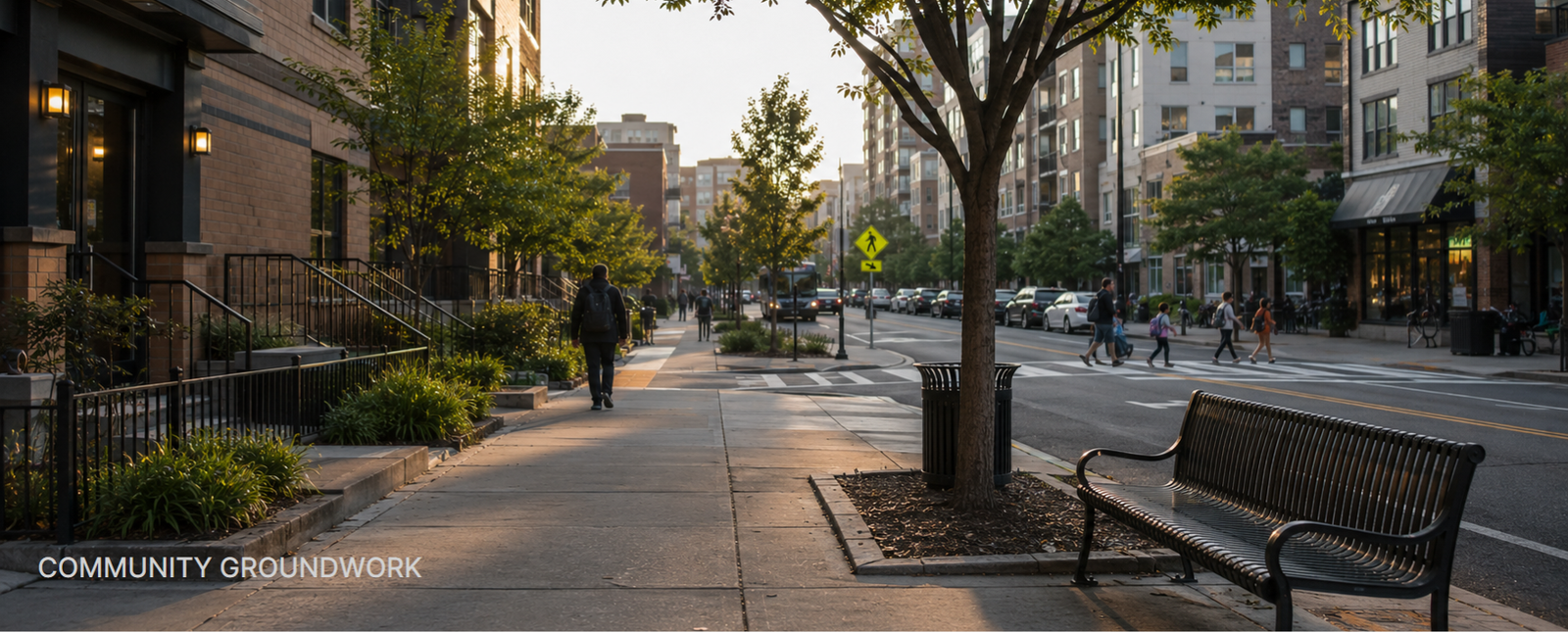
Community Groundwork: How Communities Become Stronger, Drift, Adapt, or Fail
Community Groundwork is the Groundwork Daily category for studying how communities function through shared systems, visible behavior, maintenance, participation, incentives, and institutional durability.
This is not community commentary.
This is system observation.
Every neighborhood has an operating system. Every apartment building has one. Every school, church, block association, workplace, public space, and community institution has one too.
Some systems are formal.
Rules. Schedules. policies. Boards. meetings. budgets. maintenance plans. staffing charts.
Other systems are informal.
Who notices the mess. Who reports the problem. Who shows up. Who stops showing up. Who carries more than their share. Who benefits without contributing. Who keeps the place functioning when nobody is watching.
Community Groundwork studies those patterns.
The core question is simple:
Why do some communities stay durable while others quietly weaken?
The answer is rarely inspiration.
It is usually structure.
What Community Groundwork Studies
Community Groundwork examines the ordinary systems that hold shared life together.
It studies the block before the headline.
It studies the hallway before the crisis.
It studies the meeting before the collapse.
It studies the person who always shows up before the system admits it depends on them.
This category focuses on:
- shared responsibility
- maintenance behavior
- community participation
- free rider behavior
- institutional durability
- social trust
- local coordination
- public behavior
- household patterns
- neighborhood systems
- contribution and burden concentration
The work is practical because the evidence is visible.
Trash patterns reveal household routines.
Maintenance delays reveal responsibility gaps.
Volunteer fatigue reveals participation decline.
Clean shared spaces reveal repeated care.
Institutions that endure reveal hidden maintenance.
Communities do not rise or fall all at once.
They become what repeated behavior allows.
The Community Groundwork Framework
Community Groundwork follows a simple framework:
Observed Behavior
↓
Participation
↓
Maintenance
↓
Durability
↓
Outcome
That is the lane.
Start with what people actually do.
Then ask what their behavior reveals about the system.
A community may say it values responsibility. The question is whether responsibility is visible, distributed, and reinforced.
A workplace may say it values teamwork. The question is whether reliable people are quietly becoming infrastructure.
A neighborhood may say it values safety and care. The question is whether anyone still maintains the shared spaces that make trust possible.
Community Groundwork does not study ideal communities.
It studies real ones.
Start Here: The Reading Path
If you are new to Community Groundwork, start with the participation path.
This sequence explains how shared responsibility becomes community durability, and how systems weaken when contribution disappears.
1. Communities Become Stable When Responsibility Stays Distributed
Begin here to understand why stability depends on shared responsibility, not sentiment.
2. Community Systems Fail When Contribution Stops
See how systems drift when fewer people participate while everyone continues to benefit.
3. The Free Rider Problem Is Not Theory. It Is Practice.
Understand how shared systems weaken when benefit separates from responsibility.
4. Contribution Must Be Visible or It Disappears
Learn why people stop contributing when effort becomes invisible and unrewarded by the system.
5. Reliability Should Not Become a Job Title
See what happens when dependable people quietly become the system.
6. Maintenance Without Ownership
Move into the commons layer and examine what happens when everyone benefits but nobody owns the outcome.
Explore the Community Groundwork Series
Community Groundwork contains several lenses. Each one studies a different part of community behavior.
Cultivating the Commons
Core question: Who maintains?
This series studies shared environments, maintenance behavior, ownership, stewardship, and the small actions that keep common spaces usable.
Community Participation
Core question: Who contributes?
This lane studies contribution, reliability, visible participation, free rider behavior, burden concentration, and community durability.
Block Logic
Core question: What do people actually do?
This series studies public behavior, informal rules, incentives, pressure, correction, and the real patterns people reveal in shared environments.
Community Groundwork Owns Shared Systems
The search territory is clear.
Community Groundwork owns the question of how shared systems survive.
That includes local systems, households, apartment buildings, neighborhoods, public spaces, community institutions, informal networks, and the behaviors that determine whether people continue to participate.
This category is built around a simple belief:
Communities rise or fall through shared systems.
Not mood.
Not branding.
Not slogans.
Systems.
A block becomes stable when contribution is visible.
A building becomes trustworthy when maintenance is repeated.
A community becomes durable when responsibility does not concentrate in silence.
An institution remains alive when quiet work continues after attention moves elsewhere.
Community Groundwork studies those systems before they fail.
Core Ideas in Community Groundwork
Shared responsibility must be structured. If nobody knows who notices, reports, responds, or verifies, responsibility becomes a slogan.
Contribution must remain visible. People continue participating when they can see that effort still matters.
Maintenance is social infrastructure. The work that prevents decline may be quiet, but it determines whether a shared environment remains trustworthy.
Free riding spreads when benefit separates from responsibility. A system weakens when too many people consume stability without helping produce it.
Reliability should not become hidden infrastructure. Dependable people strengthen systems. They should not have to become the system.
Institutions survive through maintenance. Vision can launch an institution, but repeated quiet work keeps it alive.
Featured Community Groundwork Articles
What Your Trash Reveals About Your Household
Household waste reveals more than consumption. It shows routines, preparation, maintenance, and decision-making.
The Work Nobody Notices Until It Stops
Maintenance often becomes visible only after it disappears. This piece studies the hidden work that keeps shared systems stable.
Community Reintegration Requires More Than a Second Chance
Communities are not measured only by who belongs. They are measured by how people return.
The Quiet Work That Keeps Institutions Alive
Institutions endure because somebody keeps maintaining them after attention moves elsewhere.
Why This Category Matters
Community failure is often misdiagnosed.
People blame attitude when the system lacks reinforcement.
They blame culture when responsibility has become invisible.
They blame apathy when contributors have been carrying excess load too long.
They blame individuals when the operating structure quietly trained people to withdraw.
Community Groundwork slows that reaction down.
It asks better questions.
What is being shared?
Who maintains it?
Who contributes?
Who benefits?
Who carries more than their share?
What happens if nobody acts?
Those questions reveal the system under the surface.
That is the work.
How to Use This Page
Use this page as the entry point for Community Groundwork.
Start with the reading path if you want the clearest sequence.
Move into Cultivating the Commons if you want to study maintenance, shared environments, and responsibility diffusion.
Move into Community Participation if you want to study contribution, free riding, reliability, burden concentration, and durability.
Move into Block Logic if you want to study what people actually do under pressure.
Then return here as the category grows.
This page will continue to function as the hub for Groundwork Daily’s work on community systems, shared responsibility, maintenance behavior, participation systems, and community durability.
Build better. Every day.
Get the next Groundwork Daily framework on systems, responsibility, community stability, and long-term structure.
The Groundwork
A community is not only what people say they value.
It is what people repeatedly maintain.
It is what people protect when nobody is celebrating the work.
It is what still functions after attention moves elsewhere.
That is why Community Groundwork exists.
To study the systems people live inside every day.
To make the invisible structure visible.
To name the behaviors that strengthen or weaken shared life.
To show that durable communities are built through repeated care, distributed responsibility, visible contribution, and quiet maintenance.
Not once.
Repeatedly.
That is how communities hold.