
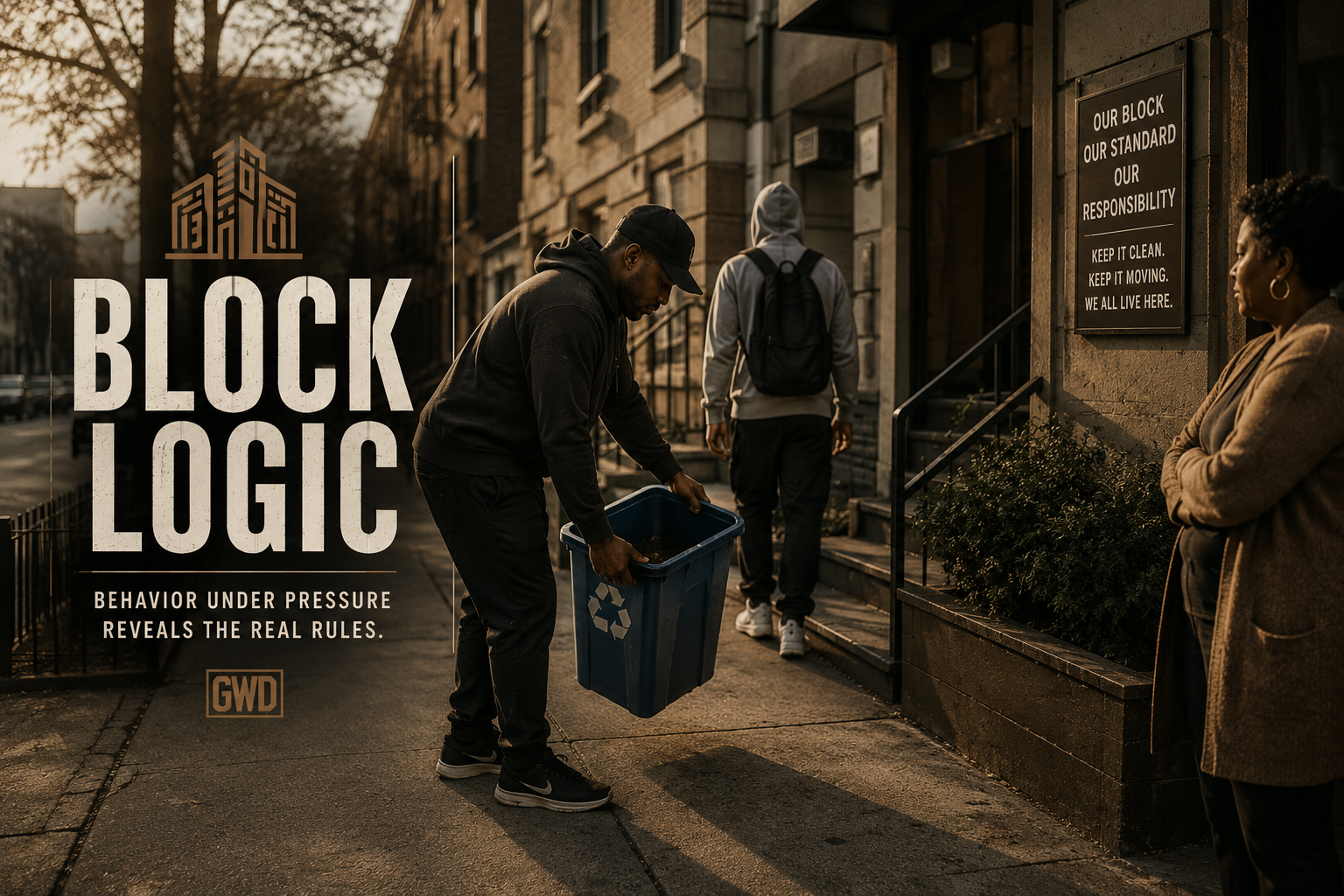
Block Logic studies what people actually do when pressure, incentives, informal rules, and real consequences enter the picture.
Values matter. However, behavior often tells us faster which rule is actually governing the system.
That distinction is where this Series starts.

People can agree with a standard when following it costs nothing. The useful information arrives when compliance becomes inconvenient.
Maybe somebody is tired. Perhaps nobody appears to be watching. Following the rule may take longer, while ignoring it creates an immediate benefit. In another situation, speaking up may carry a social cost.
Those moments make the operating system visible.
Rather than beginning with a judgment about character, Block Logic examines the incentive, pressure, informal rule, consequence, or status structure underneath the behavior. The goal is to understand what the environment is teaching people to do.
The Block Logic Question
What do people actually do when incentives are real?
Block Logic studies the distance between the stated rule and the operating rule. When the two diverge, repeated behavior usually reveals which one has authority.
How Block Logic Reads Behavior Under Pressure
Block Logic does not begin by deciding whether somebody is good, bad, selfish, disciplined, or irresponsible. Character judgments arrive too early and usually explain too little.
Instead, the Series begins with an observed moment. What happened? What did the person gain, avoid, risk, or protect? How did the surrounding environment respond?
Next, the analysis looks for repetition. Did anyone correct the behavior? Did the action become easier to repeat? Did somebody else learn from what happened?
Once pressure and repetition become visible, the structural meaning becomes easier to identify.
Block Logic Observation Path
| Observed Moment | → | Pressure | → | Pattern | → | Structural Meaning |
The Field Rule
Before asking what people should do, look at what the system makes easy, costly, rewarding, embarrassing, risky, or consequence-free.
Start Here With Block Logic
These pieces establish the basic Series sequence. First, order becomes visible through standards. Then neglect tests those standards. Correction follows, while enforcement becomes necessary when correction no longer carries enough weight.
| 01 |
Why Neighborhood Order Beats Big Promises →
Why visible standards matter before large interventions arrive. |
| 02 |
How Small Neglect Turns Into Normal Disorder →
How an uncorrected exception begins changing expectations. |
| 03 |
Correction Without Spectacle →
Why many systems can restore alignment before punishment becomes necessary. |
| 04 |
When Quiet Correction Is Not Enough →
What happens when a standard needs predictable consequence to remain credible. |
Block Logic Standards: When Rules Are Tested
A rule on paper tells you what an institution intends. By contrast, behavior shows what the environment actually permits.
Suppose a shared entrance is supposed to remain clear, yet people routinely block it. In that environment, the operating standard is no longer simply “keep the entrance clear.” The practical lesson is that obstruction produces no meaningful response.
The same pattern appears elsewhere. Noise restrictions may exist, but if complaints disappear into a void, the written rule carries less weight than the behavior residents repeatedly observe.
For that reason, Block Logic pays close attention to small exceptions. Repeated often enough, an exception can become the new operating standard.
Visible StandardPeople can see what the environment intends to protect. | CorrectionA timely response shows that small departures still matter. | Predictable ConsequenceRepeated refusal produces a known response rather than endless negotiation. |
Block Logic Incentives: Why the Shortcut Wins
Most people do not wake up intending to weaken a community system. Instead, they make a series of smaller choices.
A problem gets left because somebody else usually handles it. Responsibility gets skipped because the benefit arrives anyway. Correction gets avoided because speaking up creates friction. Meanwhile, the shortcut wins because the formal process costs more time.
Each decision can look reasonable in isolation. Nevertheless, the system changes when enough people receive the same signal.
That is the point at which individual convenience becomes structural behavior.
The Incentive Test
If responsible behavior carries the cost while irresponsible behavior keeps the benefit, the system is teaching the wrong lesson.
Block Logic Under Pressure
Pressure changes decisions because it removes some of the space people normally use to perform their stated values.
Time gets short, money gets tight, status becomes important, and risk becomes visible. At the same time, social approval may matter more, while the easier option starts looking more attractive.
None of this means that every pressured decision becomes excusable. It does mean the decision becomes more informative.
Therefore, Block Logic asks what the pressure exposed. Was the standard too expensive to maintain? Was enforcement absent? Did informal status matter more than the written rule? Did short-term survival overwhelm long-term stability? Or did the system place the burden on the person least able to carry it?
Everyday Block Logic Tests
Block Logic does not require a crisis. In fact, ordinary situations can be more revealing because the incentives are small enough for behavior to appear natural.
| Shopping Cart |
Why Don’t People Return Shopping Carts? →
A small test of responsibility when compliance is voluntary and personal reward is almost nonexistent. |
| Small Neglect |
How Small Neglect Turns Into Normal Disorder →
What happens when an environment repeatedly teaches people that nobody will correct the small thing. |
| Enforcement |
When Quiet Correction Is Not Enough →
Why a shared standard eventually loses credibility when repeated refusal produces no consequence. |
What Belongs in Block Logic
Block Logic is not a container for every article about neighborhoods, frustration, or bad behavior.
A piece belongs here when an observable decision becomes more understandable after identifying the pressure, incentive, informal rule, status structure, or consequence underneath it.
| Fits Block Logic | Does Not Belong by Default |
|---|---|
| Street-level behavior under identifiable incentives | General commentary about whether people behave well or badly |
| Informal rules that govern behavior more strongly than formal rules | Culture commentary without an identifiable system mechanism |
| Status, risk, reward, friction, enforcement, and consequence | Outrage centered on isolated individual conduct |
| Repeated behavior that changes what the environment considers normal | Abstract theory without observable real-world application |
Parent Territory
Block Logic Lives Inside Community Groundwork
Community Groundwork examines how shared systems strengthen, drift, adapt, and endure. Block Logic narrows that territory to observable behavior under real incentives and pressure.
The Groundwork
Block Logic Treats Behavior as Evidence
A system can describe itself one way while training people to behave another way. Eventually, that contradiction becomes visible.
Look at what happens when following the standard becomes inconvenient. Notice what receives correction and what gets ignored. Then ask who carries the cost, who keeps the benefit, and which behavior becomes easier after somebody tests the boundary.
Those moments are not distractions from the system. They are evidence about the system.
Block Logic reads the operating rule where it is hardest to fake: in behavior under pressure.
Watch what the system rewards.
Groundwork Daily examines behavior, incentives, standards, participation, maintenance, and the systems underneath ordinary community life.
Groundwork Architecture
The Architecture Beneath This Hub
This Series hub is classified through the Groundwork Daily architecture according to the specific system it is designed to explain.
Primary Core Principle Accountability Is a Form of StrengthThis hub repeatedly examines the distance between a stated standard and the behavior an environment actually permits, especially when correction or consequence becomes inconsistent. | Primary Condition · Defines StandardsThe hub asks which threshold a system claims to protect, then watches behavior to determine whether that threshold remains visible and credible under pressure. |
See the full Core Principles and Conditions architecture.
Groundwork Daily Builder
Cyrus Mbeki
Community Groundwork · Block Logic
Cyrus Mbeki examines how people behave inside real systems when incentives, pressure, responsibility, standards, and consequences become visible.
Within Block Logic, the work becomes especially direct. Cyrus starts with what happened, identifies what made the behavior rational or costly, and follows the pattern until the operating rule becomes clear.
The objective is not to moralize about people. It is to read the system accurately enough to understand what their behavior is revealing.
Watch long enough and the incentive usually introduces itself.
| Meet Cyrus Mbeki → |
| Community Groundwork → |
| Cultivating the Commons → |