Cultivating the Commons is Groundwork Daily’s series on shared systems, community maintenance, responsibility, ownership behavior, and the everyday environments people depend on together.
Built by Cyrus Mbeki, the series studies what happens when shared spaces are maintained, neglected, repaired, protected, or slowly allowed to decline.
Most community problems do not begin with dramatic collapse. They begin with small conditions people learn to live around. A hallway light stays out. A trash room starts to smell. A park bench breaks and remains broken. A shared kitchen gets used by everyone but cleaned by nobody.
Those conditions are not background. They are signals. Over time, they teach people what the standard is, what nobody will correct, and how much responsibility the environment actually expects from them.
What happens when people benefit from a shared environment but responsibility for that environment becomes unclear?
What Is the Commons?
The commons is any environment where people benefit from something they do not maintain alone.
It can be public infrastructure, but it can also be an ordinary space people pass through without naming as a shared system.
A family kitchen is a commons. Everyone eats from it, but someone has to clean, prepare, organize, and restock it. An apartment laundry room is a commons. Everyone uses it, but the space works only when machines are repaired, trash is removed, and basic standards are respected.
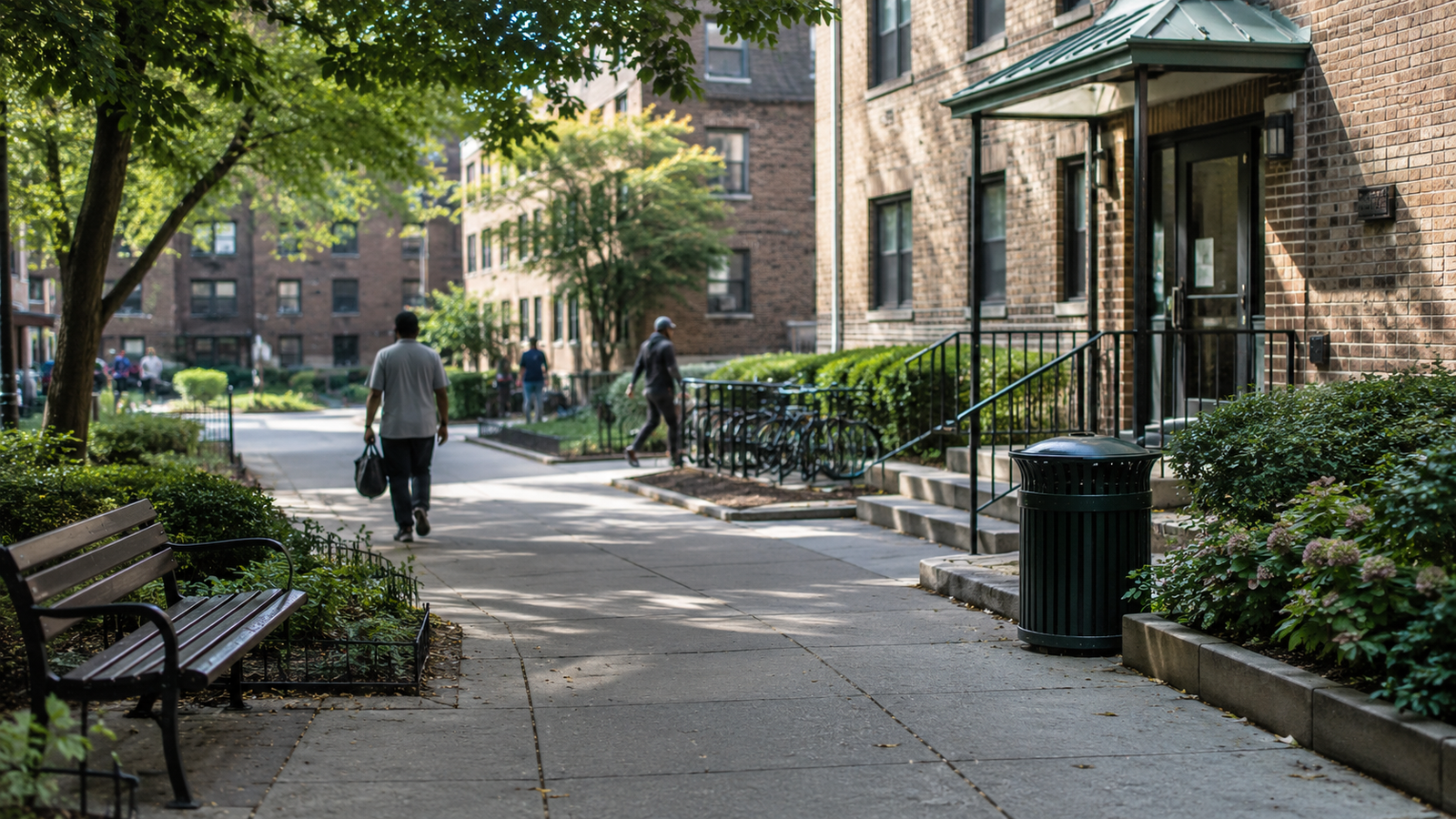
A sidewalk is a commons. It carries neighbors, children, workers, elders, deliveries, and daily movement. Yet its usefulness weakens when nobody treats its condition as shared responsibility.
The commons, then, is not only a place. It is a test of behavior. It reveals whether people know how to share use, carry responsibility, and respond before decline becomes normal.
Why Cultivating the Commons Matters
Shared environments shape behavior before anyone gives a speech about values.
A clean hallway teaches one thing. A neglected hallway teaches another. A maintained park invites care. A damaged park creates distance. A household with rhythm trains a different expectation from one where everything is left for later.
People read the condition of an environment. When shared spaces are cared for, problems are easier to notice, reporting feels worthwhile, contribution seems normal, and the system earns more trust.
When neglect persists, expectations move downward. People step around problems. They stop reporting them. Eventually, they behave as though decline is simply how the place works.
That is why this series focuses on systems rather than slogans. Telling people to care more is not enough. Care needs a path. It needs visible standards, clear responsibility, and repeated action.
What This Series Studies
Cultivating the Commons follows the quiet systems underneath community life. Some are formal. Others are informal. Real environments depend on both.
Maintenance
What gets cleaned, repaired, checked, replenished, and protected before failure becomes visible.
Responsibility
Who notices, reports, responds, verifies, follows through, and carries the consequences when nobody does.
Behavior
What people actually do when a shared system gives them room to contribute, withdraw, exploit, or ignore.
Ownership
The difference between merely using a place and behaving as though its condition matters.
Standards
The visible cues that tell people what is normal, what is tolerated, and what must be corrected.
Trust
Whether people still believe the system will respond when they contribute, report a problem, or depend on it.
A park may have an official maintenance department, but residents still decide whether to report a broken light. A building may have a property manager, but tenants still decide whether to leave trash beside the bin. A household may have one person doing most of the work, but everyone inside the home learns from that arrangement.
Each essay begins with something visible and follows the system underneath it. Trash becomes a record of household rhythm. Maintenance becomes invisible infrastructure. Ownership becomes behavior rather than paperwork. Shared responsibility becomes a system that either holds or dissolves into confusion.
The Questions Behind the Series
Every Cultivating the Commons essay returns to a practical set of questions. They keep the series grounded in behavior rather than abstraction.
Community stability is not built by intention alone. It depends on repeated behavior and systems that make responsibility clear enough for people to act.
Start Here: The Reading Path
New to the series? Begin here. These essays establish the core architecture: system failure, household behavior, maintenance, and ownership.
Community Systems Failure
Understand why shared systems break down when contribution becomes optional and extraction goes unchecked.
What Your Trash Reveals About Your Household
See how private habits become visible patterns that eventually shape shared environments.
The Work Nobody Notices Until It Stops
Maintenance is easiest to ignore while it is working. This essay shows why ordinary care holds systems together.
Maintenance Without Ownership
Shared spaces weaken when everyone benefits but nobody clearly owns the outcome.
Core Ideas in Cultivating the Commons
If nobody knows who notices, reports, responds, verifies, or follows through, responsibility becomes a slogan instead of a system.
The work that prevents decline is often invisible, but it determines whether a place remains trustworthy.
When people see problems ignored long enough, they adjust expectations and begin behaving differently.
People protect spaces differently when they believe their actions affect what happens next.
Systems weaken when those carrying responsibility disappear into the background while others receive the same benefit.
Stability emerges when enough people repeat the actions that preserve the standard.
How to Read the Series
Read Cultivating the Commons as a field guide for shared systems. Do not begin with opinion. Begin with observation.
The method is deliberately simple. Start with what can be seen. Then follow the behavior until the underlying system becomes visible.
What is happening in the actual environment?
Who benefits, contributes, maintains, reports, or withdraws?
What incentive, rule, gap, or pattern keeps producing the behavior?
What structure would make the system clearer, stronger, or more durable?
Look at the trash, maintenance, repair, participation, disorder, contribution, delay, or care. Then ask who benefits from the space. Who maintains it? Who reports problems? Who responds? Who is exhausted from carrying too much? Who benefits without contributing? What happens when nobody acts?
Those questions turn vague frustration into structure.
Why This Belongs on Groundwork Daily
Groundwork Daily is built around structure, stability, responsibility, and long-term thinking. Cultivating the Commons extends that architecture into the places people share.
Community is not treated here as decoration. It is treated as an operating system.
That changes the question. The issue is no longer whether people say they care. The issue is what they repeatedly do when nobody is forcing them to care.
That is the territory Cyrus Mbeki works in. The voice stays close to the environment, names the pattern, and follows the behavior until the system underneath it becomes visible.
Where the Series Is Going
Cultivating the Commons is expanding deeper into responsibility diffusion, free-rider behavior, neglected shared space, maintenance culture, contribution imbalance, participation failure, visible standards, and the systems that make common environments durable.
Future essays will continue examining why shared spaces become nobody’s responsibility, how small disorder changes group behavior, why a minority of people often carry more than their share, and what can be corrected before neglect becomes part of a place’s identity.
This is the lane: shared systems, visible behavior, practical responsibility, and the real environments that shape community life.
Cyrus Mbeki
Builder of Community Groundwork
Cyrus Mbeki studies the systems people can walk through, touch, inherit, maintain, ignore, repair, and repeat.
The work begins with ordinary evidence: the broken light, the unclaimed mess, the person who always cleans up, the rule everybody knows but nobody enforces, the shared space people slowly stop trusting.
From there, Cyrus follows the pattern beneath the behavior.
The central question is simple:
What are people teaching each other through repeated action?