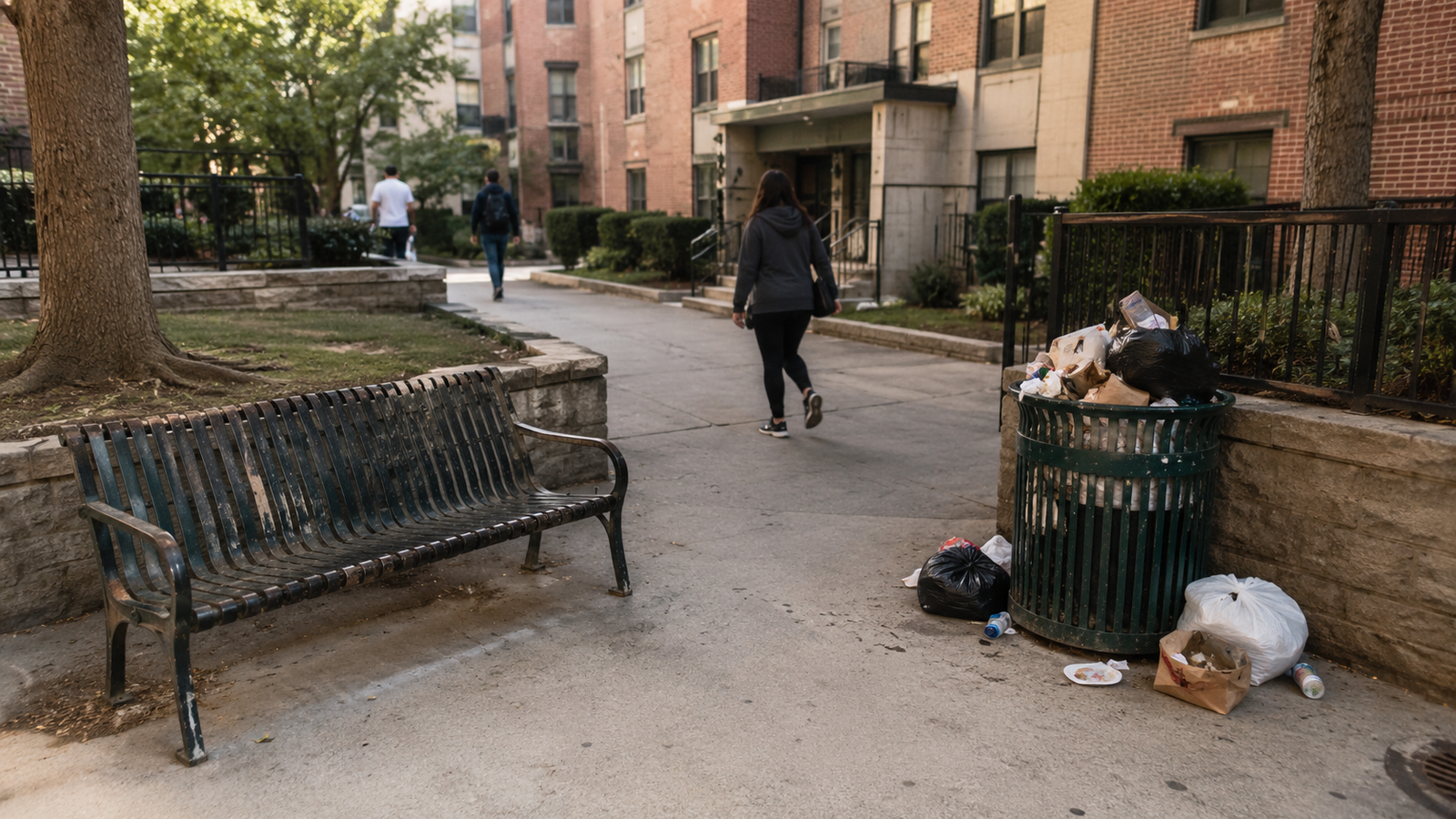
Maintenance without ownership is what happens when everybody benefits from a shared space, but nobody feels clearly responsible for keeping it alive. The space may still function for a while. People may still walk through it, sit in it, use it, and depend on it. But once responsibility becomes unclear, decline begins moving quietly through the system.
You can see it in apartment courtyards, office kitchens, laundry rooms, public parks, school bathrooms, church basements, transit shelters, and neighborhood sidewalks. Nothing collapses immediately. That is what makes the pattern easy to ignore. The trash can overflows once. A light stays out for a few days. A broken latch becomes normal. A spill dries where it fell. People keep moving through the space, but they begin adjusting their expectations downward.
That is how shared environments usually weaken. Not because every person involved is careless. Not because nobody values the space. More often, the problem is simpler and more dangerous: responsibility has become anonymous. When nobody can tell who owns the outcome, the outcome starts drifting.
Maintenance Without Ownership Begins With Unclear Responsibility
Private spaces usually make responsibility obvious. If your kitchen sink leaks, you know the problem belongs to you. You may delay the repair, but the consequence returns directly to your household. Shared spaces do not work that way. The benefit is distributed, the burden is unclear, and the failure can be ignored long enough for everyone to pretend it belongs somewhere else.
That is the opening move of maintenance without ownership. People assume someone else will notice. Someone else will report it. Someone else will clean it. Someone else will follow up. Someone else is paid for this. Someone else caused it. These assumptions feel small in the moment, but together they create a system where attention leaks out of the environment.
This is not just a character issue. It is a design issue. If responsibility is not visible, people behave around the gap. They may care in theory, but theory does not empty trash, repair doors, restock supplies, report hazards, or follow up on ignored requests. A shared space needs more than concern. It needs ownership behavior that is clear enough to guide action.
The Apartment Courtyard That Slowly Changes the Rules
Start with a residential courtyard. The building entrance is active. Residents pass through it every day. Children cut across the path after school. Delivery workers use the same route. Older residents sit outside when the weather is good. The space belongs to everyone in practice, even if management owns it on paper.
At first, the courtyard works because several systems overlap. Trash pickup happens on schedule. Landscaping is maintained. Lighting is checked. Residents understand what is acceptable. Management responds when something breaks. None of this needs to be dramatic. The courtyard simply feels cared for, which means people tend to treat it with more care.
Then small delays begin. The trash container fills before pickup. A bag gets placed beside the bin. The next person sees the bag and adds another. A bench starts wearing down. The gate does not close properly. Leaves collect near the entrance. Nobody thinks the courtyard is ruined, so nobody treats the moment as urgent.
That is the dangerous part. The space continues to function while the standard weakens. People still use it, but they stop trusting it. They walk past problems instead of reporting them. They assume management already knows. Management assumes residents will submit requests. Residents assume staff will see the issues during rounds. The result is a shared environment full of private assumptions.
A courtyard like that does not need a motivational speech. It needs a clear maintenance loop. Who checks the space daily? Who reports issues? Who responds? How fast? How do residents know the issue was seen? Without that loop, the space teaches the wrong lesson: this is everybody’s space, which means it is nobody’s responsibility.
Ownership Behavior Changes What People Notice
Ownership behavior does not always come from legal ownership. Renters can show it. Students can show it. Workers can show it. Neighbors can show it. Volunteers can show it. Ownership behavior appears when people believe their actions matter to the condition of the environment.
That belief changes what people notice. A person with ownership behavior sees the overflowing bin earlier. They report the broken light sooner. They move the chair back. They wipe the spill. They do not need to control the entire space to protect part of the standard.
However, ownership behavior cannot survive forever inside a system that refuses to respond. If people report problems and nothing happens, they learn that attention is wasted. If the same residents, workers, or volunteers keep carrying the load while everyone else benefits, resentment grows. Eventually, the most responsible people either overfunction or withdraw.
That is one of the hidden costs of maintenance without ownership. It does not only damage the space. It burns out the people who were trying to hold the space together.
The Office Kitchen Nobody Owns
An office kitchen can show the same pattern in a smaller frame. At first, the space works because people understand the standard. Dishes get washed. Counters stay clean. The refrigerator is cleared. Coffee supplies are replaced. Nobody needs a meeting about it because the system is visible enough to guide behavior.
Then the standard loosens. One person leaves dishes in the sink. Another person stops wiping the microwave. Expired food stays in the refrigerator. Supplies run out and nobody knows who orders them. The kitchen is still usable, so leadership ignores it. Staff complain, but mostly in private.
Eventually, the kitchen becomes a daily trust signal. People start reading the room differently. If nobody maintains the shared kitchen, what else is being ignored? If nobody can solve a recurring mess, how strong is the operating culture? That may sound small, but shared spaces often reveal institutional behavior before official language does.
The fix is rarely complicated. Assign a visible owner. Create a weekly reset. Post simple standards. Make restocking someone’s responsibility, not everyone’s hope. If the refrigerator gets cleared every Friday, people adapt. If supplies have a clear owner, frustration drops. If the standard is repeated long enough, the room starts teaching care again.
Shared Responsibility Fails When Nobody Can See the System
Shared responsibility sounds good until nobody knows what it means. A phrase like “everyone should do their part” may feel fair, but it is weak operating language. Everyone is not a maintenance plan. Everyone is not a reporting system. Everyone is not an escalation path.
In practice, shared responsibility needs structure. A functioning shared system answers basic questions. What is being shared? Who maintains it? Who benefits? What happens if nobody acts? If those answers are unclear, the system is already unstable, even if the space still looks acceptable.
This is why communities often confuse participation with ownership. A person may use a park every day and still not know how to report a broken swing. A tenant may care about the hallway and still not know whether maintenance requests are tracked. A parent may value a school bathroom being clean and still not know who is accountable for daily inspection. Concern without a pathway becomes frustration.
Good systems make the pathway visible. They do not rely on people guessing where responsibility lives. They show the standard, name the owner, and close the loop.
What a Public Park Teaches a Neighborhood
A public park is one of the clearest tests of community maintenance. When the grass is cut, paths are clear, lights work, trash is removed, and equipment is repaired, the park sends a stabilizing signal. Families stay longer. Children use more of the space. Older residents sit without scanning constantly for problems. People are more likely to correct small disorder because the larger environment already communicates care.
When maintenance becomes inconsistent, the park teaches a different lesson. Overflowing trash becomes normal. A broken bench stays broken. Graffiti remains longer. One section of the park becomes less used. Parents shorten visits. Residents begin saying the park “is not what it used to be.” That phrase usually means the maintenance system has been failing long enough for people to feel the decline before they can name the mechanism.
Public parks also show why volunteer cleanup alone is not enough. A cleanup day can strengthen pride, but it cannot replace sanitation schedules, capital repairs, lighting maintenance, or clear public accountability. When residents are asked to compensate for systems that should already function, the burden shifts downward. That is not community power. That is institutional drift wearing a community shirt.
Strong community maintenance works differently. It combines public responsibility with resident visibility. The city, agency, building owner, or institution must handle its obligations. Residents can strengthen the standard by reporting issues, organizing care, and refusing to normalize neglect. Both matter. One does not excuse the other.
Why Maintenance Without Ownership Becomes Expensive
The first cost of maintenance without ownership is usually appearance. The space looks worse. The second cost is behavior. People treat the space worse. The third cost is trust. People stop believing the system will respond. After that, the financial cost arrives.
A small leak becomes water damage. A loose railing becomes a safety hazard. A broken gate becomes a security concern. A dirty common area becomes a pest problem. A neglected park becomes underused public infrastructure. The longer responsibility remains unclear, the more expensive the eventual correction becomes.
This is not theory. The Federal Highway Administration has long emphasized that preventive maintenance extends the life of infrastructure and reduces larger repair costs over time. The same principle applies at a smaller scale. Whether the system is a bridge, building, park, or household, early maintenance is cheaper than late recovery.
That is why ownership matters. Ownership does not eliminate every problem. It shortens the delay between problem and response.
What Recovering Systems Do Differently
Systems recover when responsibility becomes visible again. That does not always require a large program. In many cases, recovery begins with a simple maintenance map. Identify the shared space. Identify the recurring problem. Identify the person or office responsible for response. Identify the timeline. Identify how completion is confirmed.
Apartment buildings can use visible work-order tracking and scheduled common-area inspections. Offices can use assigned zones, supply owners, and weekly resets. Schools can use inspection logs and fast reporting for bathrooms, hallways, playgrounds, and cafeterias. Neighborhood groups can pair cleanup efforts with documented requests to city agencies so volunteer labor does not hide public neglect.
The strongest systems do not ask people to care harder. They make care easier to act on. They reduce ambiguity. They make reporting simple. They respond quickly enough for people to believe the loop is real. Then they make completion visible.
People protect spaces differently when they can see the system working.
The Groundwork
Choose one shared environment you use often. It may be a hallway, laundry room, office kitchen, building entrance, parking area, park, sidewalk, school room, or church basement. Do not begin with blame. Begin with observation.
Ask four questions. What is being shared? Who benefits from it? Who is responsible for maintaining it? What problem keeps surviving because nobody owns the follow-through?
Then look for the missing piece. Is the problem attention, reporting, response, verification, or enforcement? Each one requires a different fix. If nobody notices, create inspection rhythm. If nobody reports, simplify the reporting path. If nobody responds, name the responsible party. If nobody verifies completion, close the loop publicly. If nobody enforces the standard, the standard is only decoration.
The goal is not to make every person responsible for everything. That sounds noble, but it usually fails. The goal is to make responsibility clear enough that people know where their part begins and where the system must respond.
The Structural Takeaway
Maintenance without ownership is not just a maintenance problem. It is a governance problem. It reveals whether a shared system knows how to protect what people depend on.
Shared environments rarely fail because nobody cared at all. More often, they fail because too many people cared vaguely and nobody owned clearly. The space kept functioning, so the risk stayed hidden. Then the standard drifted. Then trust weakened. Then repair became harder than prevention would have been.
The commons survives when ownership is visible. Someone must notice. Someone must report. Someone must respond. Someone must verify. Without that chain, shared responsibility becomes a phrase people use while decline keeps moving.
Shared spaces survive when responsibility has a face. — Cyrus Mbeki
Continue Building
This piece continues the Cultivating the Commons cluster by showing how shared environments weaken when responsibility becomes unclear.
→ Framework: Cultivating the Commons
→ Previous: The Work Nobody Notices Until It Stops
Receipts
→ Federal Highway Administration: Pavement Preservation and Maintenance
Build better. Every day.
Get the next Groundwork Daily framework on systems, responsibility, and community stability.