

Build What Holds begins with a simple distinction: something can work without being built well.
Favorable conditions can conceal weakness. An exceptional person can keep a fragile operation moving. Money, attention, momentum, or sheer effort can make an unstable structure appear stronger than it is.
A business can grow quickly and still be fragile. A household can earn more while remaining financially unstable. A leader can command attention while the institution underneath them deteriorates. A relationship can appear strong until pressure arrives.
A community program can produce extraordinary results while one extraordinary person is carrying it, then disappear when that person leaves.
We tend to judge things while they are standing.
Builders ask a harder question: what is keeping it standing?
Groundwork Daily Core Principle
Build What Holds: a strong structure is not judged only by whether it works today. It is judged by what it can carry, how it responds to pressure, whether it can be maintained, whether its value can transfer, and what remains over time.
The governing question: What is keeping this standing?
Groundwork Daily Core Principles
Build What Holds is the durability principle within the Groundwork Daily Core Principles . It tests whether a structure can carry its real load, absorb pressure, be maintained, transfer beyond concentrated dependency, and continue creating value after favorable conditions change.
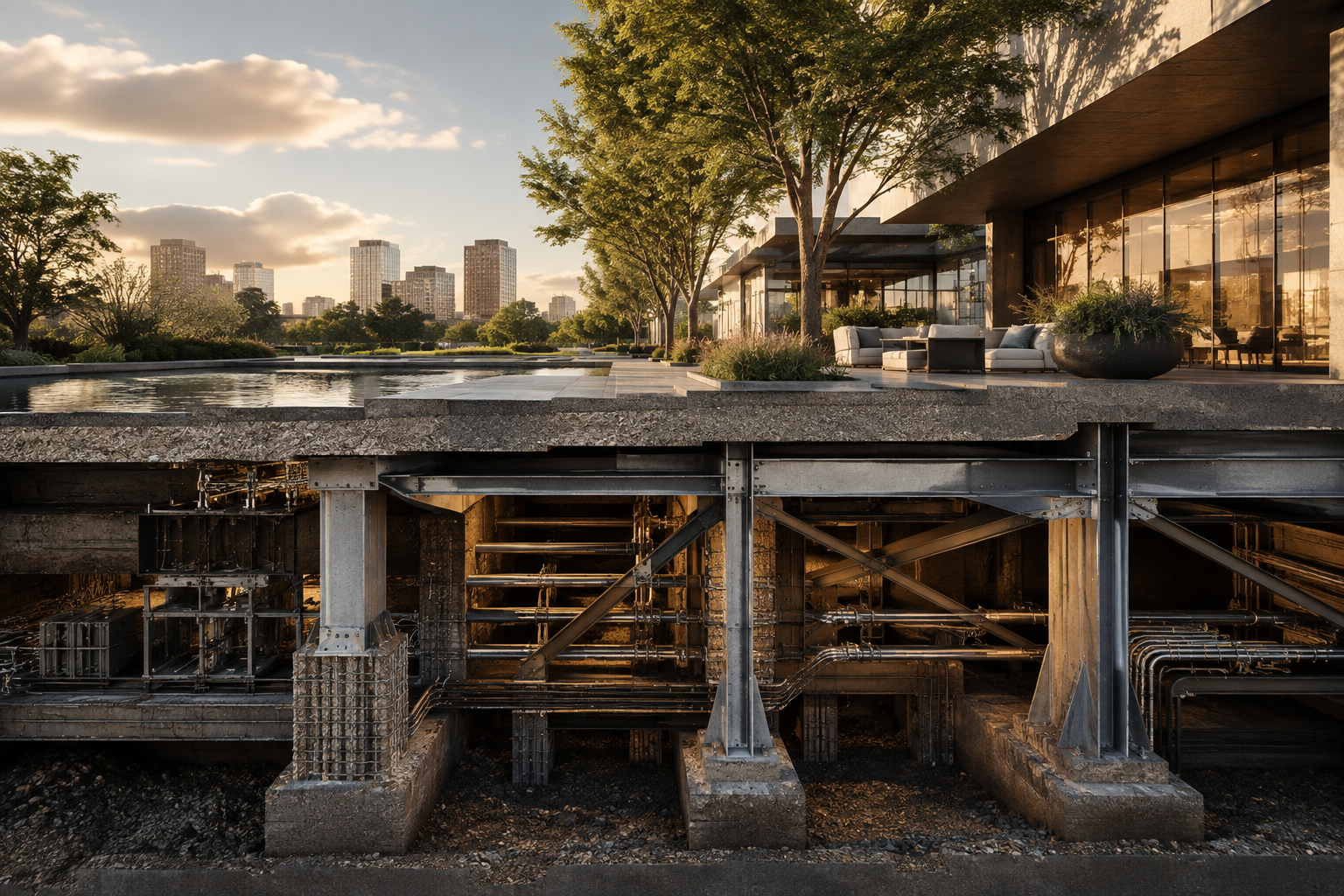
Functioning Is Not the Same as Holding
One of the easiest structural mistakes is treating continued operation as proof of strength.
Something can function because conditions remain favorable. It can function because money is temporarily abundant. It can function because one unusually capable person keeps compensating for every defect.
A household can remain operational because one person remembers every appointment, bill, deadline, and obligation. A company can look efficient because experienced staff carry undocumented knowledge. A relationship can remain intact because one person continually absorbs the imbalance.
None of those examples proves the underlying structure is strong.
A structure can keep functioning while somebody, something, or some favorable condition quietly compensates for what the structure itself cannot carry.
Build What Holds therefore refuses to use functioning as the final test.
The question is not only whether it works. The question is what makes the working possible.
The Structure Underneath the Outcome
Most visible outcomes have invisible architecture beneath them.
Habits. Rules. Relationships. Capital. Knowledge. Trust. Maintenance. Documentation. Leadership. Incentives. Redundancy. Accountability.
None of those things is especially glamorous. Yet they are often the first things we notice when they disappear.
A bridge is not impressive merely because it looks strong in a photograph. Its value is revealed by the weight it can safely carry, repeatedly, under changing conditions.
Human systems work the same way.
The finish gets attention while the framing carries the load.
Look beneath the outcome before deciding what made it possible.
Groundwork takes the underlying structure seriously because the structure determines what the outcome can survive.
The Groundwork Durability Architecture
Groundwork Daily uses five connected structural dimensions to examine whether apparent strength is supported by something durable.
Groundwork Durability Architecture
Load → Pressure → Maintenance → Transfer → Durability
Load identifies what is actually carrying the system.
Pressure reveals what the structure can absorb without losing its purpose.
Maintenance determines whether wear, failure, and degradation can be corrected.
Transfer tests whether knowledge, responsibility, capability, and value can survive beyond concentrated dependency.
Durability asks what remains after favorable conditions change.
The architecture is not a sequence in which one stage permanently ends before the next begins.
It is a set of structural conditions that reinforce one another. Weakness in one area can eventually compromise the others.
The Five Tests turn that architecture into something a Builder can actually use.
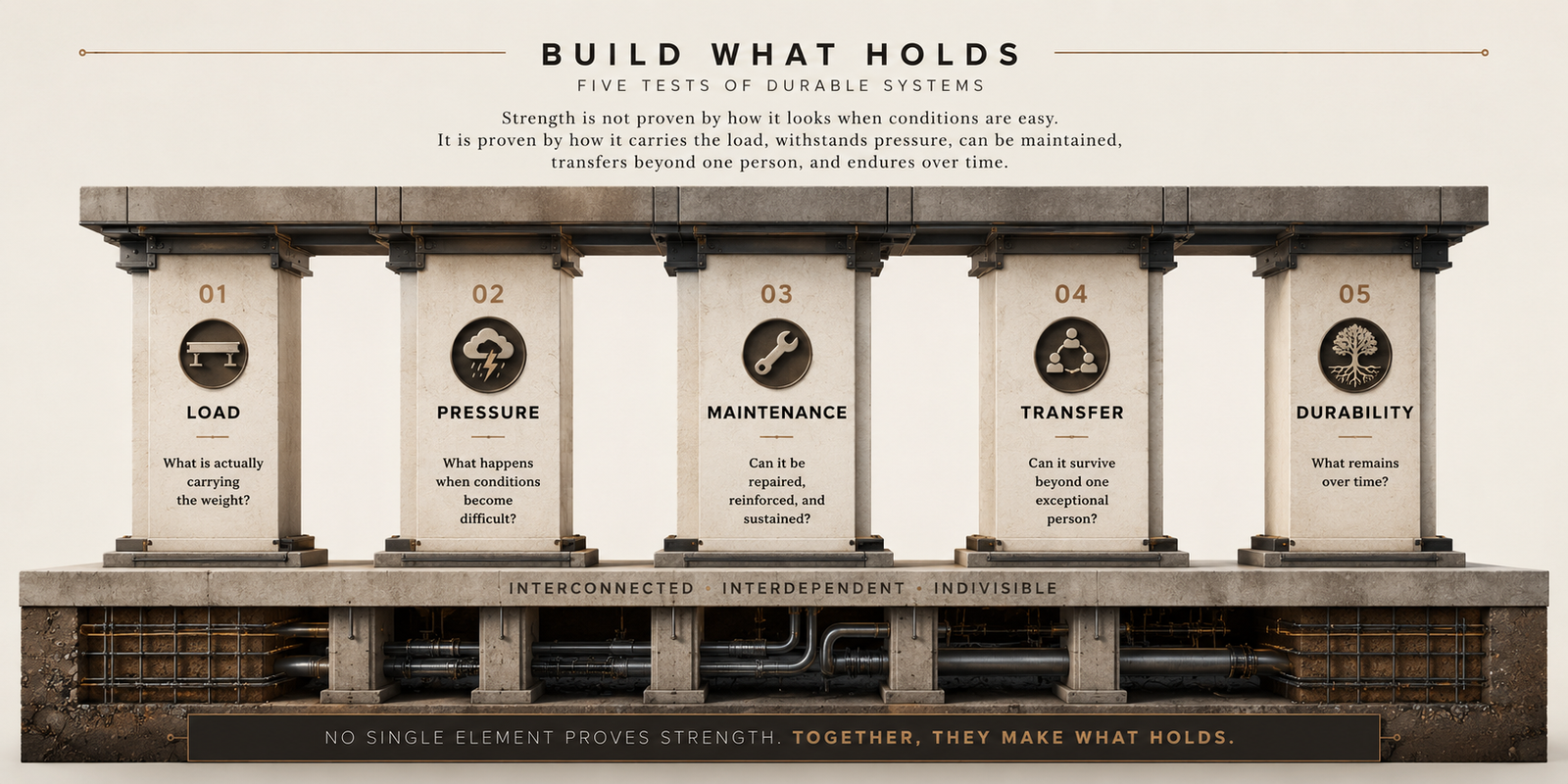
The Build What Holds Five Tests
The Five Tests convert the Durability Architecture into a practical diagnostic.
Test One
Load
What is actually carrying the weight?
Every functioning system depends on something. The load may be carried by money, skill, trust, unpaid labor, infrastructure, institutional memory, reputation, or one unusually competent person.
In a household, the load may rest on the person quietly coordinating everything. In an organization, it may rest on the employee who understands every workaround. In a community, it may rest on a small group performing maintenance everyone else assumes simply happens.
The first Builder task is identifying the load-bearing element.
Visibility and importance are not the same thing. If we misidentify what carries the load, we eventually underinvest in the thing keeping the structure standing.
Test Two
Pressure
What happens when conditions become difficult?
Good conditions hide weak structures. Pressure reveals them.
A household budget looks different after an income interruption. Leadership looks different during a crisis. A business model looks different when demand falls. A relationship looks different when sacrifice is required.
An institution also looks different when its most capable person leaves.
Pressure does not create every weakness. Often, it simply makes an existing weakness impossible to ignore.
Groundwork is less interested in whether something works under ideal conditions than whether its structure can absorb disruption without losing its purpose.
Test Three
Maintenance
Can this be repaired, reinforced, and sustained?
We like breakthroughs. Builders learn to respect maintenance.
Anything expected to last will eventually require repair, reinforcement, correction, replacement, documentation, training, capital, and attention.
Maintenance is not evidence that something failed. It is part of having something worth keeping.
The dangerous system is not one that requires maintenance. It is the system that depends on everyone pretending maintenance will never be necessary.
Durability is not the absence of wear. It is the capacity to respond to it.
Test Four
Transfer
Can it survive beyond the person who made it work?
This may be one of the most neglected tests of strength.
An exceptional person can make a weak system appear functional for years.
The founder remembers everything. The grandmother keeps everyone connected. The manager knows every workaround. The pastor holds the institution together. The employee quietly fixes problems nobody else understands.
Then that person leaves, and everyone discovers that what looked like a system was actually a person.
That is not structural strength.
It is concentrated dependency.
Strong structures transfer knowledge. They document what matters, teach others how the system works, distribute responsibility, and develop successors.
They make competence repeatable rather than leaving it trapped inside one person.
Test Five
Durability
Does the value remain after favorable conditions disappear?
Attention disappears. Trends change. Markets turn. People move.
Leadership changes. Children grow up. Technology evolves. Policies shift. The energy that once sustained a project can fade.
Durability asks what remains after those conditions change.
Not everything needs to last forever. That would be a foolish standard.
Yet things designed to create long-term value should be judged over an appropriate horizon.
A decision that solves today’s problem while creating three tomorrow may not be progress. Growth that cannot be maintained may not be strength.
Visibility that disappears without producing ownership may have created attention rather than durable value.
The Builder looks beyond the immediate win and asks what remains when the moment is over.
Concentrated Dependency: When a System Is Really a Person
Some systems look stronger than they are because the dependency underneath them is concentrated.
Groundwork Concept
Concentrated Dependency
Concentrated Dependency is a condition in which the apparent strength of a system depends disproportionately on one person, resource, relationship, workaround, or favorable condition.
Concentrated dependency can be efficient for a while.
One expert can make decisions quickly. One parent can remember everything. One donor can keep a program funded. One client can carry a business. One employee can know every critical process.
The problem appears when that concentration is mistaken for durability.
Dependency Is Not Automatically Weakness
Every system depends on something. The goal is not eliminating dependence.
The goal is recognizing dependencies important enough that the system should understand, protect, distribute, document, diversify, or plan around them.
A critical dependency becomes dangerous when the system cannot explain what happens if it disappears.
Transfer is therefore not only about succession. It is about reducing the amount of structural value that exists in only one place.
How Durable Systems Fail
Structural failure often looks sudden from the outside. Internally, it may have been developing for much longer.
Durability Failure Pattern
Hidden Dependency → Rising Load → Deferred Maintenance → Concentrated Dependency → Structural Failure
Hidden Dependency: the system depends on something more heavily than people realize.
Rising Load: the demand on that dependency increases without corresponding reinforcement.
Deferred Maintenance: wear, repair, documentation, training, replacement, or investment is postponed.
Concentrated Dependency: the system increasingly relies on a narrow point of capability or support.
Structural Failure: a disruption removes or overwhelms that support and reveals weakness that had previously been hidden by compensation.
The Collapse Was Often the Final Event, Not the First Failure
A system can deteriorate while still producing acceptable outcomes.
People work longer. Reserves get consumed. Workarounds multiply. Maintenance gets deferred. Knowledge becomes more concentrated.
As long as those compensations remain available, the structure can continue looking functional.
Build What Holds asks us to notice the weakness before the compensating mechanism disappears.
Build What Holds Is Not an Argument Against Change
Build What Holds can sound conservative if misunderstood.
It is not.
Groundwork is not arguing that existing structures should remain simply because they already exist.
Some structures deserve repair or redesign. Others deserve replacement. A few deserve demolition.
Durability is valuable only when the thing being preserved is worth preserving.
A bad system that survives for generations is not evidence of good construction. Durability can serve bad outcomes too.
Two Different Questions
Is this worth building?
Can we build it well enough to hold?
Both matter.
Where Build What Holds Becomes Practical
A Core Principle should remain useful when the subject changes. The Five Tests can be applied across money, work, institutions, relationships, family, personal systems, and community.
Money and Ownership
Financial strength is not only about accumulation. It is about whether reserves can absorb pressure, whether assets are protected, whether ownership can survive disruption, and whether value can transfer beyond one generation.
Groundwork question: Is the financial structure creating value that can survive beyond the next favorable period?
Work and Institutions
A strong organization should not depend permanently on one employee remembering every detail, compensating for every defect, or translating every undocumented process.
Transfer, maintenance, redundancy, and accountability are not administrative extras. They are part of institutional durability.
Groundwork question: Would the operation remain understandable and functional if its strongest individual left tomorrow?
Relationships
Trust has to survive more than good moods.
A relationship also has to survive disappointment, conflict, pressure, changing roles, periods of low capacity, and the need for repair.
Groundwork question: What happens to the relationship when favorable conditions disappear?
Family Systems
Family systems face changing needs across time. Children grow. Parents age. Income changes. Caregiving demands shift.
A durable family structure cannot depend permanently on one person carrying all planning, coordination, memory, and emotional repair.
Groundwork question: Can responsibility and knowledge move when the family’s needs change?
Community
A community system that depends on a few exhausted people carrying every shared responsibility may appear functional while those people remain in place.
Groundwork question: Can participation, maintenance, knowledge, and responsibility transfer widely enough for the shared structure to survive?
Personal Systems
A routine that works only during a highly motivated week is not yet a durable system.
Personal structure has to account for ordinary fatigue, competing demands, interruptions, recovery, and the reality that motivation will not always be available.
Groundwork question: Can the system still function when energy, attention, or motivation falls?
Build What Holds and the Stability Framework
The Stability Framework sits especially close to Build What Holds because both care about what happens when pressure arrives.
Stability asks whether a person, household, institution, or system can preserve essential function and alignment while pressure is being absorbed.
Build What Holds extends the horizon.
It asks whether that stability can be maintained, repaired, transferred, and sustained beyond the immediate disruption.
Stability: What happens during the pressure?
Durability: What remains after it?
Resilience, Adaptation, and Recovery
Build What Holds is a Groundwork Daily principle, not a technical engineering standard. Still, its logic overlaps with broader resilience thinking.
Strong systems are commonly evaluated not only by ordinary performance, but also by their ability to absorb disruption, adapt, recover, and continue providing essential function.
For broader institutional context, see the National Institute of Standards and Technology’s work on community resilience .
The Groundwork contribution is broader: the same durability questions can be asked of organizations, households, relationships, financial structures, personal systems, and communities.
How Build What Holds Connects to the Core Principles
Groundwork Daily’s Core Principles are not isolated slogans.
Build What Holds contributes the durability question: can the structure continue carrying what matters after pressure, wear, change, and transfer enter the system?
Structure Builds Freedom
Examines what reliable structure makes possible by protecting capacity
and preserving meaningful options.
Structure Is Mercy
Examines how thoughtful structure reduces preventable burden before that burden
is transferred to people.
Discipline Before Dollars
Examines whether behavior and operating structure are stable enough to preserve
and direct additional resources.
Discipline Is Emotional Governance
Examines whether long-term standards retain authority when temporary internal
pressure pushes in another direction.
Stillness Is Strategy
Creates the observational distance required to recognize load, pressure,
drift, and weakness before reacting.
Accountability Is a Form of Strength
Provides the correction required to keep standards from degrading as the
structure encounters pressure and time.
The Durability Question
Structure establishes capacity → Discipline supports repetition → Accountability corrects drift → Stability absorbs pressure → Durability determines what remains
The Build What Holds Groundwork Test
There is a temptation to turn every Groundwork principle into a motivational slogan.
Do not.
Build What Holds is not an instruction to hustle harder, endure everything, or remain committed to something simply because it already exists.
It is a structural test.
The Groundwork Test
What is actually carrying the load?
What happens when pressure increases?
How is the structure maintained, repaired, and reinforced?
Can knowledge, responsibility, capability, and value transfer beyond one person?
What remains when favorable conditions disappear?
Those questions change what strength looks like.
They move attention away from appearance and toward architecture, away from the launch and toward the operating system, and away from exceptional moments toward repeatable capability.
Groundwork Framework Note
Build What Holds is a Groundwork Daily Core Principle.
The Groundwork Durability Architecture, the Five Tests of Load, Pressure, Maintenance, Transfer, and Durability, and the concept of Concentrated Dependency are used within the Groundwork Daily system to examine whether apparent strength is supported by structures capable of carrying load, absorbing disruption, being maintained, transferring capability, and preserving value across changing conditions.
Continue Building
Build What Holds tests durability. Continue into the principles that establish useful structure before pressure arrives and the framework that examines what happens while pressure is being absorbed.
→ Core Framework: The Groundwork Daily Core Principles
→ Build the Foundation: Structure Builds Freedom
→ Protect Capacity: Structure Is Mercy
→ Absorb the Pressure: The Stability Framework
Receipts
National Institute of Standards and Technology: Community Resilience
Institutional context on resilience, recovery, adaptation, and the ability
of systems to continue performing essential functions after disruption.
Build What Holds FAQ
What does Build What Holds mean?
Build What Holds means judging a structure not only by whether it works today, but by what it can carry, how it responds to pressure, whether it can be maintained, whether capability and value can transfer, and what remains over time.
What is the Groundwork Durability Architecture?
The Groundwork Durability Architecture is a five-part framework consisting of Load, Pressure, Maintenance, Transfer, and Durability. It is used to examine whether apparent strength is supported by a structure capable of enduring real conditions.
What are the Build What Holds Five Tests?
The Five Tests ask what is carrying the load, what happens under pressure, how the structure is maintained, whether knowledge and value can transfer, and what remains when favorable conditions change.
What is Concentrated Dependency?
Concentrated Dependency is a Groundwork Daily concept describing a condition in which the apparent strength of a system depends disproportionately on one person, resource, relationship, workaround, or favorable condition.
Why is maintenance part of durability?
Anything expected to last will experience wear, failure, or changing conditions. Maintenance determines whether those changes can be repaired, reinforced, and managed without requiring the entire structure to fail first.
Is Build What Holds an argument against change?
No. A durable structure is valuable only when what it preserves is worth preserving. Some systems should be repaired, redesigned, replaced, or removed. Build What Holds asks both whether something is worth building and whether it can be built well enough to endure.
What is the difference between stability and durability?
Stability asks whether essential function and alignment can be preserved while pressure is being absorbed. Durability asks what remains after the pressure and whether the structure can continue being maintained, transferred, and used over time.
Keep Building
Build for what happens after the launch.
Join the Groundwork List for new Core Principles, frameworks, systems, and practical ideas for building structures that can carry load, survive pressure, transfer capability, and keep creating value over time.
The Groundwork
What Holds Is What Remains Useful After Conditions Change.
Build something strong enough to carry what you ask of it, flexible enough to adapt when conditions change, maintainable enough to recover from wear, and clear enough that someone else can understand how to keep it going.
The goal is not permanence.
The goal is not appearance.
The goal is not surviving through constant rescue.
A structure proves itself by what it can carry and by how little compensation, hidden dependency, or favorable circumstance is required to keep calling it strong.
Something can work without being built well.
Build what can carry the load. Build what can survive the pressure. Build what can transfer. Build what holds.