
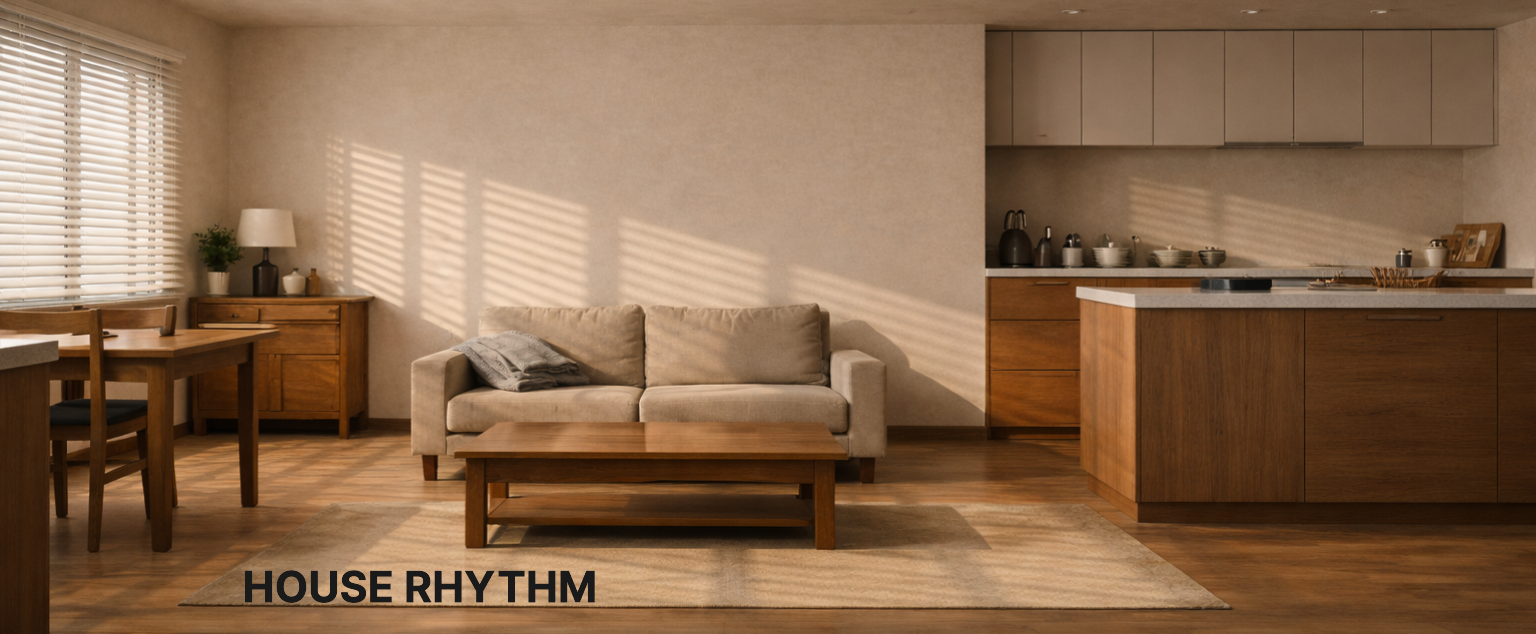
House Rhythm examines the systems that determine how a home actually runs.
A house can look orderly and still create unnecessary work. The kitchen may be clean while making every morning harder than necessary. A hallway can become a permanent landing zone. Laundry may repeatedly stall at the same stage. Even a counter cleared every night can collect the same objects again by afternoon.
Those repetitions are not random. They are operational evidence. House Rhythm treats ordinary domestic friction as information about the structure underneath it. Rather than asking only how to clean, organize, or improve a room, the series asks a more useful question: why does this problem keep returning?
House Rhythm is about the home beneath the appearance.
The routines, resets, maintenance decisions, placement choices, and repeated behaviors either reduce friction or quietly recreate it.
How a Home Develops Rhythm
Most household problems do not begin as major failures. They accumulate through small points of drift.
A bag has no reliable place to land. Supplies sit too far from where people use them. Cleaning depends on someone noticing first. One task may contain several steps but no clear finish point. The evening ends without returning important rooms to baseline. Maintenance gets delayed because nothing seems urgent yet.
Each issue looks minor in isolation, but repetition changes the equation. A home becomes harder to run when ordinary tasks require too many decisions, too much memory, or too much recovery, and the household ends up spending its energy restoring order instead of operating from it. House Rhythm studies that gap.
Household Systems Over Household Perfection
This series does not argue for immaculate rooms. Perfection is fragile. A functional household needs something more durable: arrangements that continue working when people are tired, busy, distracted, running late, carrying groceries, managing children, or simply living normally.
Sequence matters more than appearance. Where does something enter the home? Where do people use it? Where does it wait? What has to happen before the task is actually finished? Which surfaces repeatedly absorb objects that lack another destination? Which routines collapse as soon as one person stops maintaining them?
Good household design removes unnecessary negotiation from ordinary life. The better arrangement makes the next action easier to see.
What House Rhythm Examines
The series follows the places where domestic life repeatedly creates or loses order: kitchens, counters, entryways, storage, laundry, cleaning, household maintenance, morning preparation, evening resets, weekly routines, transitions between tasks, and shared responsibility.
Decoration is not the subject. Operation is. A beautiful kitchen that produces constant clutter contains an unresolved problem, while an unremarkable entryway that catches keys, bags, shoes, mail, and coats without spreading them through the house is doing its job perfectly well. House Rhythm is interested in that difference: function over appearance, every time.
Start With the Daily Rhythm
Build the day from the operating points that matter most.
→ Daily Routines for Stability at Home
→ Morning Activation Protocol: Start the Day Without Friction
Read Recurring Friction Differently
One of the most useful shifts in House Rhythm is learning to stop treating recurrence as personal failure.
If the same counter fills every day, clearing it more aggressively will not create a durable correction. When laundry repeatedly stops between washing and putting away, the full sequence deserves review, not just the final step. A house that becomes difficult to manage every weekend may also reveal problems that began several days earlier and simply went unnoticed until the pile got large enough to see.
Repetition reveals design. The question becomes less accusatory and more useful: what about the current arrangement keeps producing this result? That is where correction begins, not with more effort, but with a better look at the setup itself.
The Cost of Domestic Friction
Household friction rarely announces itself as a major problem. More often, it appears as an extra trip across the room, another search for a missing object, a task reopened after someone believed it was finished, or a surface that repeatedly needs clearing.
Individually, those moments seem small. Together, they increase the amount of attention the home requires.
Consider a morning in which keys have no dependable location. Someone checks a counter, then a coat pocket, then yesterday’s bag. The search may last only a few minutes, but the household pays that same cost every time the sequence repeats, and it repeats because nothing about the arrangement changed.
A similar pattern appears with supplies. When cleaning products live far from the room where people use them, a simple task gains extra steps, and postponement becomes easier. The physical arrangement quietly shapes whether the task happens now, later, or not at all.
These moments illustrate the operating principle behind House Rhythm: small points of friction compound. Reducing that friction does not require turning the home into a rigid environment. The goal is simply to notice where ordinary behavior repeatedly meets unnecessary resistance.
Build Around What Actually Happens
Household arrangements often fail because someone built them around ideal behavior rather than observed behavior.
A family may intend to place mail directly into a filing system, yet envelopes repeatedly land beside the door. Shoes may technically belong in an upstairs closet, although everyone removes them downstairs. A charging station can look perfectly organized while sitting nowhere near the place where devices naturally accumulate.
In each case, the house already supplies useful evidence. Rather than forcing behavior to obey an inconvenient arrangement, House Rhythm looks for ways to align the arrangement with the behavior that actually repeats.
If bags land near the entrance every day, that location deserves attention. If the kitchen counter collects paperwork because no nearby landing point exists, clearing the counter addresses the symptom while leaving the cause untouched. If evening cleanup repeatedly breaks down at the same point, that specific point deserves correction before the entire routine gets rewritten from scratch.
Observation comes first. From there, the house becomes easier to read.
Resets Protect the Baseline
A reset returns a space to a condition that supports its next use. That distinction matters because cleaning and resetting do not always perform the same job. A room may be technically clean while still being poorly prepared for tomorrow morning, and a quick evening reset can restore function without requiring a full cleaning session at all.
An evening kitchen reset, for example, might return dishes, counters, frequently used tools, and breakfast items to useful positions. The point is not visual perfection. The reset reduces the number of decisions waiting at the start of the next day.
The same principle applies elsewhere. An entryway reset clears yesterday’s objects before tomorrow’s arrivals. A laundry reset completes the final stage instead of leaving clean clothing in an unresolved pile. A weekly household reset catches small points of drift before they spread across several rooms.
Resets preserve the baseline. When the baseline holds, ordinary life requires less recovery.
Maintenance Before Failure
Maintenance is another part of household rhythm because homes communicate through small changes long before a major failure appears.
A cabinet hinge loosens. A frequently used supply reaches its last few units. A drain begins moving more slowly. One light burns out in a space that already feels dim. None of these conditions necessarily creates a crisis on its own.
But unresolved maintenance adds open loops to the household, and those loops require someone to remember, revisit, compensate, or work around the problem. Over time, the home accumulates more unfinished business than its occupants realize.
House Rhythm treats early correction as part of ordinary operation. A small repair completed when first noticed prevents the household from adapting around a defect that never needed to become permanent in the first place.
Current House Rhythm Groundwork
Recent House Rhythm work extends this operating lens into the small problems that quietly compound. Why Everything Ends Up on the Kitchen Counter examines recurring counter clutter as a landing-place problem rather than a simple cleanliness problem.
The same logic applies to other forms of household drift. A loose handle, a depleted household supply, an unfinished load of laundry, or a repair postponed for another week may each seem insignificant on its own. Together, small open loops increase the attention a house requires simply to remain functional.
House Rhythm closes those loops before they become the atmosphere of the home.
The House as Evidence
A home constantly produces information about how well its arrangements support daily life.
Frequently cleared surfaces reveal where objects lack destinations. Repeated searches reveal where storage and use have drifted apart. Tasks that depend on one person noticing first reveal where responsibility lacks a dependable trigger. Rooms that remain easy to restore, meanwhile, often reveal arrangements that already match the household’s natural behavior.
The goal is not to judge those patterns. The goal is to read them.
Once repetition becomes evidence, household correction becomes more precise. The house no longer needs another ambitious overhaul every time disorder appears. Each recurring point of friction becomes a clue about what deserves adjustment instead.
That creates a different relationship with domestic order. Order stops being a condition that must constantly be rescued and becomes something the environment helps reproduce on its own.
Receipts
The U.S. Bureau of Labor Statistics tracks how Americans distribute time across household activities, work, care, leisure, and other parts of daily life through the American Time Use Survey. The data provide broader context for why recurring domestic tasks and routines remain a meaningful part of everyday time allocation.
Keep Building With Groundwork Daily
Get new Groundwork Daily essays, commentary, and practical frameworks delivered by email. Thoughtful work for building a clearer life, stronger systems, and better decisions.
Join the Groundwork Daily NewsletterExplore House Rhythm
The full series follows household systems as they move through the day, the week, and the spaces people use most. New pieces continue to examine the routines, resets, recurring friction, and maintenance decisions that determine whether a home supports ordinary life or repeatedly creates more work.
Browse All House Rhythm Articles
For the builder behind the series, visit Celeste Monroe.
About the Builder: Celeste Monroe builds the House Rhythm and Soul Commentary series for Groundwork Daily. House Rhythm documents how homes hold order; Soul Commentary examines how people hold themselves. Both are built from direct observation, not theory, tracing what repeats, what drifts, and what quietly costs more than it should.