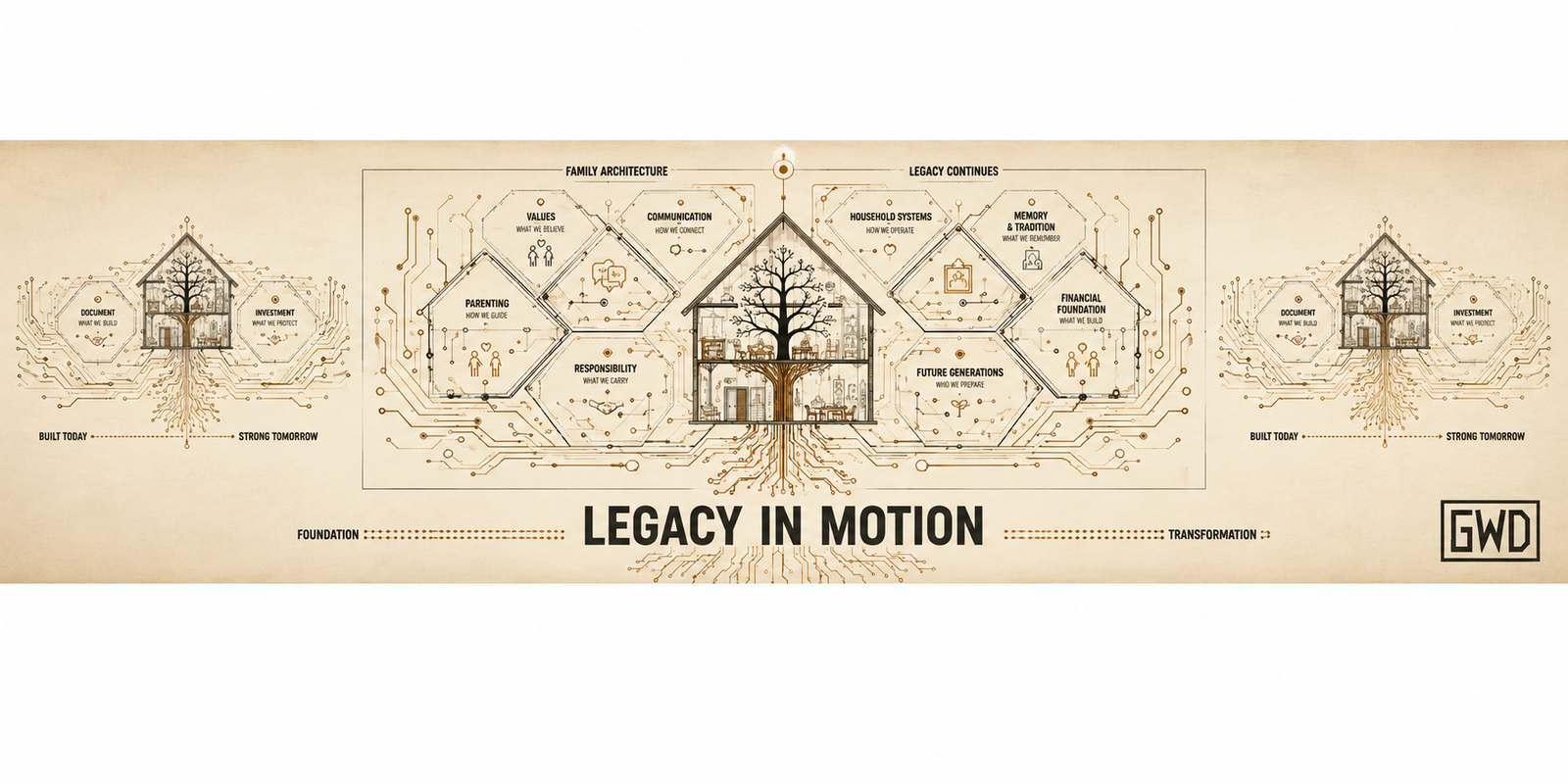
Legacy In Motion is Groundwork Daily’s series about family structure, responsibility, communication, parenting, household systems, and what families pass from one generation to the next.
Every family passes something forward. For instance, some of it is visible: a home, a photograph, a business, a recipe, a letter, a piece of land, or a set of keys.
However, much of the inheritance cannot be held in your hands. Families also transmit expectations, communication habits, definitions of responsibility, financial behavior, emotional patterns, household rules, ideas about adulthood, and ways of responding when pressure arrives.
Therefore, the real question is not whether a legacy is moving. The question is what is being carried forward.
The Series Principle
Legacy is not only what you leave. It is what continues because of what you built.
Start Here
Start Here With Legacy In Motion
Legacy In Motion does not begin with family perfection. Instead, it begins with family architecture. Love matters, but love operates inside routines, expectations, responsibilities, boundaries, communication, repair, and repeated behavior.
Legacy In Motion: Three More Ways Into the Series
Transmission
Children Inherit Normal
Repeated adult behavior becomes a child’s first working definition of ordinary life.
Read →Partnership
Love Needs Structure
Affection is real. Yet durable partnership also requires expectations, responsibility, boundaries, communication, and repair.
Read →Continuity
Building What Outlives You
Ultimately, legacy becomes meaningful when useful strength remains after one lifetime ends.
Read →What Families Pass Forward
Legacy In Motion Begins Before an Inheritance
A family’s real inheritance is broader than property. Long before a legal transfer occurs, the household is already teaching people how life works.
Four Forms of Generational Transmission
01
Values
First, families transmit what they say matters and what their behavior proves matters.
02
Behavior
Over time, repeated responses become patterns that children and adults learn to treat as normal.
03
Structure
Meanwhile, rules, routines, responsibilities, boundaries, and decisions organize daily life.
04
Opportunity
Finally, knowledge, stability, access, confidence, relationships, and resources shape the next generation’s starting point.
Foundational Arc
The Legacy In Motion Family Stability Arc
The first major Legacy In Motion cycle moves through eight structural questions. Taken together, the arc shows how family stability develops from architecture into culture, partnership, governance, communication, formation, adulthood, and continuity.
Each part builds on the one before it. As a result, the sequence works best as a connected pathway rather than eight unrelated articles.
Legacy In Motion: Foundation and Transmission
Foundation
The Architecture of Family Stability
Strong families are intentionally supported by trust, shared purpose, responsibility, daily rhythm, boundaries, and repair.
Part 1 →Transmission
Children Inherit Normal
What adults repeatedly model becomes part of a child’s understanding of relationships, money, conflict, responsibility, and everyday life.
Part 2 →Legacy In Motion: Partnership and Household Governance
Partnership
Love Needs Structure
Durable partnership requires expectations, shared responsibility, communication, boundaries, and repair in addition to affection.
Part 3 →Governance
Every Household Has a Constitution
Every home already has rules. Therefore, stability improves when values, expectations, roles, boundaries, and decision authority become clear before crisis.
Part 4 →Legacy In Motion: Communication and Formation
Communication
Family Meetings Change Everything
Communication becomes household infrastructure when families create a repeatable place to review pressure, responsibility, conflict, and shared direction.
Part 5 →Formation
The Discipline Children Remember
In fact, children remember repeated structure more than occasional speeches. Consequently, consistency quietly teaches what responsibility feels like.
Part 6 →Legacy In Motion: Adulthood and Generational Continuity
Adulthood
Raising Adults, Not Just Children
The destination of parenting is not permanent dependence. Instead, it is capable adulthood, judgment, responsibility, self-governance, and contribution.
Part 7 →Continuity
Building What Outlives You
Finally, the first cycle asks what people, values, institutions, skills, systems, and opportunities remain useful after one lifetime ends.
Part 8 →The Completed Arc
What the Legacy In Motion Arc Makes Visible
The eight parts form one system. Family architecture establishes the operating structure, while repeated behavior gradually turns that structure into culture.
From Partnership to Formation
From there, partnership determines whether adults can carry the work together. Governance creates clarity, while family meetings make communication repeatable.
From Formation to Continuity
In turn, discipline shapes formation. Parenting prepares children for self-governance. Finally, legacy asks whether the resulting strength can continue.
Stability is not one behavior. It is a chain of structures reinforcing one another over time.
The strongest family system does not make the next generation dependent on it. It prepares the next generation to build again.
Signature Frameworks
Four Legacy In Motion Family Structures
These are not separate slogans. Instead, they are recurring ways of examining how a household becomes stable enough to carry responsibility across time.
Structure 01
Legacy In Motion: Family Architecture
The rules, rhythms, expectations, responsibilities, boundaries, habits, and repair practices shaping everyday family life.
Structure 02
Household Governance
The systems families use to clarify values, roles, expectations, boundaries, accountability, communication, and decision-making.
Structure 03
Intergenerational Transmission
How values, behavior, memory, emotional patterns, financial habits, skills, and expectations move from one generation to another.
Structure 04
Legacy In Motion: Adult Formation
Parenting organized around judgment, capability, responsibility, independence, self-governance, and eventual contribution.
Where the Systems Meet
How Legacy In Motion Connects to Money Monday
Money Monday and Legacy In Motion share a worldview. However, they do not ask the same question.
Where Financial Structure and Family Structure Meet
For the point where both systems converge, explore Generational Wealth Architecture.
More Legacy In Motion
More From the Legacy In Motion Series
The foundational arc establishes the framework. From there, the larger series examines what happens when responsibility, power, money, communication, partnership, and long-term expectations come under pressure.
Relationship, Power, and Household Systems
Money & Power
When Financial Leadership Becomes Financial Control
A household can divide financial responsibilities without creating dependency. Of course, the line is crossed when access, information, and decision authority become tools of control.
Relationship Systems
When Love Becomes Infrastructure
Strong relationships become more durable when affection is supported by agreements, shared labor, repair, expectations, and repeatable systems.
Complete Archive
Browse Legacy In Motion
In addition, the chronological archive provides access to the full collection beyond the curated pathways on this page.
Outside Groundwork
Research Behind Legacy In Motion Themes
For additional research on the relationships and environments that shape development, explore the Harvard Center on the Developing Child .
Likewise, broader demographic research on families, relationships, households, and social change is available through Pew Research Center’s Social & Demographic Trends .
The Groundwork
Legacy In Motion Starts With What Your Family Repeats
Legacy is already moving through ordinary life.
Watch the Patterns
Children watch what adults tolerate. Families repeat certain patterns, while elders explain some lessons and leave others unspoken.
Meanwhile, responsibility gets distributed. Conflict either gets repaired or carried forward. Expectations are reinforced through what people repeatedly do, not only through what they say.
Test What Deserves to Continue
Because of that, the work does not begin someday. It begins with the systems already operating inside the household.
Start by looking at one pattern your family repeats without much discussion.
If that pattern survives another generation exactly as it is, will it be an inheritance worth keeping?

Marcus Vaughn
Marcus Vaughn and Legacy In Motion
Specifically, Marcus Vaughn is a Groundwork Daily builder focused on ownership, financial discipline, family structure, and generational continuity.
Through Money Monday and Legacy In Motion, the work examines systems that turn income into stability, responsibility into structure, and today’s decisions into tomorrow’s inheritance.
Continue Building
Continue Beyond Legacy In Motion
Economic Structure
Money MondayBuild financial stability, protection, control, and ownership.
Wealth & Continuity
Generational Wealth ArchitectureConnect ownership, governance, protection, investment, behavior, and transfer.
Builder
Marcus VaughnExplore the complete body of work around money, family, ownership, responsibility, and continuity.