

Keeping humans in the loop is the difference between automation that extends human capability and automation that quietly inherits human authority. The goal is not to preserve a person somewhere in the workflow for appearance. The goal is to preserve meaningful judgment where consequences still require it.
Technology is exceptionally good at removing friction. It can rank options, detect patterns, generate drafts, route decisions, recommend actions, and execute repetitive work faster than a person could manage alone.
That efficiency creates leverage. However, it also creates a governance question: what happens when the system becomes easier to trust than to question?
If automation chooses first and the person merely clicks approve, the human may still be technically present. Yet presence is not the same as control.
Over time, review can become ritual. The system proposes. The person confirms. Exceptions become harder to notice because the automated path has become normal.
Tech as Discipline exists to resist that drift. Technology should carry more of the burden without quietly carrying away authorship.
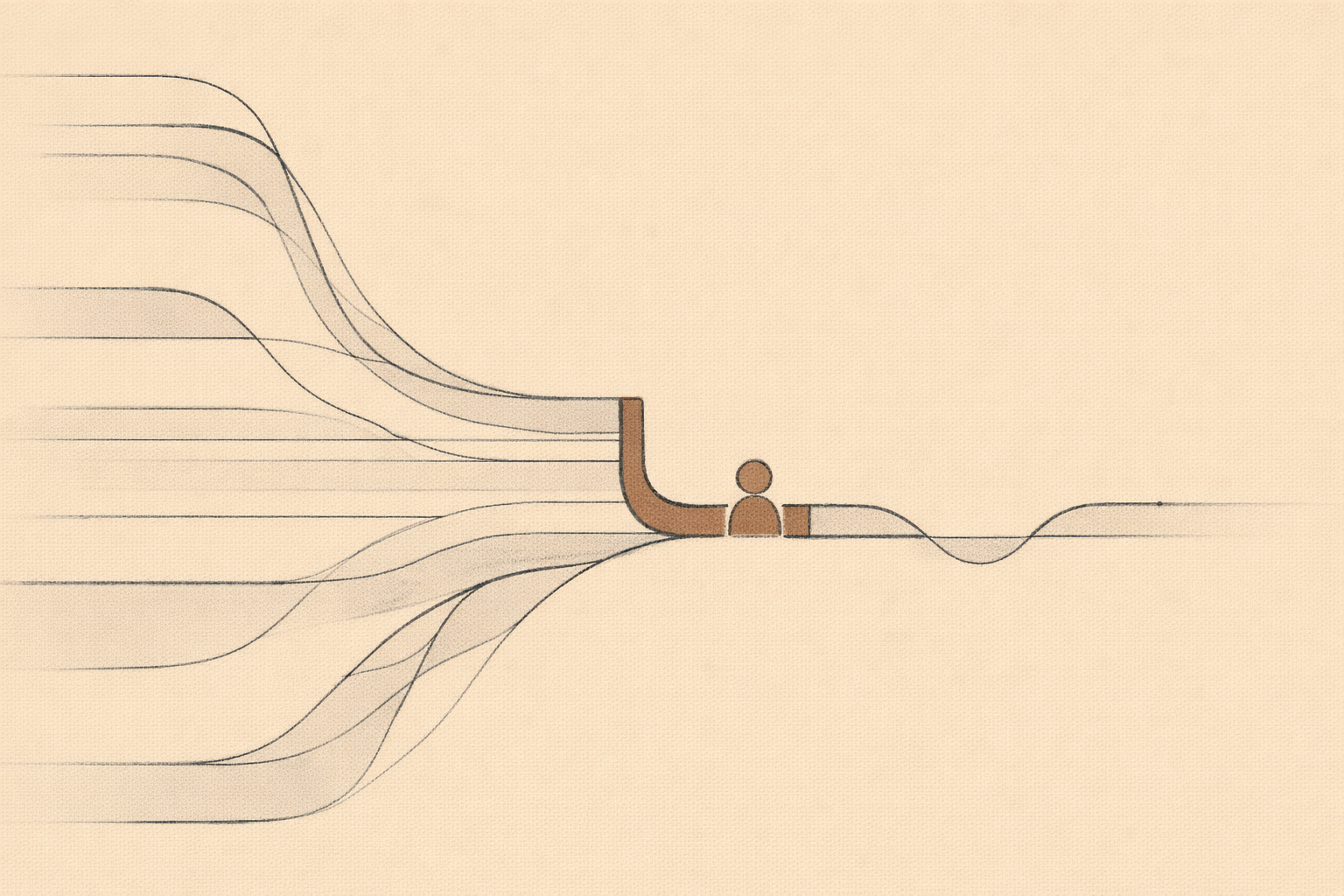
Keeping Humans in the Loop Requires More Than Human Presence
“Human in the loop” can sound reassuring because it suggests that a person remains in control. Unfortunately, that phrase can hide weak design.
A person may technically review an automated decision while lacking the information needed to challenge it. Someone may have an override button but face pressure never to use it. Likewise, a reviewer may receive so many automated recommendations that careful inspection becomes impossible.
In each case, a human remains inside the workflow. Meaningful human authority does not.
The Human Must Be Able to Affect the Outcome
Real oversight requires more than a final click. The person needs enough visibility to understand what matters, enough authority to disagree, enough time to inspect the decision, and a practical path for intervention.
Accountability must also survive the automation. A system can generate, recommend, rank, route, or execute. It cannot make responsibility disappear.
A human who cannot meaningfully change the outcome is not in the loop. The human is part of the interface.
Five Requirements for Meaningful Human Oversight
Keeping humans in the loop becomes useful only when the idea can be translated into system requirements. Five elements provide a practical starting point.
01
Visibility
The person can see the relevant inputs, assumptions, uncertainty, and consequences rather than receiving only a polished recommendation.
02
Authority
The human has legitimate power to disagree, redirect, delay, escalate, or refuse the automated path.
03
Intervention
The system provides a usable mechanism for stopping or changing what happens next.
04
Accountability
Responsibility remains assigned to people or institutions even when automation performs much of the work.
05
Recovery
When the system fails, people can detect the problem, correct the outcome where possible, and learn from the failure.
Remove any one of these and oversight becomes weaker. Remove several, and “human in the loop” can become little more than governance theater.
Visibility Comes Before Judgment
People cannot challenge what they cannot see. For that reason, keeping humans in the loop begins before the approval screen.
A reviewer needs the information that changes the decision. That may include source material, relevant inputs, uncertainty, exceptions, prior actions, or the reason a system flagged one option over another.
More Information Is Not Automatically More Visibility
Dumping every available data point onto a dashboard does not solve the problem. Too much information can hide the important signal as effectively as too little.
Instead, the system should make consequential information legible. What changed? What is unusual? What assumption is carrying the recommendation? Where is confidence weak? What happens if the person approves?
Good visibility does not explain everything. It exposes what the human needs in order to exercise judgment.
Human Oversight Requires Authority, Not Just Approval
An approval button is meaningless when disagreement carries no practical path forward.
Consider a reviewer who sees a questionable automated recommendation but cannot change it without navigating several systems, finding a supervisor, or accepting a major delay. Formally, the person has oversight. Operationally, the automated default still holds most of the power.
The Override Must Be Real
Meaningful authority means a person can pause, reject, modify, escalate, or request another review when circumstances justify it.
That does not mean every employee should be able to override every system. Authority can and should be governed. Still, someone must possess enough legitimate power to interrupt the automated path when the system reaches its limits.
Otherwise, the organization has created responsibility without agency: the human remains accountable for a decision the human could not realistically change.
When Human Oversight Becomes Ceremonial
One of the largest risks in automated systems is not the complete removal of people. It is keeping people present while stripping the role of substance.
That can happen quietly.
Rubber-Stamp Review
If a system is usually correct, reviewers naturally become more willing to accept its output. Eventually, approval can become habitual rather than analytical.
Research on automation bias has documented the risk of people over-relying on automated decision support and failing to detect errors they might otherwise notice.
Volume Can Destroy Oversight
A reviewer who must inspect a handful of meaningful exceptions can exercise judgment. Give the same person hundreds or thousands of routine approvals, and the task changes.
Attention becomes the bottleneck. At that point, the organization may still claim that a human reviews every action, but the design itself makes thoughtful review unrealistic.
Time Pressure Can Do the Same Thing
Oversight also weakens when decisions arrive faster than people can reasonably evaluate them. If every pause creates operational punishment, people learn to follow the automated path.
The operational test: if the human is expected to approve nearly everything, lacks enough time to inspect the recommendation, or faces unreasonable friction for disagreeing, the loop may exist on paper more than in practice.
Put Humans in the Loop Where the Stakes Change
Keeping humans involved in every automated action would defeat much of the value of automation. It would also bury meaningful review under routine work.
The better strategy is selective intervention. Human judgment belongs where context, consequence, uncertainty, or irreversibility changes the risk.
Money and Material Commitments
Significant transfers, unusual transactions, contractual commitments, and decisions with substantial financial consequences may justify stronger review than ordinary low-risk activity.
Identity, Privacy, and Access
Permissions, sensitive information, authentication, account control, and consequential data-sharing decisions deserve clear ownership because failures can spread beyond a single action.
Safety and High-Consequence Decisions
As potential harm rises, so does the need for qualified human judgment and appropriate domain expertise. Automation may surface information or support analysis, but high-consequence decisions require controls proportionate to the risk.
Irreversible Actions
Deletion, publication, destructive changes, final submissions, and actions that cannot be easily undone deserve a stronger checkpoint than reversible work.
Exceptions and Uncertainty
Automation is often strongest inside recurring patterns. Humans become particularly valuable when the case falls outside those patterns.
Therefore, a mature system does not simply ask, “Where can we automate?” It also asks, “Where does the automated path become least trustworthy?”
Keeping Humans in the Loop Sometimes Requires Designed Friction
Human oversight and friction are closely connected. If a system moves from recommendation to execution without a meaningful decision point, the person may never get a real chance to intervene.
However, adding confirmation boxes everywhere is not the answer. Constant interruption trains users to click through warnings without thinking.
Friction Should Follow Consequence
The useful question is not whether the workflow contains an extra step. Instead, ask whether that step protects judgment at a moment when an unexamined action could create meaningful harm.
This is the argument developed more fully in Designing Friction on Purpose . Protective friction should make a consequential choice clearer without turning ordinary work into a maze.
Defaults Should Remain Reviewable
Defaults are decisions made in advance. They save time because someone has already chosen the starting path.
That is useful until the context changes.
A permission can remain active after the original need disappears. A recurring automated action can continue after priorities shift. A recommendation rule can keep shaping behavior even though nobody remembers why it was adopted.
Review Prevents Convenience From Becoming Authority
Important defaults should therefore be visible and, when appropriate, revisited. Users should be able to understand what is happening automatically and change the rule without fighting the system.
This is one of the central concerns in When Systems Make Decisions for You . The most consequential transfer of authority may occur long before the final decision screen.
Design the Human Loop for Failure, Not Just Normal Operation
Any serious automated system needs a theory of failure. “The model is usually right” or “the workflow normally works” is not enough.
The system will eventually encounter incomplete information, an unusual case, bad data, changing conditions, human misuse, technical failure, or an assumption that no longer holds.
Ask What Happens When the Automation Is Wrong
Who notices? Who can stop it? Who investigates? Can the action be reversed? Does the affected person have an escalation path? Will the failure teach the system or organization anything?
Those questions are not secondary. They reveal whether the human layer is actually part of the operating system or merely attached to the end.
Recovery Is Part of Oversight
Strong systems do not pretend errors can be eliminated. Instead, they make detection, escalation, correction, and learning possible.
Recovery also protects accountability. When failures disappear into an automated pipeline, nobody learns where the structure broke. Once failures become visible, the organization can improve the boundary rather than simply blaming the operator or the machine.
The Human Authority Test
A simple test can expose whether human oversight is substantive or decorative.
Groundwork Human Authority Test
-
Can the person see what matters?
The reviewer needs enough relevant information to recognize uncertainty, exceptions, and consequences. -
Can the person disagree?
Human oversight requires legitimate authority to challenge the automated recommendation. -
Can the person stop or change the action?
Intervention must be operationally possible, not merely theoretical. -
Is there enough time to think?
Review becomes ceremonial when volume or speed makes meaningful inspection unrealistic. -
Does someone still own the outcome?
Automation should not dissolve responsibility into “the system.” -
Can the system recover when it is wrong?
Detection, escalation, correction, and learning belong inside the design.
If several answers are no, calling the workflow “human in the loop” does not repair the architecture.
What the First Tech as Discipline Arc Established
Keeping humans in the loop pulls together the first sequence of Tech as Discipline. Each piece addresses a different point where technology can quietly change the relationship between efficiency and human authority.
Arc I · Cost
The Cost of Convenience
Automation can remove effort that was also maintaining awareness, skill, attention, or judgment.
Arc I · Authority
When Systems Make Decisions for You
Defaults, rankings, recommendations, and automated pathways can move decisions upstream before people realize authority has shifted.
Arc I · Guardrail
Designing Friction on Purpose
Good systems deliberately slow down where speed would make consequential mistakes easier to miss.
Keeping Humans in the Loop Is the Operating Rule
The three arguments converge here. Convenience can remove capability. Systems can inherit decisions. Friction can protect the moments where judgment still matters.
Therefore, the operating rule is not “keep humans involved in everything.” That would be inefficient and intellectually lazy.
The stronger rule is this: automate the burden while preserving human authority at the boundary of consequence.
Practical Rules for Human-Centered Automation
Automate Routine Work Before Consequential Judgment
Repetition, formatting, sorting, routing, transformation, and low-risk processing are natural candidates for automation. The case for human review becomes stronger when ambiguity, consequence, or responsibility rises.
Route Exceptions to People
Do not force unusual cases through a workflow designed for normal ones. Exceptions are often exactly where context and judgment become most valuable.
Make Overrides Usable
An override hidden behind bureaucracy is not much of an override. Intervention should be governed, documented, and proportionate, but it must remain practical enough to use when conditions justify it.
Audit the Human Layer Too
Organizations should not only measure whether the automated system performs well. They should also examine whether reviewers are overloaded, whether warnings are ignored, whether overrides happen appropriately, and whether people understand the responsibility attached to their role.
Measure Outcomes, Not the Appearance of Oversight
Counting human approvals proves that clicks occurred. It does not prove that judgment occurred.
Better evaluation asks whether meaningful errors are caught, exceptions are escalated, failures can be corrected, and responsibility remains clear.
Further Groundwork
→ The Cost of Convenience: What Automation Removes That You Still Need
→ When Systems Make Decisions for You
→ Designing Friction on Purpose
→ The Structure of Control: Automation, AI, and Human Authority
The Groundwork: Keep Authority Attached to Consequence
Keeping humans in the loop is not about protecting human involvement for sentimental reasons. Machines can perform many tasks faster, more consistently, and at greater scale than people.
The question is where efficiency should stop carrying authority with it.
A mature system automates what can be safely delegated. At the same time, it preserves visibility where uncertainty matters, authority where consequences rise, intervention where failure can spread, accountability where outcomes affect people, and recovery where mistakes cannot simply be ignored.
That is a higher standard than putting an approval button at the end of an automated workflow.
It means designing the human role with the same care used to design the machine role.
Automate the burden. Preserve the judgment. Keep responsibility human.
Groundwork Architecture
What Holds Human Oversight Together
Human oversight holds only when authority, responsibility, and intervention remain connected. Otherwise, the system can preserve the appearance of control while moving control elsewhere.
Primary Core Principle
Build What Holds
Build What Holds asks whether a structure remains reliable when conditions become harder than normal.
In automated systems, the test is not whether the workflow performs beautifully when inputs are clean and recommendations are correct. The test arrives when the case is unusual, the automation is wrong, or the consequence becomes larger than expected.
Human oversight should be designed for those moments before those moments arrive.
The human layer must still hold when the automated layer reaches its limit.
Primary Condition · Owns
Accountability
Accountability keeps responsibility attached to people and institutions even when technology performs more of the work.
A model can recommend. An automated system can route. Software can execute. Yet none of those actions should create a vacuum where nobody owns the consequence.
Human oversight becomes meaningful when the person or institution responsible for the outcome also has enough authority to affect it.
Responsibility without authority is theater. Authority without responsibility is drift.
Supporting Conditions: Boundaries define where automated authority should stop, while Discernment helps distinguish routine work that can be delegated from consequential judgment that still requires human context.
Explore the Groundwork Daily Core Principles and Conditions Architecture .
Receipts
- National Institute of Standards and Technology. The NIST AI Risk Management Framework provides a structured approach to governing, mapping, measuring, and managing risks associated with artificial intelligence systems. Review the NIST AI Risk Management Framework .
- Parasuraman and Manzey. Research on automation bias and complacency examines how reliance on automated decision support can contribute to missed errors and inappropriate acceptance of system recommendations. Review the systematic discussion of automation bias .
- Federal Trade Commission. FTC guidance on dark patterns examines interface designs that can steer or manipulate users toward choices they might not otherwise make, reinforcing the importance of meaningful choice and legible system design. Review FTC guidance on dark patterns .