
Stillness Notes
For the moments that do not ask to be solved quickly, only noticed carefully.
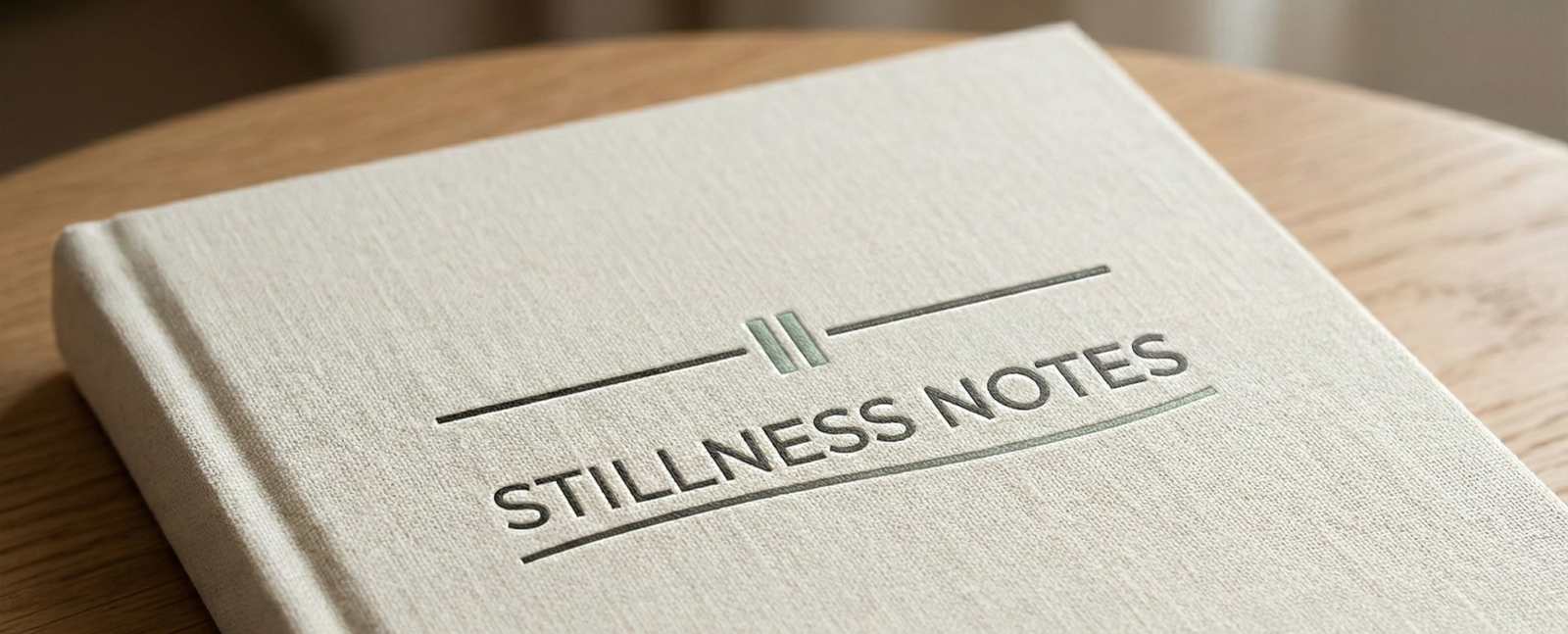
There are shelves full of books that promise to change your life. This is not one of them.
Stillness Notes began with something smaller: a habit of paying attention. It pays attention to ordinary mornings, conversations that linger after they end, questions that refuse quick answers, and quiet places where life reveals more than it explains.
These essays are not written to help anyone move faster. Instead, they are written to help us notice what speed has been hiding.
Some observations become discipline. Others become boundaries. Some become healing, while others remain questions for a long time. Still, all of them begin the same way: by slowing down long enough to see.
A Stillness Note is a preserved observation. It begins with something ordinary and follows it until something deeper becomes visible.
That definition matters because the internet has made almost every kind of writing feel like instruction. Articles tell us how to fix our mornings, optimize focus, control habits, improve relationships, and become more useful in less time. Some of that writing is helpful. Much of it is exhausting.
Stillness Notes moves differently. It does not begin with a promise to repair the reader. Instead, it begins with a small act of attention: a room, a pause, a sentence left unsaid, a body that is resting but not restored, or a familiar discomfort that may be a pattern asking to be understood.
That is why this page should not be read like a directory. It is a front door. It explains the series, offers a way in, and gathers the essays into a shape that makes their shared purpose easier to feel.
Why Stillness Notes Exists
The series begins with a simple belief: most people do not need more noise. They need more room.
A Life Full of Interruption
There are few things modern life produces more efficiently than interruption. Not because interruption has become more important, but because it has become more profitable.
Someone always wants another glance, another click, another response, another opinion, or another reason to believe that whatever just happened deserves immediate attention. Eventually, the interruptions arrive so quickly that they stop feeling like interruptions at all.
They become the weather. We wake inside them, carry them into conversations, eat lunch beside them, and fall asleep with them still speaking.
The remarkable thing is not only that the world has become louder. The remarkable thing is how quickly we adjusted.
Many people no longer notice the constant pull on their attention because it has become ordinary. Ordinary things are easy to overlook, and that has always been the quiet tension underneath Stillness Notes.
The Ordinary Keeps Teaching
The sunrise happens every morning. Because of that, we stop watching. A familiar voice says our name. Because we expect it, we barely hear it. Someone quietly carries the weight of a family for years. Only when they are gone do we understand how much they were holding.
Life hides some of its greatest truths inside ordinary moments. Not because they are difficult to understand, but because they arrive without announcing themselves.
That observation became the beginning of this series. It was not a publishing strategy or a performance of depth. It was a growing collection of moments that refused to disappear after they happened.
Some began with conversations. Others began with silence. Some began while standing in line, washing dishes, or watching morning light move across a kitchen table. None of them appeared important at first. Most important things rarely do.
Questions That Deserve Room
When those small moments were held a little longer, they quietly unfolded into larger questions.
Why do people confuse being busy with being useful? Why does slowing down feel so difficult? Why does rest sometimes fail to restore us? Why do the strongest boundaries usually begin before anyone hears the word no? Why do unspoken things keep leaving evidence long after the conversation ends?
Those questions became essays. Not because they demanded quick answers, but because they deserved attention.
The world already has enough quick answers. Stillness Notes exists for the questions that need room.
That does not mean the series avoids usefulness. Instead, it refuses to force usefulness into the shape of a checklist. Some truths become less useful when they are rushed. Some experiences cannot be reduced without being distorted. Some moments need to be named before they can be solved.
This is why Stillness Notes is slower than most online writing. It does not treat slowness as weakness. It treats slowness as a way of allowing the real subject to arrive.
Why the First Answer Is Not Always Enough
The first explanation is often not the truest one. It is often the easiest one. It protects pride, fear, and the version of the story that asks the least from us.
Stillness gives those answers time to reveal what they are carrying. Maybe the issue was never laziness. Maybe it was fatigue. Maybe it was not confusion. Maybe it was avoidance. Maybe the problem was not that life was too quiet. Maybe the quiet finally made the truth easier to hear.
That is why this series does not move like urgency. Urgency wants the next step. Stillness asks whether the step belongs. Urgency wants an answer. Stillness asks whether the question has been honest. Urgency wants the feeling to end. Stillness asks what the feeling has been trying to say.
This series exists because there are parts of life that cannot be understood at full speed. Some clarity must arrive gently. Some recognition must settle. Some truths do not raise their voice.
What Is a Stillness Note?
A Stillness Note is not advice first. It is attention first.
Not a Lecture
A Stillness Note is not a lecture, a motivational speech, or a productivity hack with softer lighting. It begins with an ordinary observation and follows that observation until something deeper becomes visible.
That is the whole form. It is small enough to carry, quiet enough to return to, and honest enough to keep asking something of the reader after the page has closed.
Advice tells people what to do. Reflection helps people understand why they keep doing what they already do. Advice often expires. Understanding keeps unfolding.
That is why these essays are called notes. A note is not a complete book. It is a preserved observation, a record of something noticed before it disappeared back into the day.
The Question Beneath the Series
Some notes are about discipline. Others are about attention, emotional boundaries, rest, or what was never said. Beneath all of them is the same question:
What becomes visible when life is quiet enough to tell the truth?
That is the question Stillness Notes keeps returning to.
There is a reason the pieces are written slowly. A rushed sentence can still be true, but it may not leave enough room for the reader to recognize themselves inside it.
A Stillness Note needs room: room for silence, room for recognition, and room for the part of the reader that already knows but has not yet admitted it.
The Pause Before Advice
Instruction can be useful. However, not every moment calls for instruction. Some moments call for witness. Some call for a slower question. Others call for language that does not rush the healing it is trying to name.
Stillness Notes lives there: in the pause before advice, in the space after reaction, and in the small truth that keeps returning until it is finally heard.
That is why the series can move from focus to grief, from discipline to rest, and from boundaries to productivity without losing its center. The subject changes. The practice remains the same.
Notice. Pause. Stay with the observation. Let it tell the truth.
Series position: Stillness Notes is the quieter shelf inside Groundwork Daily. It does not compete with the policy desk, the money framework, or the cultural critique. It holds the interior work that makes those other forms of building possible.
The Ordinary Does Not Stay Ordinary
The danger with any reflective series is that it becomes vague. Stillness Notes avoids that by staying close to ordinary life. It does not float above the reader. It sits beside them.
A note may begin with the feeling of being unable to rest. That is ordinary. It may end by showing that the body stopped but the mind remained available to pressure. That is deeper.
A note may begin with focus. That is ordinary. It may end by showing that focus is not always produced by doing more. Sometimes it is protected by allowing less in. That is deeper.
A note may begin with silence after a conversation. That is ordinary. It may end by showing that silence does not always mean peace. Sometimes it means no one had enough safety or courage to say the thing that mattered. That is deeper.
This is the form. The ordinary does not stay ordinary when attention holds it long enough.
The Stillness Notes Manifesto
Seven quiet principles guide the series.
1. Quiet is not empty.
2. Attention is a form of care.
3. Reflection comes before clarity.
4. Boundaries protect what matters.
5. Discipline begins beneath visible behavior.
6. Small observations can reveal large truths.
7. Growth is quieter than performance.
Not Slogans, Reminders
These are not slogans. They are reminders.
Quiet is not empty because silence often holds what noise has been covering. Attention is a form of care because what receives attention receives part of a life. Reflection comes before clarity because a life rarely explains itself while we are rushing through it.
Likewise, boundaries protect what matters because anything valuable needs an edge. Discipline begins beneath visible behavior because action is usually shaped before anyone sees it. Small observations reveal large truths because the ordinary is where life repeats itself. Growth is quieter than performance because the deepest changes often happen before they become visible.
That is the heart of Stillness Notes. Not spectacle. Not performance. Not the loud announcement of transformation. Just the quiet practice of noticing what has been trying to teach us.
How the Principles Return
Each principle returns in different ways across the series. Sometimes attention appears as focus. Sometimes it appears as listening. At other times, it appears as the refusal to keep handing the best of yourself to things that only know how to take.
Boundaries may appear as protection. They may also appear as grief, disappointment, or the first honest sentence after years of trying to be easy to love.
Stillness Notes does not treat these subjects as separate rooms. They are connected. Attention shapes discipline. Discipline protects rest. Rest makes reflection possible. Reflection clarifies boundaries. Boundaries protect the life that is trying to grow.
Nothing here is isolated. That is why a single observation can open into something larger. A cold cup of coffee can become a question about presence. A delayed answer can become a question about fear. A quiet room can become a question about what was being avoided while the room was loud.
The ordinary keeps teaching. Stillness Notes is where some of those lessons are written down.
The Stillness as Discipline Sequence
Begin here if you want the foundation. These five essays build one argument in order.
This is the spine of the collection. Read it in sequence if you are new to the series. Each essay hands something to the next. Judgment, orientation, boundary, filter, and standard become a quiet architecture for practicing stillness in ordinary life.
Stillness as Discipline: Why Quiet Improves Judgment
Opens the sequence by naming the misread directly. Stillness gets mistaken for delay, avoidance, or weakness because modern life rewards visible motion over invisible clarity. This essay draws the first hard line between noise and judgment.
Stillness as Discipline: Orientation Before Movement
Reframes stillness as orientation rather than hesitation. Before effort gets spent, direction has to be set. Most wasted motion is not a discipline problem. It is a direction problem that stillness could have caught earlier.
Stillness as Discipline: Boundary Before Drift
Moves stillness from an internal practice to a functional line. Boundary is what protects orientation after pressure arrives. Without it, direction erodes one small compromise at a time.
Stillness as Discipline: Filter Before Focus
Treats focus as a subtraction problem, not an addition problem. Stillness becomes the filter that decides what never reaches attention in the first place.
Stillness as Discipline: Standard Before Scale
Closes the foundational sequence by asking what happens when stillness becomes a standard instead of an occasional practice. What holds under pressure is what defines discipline.
The point of this sequence is not to make stillness impressive. It is to make it usable. A person does not need a quiet life to practice stillness. They need a reliable pause inside an ordinary one.
Stillness in Relationships
Quiet becomes most revealing when another person is involved.
When the Pause Has Stakes
Stillness is easy to romanticize when no one is asking anything of us. It becomes more difficult when someone is disappointed, waiting, defensive, or close enough to be hurt by what we say too quickly.
Relationships reveal whether stillness has become discipline or merely a preference. Anyone can be calm in a room where nothing is at stake. The real test is whether a pause remains available when a conversation begins to pull old instincts to the surface.
What Was Never Said
Some conversations end without conflict but not without consequence. This essay traces the emotional evidence left behind by what never became language.
Emotional Boundaries: Control vs. Protection
Draws the line between managing another person and protecting your own peace. A boundary is not a performance of distance. It is a decision about access.
What Silence Can Hide
Both essays share a quiet thread: unstated things do not disappear because no one names them. They move into distance, tension, resentment, confusion, or the next conversation that seems to come out of nowhere but has actually been gathering for months.
Stillness in relationships is not silence as punishment. It is the pause that asks what is true before speech tries to win.
Some silence protects dignity. Some silence protects avoidance. Some silence gives a person time to choose words carefully. Some silence simply withholds the truth because the truth would require a different kind of courage.
Stillness Notes does not pretend these distinctions are easy. It simply insists that they matter.
A relationship can survive difficult truth better than it can survive constant distortion. However, difficult truth needs a clear vessel. It needs a person who has paused long enough to know whether they are speaking from honesty, fear, control, exhaustion, or love.
That pause is stillness doing relational work.
Rest, Focus, and Constant Productivity
These essays examine what happens when the body stops but the inner life keeps running.
Why Stopping Is Not Always Recovery
The newest thread in Stillness Notes turns from the discipline itself toward the resistance to it. Why is stillness, despite being simple to describe, so difficult to practice?
The answer often lives in identity. Many people do not simply do too much. They have learned to feel real through motion. They have learned to trust themselves only when effort is visible. As a result, they may rest physically while remaining mentally reachable.
These four essays go looking for that pattern.
Why Slowing Down Feels So Difficult
Names the discomfort that appears when motion stops. Slowing down can expose how much identity has become tied to constant usefulness.
Why Rest Does Not Feel Restful Anymore
Explores the gap between stopping and recovering. Rest cannot restore what attention refuses to release.
How to Focus Without Doing More
Challenges the instinct to solve focus by adding more effort. Sometimes focus improves when less is allowed to enter.
Why Constant Productivity Is Making You Less Effective
Closes the thread by naming the trap directly. Constant motion can make a person feel productive while slowly weakening judgment.
The Productivity Trap
This thread matters because a culture obsessed with productivity often misunderstands effectiveness. Effectiveness is not simply doing more. It is doing what matters with enough clarity that the work holds.
Stillness protects that clarity. Without it, productivity becomes a treadmill wearing work clothes.
Themes You Will Find Here
Stillness Notes returns to a few quiet rooms again and again.
Attention
What receives attention receives part of a life. Stillness asks whether that exchange is worth the cost.
Discipline
Discipline begins before visible behavior. It begins in what is noticed, filtered, and refused.
Boundaries
Boundaries are the quiet edge that keeps important things from being slowly eroded.
Rest
Rest is not simply stopping. It is recovering the parts of attention that pressure keeps borrowing.
Reflection
Reflection stays with a question long enough for the easy answer to become less convincing.
Emotional Clarity
Emotion carries information. Stillness gives it time to speak before it becomes behavior.
Where the Themes Appear
These themes do not always announce themselves directly. Sometimes attention appears as a room that finally gets quiet. Sometimes discipline appears as the choice not to answer immediately. Sometimes rest appears as grief because the body no longer knows how to receive peace without suspicion.
Sometimes boundaries appear as disappointment because not everyone will understand the protection they require. Stillness Notes does not flatten those experiences into neat lessons. It lets them remain human.
That is part of the series discipline too. Not everything has to become a formula to become useful.
How to Read Stillness Notes
These essays are not designed to be consumed quickly.
Read One, Then Carry It
Read one essay. Then close the browser. Carry the observation into the day and notice where it appears again.
Maybe it appears while answering a message too quickly. Maybe it appears while trying to rest but remaining mentally available. Maybe it appears when a boundary needs to be named. Maybe it appears in the silence after a conversation ends.
That is how these notes work best. They are not meant to replace your life with ideas. They are meant to help you notice the life already in front of you.
Return when the noise gets loud again. Return when a question keeps following you. Return when you need less instruction and more honesty.
A Simple Reading Practice
There is no prize for finishing the series quickly. The reward is recognition: the moment when a sentence names something you have felt but had not yet been able to say.
Choose one essay, not three.
Begin with the title that creates the most recognition. Do not try to master the series. Let one note meet the current question.
Read without rushing toward agreement.
The strongest reflection does not always feel agreeable at first. Sometimes it irritates because it is close to something true.
Carry one sentence into the day.
Not the whole essay. One sentence. One question. One image. Let it return when it wants to.
Notice where the essay reappears.
A Stillness Note is working when it begins showing up in a message, a pause, a choice, or a familiar pattern.
Return later.
These essays often read differently after a week, a conversation, or a hard morning. That is not repetition. That is depth.
Stillness vs. Nearby Ideas
Stillness is often confused with things that look similar from the outside.
Part of what makes stillness hard to talk about is that the word gets used loosely. Someone recovering from burnout may mean rest. Someone in conflict may mean silence. Someone avoiding a hard conversation may call the avoidance peace.
Stillness Notes uses the word more carefully.
| Concept | How Stillness Notes Separates It |
|---|---|
| Avoidance | Avoidance delays responsibility to relieve discomfort. Stillness delays action so responsibility can be met with more clarity. |
| Rest | Rest addresses recovery. Stillness addresses attention. The body can stop while the mind keeps rushing. |
| Passivity | Passivity lets circumstances decide. Stillness withholds reaction until direction becomes clearer. |
| Silence | Silence can protect, punish, hide, or heal. Stillness asks what the silence is doing. |
| Mindfulness | Mindfulness can be a practice. Stillness Notes treats stillness as a way of noticing before action, in ordinary life. |
The Inner Difference
The difference is not always visible from the outside. That is why the essays keep returning to the inner movement beneath the outer pause.
Two people can be silent. One is punishing. One is listening. Two people can delay a decision. One is avoiding. One is discerning. Two people can rest. One is recovering. One is only lying down while pressure continues running the room inside them.
The outside rarely tells the whole truth. Stillness Notes is interested in the inside.
Wider Reading
Related Groundwork Daily pieces that belong near this shelf.
Stillness Is Strategy
Clarity rarely appears while rushing. This essay frames stillness as the beginning of direction.
Stillness Under Observation
Explores what happens when quiet becomes watched, judged, or performed.
Stillness Is Not Passivity
A companion piece on why quiet is often mistaken for doing nothing.
Structure Builds Freedom
The wider Groundwork Daily principle that gives stillness its structural meaning.
These pieces are not required reading. They are nearby rooms. Enter them when the series begins asking a wider question.
FAQ
Common questions about the series.
What is Stillness Notes?
Stillness Notes is a Groundwork Daily series by Joseph E. Mercer. It gathers reflective essays about attention, discipline, boundaries, rest, emotional clarity, and the ordinary moments that reveal deeper truths when they are noticed carefully.
Where should I start?
Start with the five-part Stillness as Discipline sequence if you want the foundation. Start with Why Slowing Down Feels So Difficult if life feels too fast. Start with What Was Never Said if the current question is relational.
Do I need to read the essays in order?
No. The foundational sequence works best in order, but the rest of the series can be entered wherever the question feels closest.
Is Stillness Notes about mindfulness?
Not exactly. Mindfulness may overlap with some of the ideas, but Stillness Notes is reflective writing. It focuses on noticing, attention, honesty, and the quiet patterns beneath everyday life.
Why are these essays slower?
Because some truths do not arrive under pressure. The slower rhythm gives readers room to recognize what speed often hides.
Who writes Stillness Notes?
Stillness Notes is written by Joseph E. Mercer. The series voice is quiet, observant, and reflective. It notices rather than lectures.
How is stillness different from avoidance?
Avoidance delays responsibility to relieve discomfort. Stillness pauses before action so responsibility can be met with more clarity.
How often does Stillness Notes publish?
The series is designed as an ongoing reflective lane. New essays can be added to this page as the collection grows.
Begin Here
Not with a plan. With one honest observation.
You do not need to become a different person before beginning. You only need one honest observation, one question that keeps returning, or one quiet moment you have been walking past.
That is enough.
Stillness Notes will not tell you how to rush through life more efficiently. It will invite you to notice what the rushing has been preventing you from seeing.
Read one essay. Sit with it. Return when another question begins asking for your attention.
Life rarely becomes quieter on its own. The practice of becoming quieter within it is something we build intentionally.
That is what these notes are for.
Get the next note first
New Groundwork Daily reflections and series updates can be sent directly to your inbox.
Join the newsletter →