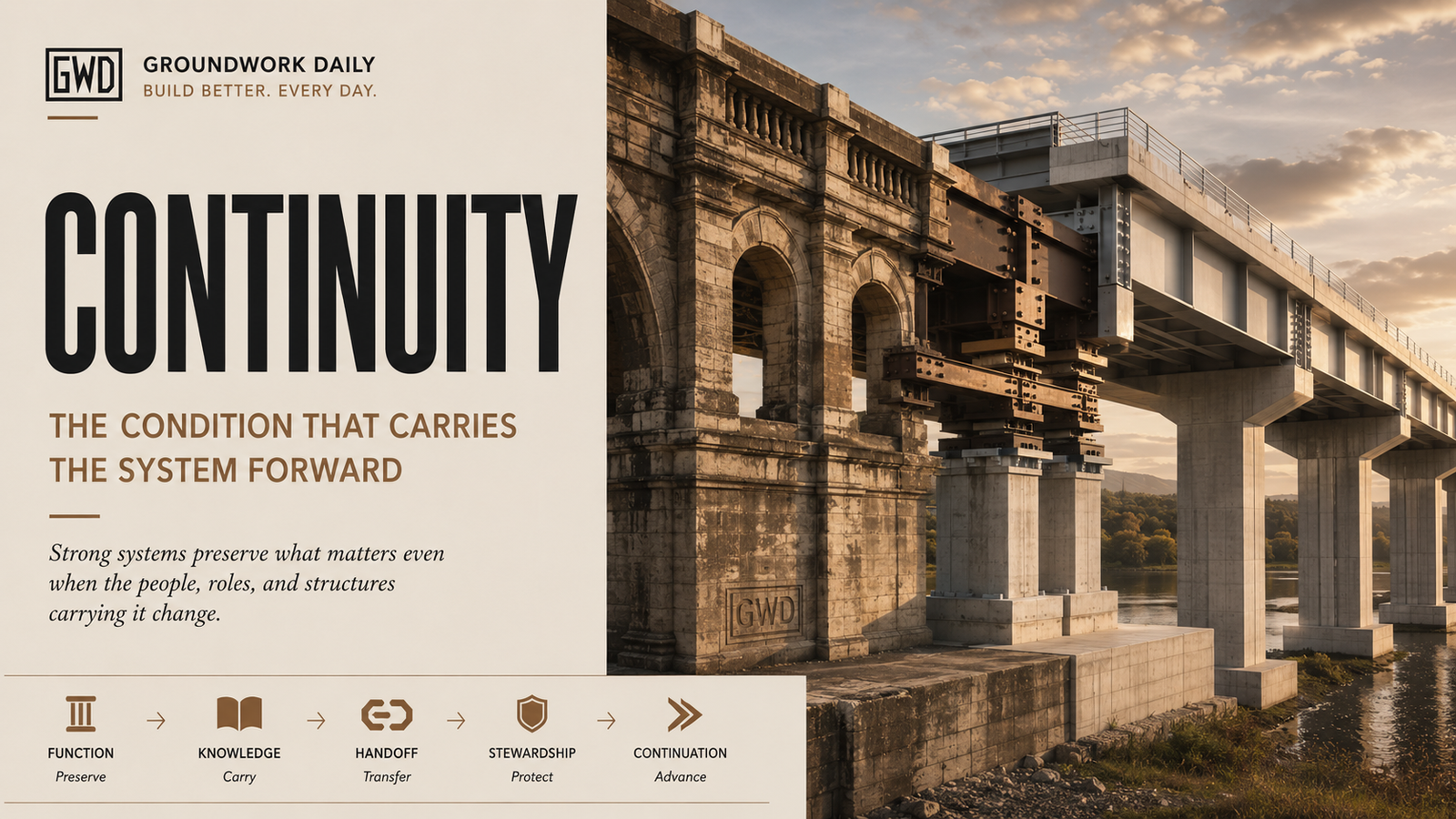
Continuity in strong systems protects what matters when the person, role, generation, or structure carrying it changes.
Groundwork Foundation / The Conditions
Every system eventually faces a handoff. Leaders leave. Employees move on. Families change. Institutions replace technology. Responsibilities shift from one person to another.
Change itself is not the problem. However, a system becomes fragile when essential knowledge, standards, relationships, or responsibilities disappear with the person who carried them.
Continuity is the ability of a system to preserve essential function, knowledge, standards, and purpose when the carrier changes.
The Groundwork Definition of ContinuityTherefore, continuity is not about keeping everything the same. It is about making sure that what must continue can survive transition.
01 / The Transfer Problem
Continuity in Strong Systems Begins Before the Handoff
Weak systems often confuse stability with permanence. If the same person keeps solving the problem, the system appears stable.
Yet that stability may be borrowed.
A capable employee may hold years of undocumented knowledge. Likewise, one parent may understand every household process. A founder may carry every critical relationship. A technician may be the only person who knows why an old system works.
As long as those people remain available, the weakness stays hidden.
The hidden dependency
This is why continuity work starts early. A handoff cannot transfer knowledge that was never captured. Nor can a successor inherit authority that was never clearly defined.
In other words, continuity is built while the current system is still working.
02 / When the Carrier Becomes the System
Continuity Fails When Too Much Lives in One Place
Most continuity failures do not begin on the day someone leaves. Instead, they develop slowly as knowledge and authority become concentrated.
Knowledge
Only one person knows how it works
Processes may exist in practice but remain undocumented, unshared, or difficult for another person to reproduce.
Relationships
Trust belongs to the individual
Clients, partners, vendors, or community relationships may depend almost entirely on one personal connection.
Authority
No one knows who decides next
When authority is unclear, transition creates delay, conflict, and competing interpretations of responsibility.
Standards
The standard lives in someone’s head
Quality can fall quickly when expectations were understood personally but never translated into a shared operating standard.
The cost appears during transition
Eventually, the carrier changes. At that point, hidden concentration becomes visible as lost knowledge, broken relationships, inconsistent decisions, or stalled work.
The departure did not create the weakness. It exposed it.
03 / The Groundwork Continuity Model
Strong Continuity Moves Through a Deliberate Sequence
A reliable transition needs more than a replacement person. It needs a transfer architecture.
The Groundwork Continuity Model
01 / Function
Identify what must continue
Begin with the essential outcome. Not every habit or method deserves preservation.
02 / Knowledge
Make the operating knowledge transferable
Capture the information, judgment, relationships, standards, and context needed to reproduce the function.
03 / Handoff
Create overlap between carriers
Whenever possible, the outgoing and incoming carriers should share responsibility before the transfer is complete.
04 / Stewardship
Protect what matters without freezing the method
The next carrier inherits responsibility for the function, not an obligation to imitate every previous practice.
05 / Verification
Test whether the transfer worked
A handoff is incomplete until the receiving structure can perform without hidden dependence on the previous carrier.
06 / Continuation
The system moves forward
The carrier changes, yet essential function, knowledge, standards, and purpose remain available.
04 / The Handoff
A Strong Handoff Creates Overlap Before Separation
Many transitions are designed badly. One carrier stops, and another is expected to begin immediately.
That creates a hard break.
By contrast, strong continuity creates a period of overlap. During that period, knowledge moves, judgment becomes visible, and the receiving carrier begins performing the work.
Current Carrier
Carry + Explain
The current carrier performs the function while making the logic, standards, risks, and relationships visible.
Next Carrier
Learn + Perform
The receiving carrier gradually assumes responsibility while questions can still be answered and mistakes can still be corrected.
Overlap creates verification
Most importantly, overlap exposes missing information before the transfer becomes irreversible.
Therefore, redundancy during transition is not waste. It is a control mechanism.
05 / Institutional Memory
Knowledge Must Become Larger Than the Person Who Holds It
Documentation matters, but continuity requires more than a folder of instructions.
Some knowledge is explicit. For example, schedules, passwords, procedures, contracts, specifications, and contact lists can be recorded directly.
Context must travel too
Other knowledge is harder to capture. Why was a particular decision made? Which exception matters? Where does a process usually fail? Which relationship requires extra care?
That context often determines whether written instructions are useful.
Make knowledge usable
As a result, strong systems combine documentation with observation, practice, conversation, and supervised responsibility.
The goal is not merely to store knowledge. The goal is to make it usable by someone else.
06 / Succession
Succession Is a Continuity System, Not a Replacement Search
Succession is often discussed too late. A departure becomes likely, and only then does the organization ask who comes next.
That approach treats succession as recruitment.
In reality, recruitment solves only one part of the problem.
Preserve the function, not the personality
A strong succession process identifies the role’s essential functions, decision rights, relationships, knowledge, standards, and unresolved risks.
Then the system determines what must transfer and what should change.
Replacement asks: Who will occupy the position?
Continuity asks: What must remain functional when the position changes hands?
The second question produces a stronger institution because it separates the mission of the role from the identity of the person currently performing it.
07 / Real Life
Continuity Matters Far Beyond Organizations
The same architecture appears anywhere responsibility must survive a change in carrier.
Households
Shared operating knowledge
Bills, appointments, accounts, maintenance, caregiving, and emergency information should not depend entirely on one person.
Work
Roles that can survive turnover
Processes, relationships, authority, and operating knowledge need enough structure to survive staffing changes.
Leadership
Authority that can transfer cleanly
Institutions need clear decision rights and succession paths before leadership changes become urgent.
Community
Knowledge that outlives one generation
History, relationships, practices, and civic knowledge need deliberate transmission or they disappear between generations.
Continuity protects against concentration
In every case, the underlying principle is the same. Essential function becomes safer when knowledge and responsibility can move without disappearing.
08 / Diagnostic Framework
The Groundwork Continuity Test
A simple test can reveal whether a system is genuinely prepared for transition.
Function: What absolutely must continue?
Separate essential outcomes from habits, preferences, and methods that can change.
Concentration: Where does critical knowledge live?
Identify information, relationships, authority, or judgment that depends too heavily on one carrier.
Transfer: Could another person reproduce the function?
Documentation alone is not enough. Test whether another capable person can actually perform the work.
Overlap: Is there time to learn before the handoff?
Build enough shared responsibility to expose gaps while the current carrier is still available.
Verification: Can the next carrier operate independently?
Confirm that the receiving structure can carry the function without hidden dependence on the previous one.
If several answers are weak, the system has a continuity problem even if current performance still looks strong.
09 / Continuity and Durability
Durability Keeps the System Holding. Continuity Carries It Forward.
These conditions belong beside each other, but they solve different problems.
Durability
Can it keep holding?
Durability concerns repeated load, wear, maintenance, reinforcement, and dependable performance over time.
Continuity
Can what matters move forward?
Continuity concerns transfer when the person, role, generation, technology, or structure carrying the function changes.
A durable system may still have poor continuity. For example, an organization can operate successfully for decades while depending on knowledge held by one leader.
Conversely, continuity protects the system when that carrier eventually changes.
Explore Durability: The Condition That Keeps the System Holding Over Time for the companion framework.
10 / The Conditions Work Together
Continuity Depends on the Architecture Built Before It
Continuity cannot compensate for a system that was never organized clearly in the first place.
Structure
Organizes
Roles and relationships must be clear enough to transfer.
Standards
Define
The next carrier needs to know what acceptable performance looks like.
Discipline
Maintains
Repeated practice turns knowledge into a stable operating pattern.
Accountability
Corrects
Feedback keeps inherited standards from drifting during transition.
Alignment
Coordinates
Purpose and priorities help the next carrier understand what the system is trying to protect.
Boundaries
Define responsibility
Clear limits establish what authority and responsibility actually transfer.
Later conditions protect continued function
Repair restores function after damage. Resilience allows the larger system to recover after disruption. Durability keeps it dependable through repeated use and time.
Finally, continuity makes sure those capabilities do not disappear when the carrier changes.
11 / Core Principle Connection
Continuity Is Part of Building What Holds
Build What Holds
A structure is not truly durable if its essential function disappears the moment one carrier leaves.
Therefore, building what holds also means building what can be handed forward.
Strong systems preserve enough knowledge, structure, standards, and responsibility for another capable carrier to continue the work.
The strongest institution is not the one that makes one person indispensable. It is the one that makes essential purpose transferable.
12 / Put the Condition to Work
How to Build Continuity Into a System
Do not begin with a succession document that no one uses. Instead, begin with the places where failure would hurt most if the current carrier became unavailable.
Identify essential functions
Name the outcomes that must continue regardless of who performs the work.
Find concentrated knowledge
Look for decisions, relationships, processes, credentials, access, or context that only one person understands.
Document the operating logic
Capture not only what happens, but also why it happens, where judgment is required, and which exceptions matter.
Create a second carrier
Cross-train another capable person before the transition becomes urgent.
Practice the handoff
Let the next carrier perform the function while support and correction are still available.
Verify independent function
Confirm that the system can continue without quietly routing every difficult decision back to the former carrier.
These steps make continuity operational rather than ceremonial.
Continue Building
Continuity Belongs to a Larger System
The Conditions are not isolated virtues. Together, they describe what strong systems require in order to organize, perform, correct, recover, endure, and continue.
→ Previous Condition: Durability: The Condition That Keeps the System Holding Over Time
→ Recovery: Resilience: The Condition That Allows the System to Recover
→ Restoration: Repair: The Condition That Restores Function After Damage
→ Core Principle: Build What Holds
→ Foundation: Structure Builds Freedom
The Groundwork
The Carrier Will Change
People leave. Roles evolve. Generations turn over. Technology changes. Leadership passes. Eventually, every system meets transition.
The question is whether the transition takes the system’s essential knowledge and function with it.
Continuity does not preserve the carrier forever.
It preserves what must keep moving after the carrier changes.
Build better. Every day.