The Groundwork Conditions
The structural requirements that allow systems to function, adapt, and endure.
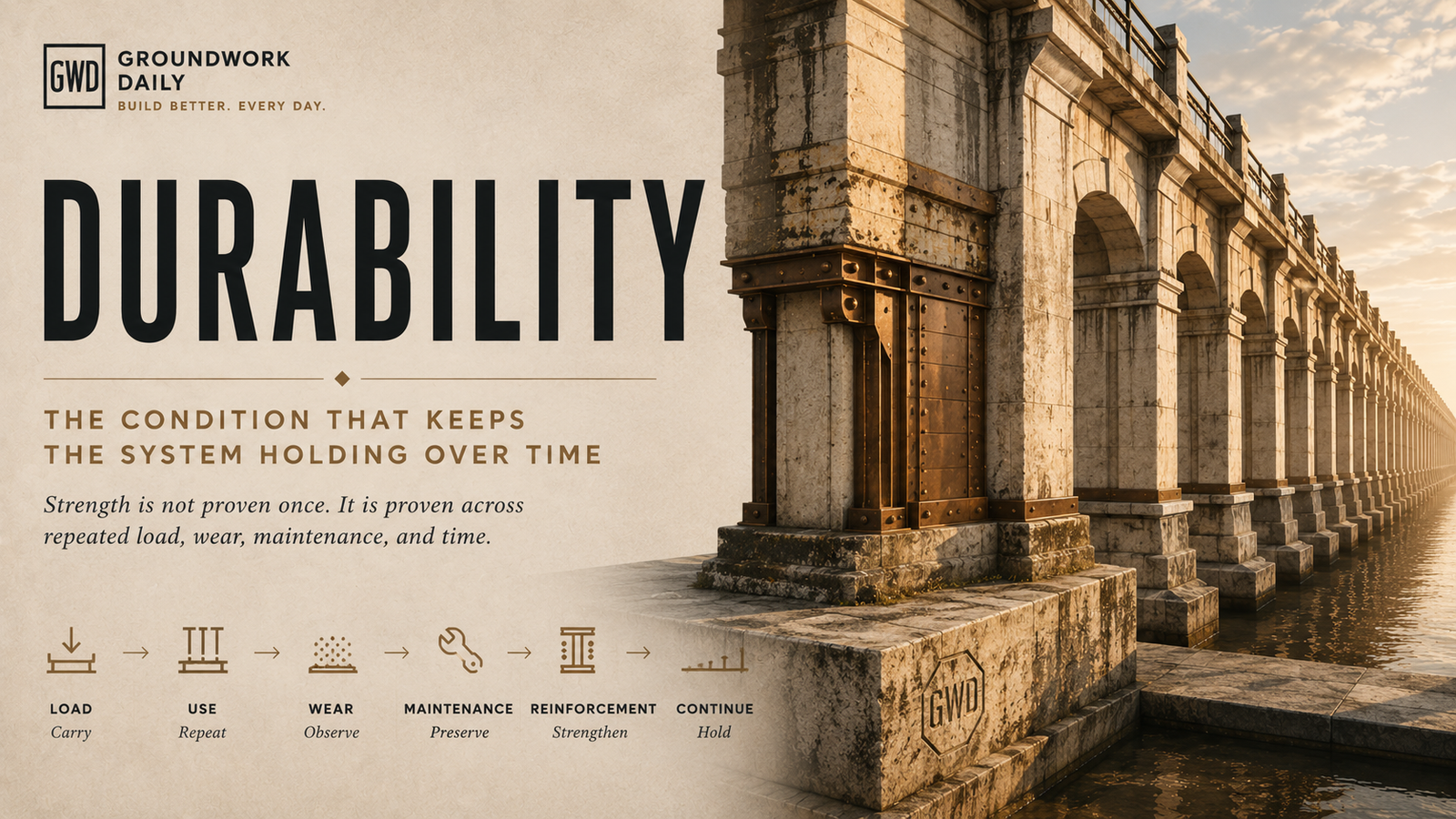
Durability is the condition that allows a system to keep carrying useful load across repeated use, wear, maintenance, change, and time. Rather than requiring a system to remain untouched, durability measures whether it can remain dependable while normal deterioration is noticed and managed.
New systems can look strong because time has not tested them yet. Eventually, however, repetition exposes weak joints, neglected maintenance, outdated assumptions, and hidden dependencies.
People change. Materials wear. Policies age. Relationships collect history. Organizations grow beyond the processes that once supported them.
Consequently, durability is what remains after novelty disappears.
Groundwork Definition
Durability is the ability of a system to preserve essential function across repeated load, use, wear, maintenance, environmental change, and time without quietly degrading beyond dependable performance.
Within The Groundwork Conditions, Durability follows Resilience. Resilience determines whether a system can recover after disruption. Durability extends the test by asking whether that same system can keep holding through ordinary demand year after year.
The Function
Durability Turns One-Time Strength Into Dependability
A system can work beautifully once. That proves far less than people often assume.
By contrast, durable systems earn trust through repetition. They continue to perform after attention fades, circumstances shift, and maintenance becomes less exciting than expansion.
Repeated Use Is a Different Test
During the first month of a new process, everyone may pay close attention. Likewise, a new budget may work because motivation is high, while a fresh relationship agreement may hold because the conversation is still recent.
Over time, though, ordinary pressure returns. That is when durability becomes visible.
Time Exposes Hidden Costs
Small inefficiencies become recurring expenses. Minor maintenance gaps compound. Informal workarounds gradually become standard operating procedure.
Meanwhile, corrections that once seemed optional become increasingly expensive.
Dependability Requires Maintenance
For that reason, durable systems are inspected, adjusted, repaired, renewed, and reinforced before normal wear becomes structural failure.
Structural Sequence
The Conditions Now Move From Recovery Into Long-Term Holding
Structure organizes, while Standards define what must hold. Discipline maintains the pattern, and Margin protects reserve. Capacity carries the load.
From there, Accountability corrects drift. Discernment weighs competing considerations, Alignment coordinates the parts, and Boundaries contain the system. Repair restores damaged function, while Resilience enables recovery.
Finally, Durability asks whether that entire architecture can continue working across time.
Why Durability Comes After Resilience
Resilience measures recovery after disruption. Durability, however, measures performance across the longer horizon of repeated use, routine stress, maintenance cycles, and change.
Recovery matters, but so does everything that happens between disruptions.
The Groundwork Durability Model
Durability Is Maintained Through a Long-Term Cycle
Durable systems do not eliminate wear. Instead, they recognize it early enough to preserve function.
The Groundwork Durability Model
Load Gives the System Something to Carry
Work, responsibility, traffic, conflict, financial obligation, leadership, caregiving, and everyday use all create load.
Use Turns Load Into Repetition
Because useful systems perform the same core functions repeatedly, each cycle places another small demand on the structure.
Wear Records the Cost of Repetition
Materials age, people tire, and processes collect friction. Similarly, policies lose relevance and relationships accumulate unresolved history if maintenance is ignored.
Maintenance Interrupts Degradation
Inspection, rest, review, replacement, renewal, and repair all protect the system before a small problem becomes an expensive one.
Reinforcement Responds to What Time Reveals
Sometimes maintenance is not enough. In those cases, the system needs stronger joints, revised processes, deeper staffing, improved documentation, larger reserves, or clearer boundaries.
Continued Function Is the Test
Ultimately, durability is proven when useful performance remains available after the system has been used long enough for wear to become visible.
Necessary Distinction
Durability Is Not the Same as Permanence
Nothing useful stays unchanged forever. Therefore, durable systems must be allowed to evolve.
Permanence
Remain unchanged
Permanence imagines that strength means resisting alteration indefinitely.
Durability
Remain dependable
Durability accepts maintenance, replacement, adaptation, and reinforcement when those changes protect essential function.
Change Can Protect the Original Purpose
A building may replace worn systems while preserving its use. Likewise, an institution can change leadership while protecting mission, and a relationship can revise routines while maintaining commitment.
In each case, the method changes so the important function can continue.
Wear
Wear Is Information
Repeated use always leaves evidence. Instead of treating that evidence as an inconvenience, durable systems read it.
Wear Shows Where Load Concentrates
Perhaps the same employee absorbs every emergency. Elsewhere, one process may require constant manual correction, while the same budget line repeatedly overruns.
In relationships, recurring conflict can reveal another form of concentrated wear.
Wear Often Appears Before Failure
Slow responses, rising errors, fatigue, repeated complaints, deferred upkeep, and growing resentment can all function as early warning signals.
Therefore, those signals should be read before the system reaches failure.
Ignored Wear Becomes Degradation
Once small problems compound, the eventual correction becomes more expensive and more disruptive.
Groundwork Rule
Wear is not evidence that the system failed. Ignored wear is evidence that maintenance failed.
Maintenance
Durable Systems Budget for Maintenance Before Failure
Maintenance is easy to postpone because successful maintenance rarely produces a dramatic moment.
When it works, nothing catastrophic happens. That quiet result is the value.
Maintenance Protects Existing Strength
Rest protects physical capacity. Financial reviews protect cash flow. Process reviews protect operational reliability.
Similarly, relationship check-ins can protect communication before resentment becomes harder to repair.
Maintenance Requires Margin
Systems operating at full load usually sacrifice maintenance first. For that reason, Margin is not wasted space.
Some reserve must remain available so the system can preserve itself.
Deferred Maintenance Borrows From the Future
Skipping maintenance can make a system appear more productive today. Eventually, however, tomorrow inherits both the original task and the accumulated damage.
Reinforcement
Maintenance Preserves. Reinforcement Improves What Time Exposes.
Some weaknesses cannot be solved by preserving the original design.
Repeated Wear Can Reveal Underbuilding
When the same joint fails again, the deeper problem may be structural rather than procedural.
Growth Can Outrun the Original Architecture
For example, a small organization may function with informal systems that become dangerous at larger scale.
In the same way, a household may need stronger financial controls as income, property, caregiving, or other obligations increase.
Reinforcement Responds to Reality
Additional support, better tools, larger reserves, improved processes, stronger boundaries, or clearer authority can make the system more durable.
Maintenance and Reinforcement
Maintenance protects what still works. Reinforcement changes what no longer carries the load well enough.
Recovery and Longevity
Resilience and Durability Protect Different Time Horizons
These Conditions belong beside each other. Even so, they answer different questions.
Resilience
Can the system recover after disruption?
Resilience protects recovery through shock absorption, stabilization, restored capacity, adaptation, and continuation.
Durability
Can the system remain dependable across time?
Durability protects long-term function through maintenance, reinforcement, renewal, and controlled response to wear.
A System Can Be Resilient but Not Durable
It may recover quickly from emergencies while repeatedly creating the same emergencies because routine maintenance remains weak.
Durable Systems Still Need Resilience
Conversely, long service does not eliminate unusual disruption. A durable system still needs enough resilience to recover when conditions exceed the ordinary pattern.
Load and Longevity
Durable Systems Respect Capacity
Every system lasts longer when normal operation remains inside what it can reliably carry.
Overload Accelerates Wear
A system may technically survive a heavy load while aging much faster because of it.
Capacity Protects the Long View
Capacity asks what a system can reliably carry without unacceptable degradation.
Durability adds another dimension: how often can that load be carried before useful life begins shrinking?
Maximum Output Can Reduce Future Output
Constant overtime may increase production this month but increase turnover next quarter. Similarly, aggressive financial leverage may increase growth today while reducing future room for error.
Long-Term Load Test
Repetition
Discipline Maintains the Standard. Durability Tests Whether the Pattern Still Works.
Discipline creates repeated behavior. Durability then asks whether that repeated behavior continues to serve the system.
Repetition Can Preserve or Degrade
Useful habits can strengthen through repetition. Yet bad processes become institutionalized through repetition too.
Durable Discipline Includes Review
Therefore, a mature system preserves useful standards without confusing an old method with a permanent truth.
A process deserves to continue because it still works, not simply because it has always existed.
Repair Across Time
Repair Becomes Part of Durability When the Lesson Stays in the Structure
Repair can restore function after damage. Durability goes further by preserving what the repair taught.
Repairs Should Leave Institutional Memory
Documentation, revised standards, maintenance schedules, changed controls, and stronger boundaries can prevent the same failure from returning.
Repeated Repair Signals a Deeper Problem
If the same part keeps failing, the system should stop congratulating itself for fixing it quickly.
Instead, leadership should ask why the weakness keeps returning.
Structural Warning
A system that repeatedly repairs the same weakness without changing the underlying architecture is maintaining failure, not durability.
Application
Durability Operates at Every Scale
Different systems wear differently. Nevertheless, the structural question stays consistent: can useful function survive repeated demand, maintenance, change, and time?
| Domain | Repeated Load | Wear Signal | Maintenance | Durability Test |
|---|---|---|---|---|
| Personal | Work, commitments, routines, stress | Fatigue, inconsistency, declining judgment | Rest, review, boundaries, recovery | Can life remain functional without repeated collapse? |
| Financial | Bills, debt, lifestyle, emergencies | Shrinking savings, rising fixed costs, recurring shortfalls | Budget review, reserves, cost control | Can financial stability survive changing conditions? |
| Relationships | Conflict, caregiving, responsibility, change | Resentment, avoidance, unresolved tension | Communication, repair, boundaries, reciprocity | Can trust remain usable across seasons? |
| Households | Caregiving, logistics, maintenance, expenses | Concentrated labor and deferred upkeep | Redistribution, scheduling, financial reserve | Can the household function as demands evolve? |
| Organizations | Operations, staffing, clients, growth | Turnover, rework, outages, knowledge loss | Training, documentation, staffing, system renewal | Can performance remain dependable beyond one team? |
| Institutions | Leadership cycles, public pressure, governance, mission | Mission drift, personality dependence, obsolete controls | Governance review, succession, institutional memory | Can the institution remain useful across generations? |
Failure Patterns
How Durability Breaks Down
Maintenance Becomes Optional
When every available resource goes toward visible output, maintenance is usually the first thing postponed.
Wear Becomes Normal
Over time, declining performance can become familiar enough that nobody treats it as evidence of degradation.
The Original Design Becomes Sacred
Methods remain unchanged even after scale, evidence, technology, or operating conditions shift.
One Person Becomes the Maintenance System
In fragile organizations, one person often remembers every exception, repairs every workaround, and fills every undocumented gap.
Replacement Happens Too Late
Eventually, maintenance cannot preserve every component. Waiting until complete failure usually increases cost and disruption.
Success Hides Degradation
Output may remain strong while the effort required to produce it keeps rising.
Structural Warning
A system can still be producing while it is quietly losing durability. Output is not the same as structural health.
Practical Tool
The Groundwork Durability Audit
Use this audit while the system still appears healthy. After all, durability is cheapest to protect before visible failure arrives.
What load does this system carry repeatedly?
Where is repeated use creating visible wear?
Which maintenance tasks protect critical function?
Which maintenance has been repeatedly deferred?
What is being held together by one person, workaround, or informal habit?
Which component now needs reinforcement rather than another small repair?
What part of the original design no longer fits current conditions?
What should be replaced before failure forces the decision?
Can the system function if the person who knows all the workarounds leaves?
What evidence would show declining reliability even if output still appears acceptable?
What the Audit Reveals
In practice, durability problems often appear first as maintenance debt, repeated workarounds, concentrated knowledge, rising effort, and declining reliability.
The audit turns those quiet signals into visible decisions.
Institutional Application
Institutions Become Durable When the Mission Can Survive the People
Institutional age should not be confused with institutional durability. An old organization can remain remarkably fragile.
Knowledge Must Outlive Individual Memory
Important processes, obligations, relationships, decisions, and standards should remain accessible after one person leaves.
Governance Must Survive Leadership Change
Authority should stay understandable when executives, board members, founders, or senior staff transition.
Mission Must Be Stronger Than Habit
Durable institutions preserve purpose while allowing outdated methods to change.
Maintenance Must Become Institutional
Facilities, technology, policies, financial controls, workforce development, succession, archives, and governance all require renewal.
For a larger treatment of these systems, explore the Governance Structure Hub.
The Groundwork
What Lasts Is Maintained
Durability is easy to romanticize. Old buildings, enduring relationships, and long-lived institutions can make longevity look almost mystical.
Usually, the explanation is more practical.
Somebody Inspected the Structure
Wear was noticed before it became failure.
Somebody Repaired the Damage
Problems were addressed instead of being normalized.
Somebody Replaced What Had Reached Its Limit
Preserving the whole sometimes requires retiring a part.
Somebody Reinforced What Time Exposed
Additional support entered where the original architecture proved insufficient.
Somebody Allowed the Method to Change
As a result, the purpose survived even when the operating method evolved.
Core Principle Connection
Durability Is the Long Test of Build What Holds
Groundwork Daily Core Principle
Build What Holds
A strong structure must do more than survive construction. Eventually, load, weather, repair, changing conditions, and time all test the original design.
Build What Holds asks whether the system can carry real life. Durability asks whether that answer remains true later.
External Context
Durable Infrastructure Is Designed Around Life-Cycle Performance
Infrastructure disciplines do not judge strength only when something is installed. Instead, they consider service life, inspection, deterioration, maintenance, repair, replacement, and continued performance.
The same systems logic applies beyond physical infrastructure because every useful system accumulates wear.
The Larger Architecture
Durability Works Inside a Larger System
Durability cannot replace Structure, Standards, Discipline, Margin, Capacity, Accountability, Discernment, Alignment, Boundaries, Repair, or Resilience.
Instead, it becomes the long-term test of whether those Conditions continue doing their work.
Structure
Organizes.
Standards
Define.
Discipline
Maintains.
Margin
Protects.
Capacity
Carries.
Accountability
Corrects.
Discernment
Weighs.
Alignment
Coordinates.
Boundaries
Contain.
Repair
Restores.
Resilience
Recovers.
Durability
Holds.
Continuity
Carries forward.
Explore the complete architecture: The Conditions: What Strong Systems Require to Hold .
Next
Continuity: The Condition That Carries the System Forward
Durability asks whether a system can keep holding over time. Continuity takes the final step by asking whether knowledge, authority, responsibility, standards, relationships, and purpose can survive transition from one person, season, or generation to the next.
Further Groundwork
Continue Through the Conditions Architecture
The Groundwork
Time Is Part of the Test
A system can be brilliant at launch and elegant while new. It can even survive one major crisis.
Even so, ordinary neglect can eventually make that same system unreliable.
Durability therefore asks the longer question. Does the system notice wear? Does it leave room for maintenance? Can it reinforce what time exposes?
Just as important, can worn parts be replaced without losing the larger structure?
In the end, dependability is proven by whether the system remains useful after years of being asked to do its job.
What lasts is not what never wears.
What lasts is what can be maintained well enough to keep holding.
Build better. Every day.