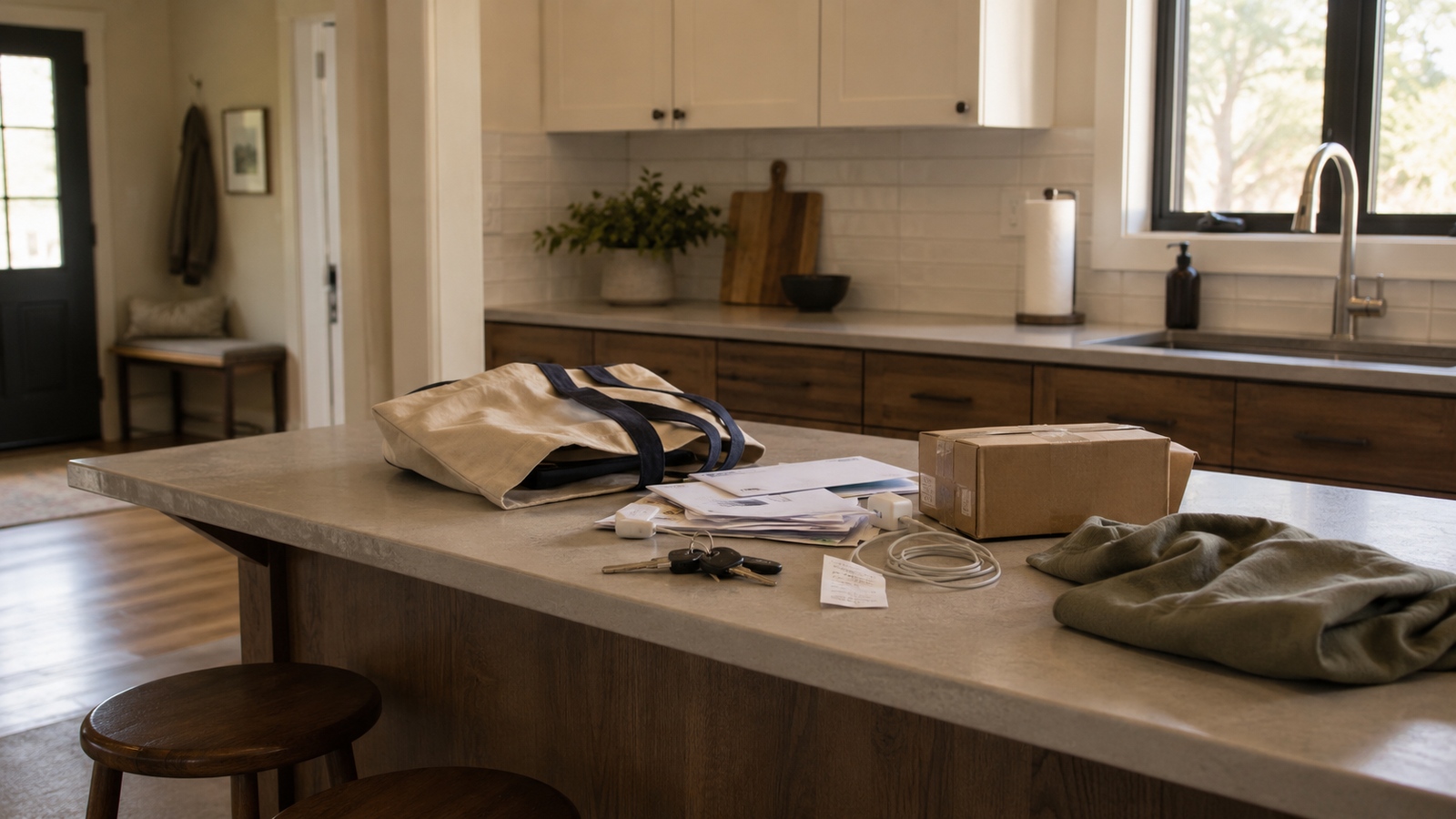
Kitchen counter clutter often appears because one convenient surface has become the landing point for several unfinished household actions. Mail arrives. Keys come through the door. One package needs to be opened. A charger belongs in another room, while a receipt still requires a decision. None of these objects belongs together, yet they repeatedly meet in the same place.
The kitchen may otherwise be orderly. Dishes are put away, the sink is clear, and cabinets close properly. Food preparation still happens without much trouble. Even so, one section of the counter keeps filling after every reset.
That repetition matters.
What the surface reveals is a system.
Why Kitchen Counter Clutter Becomes a Landing Zone
Location explains part of the pattern. A kitchen counter often sits along one of the busiest paths in the home. Someone enters carrying mail, a phone, keys, sunglasses, a water bottle, or a shopping bag. The counter offers a flat surface before the next action has been decided.
Convenience wins quickly.
The first object rarely creates a problem. A set of keys takes almost no room. Then a letter lands beside them because it needs attention later. A return package follows because the label still needs printing. Soon, the counter is holding several different categories of work.
Nothing about the arrangement was planned.
Yet repetition gives it structure.
Once a surface becomes known as the easiest place to put something temporarily, the household begins using it for exactly that purpose. The counter starts absorbing every object whose next destination is unclear.
Most Counter Clutter Is Waiting for Another Action
Look closely at the objects that repeatedly collect there. Many are not simply misplaced. They are unfinished.
A package needs opening. Mail requires sorting. One receipt needs filing or discarding. The reusable bag should return to the car. Medication may need to remain visible until tomorrow morning, while a charger belongs upstairs even though someone expects to need it again tonight.
Each object carries a next step.
That is why putting everything away can feel strangely difficult. The household is not only moving objects. It is deciding what happens next.
The Object Is Holding a Task
An unopened envelope is both paper and a decision. A return box is both cardboard and an errand. Keys are both an object and preparation for the next departure.
When several unfinished actions occupy one surface, the counter becomes a physical task list.
This is an important distinction because storage alone cannot solve it. A basket may hide the objects, but it does not complete the actions attached to them.
The basket can become another waiting room.
The Kitchen Counter Becomes Household Memory
Some items remain on the counter because visibility feels safer than storage.
If the return package goes into a closet, someone may forget to send it. A form placed inside a drawer can disappear from attention before its deadline. Medication moved away from the usual morning path may also become easier to overlook.
Visibility becomes a reminder system.
That system works in the short term. The object stays noticeable, so the task stays noticeable. However, the method becomes weaker as more reminders compete for the same surface.
One visible object can signal clearly. Ten visible objects create a field of competing signals.
What Research Suggests About the Home Environment
Research on home environments supports caution around broad claims, but it does show that the way people experience their surroundings can relate to stress. A study indexed by the National Library of Medicine found associations between more stressful descriptions of home environments and daily mood and cortisol patterns among participating couples. Separately, the American Psychological Association has described how visual clutter competes for attention and can add to a household’s background stress load.
The useful House Rhythm point is narrower: surfaces communicate. When a counter carries several unfinished tasks at once, the room asks for more attention than the surface itself should require.
Kitchen Counter Clutter Often Starts Somewhere Else
The counter may be where the problem appears, but the breakdown often starts upstream.
Mail reaches the kitchen because the entry sequence has no reliable destination for it. Keys arrive because the doorway lacks a trusted landing point. Shopping bags remain because unloading and returning them are treated as separate events.
The surface is catching weak transitions.
That explains why some counters refill within hours of being cleared. The household removed the evidence but kept the path that created it.
Watch the Route Into the House
A useful audit begins before the kitchen.
Notice what enters through the door. Track where keys naturally leave the hand. Watch where mail gets opened. See where bags stop after shopping. Follow packages after delivery.
The objective is not to force every household into the same arrangement. Instead, the structure should match the route people already use.
If the kitchen sits directly inside that route, the household needs better destinations before the counter becomes the default.
Why Clearing Kitchen Counter Clutter Does Not Last
A fast countertop reset can make a kitchen look better immediately. That has value. Preparation space returns, the room feels lighter, and the next meal becomes easier to begin.
Still, clearing alone does not explain recurrence.
If five objects return tomorrow, the household needs to examine why those same objects keep choosing the surface.
Recurrence Is the Real Signal
Consider mail. Moving today’s stack into another room creates a clear counter. Yet tomorrow’s mail will still arrive. Unless the household assigns a place and a processing sequence, another stack begins.
The same logic applies to packages, keys, receipts, chargers, and items waiting to leave the house.
Repeated clearing treats the output.
A stronger system changes the input.
Give Repeating Objects a Clear Destination
Objects that arrive repeatedly need destinations that match their actual use.
Keys may need a hook or tray near the entrance. Incoming mail may need one defined location until it gets processed. Return packages may need a departure zone closer to the door rather than the kitchen.
Chargers require a different answer. If the same cable repeatedly appears on the counter because someone uses it there, perhaps that location legitimately needs a charger. When a cable merely migrates through the room, however, it needs a reliable home somewhere else.
The system should follow behavior.
Do Not Create More Storage Than the Problem Needs
Organization products can make a weak system look impressive without improving how it works.
Five labeled bins are unnecessary when one tray and one weekly decision point will do. A large counter organizer can also consume the preparation space the household is trying to recover.
Start with the recurring object, not the container.
Ask where the item enters, what action follows, and where it should finish. Then build the smallest structure that supports that sequence.
Less infrastructure often works better.
Protect the Counter From Becoming Permanent Storage
A kitchen counter needs a primary job. In most homes, that job involves preparing food, serving meals, cleaning up, or supporting short household tasks.
Temporary use is normal. Permanent occupation is where capacity begins to disappear.
One practical rule can protect the surface: anything placed there temporarily must either leave during the next reset or have a defined reason to remain.
That rule creates a useful distinction between active use and unresolved residue.
Build a Short Closing Sequence
The counter does not need a large nightly project.
A short sequence is enough. Return keys first. Process obvious trash next. Move outgoing items toward the exit, put chargers where they belong, and leave only what supports the next morning or meal.
Five minutes can reveal a lot because recurring objects expose recurring weaknesses.
If the same item survives every reset, stop moving it automatically. Examine the missing system behind it.
What a Stable Kitchen Counter Actually Looks Like
A stable counter does not need to remain empty all day.
Breakfast happens. Groceries arrive. Someone opens a package and may charge a phone while preparing dinner. Normal household activity will temporarily occupy space.
The difference is return.
After the activity closes, the surface becomes available again. Mail moves forward, bags leave, and keys return to their destination. Packaging exits as well. The counter then recovers its primary function without requiring a major cleaning event.
That recovery is the system working.
The strongest sign of order is not permanent emptiness. It is reliable return.
Further Groundwork
The Maintenance Gap: Why Homes Get Harder to RunThe Ritual Audit: Five Questions Every Household Should Ask
Weekly Reset Protocol: Rebuild the System Before It Breaks
Quarterly Reset Protocol: How Homes Drift Without Seasonal Review
Receipts
National Library of Medicine: No Place Like HomeAmerican Psychological Association: Why Clutter Stresses Us Out
What the Counter Reveals
Kitchen counter clutter becomes useful information once the household stops treating every recurrence as another cleaning failure.
The mail points toward a processing gap. Keys reveal a weak arrival sequence, while a package exposes an unfinished errand. Meanwhile, the charger shows where convenience keeps beating its assigned destination.
The surface is evidence.
Once the household fixes the repeated transitions around it, the counter no longer has to serve as storage, memory, task list, and entry station at the same time.
It can return to being a counter.
Build Better. Every Day.
Receive practical essays and grounded frameworks for building stronger household systems, steadier routines, and homes that require less recovery.
Subscribe to Groundwork DailyOne email. No noise. Unsubscribe anytime.