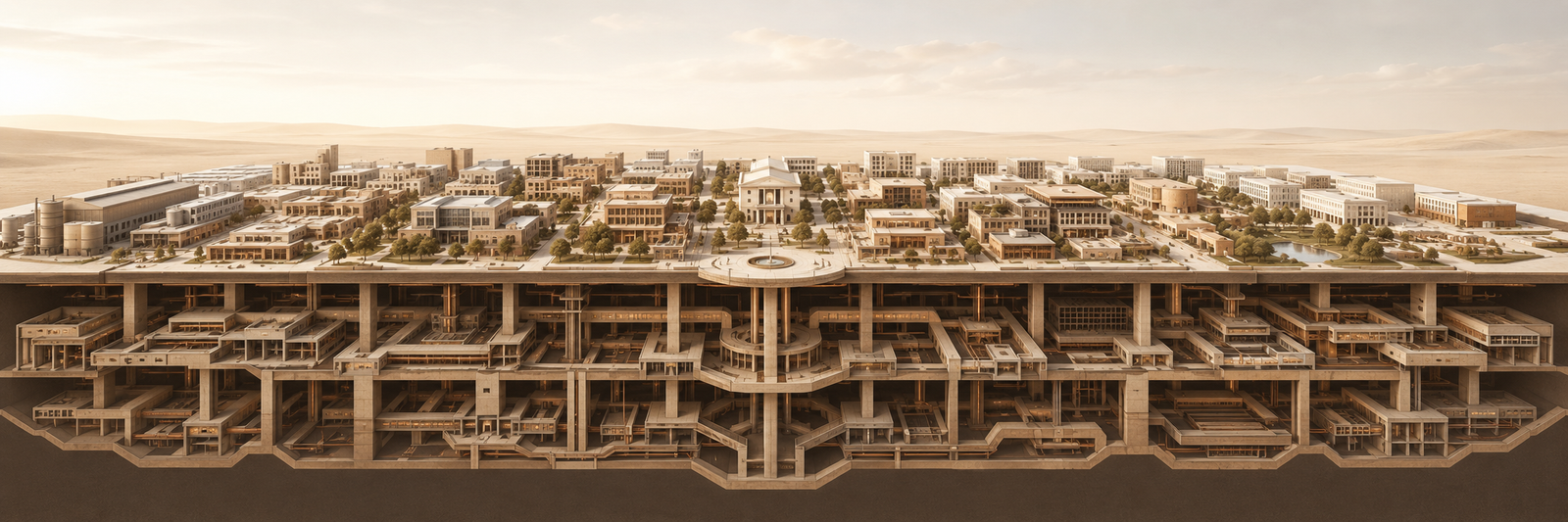
Power & Price is a series about the hidden architecture of economic life.
Most people are taught to earn money. Some are taught to save it. Fewer are taught to study the systems that decide where money settles after it moves. That gap matters because money does not move through the world randomly. It moves through ownership, contracts, property, institutions, supply chains, debt, wages, laws, habits, and trust.
The cash register is only one visible point in a much larger system. A person can see the transaction and still miss the structure. They can see the price and still miss the power. They can see the business and still miss the ownership beneath it.
Power & Price exists to make that system visible.
This is not a personal finance series in the usual sense. It will not tell readers which app to download, which trend to chase, or which shortcut to trust. That work has its place, but this series is built for something deeper. It is a guide to the systems that shape who owns, who produces, who controls access, and who benefits after the transaction ends.
This series asks better questions. Who owns the asset? Who controls access? Who sets the terms? Who captures the margin? Who carries the risk? Who benefits after the cost is paid? Those questions change how the economy looks.
Series principle: Price tells us what something costs. Power tells us who benefits after the cost is paid.
What Power & Price Means
Power & Price begins with a simple distinction. Price is visible. Power is often hidden. Price appears on a shelf, a bill, a lease, a quote, a menu, a loan, or a contract. It tells people what must be paid to gain access.
Power sits underneath that number. It explains why the price exists, who shaped it, who can change it, who can absorb it, and who profits from it. A customer sees the price of a product. An owner sees the margin, the supplier, the lease, the financing, the insurance, the labor cost, the tax exposure, the storage risk, the payment fee, and the customer relationship.
Those are not the same view. One view is transactional. The other is structural. This series trains the structural view. It teaches readers to look beneath the surface of economic activity and ask what kind of system is operating below.
That shift matters because people often mistake activity for power. A busy neighborhood may still lack ownership. A high-income household may still lack assets. A popular business may still lack control over property, supply, financing, or platform access. A consumer movement may create pressure, but pressure is not the same as institution building.
Power & Price is built around that tension. It studies the visible cost and the invisible structure. It treats markets as systems, not just as places where people buy things.
Why This Series Exists
We live in an economy full of motion. People work. People buy. People sell. People subscribe. People rent. People borrow. People deliver. People post. People hustle. People invest. People consume.
Motion is everywhere. However, motion is not the same as ownership. A community can spend heavily and still own very little. A household can earn more and still build weak assets. A neighborhood can be full of businesses and still lack local control. A market can appear open while access remains limited by distribution, financing, scale, and information.
That is the problem this series studies.
Economic life is often explained through individual effort alone. Work harder. Save better. Spend smarter. Start something. Support something. Avoid something. Those actions matter, but they are incomplete without system literacy.
Effort without structure can leak. Spending without ownership can circulate away. Consumer pressure without institutions can fade. A business without supply access can struggle before customers ever arrive. A family without asset protection can build for decades and still lose ground during a crisis.
Power & Price exists because serious economic conversation must move past the surface. The goal is not to dismiss personal responsibility. The goal is to place responsibility inside the systems that shape what responsibility can become.
The Core Problem
The economy is often discussed as if it is only a collection of choices. That is too thin. Choice matters, but choice does not happen in empty space. It happens inside systems that were already built.
Those systems include zoning, credit, leases, supplier access, educational pathways, property ownership, transportation, insurance, regulation, banking relationships, and institutional memory. They also include habits, narratives, trust networks, family expectations, and the rules people inherit before they ever make their first financial decision.
A person may make a wise choice inside a weak structure and still lose ground. A community may spend with intention and still watch value leave. A business may have demand and still collapse under supplier terms, rent pressure, debt cost, or broken logistics.
That is why this series refuses the lazy comfort of saying everything is mindset. Mindset matters. Discipline matters. Behavior matters. But systems decide what those behaviors can become.
The hard truth is simple: better choices do not always create better outcomes when the structure receiving those choices is built to extract, scatter, or redirect value elsewhere. That is not an excuse for passivity. It is a demand for better strategy.
What You Will Learn
This page is the central guide for the series. It organizes the major themes, reading order, and article arcs. Use it as an entry point, a reference map, and a teaching tool.
The series focuses on several connected ideas.
Ownership determines who holds value after money moves.
Markets are shaped by rules, relationships, scale, and access.
The shelf is the final link in a much larger system.
Institutions turn moments into durable capacity.
Communities grow stronger when they retain assets and control.
Trust lowers friction and makes coordinated work possible.
These themes are not separate lanes. They overlap. Ownership without institutions becomes fragile. Institutions without trust become hollow. Trust without standards becomes favoritism. Markets without access become closed systems with open signs. Supply chains without local participation can turn community spending into outside wealth.
That is why the series keeps returning to systems. A strong economy is not built from one isolated idea. It is built from many reinforcing structures.
How to Read Power & Price
Read this series in order when possible. Each article answers a question raised by the one before it. The first arc begins with the individual consumer and moves outward toward neighborhood ownership, supply systems, institutions, trust, and long-term economic design.
The sequence matters because economic literacy compounds. First, readers learn that spending is not ownership. Then they learn that neighborhoods are ownership systems. After that, they see that every store depends on hidden infrastructure. Finally, the sequence shows why consumer power has limits.
From there, the series turns toward trust and long-term ownership systems. This is not accidental. It is a guided build.
Opening Arc: Who Owns the Economy?
The first Power & Price arc asks the foundational question behind the entire series.
Who owns the economy?
Not who participates in it. Not who spends inside it. Not who works hard inside it. Who owns the assets, systems, relationships, and institutions that keep producing value after each transaction ends?
This arc gives readers the core language for understanding economic power. It moves from consumer activity to structural capacity. Too many economic conversations begin and end with buying. The deeper strategy begins with ownership.
- Spending Is Not Ownership
- Who Owns the Neighborhood?
- The Hidden Economy Behind Every Store
- Consumer Power Has Limits
- The Business of Trust
- Building an Ownership Economy That Lasts
1. Spending Is Not Ownership: Why Consumers Rarely Build Wealth
This article establishes the opening distinction. Spending creates movement. Ownership creates position. That single idea becomes the foundation for the series.
A person can spend for years and still own little. A community can generate revenue and still lack wealth. A customer can support an economy without controlling any of the assets that economy depends on.
This article is the best starting point for readers who are new to the series because it clears away one of the most common mistakes in economic conversation. Buying power is not the same as economic power. A transaction may create demand, but ownership determines who holds value after the demand is met.
Read: Spending Is Not Ownership
2. Who Owns the Neighborhood? The Economics Behind Every Community
This article moves from the individual consumer to the neighborhood. A neighborhood is more than the businesses people see from the sidewalk. It is a web of land, buildings, leases, lenders, property owners, institutions, and commercial relationships.
Two neighborhoods can look similar above ground while operating differently underneath. One may retain value locally. Another may generate activity while ownership sits somewhere else.
This article teaches readers to look beneath local commerce and ask where wealth settles. That question is vital because a neighborhood can be culturally rich, commercially active, and socially important while still lacking economic control over its own future.
Read: Who Owns the Neighborhood?
3. The Hidden Economy Behind Every Store
This article moves upstream. A store is not just a store. It is the visible endpoint of supply chains, distribution systems, warehouses, lenders, landlords, logistics, contracts, and inventory decisions.
Customers see shelves. Operators see systems. This article explains why market access matters and why some businesses face structural pressure before the first customer ever walks in.
Here, the series moves beyond the motivational language of entrepreneurship and into the mechanics of competition. A business needs more than demand. It needs access, terms, inventory, pricing power, and operational capacity.
Read: The Hidden Economy Behind Every Store
4. Consumer Power Has Limits. Institution Building Doesn’t.
This article clarifies the role of consumer action. Buying differently can influence demand. Withholding money can create pressure. Supporting better businesses can matter.
However, consumer power cannot replace ownership, financing, training, property control, supply access, and institutional capacity. This article separates signal from structure. It explains why the next step after consumer action must be institution building.
That distinction is crucial. A signal can expose a problem, but an institution must hold the solution. Without institutions, economic pressure often becomes temporary. It may trend, peak, and fade before the structure changes.
Read: Consumer Power Has Limits
5. The Business of Trust: Why Some Communities Build Wealth Faster
This article examines trust as an economic system. Trust is not only emotion. It is infrastructure. It lowers friction, improves coordination, supports repeat business, protects partnerships, and helps institutions function under pressure.
Communities with reliable trust networks can move faster because they do not have to rebuild credibility from scratch every time work begins. Trust becomes a kind of operating system. It helps money, information, labor, and opportunity move with less drag.
However, trust is not softness. It requires standards, accountability, and repeated proof. That is what makes it useful. Sentiment can feel good, but disciplined trust can build.
6. Building an Ownership Economy That Lasts
This cornerstone article brings the full framework together. It asks one central question: what does a durable ownership economy actually require?
The answer includes assets, institutions, supply systems, trust, skill, stewardship, property, financing, governance, and disciplined continuity. In other words, ownership is not one thing. It is an ecosystem.
This article closes the opening arc by showing how the earlier concepts reinforce one another. Spending, neighborhoods, supply chains, institutions, and trust all matter because they determine whether value becomes durable position.
Read: Building an Ownership Economy That Lasts
Next Arc: The Architecture of Wealth
The next arc moves from economic literacy to economic history and structure. If the opening arc asks how ownership works, the next arc asks why wealth systems developed the way they did.
This arc will examine policy, capital flow, institutional design, and the long-term consequences of exclusion from ownership. It will not treat the wealth gap as a mystery. It will treat it as an outcome.
Systems produce results. Repeated rules produce repeated outcomes. Incentives shape behavior. Access shapes ownership. Ownership shapes wealth.
- Buying Power Without Ownership Is Not Wealth
- The Rules Were Written Before We Entered the Market
- Why Money Leaves the Neighborhood So Quickly
- Group Economics Begins With Ownership, Not Spending
Buying Power Without Ownership Is Not Wealth
This article will examine why large consumer spending power does not automatically create lasting wealth. Buying power can influence demand. It can support businesses. It can create market attention.
But without ownership, production, distribution, property, and institutions, buying power often strengthens systems owned by someone else. That does not mean spending choices are meaningless. It means they are incomplete without ownership strategy.
The Rules Were Written Before We Entered the Market
This article will examine how public policy, access, exclusion, and institutional design shaped present economic outcomes. The goal is not to rehearse grievance. The goal is to explain mechanics.
Economic gaps are not only cultural. They are legal, financial, geographic, institutional, and historical. If the rules created the outcome, then serious analysis must study the rules.
Why Money Leaves the Neighborhood So Quickly
This article will explain capital leakage. Money can enter a community and leave almost immediately through rent, debt, suppliers, insurance, franchise fees, platform fees, and outside ownership.
The issue is not only how much money arrives. The issue is how much remains, compounds, and returns with greater capacity.
Group Economics Begins With Ownership, Not Spending
This article will clarify a phrase that is often used too loosely. Group economics is not simply buying from each other. That can be part of it.
But sustainable group economics requires ownership, production, financing, governance, trust, skill, and institutions that can hold assets over time. Anything less is just coordinated consumption.
Major Theme: Ownership
Ownership is the central theme of this series. It changes incentives, time horizons, and who benefits from appreciation, revenue, control, and future opportunity.
Owning a product is not the same as owning the business that sells it. Owning a business is not the same as owning the building it operates from. Owning a building is not the same as owning the financing, supply chain, or platform that shapes the market.
Ownership has layers. Power & Price studies those layers.
The series asks readers to stop treating every transaction as the whole story. The better question is what remains after the transaction is complete. If nothing remains, money only moved. If equity remains, position grew. If skill remains, capacity grew. If trust remains, coordination grew. If an institution remains, the community grew.
That is why ownership is not only a financial question. It is a civic question, a family question, a community question, and a cultural question.
Major Theme: Institutions
Institutions are the containers that hold progress after emotion fades. A campaign can create pressure. An institution can hold responsibility. A trend can create attention. An institution can maintain standards. A leader can inspire action. An institution can survive leadership change.
This is why institution building matters across the series. Without institutions, economic energy often becomes temporary. People gather, react, spend, boycott, support, donate, and share. Then the moment passes.
Institutions turn that moment into structure. They hold assets. They train people. They manage funds. They document decisions. They enforce standards. They preserve memory. They build continuity.
That is how economic strength becomes durable. It is not enough to generate energy. Energy has to be housed somewhere. Otherwise, every generation keeps starting from zero.
Major Theme: Supply Chains
Supply chains explain why the shelf is never the beginning of the story. A product reaches a customer after passing through many layers. Production, sourcing, packaging, freight, warehousing, distribution, financing, insurance, shelf placement, and retail operations all shape the final price.
This matters because opportunity is often controlled upstream. A new business can have eager customers and still struggle if it lacks supplier access, credit terms, storage, logistics, or property stability.
Power does not always sit where the public can see it. Sometimes power sits in the warehouse. Sometimes it sits in the distributor relationship. Sometimes it sits in the financing terms. Sometimes it sits in the lease. Sometimes it sits in the platform.
Supply chains show how markets are built before customers arrive. That is why serious economic strategy cannot stop at the storefront.
Major Theme: Community Wealth
Community wealth is not the same as community spending. Spending can help, but wealth is value retained, governed, transferred, and strengthened over time.
A community builds wealth when it owns productive assets, supports viable businesses, maintains institutions, trains people, preserves property, and keeps economic decisions close enough to remain accountable.
That does not mean every owner must be local. That is too simplistic. Outside capital can help. Local ownership can fail. Familiar people can still exploit. Distant actors can sometimes invest responsibly.
The deeper issue is control, accountability, and retained value. Community wealth grows when residents, institutions, and aligned builders have a real position in the value being created around them.
That position does not appear by accident. It is designed through ownership pathways, capital strategy, land control, business support, trust networks, and governance.
Major Theme: Trust
Trust is one of the least understood economic forces. People often treat trust as a feeling. In economic systems, trust is a form of infrastructure.
Trust reduces friction. It lowers transaction costs. It makes partnerships easier. It allows people to coordinate faster. It helps money, labor, information, and opportunity move with less suspicion.
But trust cannot be demanded. It must be earned through standards. Communities build trust by keeping records, honoring agreements, telling the truth about capacity, paying people on time, resolving conflict with discipline, and correcting failure without spectacle.
Trust is not softness. Trust is structure proven over time. That is why it belongs in an economic series. Without trust, every transaction becomes heavier than it needs to be.
Major Theme: Economic Systems
Power & Price is ultimately about systems. Systems produce patterns. When a pattern repeats, the serious question is not only who made a bad decision. The serious question is what structure keeps producing the same result.
If money keeps leaving a neighborhood, study ownership. If small businesses keep failing before scale, study access. If consumers keep creating demand but not wealth, study assets. If institutions keep collapsing after the founding leader leaves, study governance. If trust keeps breaking, study standards.
Economic systems are not abstract. They show up in rent, wages, debt, prices, inventory, ownership records, school quality, commercial corridors, banking access, and the durability of local institutions.
Systems thinking is not about avoiding responsibility. It is about locating leverage. A person cannot fix what they cannot see. A community cannot build what it cannot name.
How This Series Changes the Conversation
The weak conversation stops at blame. The stronger conversation studies design.
Blame may identify pain, but design identifies leverage. Blame says something is wrong. Design asks what structure keeps making it wrong. That difference matters because economic frustration without structural understanding can become noise.
Noise may feel honest. It may even be justified. But noise alone does not build.
Power & Price pushes the conversation toward buildable questions. What asset is missing? What institution is needed? What financing path does not exist? What skill pipeline is weak? What supply relationship is blocked? What trust standard has broken? What governance container is absent?
Those questions are harder than slogans. That is why they matter. A slogan can gather attention. A buildable question can shape work.
Meet Samual Drayton
Samual Drayton builds the Power & Price series for Groundwork Daily. His territory is Economic Power, Ownership & Leverage, with a focus on markets, ownership, institutions, incentives, pricing, capital, and economic systems.
Samual’s work is not written to flatter easy answers. It is written to clarify structure. The voice is calm, direct, and practical. It treats economic power as something that can be studied, mapped, and built.
The work avoids slogans when systems need explanation. It avoids panic when discipline is required. It also avoids the false comfort of pretending that intention is the same as infrastructure.
The purpose is not to make readers feel smarter for noticing problems. The purpose is to help readers see what must be built next.
Where This Fits in Groundwork Daily
Groundwork Daily is built around a simple idea.
Build better. Every day.
That work begins with personal order, but it does not end there. Personal discipline should strengthen collective life. Internal structure should become public responsibility. What gets built within should help sustain what is built together.
Power & Price extends that philosophy into economic life. It asks how discipline becomes ownership. It asks how ownership becomes institutions. It asks how institutions become community strength. It asks how community strength becomes continuity.
The series belongs in Economy & Ownership, but it touches other Groundwork lanes as well. It connects to family stability, civic design, education, work, culture, and institutional durability.
Money is never only money. It carries values, systems, habits, incentives, and power.
Explore Related Groundwork
Power & Price should be read alongside several Groundwork Daily frameworks. These pieces help readers connect economic systems to behavior, discipline, ownership, and local life.
How Builders Can Use This Page
This page is more than an index. Use it as a reference point.
When writing about money, link here to explain the larger economic system. When writing about institutions, link here to show why ownership and structure matter. When writing about family stability, link here to connect household outcomes to economic position.
When writing about civic life, link here to connect public power with economic infrastructure. When writing about work, link here to show how labor connects to ownership, skills, and institutions.
This page is the canonical home for the Power & Price framework. The tag archive collects the articles. This page explains the architecture.
Frequently Asked Questions
What is Power & Price?
Power & Price is Groundwork Daily’s series on ownership, markets, institutions, supply chains, and economic systems. It explains how money moves, who controls economic structures, and why ownership shapes long-term prosperity.
Is Power & Price a personal finance series?
No. It may help readers think more clearly about money, but it is not a standard personal finance series. It focuses on economic systems, ownership, institutions, leverage, and market structure.
Where should new readers start?
Start with Spending Is Not Ownership . That article introduces the core distinction between consumption and ownership.
Who writes Power & Price?
Samual Drayton builds Power & Price for Groundwork Daily. His Builder Territory is Economic Power, Ownership & Leverage.
What is the main lesson of the series?
The main lesson is that lasting wealth depends on ownership, structure, institutions, trust, leverage, and durable systems. Spending alone is not enough.
How often will the series expand?
The opening arc establishes the core framework. Future arcs extend that framework into wealth architecture, policy, capital flow, group economics, business scale, succession, and ownership systems.
The Groundwork
Price is the surface. Power is the structure beneath it.
When people understand only price, they can react to the economy. When people understand power, they can study how the economy is built.
That is the work of this series. It is not here to make transactions feel dramatic. It is here to make systems visible.
Once systems are visible, better questions become possible. Better questions create better strategy. Better strategy builds stronger institutions. Stronger institutions make ownership durable.
And durable ownership is where economic power begins to last.
Follow the full Power & Price series.
New entries build a practical map of ownership, markets, institutions, supply chains, leverage, and community wealth.
Explore the Series