
Groundwork Daily Builder
T.L. Ellis examines the system that forms between two people: what gets said, what gets assumed, how each person interprets the other, what happens next, and what those repeated exchanges teach both people to expect.
His Groundwork is not generic relationship advice. It looks beneath the visible argument to identify the mechanism producing it. Expectations, incentives, boundaries, trust, reciprocity, conflict, withdrawal, and repair all become easier to understand once the pattern between two people becomes visible.


Builder Territory
T.L. Ellis Studies the Architecture Between Two People
Every person enters a relationship with a system already in place: habits, expectations, standards, memories, boundaries, incentives, assumptions, and ways of interpreting behavior.
Partnership creates an interface between those systems. Sometimes they reinforce each other. Sometimes they collide. Sometimes one person adapts while the other barely notices that adaptation was required.
T.L. Ellis studies that interface. The focus is not whether two people become identical. It is whether the system forming between them can produce trust, cooperation, accountability, autonomy, and enough repair capacity to survive pressure.
Governing Question
What system has formed between these two people, what is it rewarding or punishing, and why is it producing this outcome?
Partnership Mechanics
T.L. Ellis Follows the Mechanism, Not Just the Argument
The visible disagreement is often the end of a longer sequence. Something happened. Each person assigned meaning to it. One responded. That response taught the other person something. Once the exchange repeats, both people begin anticipating what will happen before the next interaction even begins.
The result may be trust, cooperation, vigilance, resentment, distance, stability, or collapse. Ellis focuses on the process that keeps producing the result.
Interpretation
What meaning did each person assign to what happened, and was that meaning ever tested?
Expectations
What has repetition taught each person to anticipate before the next interaction begins?
Reciprocity
Do care, effort, responsibility, and consideration move in both directions over time?
Boundaries
Where do access, authority, obligation, privacy, and individual responsibility begin and end?
Conflict
What does disagreement trigger next: curiosity, escalation, scorekeeping, withdrawal, or repair?
Repair
What changes after damage, and does changed behavior restore confidence in the system?
“Partnership does not require two people to become one structure. It requires two structures capable of carrying something together.”
Primary Series
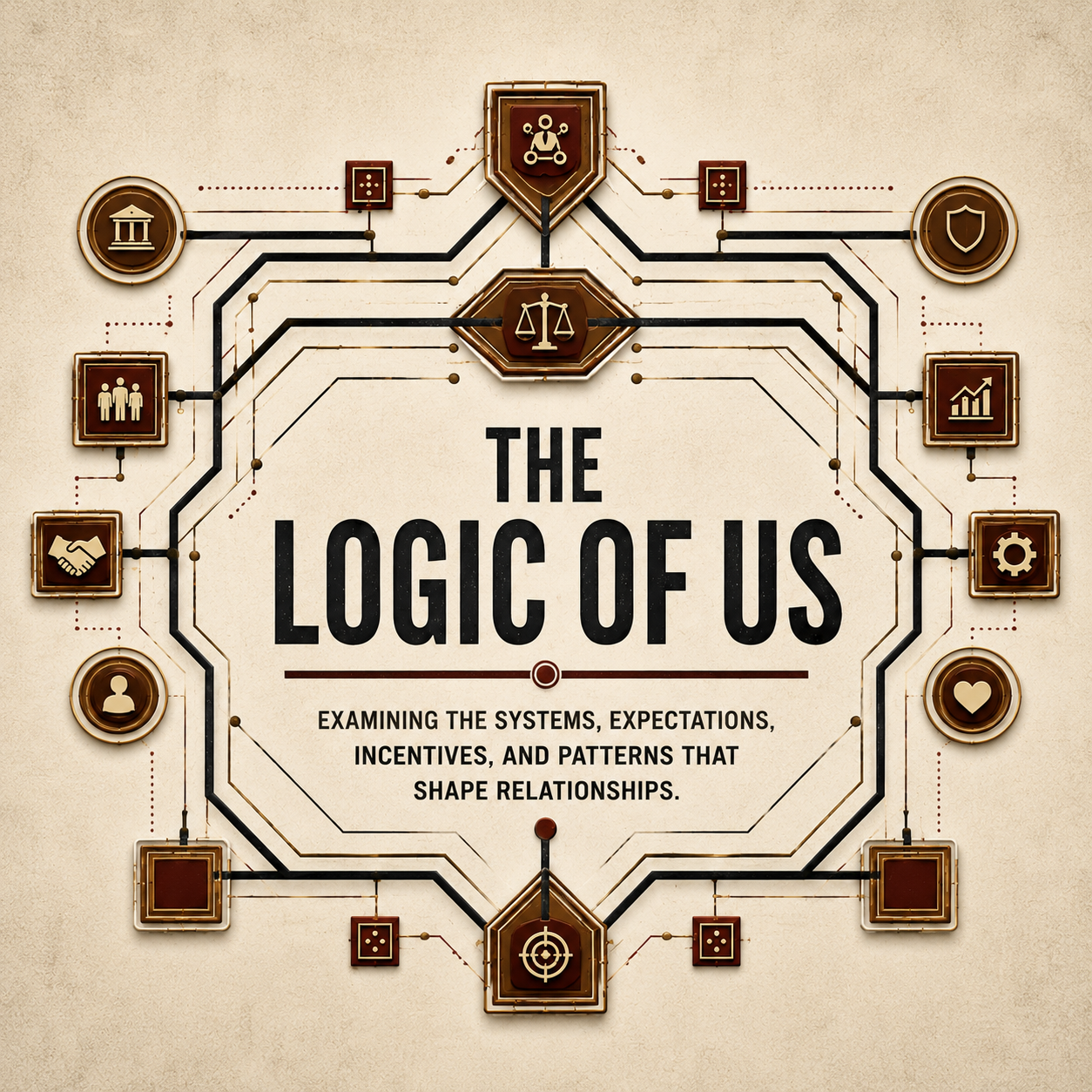
T.L. Ellis Builds The Logic of Us
The Logic of Us reverse-engineers the operating system between two people. The series examines interaction, interpretation, feedback, expectation, reinforcement, adaptation, and outcome.
Its territory includes dating and courtship, unspoken agreements, communication loops, trust, respect, reciprocity, autonomy, conflict, repair, intimacy, withdrawal, compatibility, and the patterns that precede relationship endings.
The point is not to force human relationships into a flowchart. The point is to make repeated behavior legible enough that readers can see what the relationship has begun teaching both people to expect.
The Logic Model
How a Moment Becomes a Relationship Pattern
The system does not appear all at once. It forms through repetition. T.L. Ellis follows a sequence that begins with what happened and ends with what the relationship now reliably produces.
Shared Load
Partnership Is a Load-Bearing System
Every partnership carries weight. Time, money, emotional pressure, caregiving, domestic work, decisions, family obligations, loyalty, planning, sex, attention, and ordinary maintenance all place demands on the system.
That load does not have to be divided identically. It does have to be visible enough that both people understand what is being carried and what happens when capacity changes.
One person can believe a partnership is balanced while the other is quietly compensating for an arrangement nobody has named. Once that compensation becomes expected, the system begins teaching one person that more will be absorbed and the other that less adjustment is required.
This is why Ellis distinguishes reciprocity from sameness. Different functions can coexist inside a durable partnership. Invisible responsibility is harder to sustain.
Under Pressure
Pressure Does Not Invent the Pattern. It Exposes It.
Calm conditions can make a weak system look stronger than it is. Conflict, disappointment, money strain, family demands, unmet expectations, competing priorities, and emotional fatigue increase the load.
Under pressure, respect becomes easier to measure. So does trust. Does disagreement remain disagreement, or does it become contempt? Can one person say no without retaliation? Can somebody admit harm without turning accountability into humiliation?
Repair becomes the final test. An apology can acknowledge damage, but the system changes only when behavior changes what the other person has learned to expect.
Selected Groundwork
Start With T.L. Ellis
These pieces show the range of Ellis’s territory, from expectations and role design to respect, repair, stability, and the patterns that form between people.
Expectations
The Cost of Naming Things: Why Labels Shape the Dating Market
What happens when two people operate from different definitions of the same relationship.
Function
Equal Value, Unequal Function
Why equal worth does not automatically mean identical roles, and why role clarity still matters.
Repair
Apology as Structural Repair
How accountability becomes meaningful when changed behavior alters the pattern that produced the damage.
Respect
Respect Is the Infrastructure of Relationships
Why dignity under disagreement matters more than surface harmony during easy conditions.
Stability
What Healthy Relationships Optimize For
A systems view of clarity, cooperation, trust, respect, and stability under pressure.
Full Series
The Logic of Us
Enter the canonical series hub for the full relationship-systems framework and curated path through the archive.
Builder Voice
Close Enough to See the Transaction. Far Enough Back to See the Pattern.
T.L. Ellis writes like a systems analyst who has spent enough time around real people to know that nobody experiences a relationship as a diagram.
The work begins with recognizable behavior. A conversation changes tone. Somebody stops volunteering ideas. A boundary keeps getting tested. One person apologizes, but nothing changes. The same argument keeps appearing with different nouns.
Ellis gets close enough to identify the small transaction beneath the large argument, then pulls back far enough to show what that transaction has been teaching the relationship to repeat.
Groundwork Architecture
The Principle and Condition Beneath T.L. Ellis’s Work
Ellis’s Builder territory sits inside the larger Groundwork Daily system. One Core Principle explains why relational structure matters. One Condition explains what coordinated partnership must achieve.
Primary Core Principle
Structure Builds Freedom
Clear expectations, boundaries, responsibilities, and decision pathways reduce the amount of energy partners have to spend guessing what the relationship requires.
Primary Condition
Alignment
Alignment coordinates purpose, expectations, authority, incentives, priorities, resources, and action so two people can move toward an outcome they both recognize.
Explore the Groundwork Daily Core Principles and Conditions .
Reader Promise
What Readers Can Expect From T.L. Ellis
Expect practical Groundwork on relationship systems, expectations, interpretation, communication, reciprocity, trust, respect, boundaries, incentives, conflict, withdrawal, compatibility, repair, and shared responsibility.
T.L. Ellis does not offer formulas for controlling another person. His work gives readers a model for identifying what is happening between two people, why the pattern keeps reproducing itself, and what would have to change for the outcome to change.
The goal is clearer diagnosis, stronger questions, and better decisions about what should be clarified, challenged, repaired, accepted, or ended.
The Groundwork
The Relationship Is Also What It Teaches
A relationship teaches both people something long before either one describes the pattern out loud.
It teaches whether difficult questions are safe to ask. Whether a boundary will hold. Whether an apology changes anything. Whether initiative is welcomed, ignored, or punished. Whether responsibility becomes shared or quietly transferred.
Repetition turns those lessons into expectation. Expectation changes behavior before the next interaction even begins.
T.L. Ellis builds to make that system visible while people can still decide what they want it to become.
Continue Building
Move from the Builder into the series, archive, and category that extend this relationship-systems Groundwork.
→ Series Hub: The Logic of Us
→ Series Archive: Browse Logic of Us Articles
→ Category: Family, Gender & Relationships
Build better. Every day.
Groundwork Daily examines the systems behind relationships, families, decisions, communities, and everyday life. Get new Groundwork delivered directly, with less noise and more clarity.