The Conditions are the thirteen conditions for strong systems Groundwork Daily uses to explain how a person, a relationship, an institution, a community, or an operating system organizes itself, carries demand, corrects its own mistakes, recovers, and keeps going over time.
The Foundation · Groundwork Daily Architecture
We tend to explain strength through individual traits: discipline, intelligence, resilience, leadership, grit. They’re easy to point to because they belong to a person.
But strong people still burn out. Good relationships still fracture. Capable organizations still turn brittle. Individual strength matters, obviously, but it’s not the whole story.
Something underneath it usually decides whether the outcome holds.
Why The Conditions Matter for Strong Systems
A person can be disciplined and still have no margin. An organization can hold high standards and still have weak accountability. A relationship can run on real commitment and still leave its boundaries undefined.
In each case, one strength is quietly covering for a condition that’s missing. That arrangement can work for a while, sometimes a long while. But the cost tends to get harder to hide, not easier.
Groundwork Daily Definition
The Conditions are the structural requirements that let a system organize itself, carry demand, correct itself, recover, endure, and continue.
Groundwork Daily recognizes thirteen canonical Conditions. Each does a different job, but all thirteen belong to one connected architecture, not thirteen separate ideas competing for attention.
Groundwork Guide Move through the Conditions architecture
The Structural Problem
What The Conditions Reveal Before Failure Arrives
Most failure gets diagnosed after the damage is already visible.
A person burns out, and motivation takes the blame. A relationship fractures, and the story becomes “we stopped communicating.” An organization stalls, and leadership gets pinned with it.
Sometimes those diagnoses are correct. More often, they describe the last symptom rather than the structural weakness that had been building for a while.
Failure Often Begins Earlier Than We Think
Capacity may have been exceeded months before anyone noticed. Margin may have thinned out gradually, almost invisibly. Accountability may have stopped producing real correction long before performance actually dropped.
By the time the breakdown is obvious, the system has usually been weakening quietly for a while.
One Strength Cannot Do Every Job
Discipline can keep a behavior going, but it can’t manufacture capacity that isn’t there. Margin can hold reserve, but reserve on its own won’t correct bad judgment.
Boundaries can contain responsibility before harm happens. Once harm has happened, though, boundaries have nothing left to do. That’s a different job.
Repair can restore function. It can’t guarantee durability if the weak structure underneath never actually gets fixed.
Pressure Shows What the System Actually Has
Under calm conditions, a weak system can look stronger than it is. Add pressure, and the picture changes fast. Load reveals what a system can genuinely carry, not what it claims to carry.
That’s exactly when The Conditions become useful: not when things are going fine, but when ordinary performance stops being enough.
The Groundwork Conditions Architecture
How the Conditions for Strong Systems Work Together
The Conditions aren’t thirteen motivational ideas sitting side by side. Each one performs a distinct structural job.
Some establish order. Others help a system carry demand. The rest govern judgment, correction, restoration, recovery, or time.
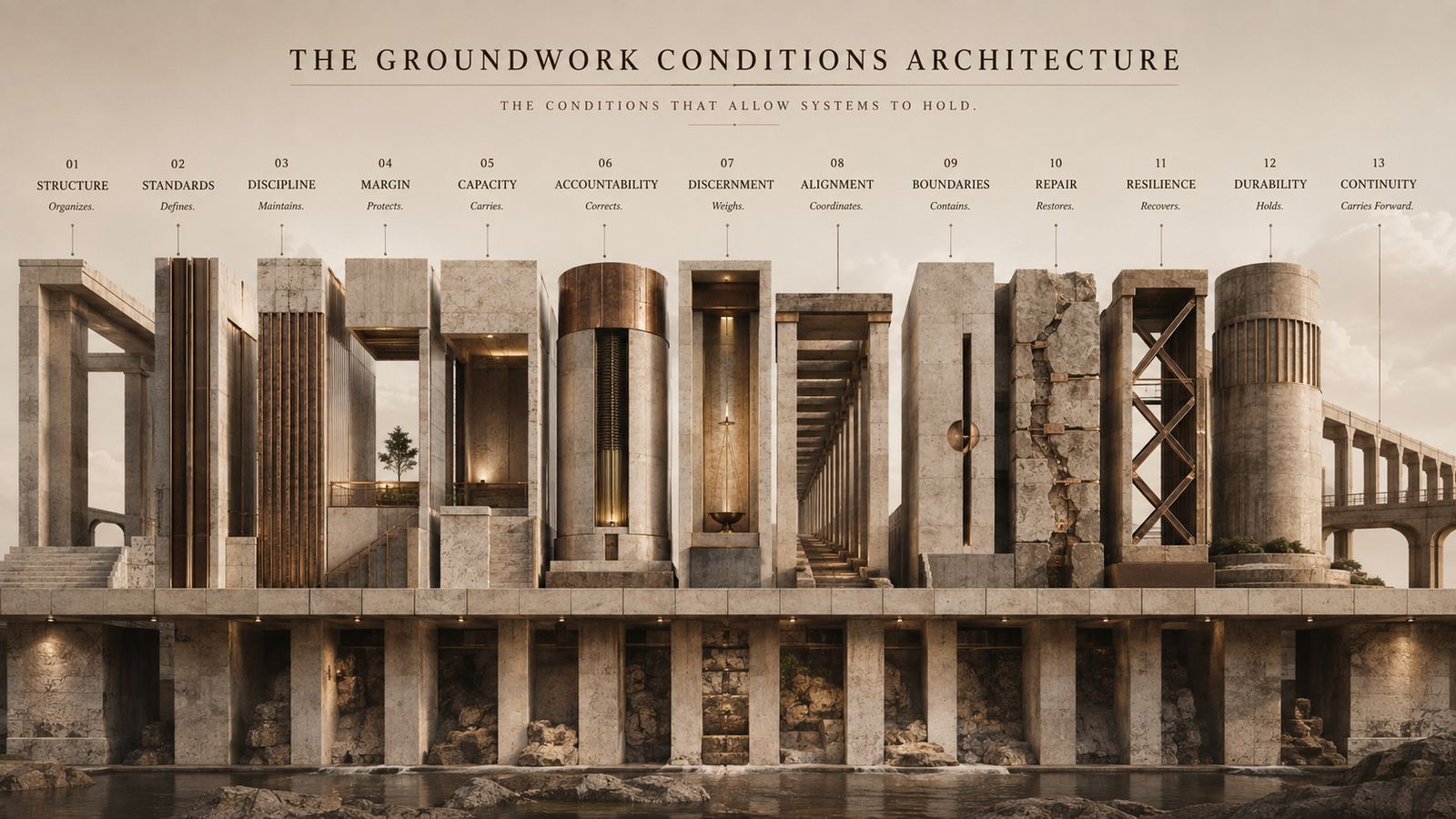
Thirteen structural jobs form one architecture for understanding how systems organize, carry load, correct themselves, recover, endure, and continue.
The Architecture Is Connected
The sequence below is a teaching device. Real systems don’t move through it in order. They move in several directions at once.
Low margin drains capacity. Drained capacity makes discipline harder to sustain. Weakened discipline, in turn, makes accountability problems more likely to slip through.
Weakness Can Travel Through the System
Poor accountability lets drift spread into alignment, trust, and continuity. Unclear standards make accountability inconsistent because people stop correcting against the same reference point.
That chain reaction is the whole reason the architecture matters. A weakness rarely stays where it started.
Operating Language
The Conditions Give Each Structural Job a Name
Shared language matters because vague language produces vague diagnoses.
So each Condition carries one governing verb, the single job it’s responsible for.
The Groundwork Sequence
Structure organizes.
Standards define.
Discipline maintains.
Margin protects.
Capacity carries.
Accountability corrects.
Discernment weighs.
Alignment coordinates.
Boundaries contain.
Repair restores.
Resilience recovers.
Durability holds.
Continuity carries forward.
Why the Governing Verbs Matter
Capacity and Margin get confused constantly, but they’re not the same job. Carrying a load is not the same thing as preserving a reserve.
Resilience and Durability get confused too. Resilience is about recovering after disruption. Durability is about continuing to perform through repeated load, wear, maintenance, and time.
Naming the mechanism precisely is what lets Groundwork talk about a problem without turning every useful word into its own doctrine.
The Canonical Set
The 13 Conditions for Strong Systems
The Conditions show up everywhere: money, relationships, work, health, governance, community, institutions, and personal decision-making.
To make the architecture easier to hold in your head, they’re grouped below by the kind of structural work they do. None of them belongs to only one group, though. Think of this as a starting map, not a set of boxes.
Conditions That Establish Order
Before a system can carry any real pressure, it needs enough order to know what belongs where, what actually matters, and what should repeat.
Structure
OrganizesHow is the system arranged?
Structure creates roles, relationships, pathways, constraints, defaults, and decision architecture.
Explore Structure →
Standards
DefinesWhat must remain acceptable?
Standards establish the threshold a system intends to protect.
Explore Standards →
Discipline
MaintainsWhat must keep being repeated?
Discipline keeps useful behavior going after novelty, mood, or motivation fades.
Explore Discipline →
Conditions That Govern Load and Judgment
Once order exists, the system has to carry demand, hold onto reserve, notice when something’s off, and decide what actually deserves authority.
Margin
ProtectsWhat remains after normal demand?
Margin preserves usable reserve between current load and reliable capacity.
Explore Margin →
Capacity
CarriesWhat can this reliably carry?
Capacity is how much load a system can carry repeatedly without unacceptable degradation.
Explore Capacity →
Accountability
CorrectsWhat happens when behavior drifts?
Accountability recognizes drift, assigns responsibility, and restores alignment.
Explore Accountability →
Discernment
WeighsWhat deserves authority?
Discernment gives evidence, values, constraints, and consequences the weight they actually deserve, not more and not less.
Explore Discernment →
Conditions That Coordinate and Restore
Systems also need a way to keep their parts moving together, keep responsibility contained, and restore useful function after damage.
Alignment
CoordinatesAre the parts moving together?
Alignment coordinates purpose, priorities, authority, incentives, resources, and action.
Explore Alignment →
Boundaries
ContainsWhere does responsibility stop?
Boundaries mark the limits around responsibility, access, authority, obligation, and consequence.
Explore Boundaries →
Repair
RestoresHow does function return?
Repair stabilizes damage, restores function, and verifies that the repaired system can carry its intended load.
Explore Repair →
Conditions That Govern Time
Strong systems have to outlast today’s demand. That means recovering, staying dependable, and carrying essential function forward.
Resilience
RecoversCan the system recover after disruption?
Resilience absorbs disruption, protects critical function, restores capacity, adapts, and keeps going.
Explore Resilience →
Durability
HoldsCan it keep carrying load?
Durability keeps performance dependable through repeated load, wear, maintenance, and time.
Explore Durability →
Continuity
Carries ForwardCan the system survive transition?
Continuity preserves essential function, knowledge, standards, and purpose when the person or team carrying them changes.
Explore Continuity →
How the System Moves
How The Conditions Operate Across Four Structural Phases
The thirteen Conditions are easier to use once you group them by the kind of work they usually do.
Establish Order
Establish
Structure · Standards · Discipline
Structure organizes the environment. Standards define the threshold. Discipline keeps useful behavior going once mood and novelty stop doing the work.
Carry Demand and Govern Judgment
Carry and Govern
Margin · Capacity · Accountability · Discernment
Margin protects reserve. Capacity carries the load. Accountability corrects deviation. Discernment decides what actually deserves the final say.
Coordinate and Restore
Coordinate and Restore
Alignment · Boundaries · Repair
Alignment keeps the parts moving together. Boundaries contain responsibility and access. When damage occurs, Repair restores function and verifies that the repaired system can carry its intended load.
Govern Time
Endure
Resilience · Durability · Continuity
Resilience handles recovery. Durability sustains dependable performance through repeated load and time. Continuity carries essential function through whatever transition comes next.
Real systems cycle through these four phases again and again. Nobody finishes the architecture once and graduates from it.
Necessary Distinctions
What The Conditions Are and What They Are Not
Groundwork works across a few layers of language, and keeping them distinct is what keeps the architecture from turning into a pile of overlapping labels.
What should remain true?
Core Principles state Groundwork’s governing positions about structure, discipline, accountability, stillness, resources, mercy, and durability.
What structural job must exist?
Conditions name the requirement: the thing that has to organize, define, maintain, protect, carry, correct, weigh, coordinate, contain, restore, recover, hold, or carry forward.
Where does the work live?
Categories own editorial territory. Series are recurring lenses used inside that territory.
How does the mechanism work?
Frameworks explain repeatable mechanics. Systems turn those mechanics into routines, procedures, defaults, and reviews.
Governed System Concepts Describe What Is Happening
Governed System Concepts
Diagnostic language belongs at a different layer.
A Governed System Concept names a recurring state, deviation pattern, or operating idea without becoming a new Condition.
Drift is one example: the gradual movement away from a standard, alignment, purpose, or sustainable operating condition.
Accountability is the Condition that corrects drift. Drift describes the pattern. Accountability supplies the structural job that recognizes and corrects it.
The Knowledge Stack Keeps the Layers Separate
The Groundwork Knowledge Stack
Core Principles define what should remain true.
The Conditions define what structural jobs must exist.
Categories define editorial territory.
Series define recurring lenses.
Frameworks, Systems, and Governed System Concepts explain mechanisms, operating models, or diagnostic patterns.
Articles and Applications show the architecture working in real life.
Real-World Applications
How The Conditions Show Up in Everyday Systems
The Conditions are deliberately cross-domain, so the same structural weakness tends to show up in very different corners of life.
Personal Systems
In personal life, The Conditions surface through time, energy, money, habits, judgment, and recovery.
Someone can look undisciplined when the real problem is exhausted Capacity or Margin that hit zero a while ago.
Relationship Systems
In relationships, Accountability, Discernment, Alignment, Boundaries, and Repair tend to be the ones you notice first.
Commitment matters, but it can’t guarantee stability on its own. A relationship also needs a way to set expectations, correct drift, contain responsibility, and repair harm when it happens.
Institutional Systems
In organizations and public institutions, Structure, Standards, Capacity, Accountability, Alignment, Durability, and Continuity often carry the real weight.
That’s why institutional strength can’t rest entirely on the talent of whoever happens to be leading today.
| Domain | Conditions Often in Play | Typical Failure | Better Question |
|---|---|---|---|
| Money | Standards, Discipline, Margin, Capacity | Income rises while obligations consume every available dollar. | What remains after normal financial demand? |
| Work | Structure, Capacity, Alignment, Boundaries | Responsibility expands faster than authority, time, or staffing. | Does the role have enough capacity and authority to carry its load? |
| Relationships | Discernment, Boundaries, Accountability, Repair | The same problem gets discussed repeatedly and never actually corrected. | Is repair changing the pattern? |
| Health | Discipline, Margin, Capacity, Resilience | Stress and effort keep outpacing recovery. | What restores usable capacity? |
| Organizations | Structure, Accountability, Alignment, Continuity | Authority and responsibility drift apart as the institution grows. | Can the system function when leadership changes? |
| Community | Standards, Boundaries, Repair, Durability | Shared purpose exists without enough structure to survive disagreement. | What keeps the institution useful after conflict? |
Diagnostic
How to Diagnose Strong Systems Through The Conditions
When a system keeps struggling, the fastest explanation is usually personal failure.
Sometimes that’s true. The person really is part of the problem. But a real diagnosis should look at the structure underneath the performance before it ends in blame.
First, Check Order
Structure
Is the environment organized well enough to support the outcome you actually want?
Standards
Is the minimum acceptable condition actually clear to everyone involved?
Discipline
Does the useful behavior repeat once motivation fades?
Next, Check Load and Judgment
Margin
Is there any usable reserve left after normal demand?
Capacity
Is the current load actually sustainable?
Accountability
Does real deviation produce real correction?
Discernment
Is the evidence getting the weight it deserves?
Then, Check Coordination and Repair
Alignment
Are purpose, incentives, resources, authority, and behavior actually pointed in the same direction?
Boundaries
Are responsibility, access, obligation, and authority clearly contained?
Repair
Has function actually been restored, and can the repaired system carry its intended load?
Finally, Check Time
Resilience
Can the system stabilize and recover after disruption?
Durability
Can it keep carrying load through wear, maintenance, and time?
Continuity
Can the essential function survive a transition?
One weak Condition is often manageable on its own. Several weak Conditions interacting at once is usually a sign of something bigger.
Start the diagnosis with the system. Let blame come later, if it needs to at all.
Core Principle Connections
How The Conditions Connect to Groundwork Core Principles
Conditions and Core Principles sit at different layers, but they reinforce each other.
A Principle is what Groundwork believes should stay true. A Condition is the structural job required to make that belief actually operable.
Structure Builds Freedom
Structure creates usable roles, pathways, constraints, and defaults, so basic order doesn’t have to be renegotiated every single day.
Accountability Is a Form of Strength
Accountability keeps what’s actually happening connected to what was promised through ownership, correction, and proof.
Build What Holds
A structure worth building has to carry load, receive maintenance, survive pressure, transfer to someone else, and stay valuable over time.
For the full doctrinal layer, see the Groundwork Daily Core Principles .
External Context
Why Strong Systems Need More Than One Kind of Strength
The Groundwork Conditions Architecture is Groundwork Daily’s own editorial model, but several of the ideas underneath it show up in established work on resilience, governance, institutional performance, and systems design.
Recovery Is Part of Resilience
The National Institute of Standards and Technology looks at community resilience through preparation, resistance to disruption, recovery, and adaptation.
Strength, in other words, isn’t only about avoiding disruption. A functioning system also needs a way to recover once disruption has already happened.
National Institute of Standards and Technology: Community Resilience →
Governance Depends on Connected Responsibilities
BoardSource frames governance as a set of connected responsibilities: oversight, planning, accountability, stewardship, and institutional health.
Groundwork’s architecture is its own model, but the parallel holds up. Durable institutions run on several responsibilities working together, not one isolated form of strength doing all the work.
How Groundwork Uses the Architecture
How Groundwork Articles Build Into The Conditions
The Conditions work as a shared structural layer running underneath everything Groundwork Daily publishes.
Start With the Real Situation
An article starts with life as people actually live it: a financial problem, a conflict, a leadership failure, burnout, a hard decision, a community problem, or a relationship pattern.
Identify the Structural Job Underneath It
Emergency savings usually trace back to Margin. Burnout usually traces back to Capacity. Repeated harm in a relationship often centers on Accountability or Repair.
A governance article might center on Structure, Alignment, Durability, or Continuity, depending on what’s actually breaking down.
Connect the Condition to a Principle
Once the structural job is clear, a Core Principle names the Groundwork position that job is defending.
Add a Framework or Governed System Concept Only When It Helps
A Framework can explain how the mechanism works. A Governed System Concept can name a recurring diagnostic pattern, such as Drift.
Neither one replaces the Primary Condition. They support it.
Groundwork Content Architecture
Situation → Core Principle → Condition → Category → Series → Framework / System / Governed System Concept → Application
Life supplies the problem. Governance tells us where that problem belongs. The article explains how the mechanism actually behaves.
Continue Building
Move From The Conditions Into the System
This hub defines the complete structural set. From here, move into the individual Conditions, Core Principles, and governed concepts that build the architecture out further.
→ Condition: Structure
→ Condition: Accountability
→ Governed System Concept: Drift
→ Governing Layer: Groundwork Daily Core Principles
The Groundwork
The Conditions Explain What Helps a System Hold
A system can survive one weakness. It can often survive several, for longer than you’d expect.
What it can’t do is ask one strength to keep covering for every missing job forever.
Discipline can’t replace Capacity. Capacity can’t replace Discernment. Good judgment can’t replace Accountability.
Accountability can’t do Repair’s job. Repair can’t guarantee Durability. Durability alone can’t guarantee Continuity.
Each Condition carries a different piece of the load, and none of them can quietly pick up the rest.
What holds is rarely one thing. It is an architecture.
Groundwork Architecture
The Conditions
Thirteen structural requirements define what strong systems need in order to organize, carry demand, correct themselves, recover, endure, and continue.
Groundwork Daily Core Principles
Core Principles define what Groundwork believes should remain true. The Conditions define the structural jobs required to make those positions operable.

Groundwork Daily Builder
Groundwork Daily Perspective
Institutional Editorial Voice · Groundwork Daily Architecture
Groundwork Daily Perspective develops the principles, definitions, systems, and structural thinking that tie the publication’s categories and builders into one coherent architecture.
Its focus sits underneath everyday outcomes: what strong systems actually require, how they weaken, how correction works, and what lets useful structure hold over time.