The Groundwork Conditions
The structural requirements that allow systems to function, adapt, and endure.

Margin is the usable space between what a system can reliably carry and what it is already carrying. That reserve allows time, money, health, relationships, work, and organizations to absorb pressure without turning every disruption into a crisis.
Most people notice margin only after it disappears. The calendar tightens. Money has fewer places to move. Patience gets shorter. One absence becomes an operational problem.
Meanwhile, ordinary disruptions begin producing consequences that feel much larger than the original problem.
The reason is structural. Every available unit of capacity already has an assignment.
Therefore, margin is not empty space. It is reserve that the system has deliberately left usable.
Groundwork Definition
Margin is the usable reserve that remains after a system carries its normal load.
This makes Margin the natural Condition after Discipline. Discipline maintains the standard. Margin protects enough reserve for that maintenance to survive ordinary disruption.
As a result, a system can be structured, clear, and disciplined while still being fragile if it has no room left.
The Function
Why Margin Matters
Most systems work reasonably well when nothing changes. However, that is not much of a test.
A schedule works when every meeting ends on time. A budget works when no surprise cost appears. A team works when everyone is available.
Likewise, a body can keep moving when sleep, stress, and recovery remain manageable.
Strong Systems Need Somewhere for Pressure to Go
Trouble begins when normal conditions become a requirement for success.
Real life eventually adds something the plan did not include. Cars break. People get sick. Bills rise. Work expands. Technology fails.
Instead of pretending those events are unusual, a durable system leaves room for them.
Margin gives pressure somewhere to land.
Reserve Keeps Problems Contained
Consider a twenty-minute delay. With open time between appointments, the delay may remain contained.
Without reserve, however, those same twenty minutes move into the next meeting, then another task, and finally the rest of the day.
The delay did not become more serious. Its effects multiplied because the system had nowhere to place it.
Structural Sequence
Structure Organizes. Standards Define. Discipline Maintains. Margin Protects.
These four Conditions solve different problems. Together, they begin turning intention into a system that can hold.
Structure
Organizes the system.
Standards
Define the threshold.
Discipline
Maintains the standard.
Margin
Protects reserve.
Why Margin Follows Discipline
Discipline cannot indefinitely compensate for a system operating at maximum load.
Eventually, maintenance itself needs breathing room. Margin provides that room.
Necessary Distinction
Margin and Capacity Are Not the Same Thing
Capacity and margin belong next to each other because people frequently confuse them.
Yet the two concepts answer different questions.
Capacity Asks What the System Can Carry
Capacity describes reliable load-bearing ability.
A person has sustainable work capacity. A household has financial capacity. A team has staffing capacity. A network has operating capacity.
Margin Asks What Remains
Once current load has been carried, margin is the usable capacity that has not yet been committed.
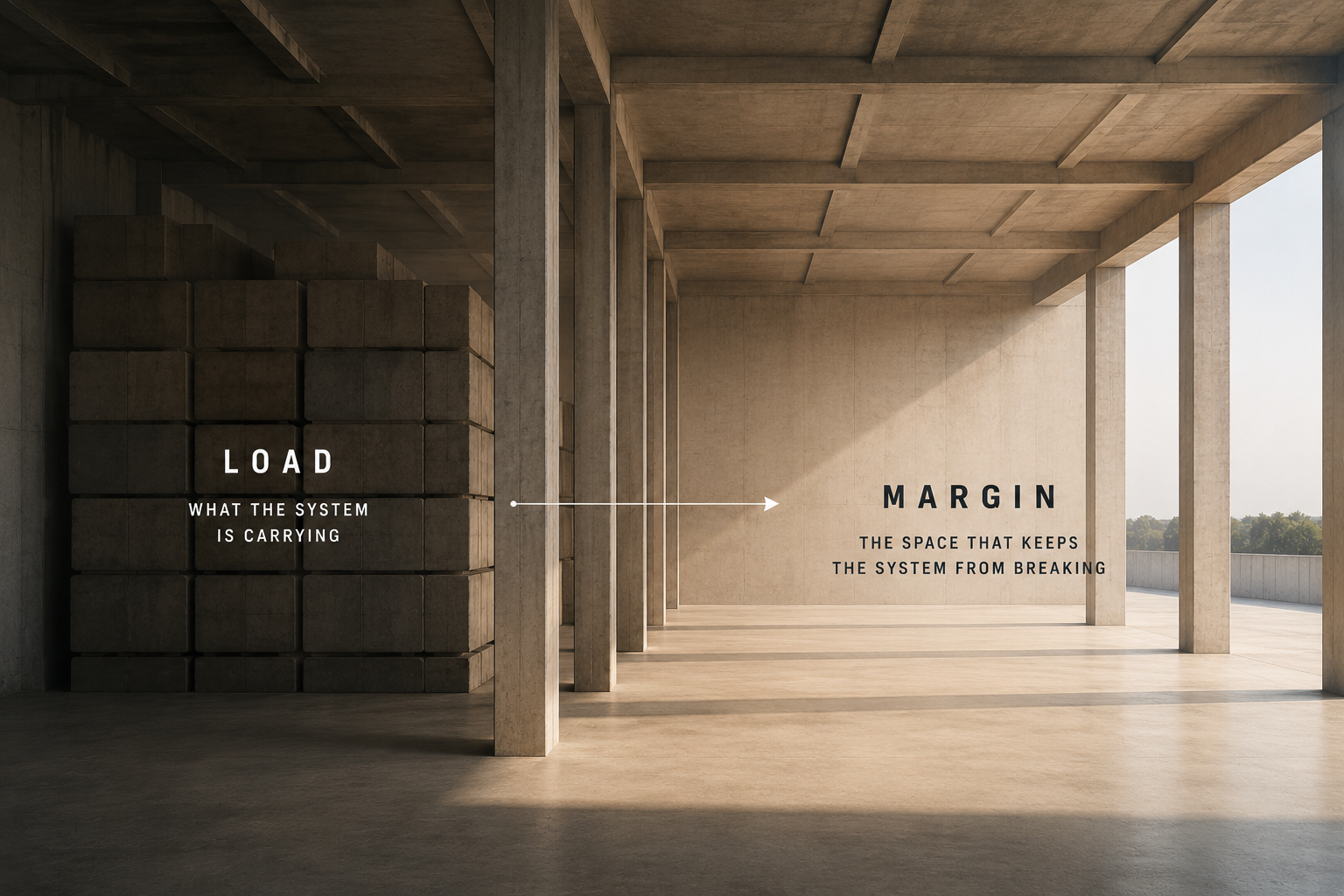
The distinction
Capacity is what the system can reliably carry.
Load is what the system is carrying now.
Margin is the usable reserve that remains.
Unused Does Not Automatically Mean Wasted
A calendar with two open hours may look underused. A reserve fund may look idle. An employee without a fully saturated workload may appear inefficient.
However, some unused capacity is already performing a useful function.
It is protecting the system from what has not happened yet.
The Groundwork Margin Model
A Five-Part Model for Margin
Reserve becomes easier to understand when it is placed inside the larger cycle of load and recovery.
The Groundwork Margin Model
1. Capacity: What Can the System Reliably Carry?
Reliable capacity is not the most you can survive once. Instead, it is what the system can carry repeatedly without degrading itself.
2. Load: What Is Consuming Capacity Now?
Bills, meetings, caregiving, unfinished work, conflict, maintenance, recovery, and uncertainty can all consume capacity.
3. Margin: What Remains Usable?
Margin is the portion of capacity that has not already been promised.
4. Shock: What Happens When Conditions Change?
A shock may be an illness, delay, conflict, repair, unexpected demand, or even a valuable opportunity that requires resources immediately.
5. Recovery: How Does Capacity Return?
Durable systems do not merely survive pressure. They also restore enough usable capacity to function well again.
The operating question
How much of the system’s reliable capacity is already promised?
Failure Pattern
What Happens When Margin Disappears
A system with almost no reserve can look impressive from the outside.
The calendar is full. Every dollar has a purpose. Everyone at work is busy. No resource appears idle.
At first, that can resemble efficiency. Then one ordinary condition changes.
At Work
One employee calls out. Managers cover tasks, service slows, and the rest of the team carries more. The absence matters, but the deeper problem is the lack of usable reserve.
At Home
Every dollar of income is committed. Then the car needs repair. The expense moves to debt, which increases next month’s load and reduces future margin.
On the Calendar
Every usable block is scheduled. One meeting runs late. Because there is no transition space, the rest of the day inherits the delay.
Fragility Usually Appears Before Failure
None of these examples requires catastrophe.
In fact, that is the point. Ordinary disruptions usually reveal insufficient margin before major failure does.
The Efficiency Trap
Full Is Not the Same as Strong
Modern systems often reward maximum use. Fill the calendar. Spend the budget. Keep everyone busy.
Yet maximum utilization can quietly increase fragility.
Healthy Margin Is Proportionate
More reserve is not automatically better. A business cannot hire unlimited staff for hypothetical demand. Likewise, a household should not keep every long-term dollar idle.
Instead, reserve should match the consequence of failure.
High-Risk Systems Need More Protection
A life-support system needs more redundancy than a low-stakes convenience. Critical operations generally need more reserve because failure costs more.
Therefore, the right amount of margin depends on what the system is protecting.
Application
Where Margin Shows Up in Real Life
The form changes across domains. Still, the mechanism remains familiar: capacity carries load, reserve remains available, pressure arrives, and the system either absorbs it or transfers it elsewhere.
| System | Capacity | Load | Margin | When Margin Is Thin |
|---|---|---|---|---|
| Time | Usable hours and attention | Meetings, tasks, travel, obligations | Uncommitted usable time | One delay spreads through the day |
| Money | Income and liquid resources | Expenses and recurring obligations | Savings and flexible cash flow | An unexpected cost becomes debt or displacement |
| Health | Physical and recovery capacity | Training, work, stress, poor sleep | Recoverable physical reserve | Normal stress creates larger fatigue |
| Emotional Life | Attention and regulation capacity | Conflict, worry, responsibility, uncertainty | Room to process before reacting | Small pressure produces larger reactions |
| Relationships | Trust, time, goodwill, repair capacity | Needs, tension, unresolved issues | Room for repair and imperfection | Minor conflict threatens the larger relationship |
| Organizations | People, capital, systems, tools | Operations and projects | Backup and surge capacity | Absence or demand spikes become crises |
| Infrastructure | Designed operating capability | Normal service demand | Redundancy and spare capacity | A single failure interrupts essential service |
Money
Financial Margin Creates Options
Financial margin is not simply money sitting in an account. Instead, it is financial capacity that normal obligations have not already consumed.
Savings Are One Form of Reserve
Savings can create margin. Lower fixed expenses can too. Flexible cash flow, insurance, and accessible funds may also improve the system’s ability to absorb a surprise cost.
More Income Does Not Guarantee More Margin
This is why Discipline Before Dollars matters.
New income can disappear into new recurring obligations just as quickly as old income did.
Consequently, someone can earn substantially more while remaining financially fragile.
Emergency Funds Are Margin Made Visible
The Consumer Financial Protection Bureau describes an emergency fund as cash reserved for unplanned expenses or financial emergencies.
Structurally, that is margin: usable financial capacity preserved before the problem arrives.
Time and Workload
Time Margin Protects the Rest of the Day
A full calendar may look productive because every hour appears accounted for.
However, a schedule with no transition time has no place to absorb ordinary variation.
“Can It Fit?” Is Not Enough
A stronger question
Do not ask only, “Can this fit?”
Ask, “What remains after this fits?”
The second question protects the larger system rather than evaluating one commitment in isolation.
Internal and Relational Systems
Emotional Margin Creates Space Before Reaction
Not every form of reserve can be measured in hours or dollars.
People also need enough internal capacity to process what is happening before pressure becomes automatic behavior.
Internal Reserve Improves Judgment
Emotional margin may look like enough sleep to think clearly, time before replying to a difficult message, quiet after a demanding day, or boundaries that stop every request from becoming an obligation.
In that sense, Margin connects naturally to Stillness Is Strategy.
Stillness protects decision space. Meanwhile, margin preserves enough capacity to use that space well.
Relationships Need Reserve Too
A relationship carrying unresolved conflict, constant demands, little shared time, and weak repair capacity may have almost no room left for ordinary mistakes.
Consequently, small problems begin carrying more weight than they should.
Margin does not lower relationship standards. Instead, it gives healthy people enough room to repair ordinary human imperfection.
Organizations and Infrastructure
Operational Margin Protects Critical Systems
Margin becomes especially visible at the organizational level.
NIST describes resilience in terms of maintaining needed capability during adversity and recovering afterward. Its cyber-resilience guidance also discusses redundancy, surplus capacity, backup, and failover.
Backup Capacity Has to Be Real
A backup employee with a full workload is not truly backup capacity. Likewise, a reserve fund required for normal bills is not a real reserve.
The same principle applies to equipment, space, vendors, technology, and staffing.
Reserve Has a Cost, but Failure Has One Too
Every organization must decide where redundancy is worth paying for.
Even so, critical operations should not assume that every person, vendor, machine, network, or process will remain available at all times.
Practical Tool
The Groundwork Margin Test
When part of life feels rushed, brittle, expensive, or unusually vulnerable, do not immediately conclude that the answer is more effort.
First, test the reserve.
Capacity
What can this system reliably carry under normal conditions?
Load
What is already consuming time, money, energy, attention, people, or operating resources?
Margin
What remains genuinely available after normal load has been carried?
Shock
What happens when one ordinary thing goes wrong?
Recovery
What restores capacity, and how long does that restoration actually take?
What the Test Reveals
If one ordinary disruption causes pressure to spread through the entire system, the first problem may be insufficient margin rather than insufficient performance.
Maintenance and Reserve
Discipline Creates Margin, and Margin Protects Discipline
Discipline and Margin reinforce each other. However, they do different work.
Discipline
Maintains important behavior
Discipline governs repetition, limits, priorities, and the return to a chosen standard.
Margin
Protects usable reserve
Margin keeps some capacity available after normal demands have already been carried.
Discipline Can Create Reserve
Spending limits can create financial margin. Fewer commitments can create time margin. Recovery routines can protect physical capacity.
In addition, stronger boundaries can preserve emotional reserve.
Reserve Makes Discipline Easier to Sustain
A system operating at maximum load must defend its standards under maximum pressure every day.
Margin reduces that burden.
Core Principle Connection
Margin Helps Us Build What Holds
Build What Holds
A system should not be judged only by whether it works under ideal conditions. It should also be judged by how it carries load, absorbs disruption, receives maintenance, recovers, and remains useful over time.
Margin supports that durability because it gives pressure somewhere to go before pressure becomes failure.
Build What Holds asks whether the structure survives load. Margin helps determine how much additional pressure it can absorb before something else must give.
Margin Also Protects Freedom
Structure Builds Freedom matters here because good structure prevents usable capacity from being consumed by accident.
Margin Can Also Be Mercy
Structure Is Mercy explains why good systems absorb preventable disorder before people must carry its full cost themselves.
Put It to Work
How to Create More Margin
Do not begin by trying to create empty space everywhere.
Instead, start where small disruptions keep producing consequences far larger than the original problem.
Reduce Fixed Load
Lower recurring obligations in money, time, work, or attention when they leave too little room for normal variation.
Improve Recovery
A system with strong recovery can restore usable capacity after heavy load instead of remaining permanently depleted.
Protect Real Reserve
Backup capacity must remain available. A reserve quietly committed elsewhere no longer protects the system.
Test Ordinary Disruption
Do not begin with catastrophe. Ask what happens after a sick day, a delayed train, a surprise bill, a missed deadline, or a difficult week.
Those ordinary disruptions often reveal the architecture faster than extreme scenarios do.
The Larger Architecture
Margin Works Inside a Larger System
Margin cannot compensate for bad Structure, weak Standards, inconsistent Discipline, or inadequate Capacity.
Instead, it performs one specific job: preserving enough usable room for the system to absorb pressure without immediately losing function.
The Groundwork Conditions Architecture
Structure
Organizes.
Standards
Define.
Discipline
Maintains.
Margin
Protects.
Capacity
Carries.
Accountability
Corrects.
Discernment
Weighs.
Alignment
Coordinates.
Boundaries
Contain.
Repair
Restores.
Resilience
Recovers.
Durability
Holds.
Continuity
Carries forward.
Explore the complete architecture: The Conditions: What Strong Systems Require to Hold.
Next
Capacity: The Condition That Determines What the System Can Carry
Margin describes what remains after load. Capacity answers the deeper question underneath that equation: how much can the system reliably carry in the first place?
Sources and Further Reading
Receipts
The Groundwork
Margin Is Room for Reality
Healthy margin often goes unnoticed because, when it works, nothing dramatic happens.
The repair gets paid without wrecking the month. A delay stays contained. A sick day does not collapse the operation.
After hard effort, the body gets room to recover. A disagreement remains a disagreement instead of becoming a rupture.
In each case, the system absorbs pressure without losing itself.
Margin is not empty space.
It is room for reality.
Build better. Every day.