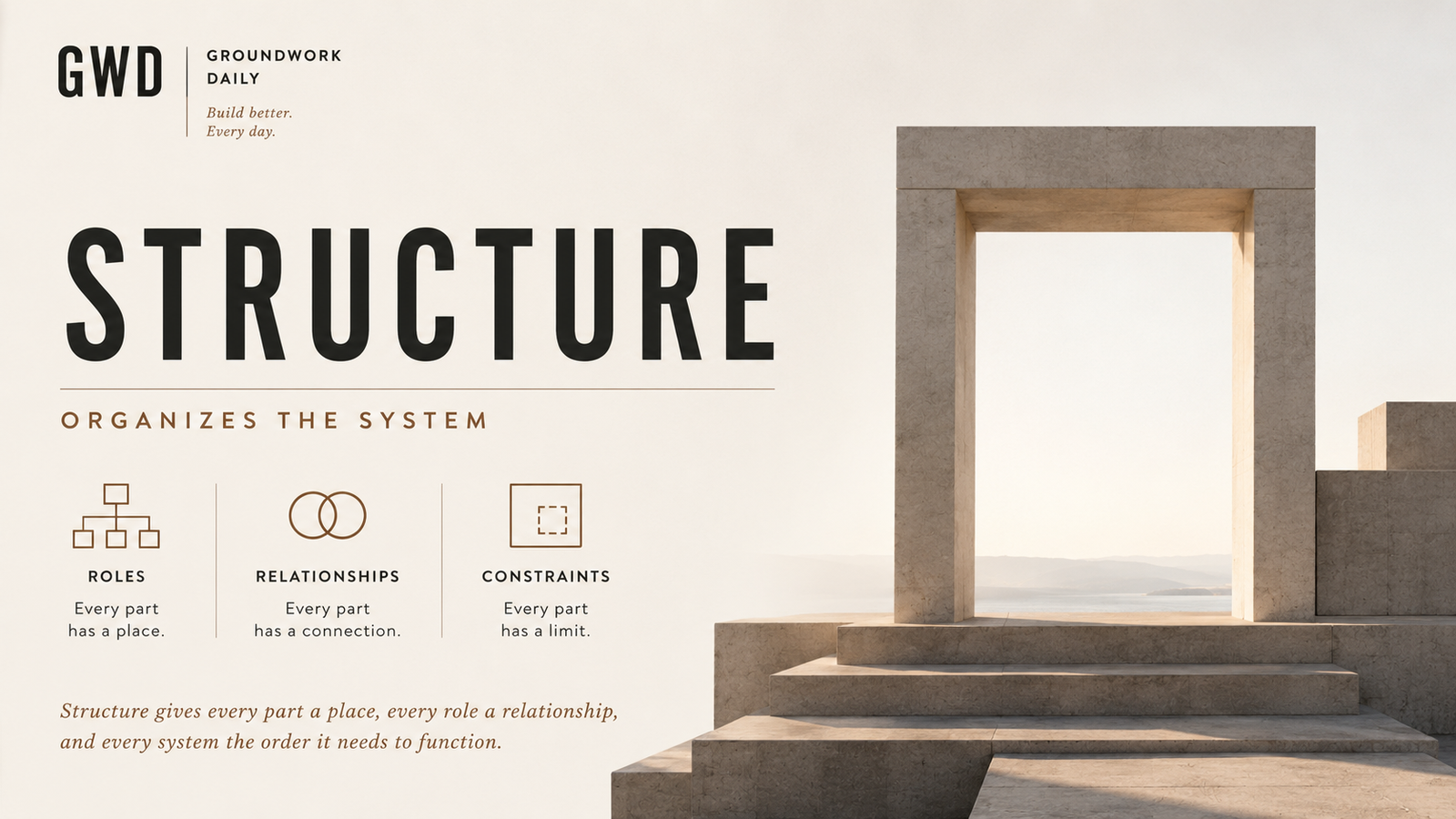
What is structure? It is the arrangement of roles, relationships, responsibilities, limits, resources, and pathways that determines how a system works.
The Conditions · 01 / Structure
Most people notice design only after something stops working.
For example, a team misses the same handoff, a household keeps arguing about work nobody clearly owns, or a leader becomes the answer to every question. Meanwhile, a calendar can remain full even though the important work never receives enough room.
From inside the problem, the explanation often feels personal. Someone looks careless. Another person seems uncommitted. Perhaps everybody simply needs to communicate better.
Sometimes that diagnosis is correct. However, repeated friction should also trigger a harder question: what is the system making unnecessarily difficult?
Structure is the arrangement of parts and relationships that gives a system enough order to function.
The Groundwork DefinitionGood design cannot guarantee wisdom, fairness, discipline, or resilience. Instead, it creates an operating environment where those qualities can become useful.
Because of that foundational role, Structure comes first. Every later Condition needs somewhere to stand.
01 / Definition
How Structure Turns Separate Parts Into a System
A pile of parts is not yet a functioning system.
People sitting around the same table are not automatically an organization. Likewise, money distributed across several accounts is not automatically a financial system. Two people can also love one another and still lack a reliable arrangement for money, time, responsibility, conflict, or repair.
Relationships Between Parts Create the System
A system begins to emerge when relationships become clear. Who decides? Who owns the work? What happens first? Where does information travel?
Once those connections are visible, people no longer have to renegotiate ordinary operation every day. As a result, the system becomes easier to understand and easier to manage.
Legibility Changes Behavior
Clear architecture helps people locate responsibility. It also makes it easier to separate an execution problem from a design problem.
More importantly, people can see where pressure is likely to travel before something breaks.
Therefore, useful architecture creates an operating system rather than a loose collection of intentions.
02 / Design Before Effort
Why Strong Systems Need Structure Before More Effort
Groundwork returns to design because effort is expensive. If ordinary functioning requires extraordinary effort every day, somebody eventually pays for that architecture.
Hidden Labor Often Keeps Weak Systems Alive
An employee may remember the process everybody else forgot. Elsewhere, one parent may carry the household calendar. In an organization, a founder may approve every meaningful decision.
Relationships can hide the same pattern. One partner may keep absorbing conflict because there is no dependable repair process.
Although the system continues functioning, continuation alone does not prove the arrangement is healthy.
Groundwork Doctrine
Chaos is expensive because somebody always has to carry what the system failed to organize.
Better Design Removes Preventable Decisions
A budget assigns money before every purchase becomes a fresh negotiation. Similarly, a calendar assigns time before every hour becomes contested.
A clear role also assigns ownership before every problem becomes everybody’s responsibility. Consequently, attention remains available for situations that truly require judgment.
Clear Responsibility Makes Correction Possible
Accountability becomes difficult when nobody knows who owned the decision or which expectation applied.
Therefore, organization comes before correction. The system first needs a reference point. Later, Accountability can examine whether reality matched that standard.
This is the practical logic behind Structure Builds Freedom.
03 / Structural Anatomy
Five Questions That Reveal the Architecture
Structure becomes vague when it simply means “being organized.” For that reason, a useful diagnosis needs more precision.
01 / Parts
What belongs here?
Identify the people, resources, tools, routines, accounts, spaces, or institutions that make up the system.
02 / Roles
Who carries what?
Roles convert participation into responsibility. Without them, expectations tend to spread informally.
03 / Relationships
How do the parts affect one another?
One delay can transfer pressure, while one decision may change another condition. Connections matter as much as individual parts.
04 / Sequence
What happens first?
Good actions performed in the wrong order can still create poor outcomes. Therefore, sequence gives movement a pathway.
05 / Limits
Where does responsibility stop?
Limits prevent roles and obligations from expanding endlessly. Later, Boundaries makes this job explicit.
Structural Test
Can the system explain itself?
If nobody can explain who owns what, what happens next, or where pressure goes, personality and memory may be doing work the architecture should handle.
04 / Necessary Distinctions
Structure, Rules, Standards, and Discipline Do Different Jobs
These ideas often get collapsed into one category. As a result, systems try to solve design problems with rules or effort.
Each Concept Answers a Different Question
Structure organizes the environment. Standards define acceptable performance. Rules govern specific behavior. Meanwhile, Discipline helps useful behavior repeat.
| Concept | Question | Job |
|---|---|---|
| Structure | How are the parts arranged? | Organizes. |
| Standards | What must remain acceptable? | Defines. |
| Rules | What is permitted or prohibited? | Constrains behavior. |
| Discipline | What must keep happening? | Maintains. |
| Accountability | What happens when reality drifts? | Corrects. |
More Rules Can Hide Bad Design
A workplace can issue another policy while authority remains unclear. Similarly, a household can create strict spending rules while bills and responsibilities stay scattered.
A person might also impose a harder routine while scheduling more than the day can carry. In each example, added rules may increase friction because the underlying arrangement remains unchanged.
Therefore, redesign should come before unnecessary restriction.
05 / Load Reveals Design
Pressure Shows Where the Real Structure Lives
Calm conditions are generous to weak systems. When people are present, money is flowing, deadlines are distant, and relationships are peaceful, poor design can remain hidden.
Disruption Exposes Dependency
A sick day reveals whether staffing has redundancy. A large bill shows whether the household has financial reserve. Likewise, a leadership departure reveals whether authority lives in the institution or inside one person’s head.
Load Follows Existing Pathways
When new work enters an organization, where does it travel? During a family disruption, who absorbs the extra labor? If money becomes tight, which obligation gets pushed aside first?
Those answers often reveal more than a policy manual or mission statement.
Capacity and Margin Enter the Picture
Capacity asks how much load can be carried reliably. By contrast, Margin asks how much usable reserve remains after normal demand.
Organization comes earlier because it determines where that load and reserve sit in relation to one another.
06 / Structural Failure
Weak Structure Usually Appears as Friction First
Systems rarely announce that their architecture is weak. Instead, people experience a series of recurring symptoms.
Ambiguity
Nobody knows who owns the decision.
Work circles, conversations repeat, and responsibility becomes clear only after failure.
Dependency
One person keeps rescuing the system.
Knowledge, approval, memory, or relationships become concentrated in one individual.
Drift
The stated system and real system separate.
Policies say one thing, while habit, convenience, or personality determines what really happens.
Overload
Pressure keeps landing in the same place.
Work, emotion, money, or responsibility moves toward the person or resource least able to refuse it.
Friction
Simple work requires constant coordination.
Ordinary tasks consume too much explaining, chasing, remembering, or improvising.
Fragility
Small disruptions create large consequences.
The system works only while specific people, resources, routines, or conditions remain undisturbed.
07 / The Human Cost
Poor Structure Determines Who Pays for Disorder
Design can sound technical until you notice who carries its absence.
Somebody Usually Absorbs the Missing Structure
One person stays late. Another remembers everything. Someone else mediates every disagreement. In a household, one person may keep extra money available because no reserve process exists.
Eventually, the system can start treating that adaptation as normal. At that point, hidden labor has become part of the operating model.
Survival Can Hide Structural Debt
A system that survives through heroics is still fragile. In fact, repeated rescue can delay redesign because visible failure never arrives.
Instead, a human being absorbs the cost first.
Groundwork Principle
Structure determines whether preventable disorder must be carried by people.
This is the protective logic behind Structure Is Mercy.
Good systems cannot remove every burden. However, they can stop manufacturing burdens that better design could have prevented.
08 / Parent Architecture
Structure Is Condition 01 in The Groundwork Conditions Architecture
This concept is not an isolated philosophy page. Instead, it sits inside a larger architecture explaining what systems need to organize, carry demand, correct drift, recover, endure, and continue.
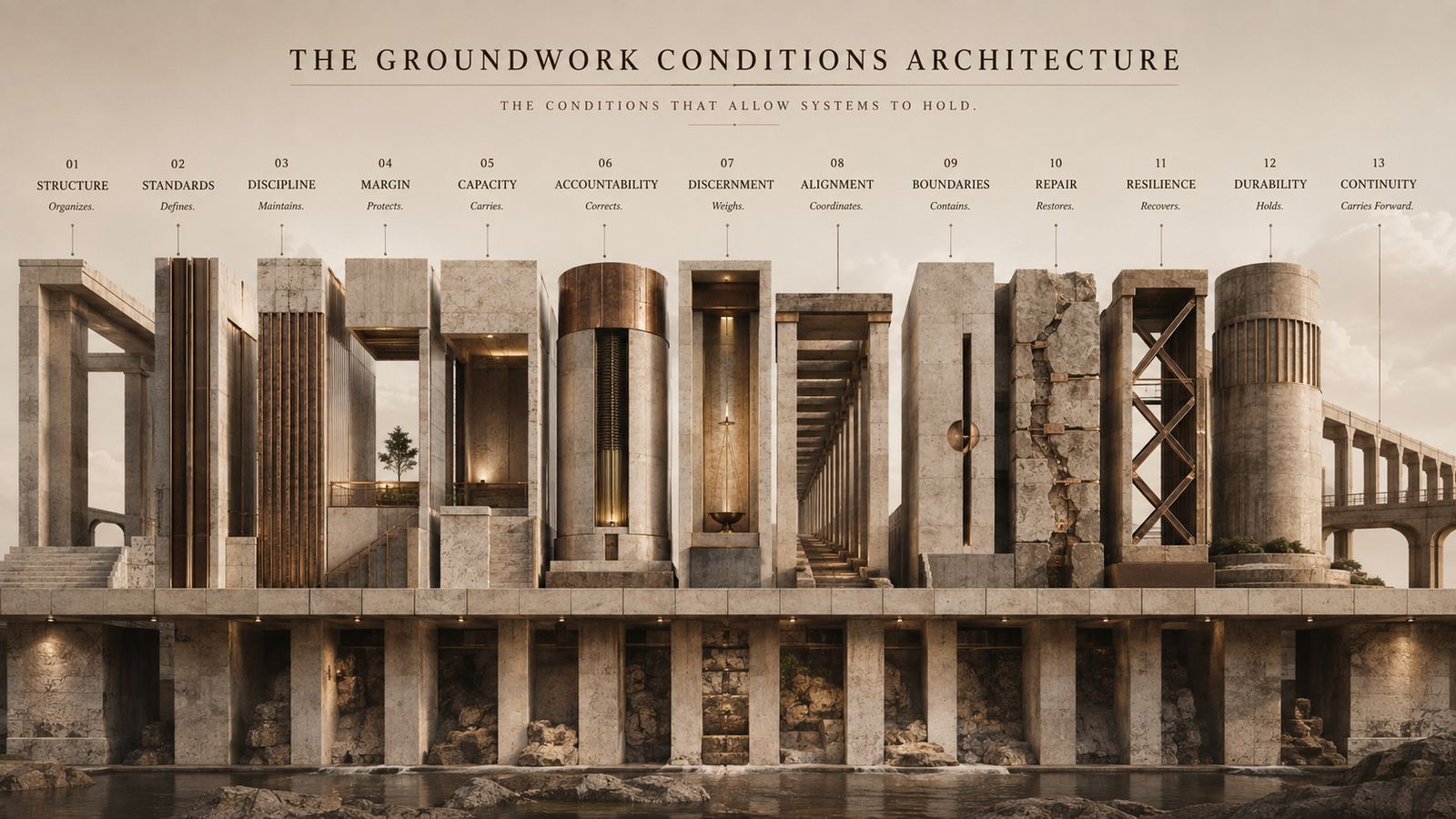
Establish and Carry
Structure organizes. Standards define. Discipline maintains. Margin protects. Capacity carries. Together, these first conditions establish the system and determine what it can support.
Govern and Coordinate
Accountability corrects. Discernment weighs. Alignment coordinates. Boundaries contain. Therefore, this middle layer governs how the system responds once reality becomes more complicated.
Recover and Endure
Repair restores. Resilience recovers. Durability holds. Finally, Continuity carries forward. These conditions determine whether the system can survive damage, pressure, and transition.
01
Structure
Organizes.
02
Standards
Defines.
03
Discipline
Maintains.
04
Margin
Protects.
05
Capacity
Carries.
06
Accountability
Corrects.
07
Discernment
Weighs.
08
Alignment
Coordinates.
09
Boundaries
Contains.
10
Repair
Restores.
11
Resilience
Recovers.
12
Durability
Holds.
13
Continuity
Carries forward.
For the complete system, visit The Conditions: What Strong Systems Require to Hold.
09 / Core Principle Network
How Structure Connects to Groundwork Core Principles
A Condition defines a structural requirement. By contrast, a Core Principle states Groundwork’s position about that reality.
The Primary Structure Principles
Two principles sit closest to this Condition. Structure Builds Freedom explains the freedom created by useful constraints, while Structure Is Mercy explains the burden that good design can prevent.
The Supporting Principle Network
Other principles govern judgment, emotional control, resource direction, correction, and endurance. As a result, they extend the architecture rather than duplicate it.
Primary Principle
Structure Builds Freedom
Deliberate organization reduces drift and preserves useful choice for moments that actually require judgment.
Protective Principle
Structure Is Mercy
Good design absorbs preventable disorder before people are forced to carry the full cost themselves.
Judgment
Stillness Is Strategy
Structure removes unnecessary decisions. Stillness protects the space needed for consequential ones.
Internal Governance
Discipline Is Emotional Governance
External organization helps, yet internal pressure can still hijack behavior. Emotional governance protects execution.
Resources
Discipline Before Dollars
Money becomes more useful when resources have defined roles and behavior can direct them consistently.
Correction
Accountability Is a Form of Strength
Clear responsibility creates a reference point. Accountability determines what happens when reality drifts.
Endurance
Build What Holds
Initial design gets a system standing. Durability asks whether it can keep carrying what matters across time.
10 / Applied Architecture
Where Structure Becomes Visible Across Groundwork
Internal links should follow meaning rather than volume. Therefore, this page connects only to frameworks where organization is genuinely upstream of the problem.
Individual and Relationship Systems
Decision Architecture, Stability, and Relationship Structure all examine how arrangements shape behavior before outcomes become visible.
Institutional and Community Systems
Governance, systems thinking, and family stability extend the same logic into larger networks of responsibility.
Decisions
Decision Architecture Framework
Environment, constraints, incentives, defaults, and cognitive load influence behavior before the moment of choice.
Stability
The Stability Framework
Stability connects personal discipline, emotional regulation, finances, physical baseline, civic systems, and community responsibility.
Relationships
Relationship Structure Framework
Strong partnerships need clear expectations around communication, responsibility, boundaries, accountability, and repair.
Institutions
Governance Structure
Institutions endure when authority, accountability, control, enforcement, succession, and continuity are designed rather than left informal.
Systems Thinking
How to Use Systems Thinking in Real Life
Systems thinking shifts attention from isolated events toward relationships, feedback, incentives, constraints, and repeated outcomes.
Family Systems
Family Stability Framework
Family stability becomes concrete through leadership clarity, defined roles, routines, economic preparation, and repair.
11 / Real Life
Structure Changes Form Across Different Systems
Although the setting changes, the mechanism remains similar. Parts need relationships, responsibility needs a home, and pressure needs somewhere to go.
Personal and Household Systems
Money, health, relationships, and personal routines all depend on arrangements that reduce unnecessary friction before pressure arrives.
Organizational and Civic Systems
Workplaces, institutions, and communities also need clear authority, responsibility, coordination, and continuity.
Money
Give resources roles.
Accounts, transfers, payment dates, reserves, and reviews create financial order before spending begins.
Work
Match responsibility with authority.
Decision rights, handoffs, deadlines, and escalation pathways reduce operating ambiguity.
Relationships
Turn assumptions into agreements.
Time, money, conflict, boundaries, expectations, and repair become more stable once they are named.
Personal Life
Use defaults to protect attention.
Calendars, routines, preparation, designated places, and limits reduce dependence on memory.
Health
Put recovery inside the plan.
Training, sleep, food, workload, and recovery need an arrangement capable of supporting repeated performance.
Organizations
Reduce dependence on heroics.
Authority, information, succession, accountability, and redundancy should survive individual personalities.
Community
Make shared responsibility visible.
Durable community systems clarify participation, maintenance, contribution, enforcement, and stewardship.
Decisions
Design the choice before testing willpower.
Defaults, friction, sequence, and incentives shape behavior before conscious judgment begins.
12 / Diagnose Before Blame
Six Symptoms That Should Trigger a Structural Question
Not every repeated problem is architectural. Still, repeated friction deserves a design check before the system concludes that somebody simply needs more character.
Look for Repeated Confusion
Questions about information, ownership, and authority often reveal unclear relationships between parts.
Look for Repeated Rescue
If the same person repeatedly saves the system, the architecture may be hiding a dependency rather than solving the underlying problem.
Symptom
“Nobody told me.”
Ask: Where does information live, and who is responsible for moving it?
Symptom
“I thought you were doing it.”
Ask: Is ownership explicit, or is the system running on assumption?
Symptom
“Everything comes through me.”
Ask: Has authority been distributed, or has dependency become normal?
Symptom
“We already talked about this.”
Ask: Did the conversation change the process, responsibility, or consequence?
Symptom
“There is never enough time.”
Ask: Is the calendar poorly organized, or has demand exceeded Capacity?
Symptom
“We fall apart whenever something changes.”
Ask: Does the system contain enough Margin, redundancy, Repair, and Resilience?
13 / Practical Tool
The Groundwork Structure Audit
When part of life or work feels harder to operate than it should, do not begin by adding another rule. Instead, inspect the architecture.
Step 1: Name the System
Be specific. “My life” is too broad, while “weekday mornings,” “monthly bill payment,” “event approvals,” or “conflict repair” can be examined.
Step 2: Identify the Parts
List the people, tools, resources, routines, accounts, responsibilities, or spaces involved.
Step 3: Clarify Ownership
Determine who owns each recurring action. Also identify who decides, who supports, and who must be informed.
Step 4: Trace the Sequence
Next, determine what happens first, what depends on something else, and where work or information tends to stop.
Step 5: Follow the Load
When pressure enters, identify which person, account, resource, or process absorbs the additional demand.
Step 6: Find Repeated Friction
Look for ordinary activities that require too much chasing, rescuing, explaining, remembering, or negotiating.
Step 7: Identify Hidden Dependencies
Then ask whether success depends on one person’s memory, perfect attendance, constant emotional restraint, or conditions never changing.
Step 8: Redesign Before Demanding More
Finally, ask what arrangement would make useful behavior easier to repeat and failure harder to reproduce.
The audit does not begin with, “How can everybody try harder?”
Instead, it begins with, “What is the system making unnecessarily difficult?”
14 / Structure Needs Judgment
Strong Structure Must Still Be Able to Change
Organization shapes behavior before many decisions become conscious. That is its power. However, the same strength can become a liability when yesterday’s arrangement survives long after yesterday’s conditions disappear.
Stability Is Not Rigidity
If every exception becomes a crisis, the system may be too rigid. Likewise, if every action requires approval, the architecture may be overbuilt.
Useful organization clarifies what should remain stable while preserving enough flexibility for judgment.
Discernment Protects Against Institutional Habit
Discernment asks what deserves authority now.
Therefore, a process that no longer protects what matters should be examined. When authority and responsibility separate, they should be realigned.
Structure organizes the field. Discernment determines whether the arrangement still deserves to remain.
15 / From Design to Endurance
Getting a System Standing Is Only the Beginning
Even good design can degrade. Roles change, demand grows, people leave, technology shifts, and institutions inherit new obligations.
Maintenance Keeps Design From Becoming History
A strong initial arrangement can weaken when nobody reviews roles, updates processes, or repairs damaged connections.
Because of that, mature systems need maintenance rather than permanent confidence in yesterday’s design.
Durability Asks a Longer Question
Eventually, the system must answer something harder: can it keep carrying what matters?
The Durability Chain
Organization → Load → Capacity → Maintenance → Repair → Adaptation → Durability
Initial architecture directs the system. Capacity determines what can be carried. Meanwhile, Repair and maintenance preserve function. Durability shows whether the whole arrangement continues to hold.
For that reason, the long-range Core Principle connection is Build What Holds.
16 / The Conditions Sequence
Structure Organizes. Standards Define.
An organized system can still operate badly. A role may be clear and still be performed poorly. Likewise, a process may be orderly while producing unacceptable results.
Organization Does Not Define Quality
An institution may know exactly who holds authority and still tolerate weak conduct. Therefore, organization cannot answer the next question by itself.
Standards Establish the Threshold
The next Condition asks: What must remain true inside this arrangement?
Condition 01
Structure
Organizes.
Creates relationships, responsibilities, limits, and pathways.
Condition 02
Standards
Defines.
Establishes the threshold normal operation should not casually fall below.
Next canonical build: Standards.
17 / External Context
Systems Engineering Also Studies Relationships Between Parts
Groundwork applies structural thinking to everyday life, relationships, organizations, and institutions.
Technical Systems Use the Same Basic Lens
Formal systems engineering operates at a different technical level. Even so, it shares an important premise: complex outcomes emerge from how components, interfaces, requirements, functions, and constraints interact.
NASA’s Systems Engineering Handbook offers a deeper technical reference for readers interested in lifecycle design, requirements, interfaces, integration, and system performance.
18 / FAQ
Frequently Asked Questions
What is structure?
It is the arrangement of parts, roles, relationships, responsibilities, sequences, resources, and limits that gives a system enough order to function.
Why does structure matter?
It reduces preventable ambiguity, clarifies responsibility, directs load, creates predictable pathways, and gives later conditions an operating environment.
How does structure work in systems thinking?
Systems thinking looks at relationships, constraints, flows, incentives, feedback, and arrangements that help produce repeated outcomes.
Is structure the same as rules?
No. Structure determines how the system is arranged, while rules govern specific behavior inside that arrangement.
Is a routine a structure?
A routine can be one part of a larger architecture. However, the full system may also include roles, resources, limits, responsibility, and decision rights.
Can a system have too much structure?
Yes. Organization becomes rigidity when it blocks judgment, prevents adaptation, or adds unnecessary control.
How do you improve a weak system?
Begin by naming the system. Then identify its parts, clarify ownership, trace sequence and load, find repeated friction, expose hidden dependencies, and redesign before demanding more effort.
How does structure relate to discipline?
Structure creates the operating pattern. Standards define what good operation requires. Discipline then helps maintain that behavior over time.
How does structure relate to capacity?
The architecture determines where load travels. Capacity determines how much load can be carried reliably.
How does structure relate to accountability?
Clear roles make responsibility visible. Accountability then determines whether expectations were met and whether drift produces correction.
Is Structure part of The Conditions?
Yes. It is Condition 01 in The Groundwork Conditions Architecture, where its governing job is to organize the system.
19 / Continue Building
Move Through the Groundwork Architecture
The best next page depends on the problem you are trying to solve.
Start With the Parent Architecture
If you want the complete map, begin with The Conditions. From there, move into the specific principle, framework, or Condition that matches the problem.
Move by Function, Not Randomly
For example, Capacity is the better next step when the issue is load. Margin is more useful when the issue is reserve. Discernment becomes relevant when the problem is judgment.
By contrast, Accountability belongs upstream when responsibility is clear but correction is weak.
Parent Architecture
The Conditions
See how Structure connects to Standards, Discipline, Margin, Capacity, Accountability, Discernment, and the conditions governing recovery and endurance.
Core Principle
Structure Builds Freedom
Explore why deliberate organization reduces drift and creates more useful freedom.
Protection
Structure Is Mercy
See why good systems should absorb preventable disorder before people are forced to carry it personally.
Judgment
Discernment
Organization creates the field. Discernment determines what deserves weight when the system must respond or change.
Load
Capacity
Once the system is organized, ask how much load it can reliably carry without degrading future usefulness.
Reserve
Margin
See why durable systems preserve usable room between ordinary demand and reliable capacity.
Correction
Accountability Is a Form of Strength
Clear responsibility creates the reference point. Accountability keeps that responsibility from becoming ceremonial.
Durability
Build What Holds
Move from getting a system standing to keeping it useful through pressure, maintenance, repair, adaptation, and time.
The Groundwork
Strong Systems Do Not Depend on Constant Rescue
Good design will not make people perfect or eliminate conflict, mistakes, uncertainty, and pressure.
However, it can make responsibility easier to locate, give work a sequence, direct load more intelligently, and reduce preventable friction.
More importantly, it can stop ordinary functioning from depending on somebody repeatedly saving the system.
Structure does not make a system strong by itself.
It makes strength possible.
Build better. Every day.