The Groundwork Conditions
The structural requirements that allow systems to function, adapt, and endure.
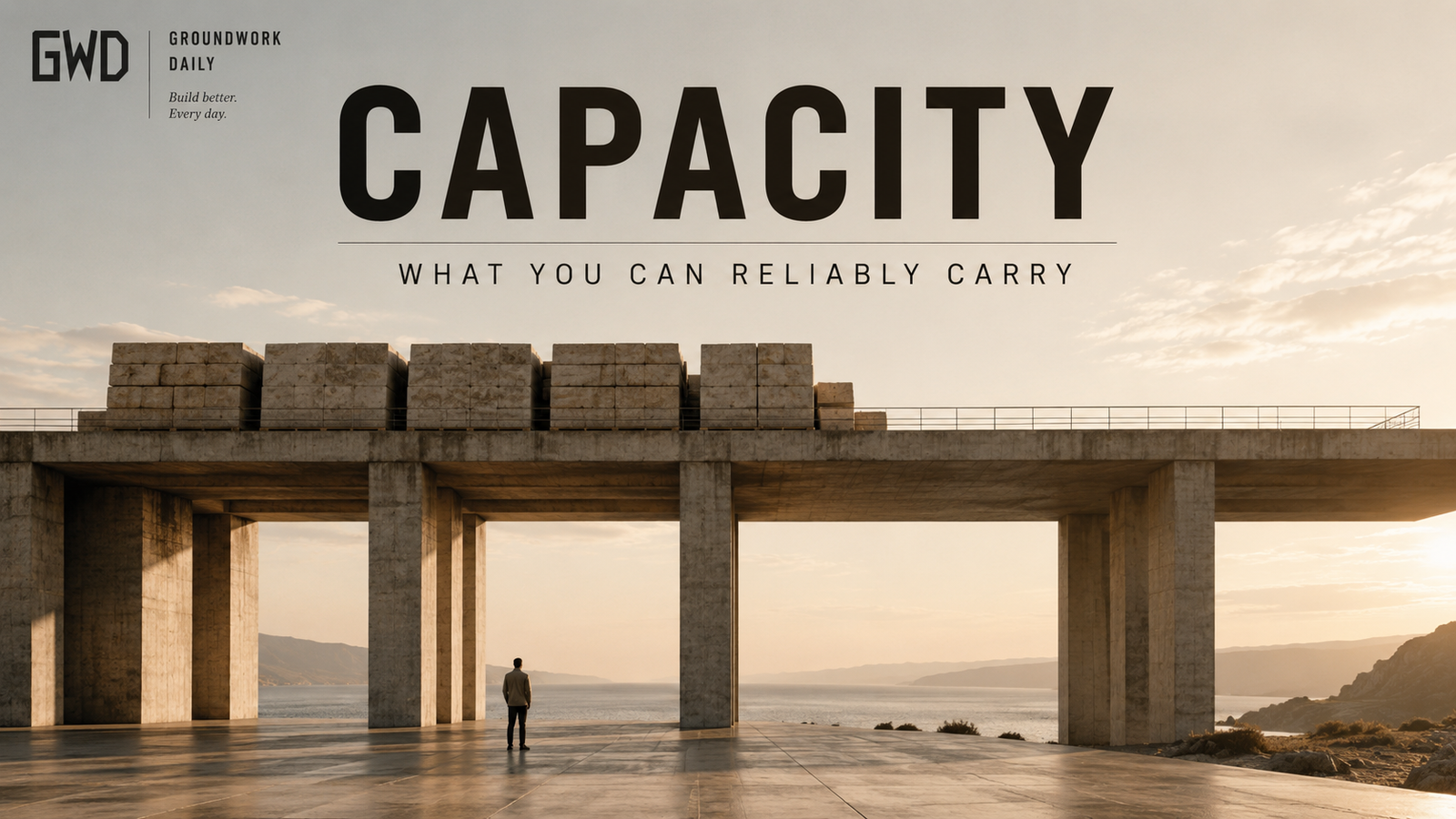
Capacity is the reliable amount of load a system can carry without degrading its function, judgment, standards, or ability to recover.
That definition is stricter than the way we usually talk about capacity.
People often measure it by survival. Someone gets through a brutal week, covers three jobs, spends the emergency fund, skips sleep, or keeps saying yes after the available room is gone. Because the system did not immediately collapse, we call it capable.
That is a weak test.
The better question is not whether a load can be carried once. It is whether the system can carry that load reliably without becoming worse at carrying the next one.
Groundwork Definition
Capacity is the amount of demand a person, household, relationship, team, organization, or system can reliably carry while preserving function and the ability to recover.
This makes Capacity the natural partner to Margin. Margin tells us what reserve remains. Capacity tells us how much load the system can reliably carry before that reserve begins to disappear.
The Function
Capacity Is About Reliable Load
Most people understand that limits exist. The harder question is where those limits actually sit.
A person may work sixteen hours once. A team may operate short-staffed for a weekend. A household may survive an unusually expensive month.
Likewise, a body may endure several demanding workouts with poor recovery.
None of those examples proves sustainable capacity. They prove only that systems can stretch.
Emergency Output Is Not Operating Capacity
Temporary overextension often feels productive while it is happening.
Deadlines get met. Bills get paid. The shift gets covered. The project gets finished.
However, the hidden cost may appear later as fatigue, debt, mistakes, resentment, deferred maintenance, or lost recovery time.
Repeatability Is the Better Test
Reliable capacity asks a harder question: Could the system carry this load again without becoming weaker because it did?
That is the standard that matters.
Structural Sequence
Structure Organizes. Standards Define. Discipline Maintains. Margin Protects. Capacity Carries.
The first five Conditions now form a clear operating sequence.
Why Capacity Follows Margin
Margin describes the usable reserve between current load and reliable capacity.
Therefore, once Margin is defined, the next question becomes unavoidable: reliable compared with what?
Capacity establishes that load-bearing limit.
False Signals
Surviving More Does Not Mean You Can Reliably Carry More
Capacity is easy to misread because people and systems can compensate.
Sleep gets cut. Maintenance is delayed. Savings get spent. Employees work overtime. A relationship postpones another difficult conversation.
For a while, the system still looks functional.
Compensation Moves Cost
Compensation does not erase the cost of load. Instead, it moves the cost somewhere else.
False Signal
“I got it done.”
Completion proves the task was finished. It does not prove the method was sustainable.
Better Question
“What did getting it done cost?”
The answer may reveal that performance was financed by sleep, money, attention, relationships, maintenance, or future recovery.
Borrowing Is Not Capacity
A system can look highly capable while becoming more fragile.
If today’s output requires tomorrow to pay the bill, the system has not demonstrated greater capacity. It has demonstrated borrowing.
Necessary Distinction
Maximum Capacity and Reliable Capacity Are Different
Maximum Capacity
What can the system survive?
Maximum capacity describes the outer edge. Reaching it may require unusual effort, temporary sacrifice, or conditions that cannot be maintained.
Reliable Capacity
What can the system carry well?
Reliable capacity preserves function, judgment, recovery, and enough reserve for normal variation.
The Groundwork distinction
Maximum capacity asks how far the system can be pushed.
Reliable capacity asks how much the system can carry without degrading itself.
Pressure Is Not the Enemy
This distinction does not argue for comfort.
Systems need challenge to grow. People need difficult work. Organizations need periods of stretch.
The important question is whether pressure creates adaptation or simply consumes the structure carrying it.
The Groundwork Capacity Model
How Capacity Actually Works
Capacity changes. It rises, falls, gets restored, and can sometimes grow.
The useful model is therefore dynamic rather than fixed.
The Groundwork Capacity Model
Resources Supply the System
Time, money, energy, skill, attention, people, equipment, knowledge, trust, and infrastructure can all contribute to capacity.
Capacity Converts Resources Into Load-Bearing Ability
Resources alone do not determine capacity. Structure matters. Skill matters. Coordination matters.
Two systems can possess similar resources yet carry very different amounts of load because one is organized more effectively.
Load Consumes Available Capacity
Work, obligations, caregiving, stress, maintenance, conflict, debt, complexity, and unfinished commitments all draw on capacity.
Strain Reveals the Relationship Between Load and Capacity
Strain is not automatically failure. It is information.
Moderate strain can produce adaptation. Chronic excessive strain can reduce future capacity.
Recovery Restores What Load Consumed
Recovery returns usable capacity through sleep, rest, maintenance, replenishment, relief, repair, financial restoration, or reduced demand.
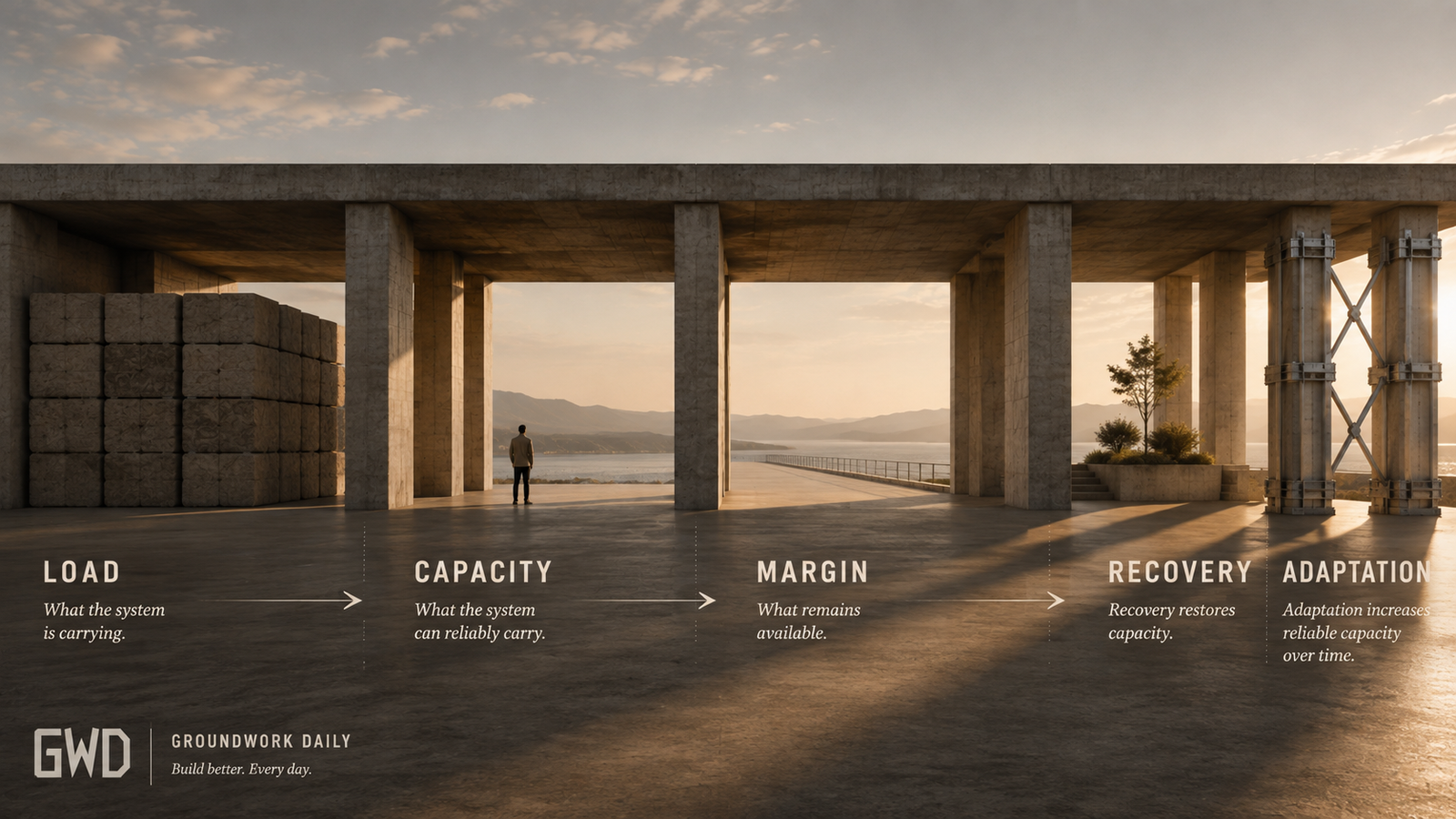
Recovery
Recovery Is Part of Capacity
One of the easiest mistakes is treating recovery as something separate from performance.
Work happens first. Recovery gets whatever remains.
That logic fails because renewable capacity depends on restoration.
Different Systems Recover Differently
A body needs sleep and nutrition. Equipment needs maintenance. A budget needs replenishment.
Employees need relief from demand. Relationships need repair. Attention needs periods when it is not being consumed.
Missing Recovery Changes Tomorrow
Without restoration, today’s load changes tomorrow’s baseline.
Eventually, the same demand feels heavier because the system carrying it has become weaker.
Adaptation
Capacity Can Grow Without Living at the Limit
Capacity is not fixed.
Physical training can increase what the body handles. Skill can increase professional capacity. Better systems can increase organizational capacity.
Savings can increase financial capacity, while experience can improve decision capacity.
Growth Requires Integration
The system experiences enough challenge to create change. Then it needs enough recovery to absorb that change.
Permanent Overload Is a Poor Development Strategy
If the system never has a chance to integrate the demand, it may become more tolerant of strain without becoming more capable.
That is not sustainable growth.
Application
Where Capacity Shows Up
The form changes across systems. However, the structural question remains consistent: how much demand can be carried reliably without damaging future function?
| System | Capacity Looks Like | Load Looks Like | What Builds Capacity | What Consumes It |
|---|---|---|---|---|
| Physical | Strength, endurance, recovery | Training, work, illness, poor sleep | Training, food, sleep, recovery | Chronic overload without restoration |
| Attention | Ability to focus and make decisions | Meetings, screens, interruptions, complexity | Boundaries, systems, quiet, prioritization | Constant switching and unresolved demand |
| Financial | Ability to absorb or fund demand | Bills, debt, obligations, emergencies | Income, savings, lower fixed costs | Recurring obligations and financial leakage |
| Emotional | Ability to process pressure without losing judgment | Conflict, grief, uncertainty, responsibility | Rest, support, boundaries, stillness | Unprocessed pressure and constant reactivity |
| Relational | Ability to support, repair, and remain present | Needs, conflict, caregiving, expectations | Trust, communication, time, repair | Unresolved tension and unequal burden |
| Household | Money, labor, time, and coordination | Caregiving, bills, maintenance, logistics | Shared systems and distributed responsibility | Load concentrated on too few people |
| Organization | People, systems, capital, knowledge | Operations, clients, projects, disruptions | Training, staffing, automation, process design | Overcommitment and weak redundancy |
| Leadership | Ability to judge, decide, coordinate, and absorb pressure | Decisions, conflict, complexity, accountability | Delegation, information quality, margin, experience | Decision overload and responsibility concentration |
Failure Pattern
Capacity Problems Often Look Like Performance Problems
At Work
A high-performing employee keeps receiving more responsibility because every assignment gets completed. Eventually, quality slips. The visible conclusion may be that performance declined. The structural problem may be that load increased while available capacity did not.
At Home
One person remembers appointments, handles bills, manages meals, solves emergencies, and carries most household planning. Nothing looks broken until that person becomes unavailable. Then the household discovers how much capacity had been concentrated in one place.
With Money
Income rises, so recurring spending rises with it. Gross financial capacity increased. Yet higher fixed load consumed most of the gain, leaving little additional margin.
In Training
More exercise does not always create more fitness. When load rises faster than recovery and adaptation, the body can accumulate fatigue instead of usable capacity.
In every example, the visible result tells only part of the story.
Capacity asks what the system underneath that result can continue carrying.
Load and Reserve
Capacity Tells You What You Can Carry. Margin Tells You What Remains.
These Conditions belong beside one another, but they solve different problems.
High Capacity Does Not Guarantee High Margin
A person can have substantial capacity and almost no margin because most of that capacity is already committed.
Someone else may have less total capacity but more reserve because fewer demands are consuming it.
Ask Two Questions, Not One
“Can I handle this?” is incomplete.
A stronger sequence is:
Can the system reliably carry this?
What will remain if it does?
Explore Margin: The Space That Keeps Systems From Breaking for the reserve side of the model.
Judgment
Discernment Decides What Deserves Capacity
Greater capacity creates more options. It does not make every option worthy.
That distinction connects Capacity to Discernment.
Discernment
Should I carry this?
Discernment weighs fit, consequence, priority, alignment, and cost.
Capacity
Can I reliably carry this?
Capacity tests whether the system can absorb the demand without unacceptable degradation.
Margin
What remains if I do?
Margin reveals the reserve left after the commitment enters the system.
Ability Is Not Obligation
Poor discernment can consume good capacity.
Just because a person, household, or organization can carry something does not mean carrying it is the best use of available resources.
Practical Tool
The Groundwork Capacity Test
When you are unsure whether a person, team, household, or system is carrying too much, examine five signals.
Function
Is the system still working well, or are quality, judgment, safety, reliability, or maintenance beginning to decline?
Reserve
What remains after the normal load has been carried?
Shock
What happens when one ordinary additional demand arrives?
Recovery
How does the system return to baseline, and is that restoration actually built into the structure?
Repeatability
Could this same load be carried again without requiring emergency effort?
What the Test Is Really Measuring
The Capacity Test does not tell you to avoid hard things.
Instead, it helps distinguish demanding work that strengthens the system from demanding work that quietly consumes it.
Put It to Work
How to Build More Capacity
Start by resisting the instinct to add more load.
When capacity feels insufficient, the first question should not automatically be, “How can I push harder?”
Instead, identify what is limiting the system.
Reduce Unnecessary Load
Some capacity problems are really commitment problems. Removing low-value obligations can restore usable capacity immediately.
Restore Recovery
A depleted system cannot display its true capacity. Restore before assuming the ceiling is permanent.
Improve Structure
Better processes, tools, boundaries, delegation, automation, and routines can increase useful output without requiring equal increases in strain.
Build Skill
Greater competence can reduce the amount of time, energy, money, or attention required to produce the same result.
Adapt Gradually
Capacity grows when challenge is followed by enough recovery for the system to absorb the change.
Core Principle Connection
Capacity Is Part of Building What Holds
Build What Holds
A durable structure must carry real load without losing the qualities that make it useful.
Capacity is part of that test. Something that functions only under low demand may be underbuilt. Yet something that survives high demand only through constant emergency effort is not necessarily strong either.
Reliable capacity tells us how much load the structure can carry without consuming itself.
Better Structure Can Increase Capacity
Capacity also connects to Structure Builds Freedom.
Better systems allow the same resources to carry more useful load with less waste.
Structure Should Not Use People as Shock Absorbers
Structure Is Mercy matters here as well.
Good systems prevent people from becoming the permanent compensating mechanism for weak design.
The Larger Architecture
Capacity Works Inside a Larger System
Capacity does not stand alone.
Structure affects how efficiently resources are used. Standards determine what level of function must be protected. Discipline maintains important behavior. Margin preserves reserve.
Capacity determines what the system can reliably carry.
The Groundwork Conditions Architecture
Structure
Organizes.
Standards
Define.
Discipline
Maintains.
Margin
Protects.
Capacity
Carries.
Accountability
Corrects.
Discernment
Weighs.
Alignment
Coordinates.
Boundaries
Contain.
Repair
Restores.
Resilience
Recovers.
Durability
Holds.
Continuity
Carries forward.
Explore the complete architecture: The Conditions: What Strong Systems Require to Hold.
Next
Accountability: The Condition That Corrects Drift
Capacity determines what the system can reliably carry. Accountability addresses what happens when behavior, performance, or responsibility moves away from the standard the system is supposed to protect.
The Groundwork
Reliable Capacity Leaves Something for Tomorrow
There will be seasons when people, families, organizations, and institutions carry more than usual.
That is part of life.
The mistake is turning emergency capacity into the permanent operating standard.
Capacity is not how much you can force the system to carry.
It is how much the system can carry without losing the ability to keep carrying.
Build better. Every day.