The Groundwork Conditions
The structural requirements that allow systems to function, adapt, and endure.
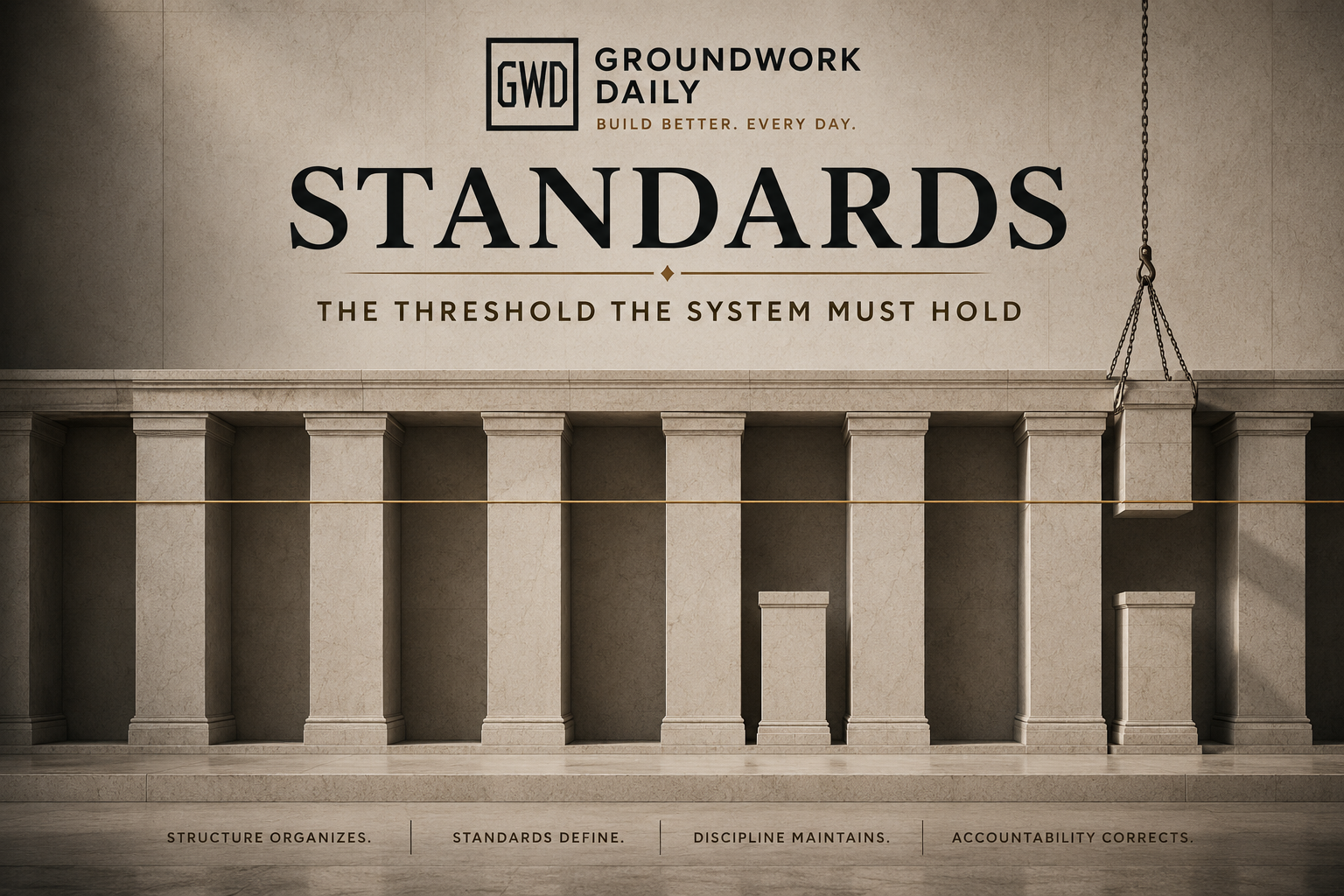
Standards define the threshold a system must hold. They establish what counts as acceptable, what falls below expectation, and when correction should begin.
Without standards, people negotiate quality in real time. Expectations begin moving with mood, pressure, authority, or convenience. Consequently, a system becomes less predictable even when everyone believes they understand what “good” means.
The problem appears across every domain. Families encounter it. Relationships expose it. Workplaces, institutions, businesses, communities, and governments eventually confront the same question: what are we actually unwilling to let fall below the line?
That is why standards solve a structural problem rather than a motivational one. They make the line visible before pressure, conflict, or failure forces the system to define it too late.
The Function
What Standards Do Inside a System
Every functioning system produces variation. Some days run better than others. People make mistakes, resources tighten, and pressure changes behavior.
A useful standard does not pretend that variation will disappear. Instead, it gives the system a reference point strong enough to survive it.
Standards Define the Acceptable Range
The central question is straightforward: what must remain good enough to protect, repeat, trust, or build upon?
At work, for example, the answer may involve safety, accuracy, timeliness, or quality. Inside a relationship, the threshold may involve honesty, respect, reciprocity, or repair.
Financial standards can govern savings, debt, or spending. Household standards can clarify contribution, communication, care, or shared responsibility.
Standards Give Judgment a Reference Point
Evaluation becomes unstable when the reference point keeps moving. Something that felt unacceptable last month can suddenly seem tolerable because people are exhausted, rushed, financially strained, or afraid of conflict.
Therefore, the line must be stable enough to survive circumstances that temporarily make lowering it attractive.
Structural Sequence
Structure Organizes. Standards Define.
Standards become clearer when placed beside Structure.
Structure Creates the Arrangement
Structure determines where responsibility sits, how parts relate, where decisions move, and how work is organized.
Yet organization alone does not guarantee performance. A process can be orderly while producing weak work. Roles can be clear while expectations remain low.
Standards Define What the Arrangement Must Protect
Once the system has shape, another question follows: How well must it operate?
Structure gives the system form. Standards establish the quality that form is expected to support over time.
The Conditions Sequence
Clarity
Clear Standards Make Good Performance Repeatable
Strong systems do not ask everyone to invent a private definition of excellence. Instead, they make important expectations visible to the people responsible for meeting them.
Standards Do Not Require Bureaucracy
Not every threshold needs a lengthy manual. A deadline can be clear. The same is true for a safety requirement, savings minimum, conflict protocol, or approval rule.
In other words, paperwork is not the objective. Shared recognition is.
Standards Reduce Repeated Negotiation
When people understand the threshold, they do not need to reinvent the same decision every time it appears.
Consequently, clarity can create operational speed without sacrificing baseline quality.
Necessary Distinction
Standards Are Not the Same as Preferences
People sometimes weaken important requirements by treating them as preferences. The opposite mistake happens too: personal preferences get elevated into universal requirements.
Preference Describes What Someone Would Like
A preference affects comfort, style, or fit. However, the larger system may continue functioning when that preference is not satisfied.
Standards Protect Function, Quality, or Trust
By contrast, a standard carries more weight because failure threatens something the system has decided matters.
| Type | Question | Example |
|---|---|---|
| Preference | What would I like? | I prefer meetings in the morning. |
| Expectation | What should normally happen? | Meeting materials should arrive beforehand. |
| Standard | What must be maintained? | Financial decisions require documented review and approval. |
Failure Pattern
How Standards Drift
Most systems do not announce that expectations have been lowered. Instead, the threshold usually moves one exception at a time.
Exceptions Become Familiar
One missed deadline seems understandable. The next feels convenient. Before long, enforcement depends more on circumstance than principle.
Meanwhile, reliable people often compensate for weaker performance. Because the work still gets finished, the deeper structural weakness stays hidden.
Familiar Failure Starts Feeling Normal
Repetition changes perception. A condition that once caused concern may begin to feel ordinary simply because people have encountered it often.
Eventually, the practical standard becomes whatever the system repeatedly allows.
Calibration
High Standards Still Need Capacity and Margin
Raising expectations is not automatically evidence of strength. A threshold that ignores resources, human limits, training, time, or operating conditions can damage the system it was meant to improve.
Capacity Determines What Can Be Sustained
Capacity asks how much load the system can reliably carry.
Therefore, an expectation that routinely requires more than available capacity is not merely ambitious. It is structurally unsustainable.
Margin Protects Standards Under Pressure
In addition, Margin provides reserve between normal demand and maximum capacity.
Strong standards should stretch performance without requiring permanent overload.
Limits
Standards and Boundaries Do Different Work
Standards identify the condition a system intends to protect. Boundaries determine what happens when an important limit is crossed.
Standards Name the Condition
“We speak respectfully during conflict” defines an expected condition.
Boundaries Name the Response
“If the conversation becomes abusive, the conversation stops” defines what follows. Accordingly, standards and boundaries support one another without becoming interchangeable.
Correction
Standards Give Accountability Something to Protect
Accountability becomes unstable when the expected threshold was never clear. In that environment, correction can feel personal because the system lacks an agreed reference point.
Clear Standards Change the Conversation
Instead of asking whether somebody is simply “good enough,” the system can ask whether a defined expectation was met.
That shift moves attention away from personality and toward behavior, responsibility, performance, or outcome.
Accountability Restores the Line
This is where Accountability Is a Form of Strength becomes practical.
Accountability recognizes drift and creates a path toward correction. Standards provide the reference point from which that correction becomes possible.
Maintenance
Discipline Turns Standards Into Repeated Behavior
A threshold can exist on paper while having little influence on everyday behavior.
Discipline closes that gap by carrying the expectation into repetition after novelty, motivation, or outside pressure fades.
Definition and Maintenance Are Different Jobs
Standards decide what should hold. Discipline handles the ongoing work required to keep performance near that threshold.
For that reason, Discipline follows Standards inside the Conditions architecture.
Application
Standards Operate at Every Scale
The language changes by domain. However, the structural function remains consistent: define the threshold the system intends to protect.
Personal and Relationship Standards
Personal standards can govern spending, health, routines, commitments, preparation, or work quality. Relationship standards can define honesty, respect, reciprocity, communication, fidelity, responsibility, and repair.
Organizational and Institutional Standards
Organizations use standards to govern performance, safety, documentation, service, governance, and decision quality. Institutions need an additional layer: expectations strong enough to survive leadership transitions.
Personal Life
Routines, money, health, preparation, commitments, and work quality.
Relationships
Honesty, respect, communication, reciprocity, repair, fidelity, and responsibility.
Organizations
Performance, safety, documentation, service, governance, and decision quality.
Institutions
Expectations that become institutional memory rather than personal preference.
Practical Tool
The Groundwork Standards Audit
When performance becomes inconsistent, do not immediately add another rule. First determine whether the system has clearly defined what it expects.
Start by Naming What Matters
Identify the behavior, outcome, value, or operating condition the system is trying to protect.
Define the Minimum Acceptable Threshold
Next, decide what cannot repeatedly fall below the line without creating a larger problem.
Make the Evidence Observable
Determine how people will recognize whether the standard is being met. If nobody can tell, the threshold remains too vague.
Separate Requirement From Preference
Not everything desirable deserves the authority of a standard. Reserve that weight for conditions that materially affect the system.
Define Correction and Review
Finally, decide what happens when performance falls below the threshold. Then determine when the standard itself should be reviewed.
A useful standard should not move simply because maintaining it becomes inconvenient. Still, better evidence may justify improving the threshold over time.
Evaluation
Six Tests for Strong Standards
| Test | Ask | Why It Matters |
|---|---|---|
| Clarity | Can people tell whether the threshold was met? | Vague expectations create inconsistent judgment. |
| Purpose | What important outcome does this protect? | Requirements without purpose become bureaucracy. |
| Capacity | Can the system maintain it under normal conditions? | Impossible expectations manufacture chronic failure. |
| Consistency | Does the requirement change depending on the person? | Selective application destroys legitimacy. |
| Correction | What happens when performance falls below the line? | A threshold without correction becomes optional. |
| Review | Does the standard still serve the system? | Durable systems preserve principles without freezing obsolete methods. |
External Context
Standards Already Operate as Infrastructure
Modern systems rely on common requirements every day. Manufacturing, technology, construction, safety, quality management, and infrastructure all depend on defined expectations because complex systems cannot rely on individual interpretation alone.
For example, the International Organization for Standardization develops shared standards intended to improve quality, safety, consistency, and compatibility across industries.
The Groundwork
Standards Make the Line Visible
Every functioning system develops thresholds, whether it names them or not.
If Standards Are Not Defined, Behavior Defines Them
When nobody decides what must be maintained, the system learns from whatever people repeatedly tolerate.
Deadlines become suggestions. Preparation becomes optional. Poor treatment feels normal. Meanwhile, maintenance gets postponed and governance becomes increasingly informal.
Strong Systems Protect the Threshold
A stronger system decides what deserves protection, makes that threshold visible, and then builds Discipline, Accountability, Boundaries, Capacity, Margin, and the later Conditions around keeping it intact.
The Larger Architecture
Standards Work Inside a Larger System
No single Condition can carry the architecture alone. Each one solves a different structural problem.
Structure organizes the arrangement, while standards define the baseline. Discipline maintains execution, and Margin protects breathing room. Capacity carries the load, Accountability corrects deviation, and Discernment weighs evidence. From there, Alignment coordinates, Boundaries contain, Repair restores, Resilience recovers, Durability holds, and Continuity carries the system forward.
The Groundwork Conditions Architecture
Organizes.
Define.
Maintains.
Protects. Capacity
Carries. Accountability
Corrects. Discernment
Weighs.
Coordinates.
Contain.
Restores.
Recovers.
Holds.
Carries forward.
Explore the complete architecture: The Conditions: What Strong Systems Require to Hold.
Next
Discipline: The Condition That Maintains the Standard
Defining the line is only the beginning. Discipline is the mechanism that keeps useful behavior aligned with the standard after novelty, mood, and motivation fade.
Keep Building
Strong systems decide what they refuse to let drift.
Join the Groundwork List for frameworks on structure, standards, discipline, judgment, capacity, accountability, ownership, relationships, and institutional strength.