
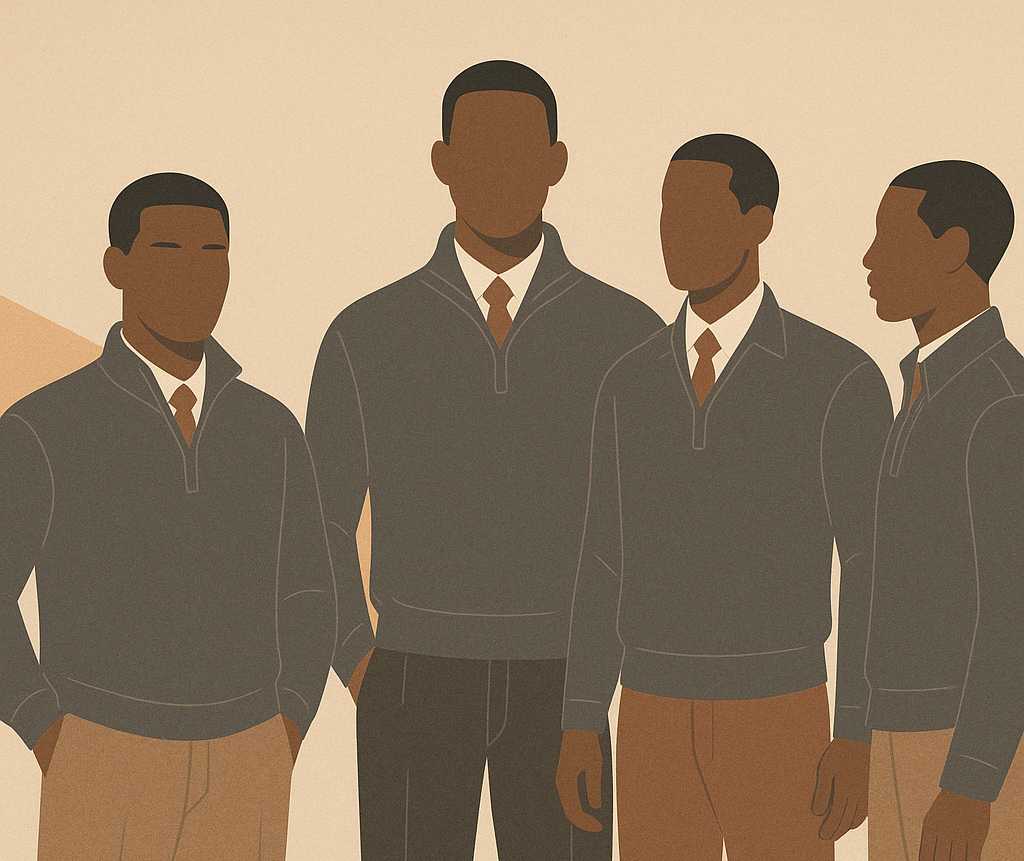
The old code vs the new code is the real argument inside the YN to YG shift. The quarter zip made the change visible, but the clothes are only the surface. Underneath them is a quieter question about how young Black men handle reputation, risk, conflict, ambition, and self-control.
For years, one kind of social script rewarded visible readiness. You stayed alert. You answered disrespect quickly. You made sure nobody mistook calm for weakness. In some environments, that posture could feel practical because the cost of being underestimated seemed higher than the cost of appearing hard.
Now another script is competing with it. Instead of proving that every challenge deserves an answer, the newer posture asks whether the challenge deserves access to your time, record, money, job, relationship, or future.
That difference is bigger than fashion.
First, one distinction matters.
YN and YG are cultural shorthand inside this Groundwork cluster. They describe competing behavioral scripts, not fixed identities and not every young Black man.
The Old Code Was Built for Survival
The old code did not come from nowhere. Protective behavior usually grows around conditions. When hesitation appears risky, quick reaction can begin to feel useful. When reputation prevents certain challenges, reputation starts functioning like armor.
In the same way, emotional distance can feel protective when vulnerability has been used against you before. A harder posture may communicate that you understand the room and will not be easily pushed around.
What the Old Code Was Trying to Protect
Clothing became one part of that language. Posture mattered too. So did volume, expression, who stood beside you, and how quickly disrespect received a response.
At its most functional, the script communicated three things:
- Awareness: I understand what is happening around me.
- Belonging: I know the codes of the people and places that shaped me.
- Deterrence: Casual disrespect may carry a cost.
None of that requires pretending the posture was always healthy. However, dismissing the entire script as foolish misses why people adopt protective behavior in the first place.
The real problem begins later, when a survival code loses its off switch.
Where the Old Code vs the New Code Gets Expensive
A behavior can protect you in one room and work against you in another. That portability problem sits near the center of the old code vs the new code debate.
Signals that create familiarity or deterrence in one environment may be read as unpredictability, disengagement, or threat somewhere else. Those judgments can be unfair. They can also be shaped by racial bias.
Changing clothes does not make that bias legitimate. More importantly, a quarter zip does not cure discrimination.
But Perception Still Has Consequences
Even when a judgment is unfair, the person being judged may still have to absorb its consequences. That is why appearance, posture, tone, and context matter without becoming the whole explanation.
Research on discrimination shows that Black Americans report unequal treatment across employment, policing, retail, and other everyday settings. Research has also examined how clothing can influence the way observers evaluate African American men.
The conclusion should not be “dress better and racism disappears.” That is unserious. Instead, the useful lesson is narrower: people read signals, and some signals become inputs inside systems that already carry bias.
A protective code becomes a cage when you cannot choose when to use it.
Once that happens, the question changes. Strength is no longer just about what keeps somebody from testing you. It is also about what preserves your options.
The YN to YG Shift Is About Range
If the YN to YG shift means nothing more than quarter zips, button-ups, loafers, matcha, and a quieter voice, then the movement has no depth. It becomes costume.
A costume can alter a photograph. It cannot govern a life.
Range, Not Respectability
The stronger version of the shift is about range. A man can recognize disrespect without automatically being recruited by it. He can understand danger without treating every disagreement as danger.
Likewise, knowing the old code does not require living inside it forever. The point is not to forget where you came from. The point is to gain enough control that one environment does not dictate how you must move in every other environment.
YG is not respectability. It is range.
Who Gets Decision Rights?
Groundwork describes the deeper mechanism as discipline as emotional governance . Emotion gets information rights. It does not automatically get decision rights.
Anger can tell you that something happened. Pride may tell you that a line feels crossed. Fear can warn that a room is unsafe. Still, none of those signals must make the final decision alone.
That space between feeling and action is where the new code either becomes real or stays cosmetic.
Old Code vs the New Code: Two Operating Priorities
The cleanest comparison is not “bad men versus good men.” That framing is lazy. A better comparison looks at the operating priorities underneath behavior.
| Layer | Reactive Code | Governed Code |
|---|---|---|
| Attention | Who is watching me? | What deserves my attention? |
| Threat | Who is testing me? | What is actually at stake? |
| Conflict | Prove the point now. | Protect the larger outcome. |
| Status | Be difficult to challenge. | Be difficult to destabilize. |
| Time | Win the moment. | Protect the trajectory. |
| Identity | Defend the image. | Build the person. |
| Clothing | Signal edge and belonging. | Signal calm, intention, and range. |
| Default Question | What do I need to prove? | What does this cost me? |
The Table Is Not the Person
Neither column describes a complete human being. They describe decision patterns, and people move between those patterns all the time.
A calm person can become reactive. Meanwhile, somebody who grew up reacting quickly can develop remarkable discipline. A man can even dress like the new code while still living under the old one.
Fabric cannot tell us which change actually happened.
What the New Code Looks Like in Real Life
Real change is usually less dramatic than the content built around it.
On an ordinary Tuesday, the new code might look like leaving early enough that one late train does not turn into an argument with somebody doing a job. Another version is keeping paperwork, deadlines, appointments, and bills clean because disorder becomes expensive when other people control the consequences.
The Quiet Decisions Carry More Weight
Sometimes the shift is hearing disrespect and deciding the person offering it does not get access to your employment, freedom, relationship, or afternoon.
Other times, discipline shows up in the people around you. Loyalty matters, but loyalty without boundaries can turn somebody else’s instability into your recurring emergency.
In practice, the governed code can look like this:
- Leaving room between emotion and action.
- Keeping commitments even when nobody is impressed.
- Building documented income and financial credibility.
- Walking away from conflicts whose only reward is escalation.
- Choosing environments where stability is reinforced rather than mocked.
- Protecting tomorrow from decisions that feel satisfying for ten minutes.
These choices rarely look cinematic. For that reason, they are easy to overlook.
Yet this is where the code becomes structure.
Keep the Awareness and Lose the Performance
The old code contains useful skills. Reading a room matters. Recognizing danger early matters too. Knowing when somebody’s energy has changed can protect you long before a situation becomes obvious.
Those abilities are not the problem.
The Upgrade Is Discernment
The upgrade is discernment . A mature code keeps awareness without requiring constant performance. It notices pressure without becoming pressure.
As a result, a person becomes better at separating a real threat from wounded pride. Not every raised voice is danger. Not every insult is a command. Not every audience deserves a demonstration.
Most importantly, disciplined awareness makes leaving possible.
You can understand exactly what is happening and still decide the situation is too small to own your next hour.
Knowing how to respond is useful. Knowing when not to respond is power.

The Groundwork
Clothing matters because people read signals. Still, clothing has limits.
A quarter zip cannot build credit. It cannot regulate anger, choose friends, arrive on time, keep a promise, repair a mistake, or walk away from a fight.
The sweater can support a different signal. Behavior is what makes the signal true.
That Is Where the Shift Either Holds or Breaks
The strongest version of the YN to YG shift does not ask young Black men to become harmless for somebody else’s comfort. Instead, it asks a harder question.
How much of your future should a stranger, an insult, an algorithm, a room, or a five-minute conflict be allowed to govern?
Over time, the answer should become smaller.
The clothes are the signal. The discipline is the code.
That is the shift worth keeping.
Further Groundwork
What Holds This Argument Together
The old code vs the new code becomes more than aesthetics when the visible shift is supported by self-governance and repeatable disciplined behavior.
Discipline Is Emotional Governance
Emotion can provide useful information without automatically governing behavior. Strength grows when anger, pride, fear, and pressure do not receive automatic control.
Discipline
Discipline maintains useful behavior after mood, novelty, impulse, or immediate pressure starts pulling conduct away from the larger standard.
Explore the full Core Principles and Conditions behind Groundwork Daily.


The Groundwork Desk examines the systems beneath culture, history, institutions, and public life. The Desk starts with what people can see, then asks what incentives, pressures, habits, and structures are making the visible pattern possible.
In the Quarter Zip Movement, the clothing is not treated as the destination. It is the entry point. The deeper work asks what happens when a change in appearance becomes a change in behavior, discipline, identity, and long-term direction.
Reader Promise: Cultural analysis that moves past the visible trend to identify the system underneath it, the behavior it rewards, and the structure required to make the better signal real.
