
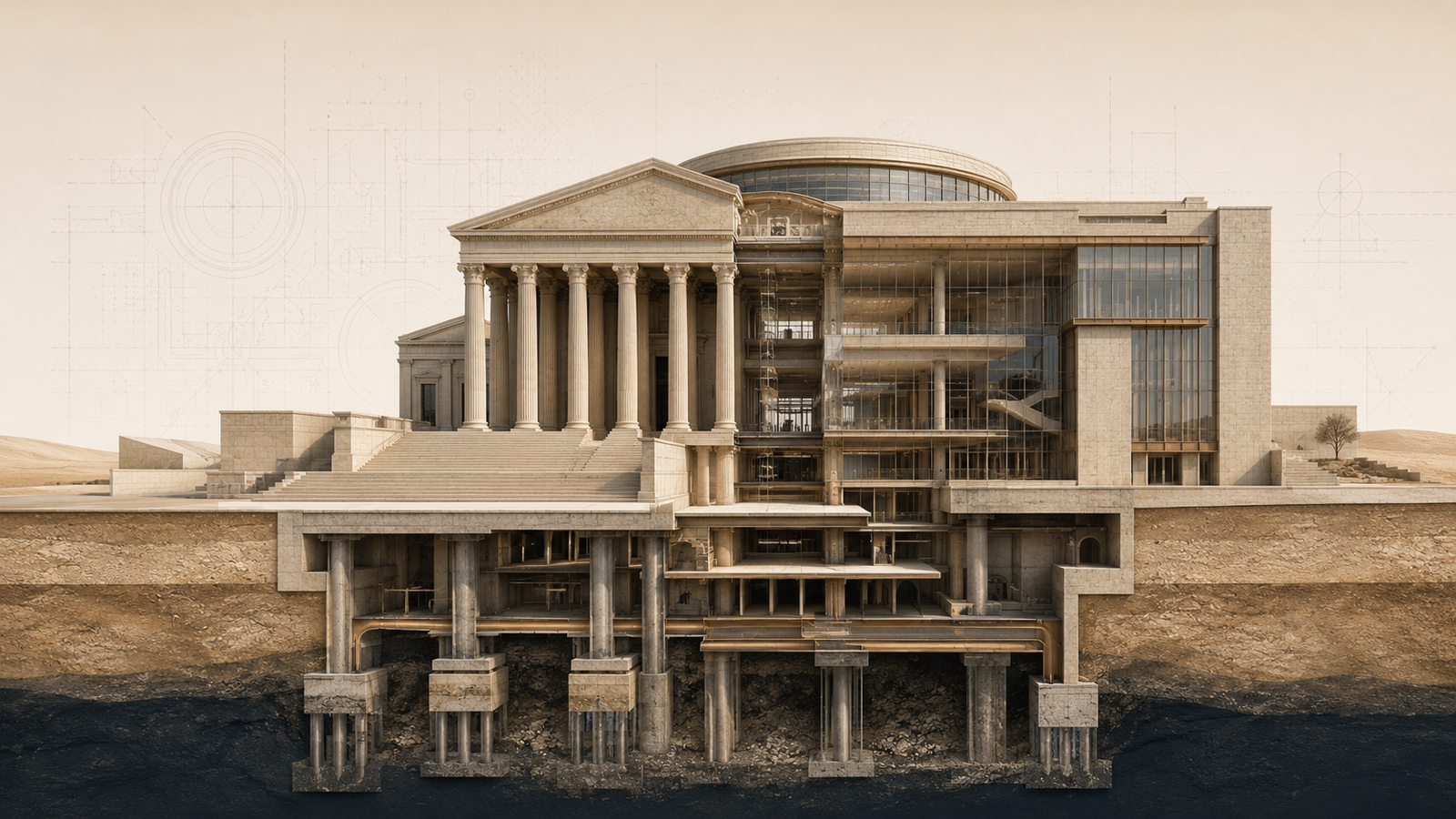
Building Institutional Literacy
Building Institutional Literacy is the practice of understanding how power moves through institutions before that power reaches your life.
Most people encounter institutions before they fully understand them. They may learn court procedure after a case begins, police authority during a stop, warrant rules when someone is already at the door, or administrative procedure after an official notice arrives. By then, the institution is already moving.
Learn the System Before the System Is Moving
When people lack an institutional map, they are often forced to react to authority in real time. For example, a document may appear official, an officer may make a request, an agency may cite a rule, or a court may issue an order. Yet the most important questions can remain unanswered.
Who has authority? Where did that authority come from? What activates it? What does it permit? Where does it stop? Finally, who can review the decision?
Institutional literacy creates a stronger starting point because it turns those questions into a repeatable method. First, identify the institution exercising power. Next, trace that power to its legal source. Then determine what threshold activates it, how far the authority reaches, what limits constrain it, and which process controls what happens next.
This page is the central learning hub for Groundwork Daily’s constitutional and civic systems curriculum. It connects constitutional rights, police encounters, searches, warrants, due process, immigration enforcement, civil rights, administrative authority, courts, and government structure into one learning system.
As a result, the objective is larger than simply knowing your rights. The objective is to know the system well enough to locate power inside it.
Critical Legal Note
This resource is educational. It is not legal advice. Constitutional and institutional questions can be highly fact-specific. Federal, state, and local law may affect the result, and legal deadlines can be short. If your liberty, immigration status, property, employment, housing, custody, government benefits, or exposure to criminal or civil liability is at stake, consult qualified legal counsel in the relevant jurisdiction.
Groundwork Guide
Start With the Problem in Front of You
You do not need to understand the entire constitutional system before one part of it becomes useful. Instead, begin with the problem you are trying to understand. From there, move outward into the larger institutional framework.
Each starting point below leads into a different branch of the curriculum. Eventually, those branches reconnect because police authority, warrants, constitutional rights, courts, agencies, and civil-rights remedies operate inside the same larger system of public power.
Constitutional foundation
How do constitutional rights actually limit government?
Start here if you need the broad map: government action, constitutional boundaries, incorporation, legal tests, procedure, review, and remedies.
Start with Constitutional Rights →
AvailablePolice encounters
Were you stopped, questioned, detained, or asked for consent?
Begin with the structure of police encounters. Afterward, move into Terry stops, Miranda, consent, and the thresholds that can expand officer authority.
Start with Police Stop Rights →
AvailableSearches
Is the question about your home, property, car, phone, or belongings?
Begin with the Fourth Amendment. Then identify whether the government relies on a warrant, consent, probable cause, an exception, or another source of authority.
Start with the Fourth Amendment →
AvailableWarrant authority
Are you trying to understand what an official document actually authorizes?
Start by identifying who issued the document and what kind of authority it carries. After all, official documents do not perform the same legal job simply because they look authoritative.
Start with Warrant Authority →
AvailableGroundwork Daily does not begin with the slogan. It begins with the system.
Therefore, the central question is not merely whether a right, rule, office, warrant, or agency exists. The useful question is how that authority operates, what activates it, what constrains it, and what institution controls the next decision.
What Institutional Literacy Means
Institutional literacy is the ability to understand how systems exercise power through rules, offices, documents, procedures, incentives, enforcement, and review. In other words, it is larger than knowing that a right exists or memorizing what an institution is called.
A constitutional right may establish a boundary while procedure determines how that boundary becomes meaningful. Likewise, a statute may authorize an agency while regulations shape implementation. A warrant may permit government action while its scope limits where that action can go. Meanwhile, a court may possess review authority without automatically providing every remedy a person wants.
Institutions Are Systems, Not Just Offices
Police departments, courts, legislatures, administrative agencies, prosecutors, public schools, licensing bodies, and local governments all exercise institutional power. However, they do not exercise identical forms of authority.
Instead, each operates through some combination of legal authorization, personnel, procedure, resources, incentives, jurisdiction, and review. Therefore, understanding an institution requires more than identifying its name. Readers also need to know what the institution can do and what makes that action legitimate.
Rights Are One Layer of the System
Rights matter enormously, but they are not the entire institutional map. For instance, a person can correctly identify a constitutional protection and still misunderstand which government actor is involved, what legal threshold applies, what procedure controls the dispute, or what remedy is available.
For that reason, this curriculum connects rights to institutions. The constitutional rule matters, but so does the actor using power. Equally important are the authority behind that actor, the trigger for action, the scope of the action, and the process available for review.
Procedure Converts Authority Into Consequences
Procedure determines how institutions move. It governs warrants, hearings, notices, investigations, appeals, deadlines, objections, motions, administrative review, and enforcement.
During a police encounter, for example, the useful question is not only, “What should I say?” A stronger question is, “What authority does the government possess at this stage of the encounter?” Similarly, during a proposed search, the question is not simply, “Can they search?” Instead, ask whether officers rely on consent, probable cause, a warrant, an emergency doctrine, or another recognized source of authority.
The same method works outside policing. When an agency sends a notice, a public school applies a rule, a government employer takes action, or a court issues an order, institutional literacy asks the same foundational questions.
Institutional literacy asks: Who is acting? What authority are they using? What activates that authority? What does it allow? Where does it stop? Finally, what process reviews the decision?
The Groundwork Institutional Authority Framework
The central method of Building Institutional Literacy is to locate power before evaluating it. Rather than treating every encounter with government as a collection of isolated rules, the framework follows authority through the institutional system.
1. Identify the Institution
First, identify the actor. A city police officer, federal immigration officer, public school, state licensing board, prosecutor, court, legislature, and government employer can all exercise public authority. Nevertheless, each institution occupies a different part of the system.
This distinction matters because the identity of the institution often determines the source of authority, applicable procedure, jurisdiction, and available review.
2. Locate the Authority
Next, locate the source of power. Authority may come from the Constitution, a statute, regulation, ordinance, warrant, court order, administrative rule, delegated power, consent, or recognized legal doctrine.
This step prevents the appearance of authority from substituting for actual authority. An official title, government seal, uniform, notice, or document may signal institutional power. Even so, the legal question remains: What does the governing authority permit?
3. Find the Trigger
Many government powers remain dormant until a legal or factual threshold is satisfied. For example, an investigative detention may depend on reasonable suspicion. A warrant generally requires probable cause and judicial authorization. By contrast, an administrative process may require notice, an application, a violation, a hearing, or another statutory condition.
Identifying the trigger shows why institutional authority is rarely all-or-nothing. Instead, power often expands or contracts as facts and procedures change.
4. Define the Government Action
After identifying the trigger, determine what the institution actually did. An officer might stop someone, search property, arrest a person, seize an item, or conduct questioning. An agency, meanwhile, might deny a benefit, issue a notice, impose a sanction, revoke a license, or begin an enforcement process.
Precision matters here. Constitutional and statutory rules usually respond to particular government actions, not merely to a general sense that government was involved.
5. Locate the Boundary
Every serious analysis must also ask where the authority stops. Constitutional rights can create boundaries. In addition, statutes may limit delegated authority, warrants may restrict the places searched or things seized, and jurisdiction may determine whether the institution has power in the first place.
Consequently, a lawful source of authority does not imply unlimited scope.
6. Identify the Review Process
Public decisions can be reviewed through different institutional channels. Depending on the system, courts, administrative judges, appellate bodies, inspectors general, internal review systems, legislatures, and other institutions may perform oversight functions.
Therefore, identifying the correct reviewing institution is essential. Otherwise, a valid grievance may be directed toward an office that lacks the power to resolve it.
7. Separate the Violation From the Remedy
A legal violation and a legal remedy are related but distinct questions. Depending on the system, a remedy may involve suppression of evidence, reversal of a decision, an injunction, damages, reinstatement, a new hearing, administrative relief, or another form of correction.
However, not every established violation produces the remedy a person expects. Some wrongs can be difficult to remedy even when the underlying institutional problem is real. For that reason, remedies belong inside institutional literacy rather than at the end of it.
8. Identify Realistic Agency
Finally, determine what the affected person can realistically do next. Depending on the situation, that may include refusing consent, preserving records, requesting clarification, meeting a deadline, seeking counsel, filing an appeal, participating in a hearing, contacting an oversight institution, or organizing for policy change.
Agency comes last for a reason. Useful action depends on understanding the system first.
Authority has a source. It also has a trigger and a scope. Rights and law create boundaries, while procedure determines how those boundaries are reviewed.
One Framework, Different Institutional Applications
The master framework applies across government, but each institution develops its own authority ladder. Police encounters provide one of the clearest examples because authority can change rapidly as facts develop.
Applied Example: The Police Authority Ladder
- Voluntary encounter: An officer may ask questions without necessarily detaining a person.
- Reasonable suspicion: Specific and articulable facts may justify a temporary investigative detention.
- Investigative stop: Once the applicable constitutional standard is satisfied, the government may briefly detain someone for investigation.
- Protective frisk: If additional safety concerns are present, a separate justification may permit a limited pat-down for weapons.
- Probable cause: A stronger evidentiary threshold can support arrest and also plays a central role in warrant applications and other Fourth Amendment doctrines.
- Judicial authorization: When the legal requirements are satisfied, a judge or magistrate may authorize a defined arrest or search.
- Execution and scope: Even then, valid authority remains bounded by the warrant, governing doctrine, location, purpose, and circumstances.
- Judicial review: Later, courts may evaluate whether the government’s conduct remained within constitutional limits.
This ladder should not be mistaken for the architecture of every public institution. Administrative agencies, schools, courts, legislatures, and immigration systems operate through different triggers and procedures.
What remains constant, however, is the method. Identify the institution, authority, trigger, action, boundary, review mechanism, remedy, and realistic agency.
Constitutional Foundations
Constitutional literacy provides the foundation for much of this curriculum because constitutional law establishes both government powers and important boundaries on public authority.
Groundwork Daily therefore approaches constitutional rights differently from a simple amendment list. The objective is to show readers how a right sits inside an operating system: which government action activates the issue, what legal standard applies, how procedure matters, and what institution can review the dispute.
Primary foundation
Constitutional Rights: How They Work, Who They Protect, and What Limits Government Power
The foundational map for government action, constitutional protections, incorporation, legal standards, procedure, courts, remedies, and the institutional boundaries surrounding public power.
AvailableSearch & seizure
Fourth Amendment Rights Explained
Explains searches, seizures, privacy, warrants, probable cause, and constitutional limits on government intrusion.
AvailableSilence & due process
Fifth Amendment Rights Explained
Explains self-incrimination, due process, government questioning, and the constitutional structure behind the right to remain silent.
AvailableFuture foundation
Due Process Clause Explained
Will examine notice, hearings, liberty, property, procedure, and how due process operates across different public institutions.
Coming SoonFoundation before application: If a narrower article tells you what rule applies but you do not understand why that rule can constrain government, return to the Constitutional Rights guide.
Police Encounters
Police encounters are where many people first experience institutional authority directly. Because these encounters can involve pressure, speed, uncertainty, and unequal information, it may be difficult to distinguish a request from a command or a voluntary encounter from a detention.
This branch of the curriculum separates those stages. In addition, it explains the legal thresholds that allow government authority to expand as an encounter develops.
Starting point
Your Rights During a Police Stop
Maps the basic decision points during a police encounter, including detention, questions, identification, consent, and practical safety.
AvailableInvestigative detention
Terry Stop Rights Explained
Explains reasonable suspicion, temporary investigative detention, and the separate safety basis required for a protective frisk.
AvailableCustodial questioning
Miranda Rights Explained
Explains when Miranda applies, what custodial interrogation means, and how the Fifth Amendment interacts with government questioning.
AvailableVoluntary permission
Consent Searches Explained
Explains how voluntary permission can expand government authority, what voluntariness means, and why the scope of consent matters.
AvailablePractical distinction: A request and a command are not the same. Likewise, consent and independent legal authority are different. A detention and an arrest also trigger different legal questions.
Therefore, institutional literacy depends on recognizing when the government moves from one category of authority into another.
Searches, Warrants, and Home Entry
Search authority is one of the most developed learning paths inside Building Institutional Literacy because this is where constitutional power becomes physical. Government authority can reach homes, vehicles, devices, records, property, and bodies.
A recurring mistake is treating every warrant, official document, or government entry as though it carries the same power. It does not. Instead, search authority depends on the source of authority, the facts, the place, the purpose, the document, the constitutional doctrine, and the scope.
Legal thresholds
Probable Cause vs. Reasonable Suspicion Explained
Explains why different government actions require different levels of constitutional justification.
AvailableWarrant authority
Administrative Warrants vs. Judicial Warrants Explained
Shows why documents issued through administrative systems and warrants issued through courts can carry fundamentally different authority.
AvailableProtected spaces
When Can Police Enter Your Home Without a Warrant?
Explains the constitutional protection surrounding the home and the limited doctrines that may justify entry without a warrant.
AvailableEmergency authority
Exigent Circumstances Explained
Explains when genuine emergencies can change the ordinary warrant analysis and why emergency authority remains bounded.
AvailableArrest authority
Can Police Search Your Home with an Arrest Warrant?
Examines why authority to arrest a person and authority to search a place are related but distinct constitutional questions.
Publication status being updatedSearch-warrant scope
Can Police Search Everything with a Search Warrant?
Examines particularity, where officers may look, what a warrant authorizes, what may be seized, and where search authority stops.
Upcoming · September 17Follow the Search and Warrant Learning Path
- Constitutional Rights — begin with the larger boundary between individual liberty and government power.
- Fourth Amendment Rights — establish the constitutional framework for searches and seizures.
- Consent Searches — understand how voluntary permission can change government authority.
- Probable Cause vs. Reasonable Suspicion — separate two major constitutional thresholds.
- Administrative Warrants vs. Judicial Warrants — identify the issuing institution before assuming what a document permits.
- Home Entry Without a Warrant — understand why the home receives especially strong constitutional protection.
- Exigent Circumstances — see how genuine emergencies interact with ordinary warrant requirements.
From there, the next layer examines arrest-warrant authority, search-warrant scope, plain view, protective sweeps, searches incident to arrest, and remedies involving unlawfully obtained evidence.
Immigration Enforcement
Immigration enforcement adds another institutional layer because federal agencies, administrative authority, civil immigration law, detention systems, courts, warrants, and constitutional protections can operate at the same time.
Consequently, institutional classification becomes essential. A document can be official without carrying the same authority as a judicial warrant. Similarly, an agency can possess substantial enforcement power while still operating within constitutional, statutory, regulatory, and procedural limits.
For that reason, the immigration branch will build on the warrant and constitutional frameworks already established in this hub rather than treating immigration enforcement as an isolated system.
Warrant authority
What Kind of Warrant Does ICE Need?
Will distinguish administrative immigration documents from judicial warrants and examine why the issuing institution matters for entry authority.
Coming SoonImmigration status
Temporary Protected Status Explained
Will explain TPS as an institutional framework, including eligibility, designation, temporary protection, work authorization, renewal, and limits.
Coming SoonInstitutional system
How Immigration Enforcement Works in the United States
Will map federal agencies, enforcement pathways, civil immigration proceedings, detention, administrative authority, and judicial review.
Coming SoonCivil Rights and Accountability
Institutional literacy cannot stop at encounters with police. Rights and legal protections also move through workplaces, schools, agencies, courts, housing systems, public employment, and civil litigation.
Accordingly, this branch examines how constitutional and statutory protections interact with mechanisms for challenging discrimination, unequal treatment, official misconduct, and other alleged violations.
It also introduces a crucial distinction: having a legal right, possessing a cause of action, overcoming procedural barriers, and obtaining a remedy are not the same thing.
Constitutional equality
Equal Protection Clause Explained
Will examine government classifications, unequal treatment, levels of scrutiny, protected interests, and how courts analyze equal-protection disputes.
Coming SoonFair procedure
Due Process Clause Explained
Will examine notice, hearings, liberty, property, and the procedures government may owe before depriving someone of a protected interest.
Coming SoonStatutory protection
How Federal Civil Rights Laws Protect Individual Rights
Will explain the statutory layer of civil-rights protection and why not every legal right arises directly from the Constitution.
Coming SoonGovernment accountability
Section 1983 Explained
Will explain the federal civil cause of action frequently used to pursue constitutional claims involving state and local government actors.
Coming SoonLiability doctrine
Qualified Immunity Explained
Will examine a major doctrine affecting damages claims against government officials and the distinction between a constitutional violation and available civil liability.
Coming SoonWorkplace rights
Title VII and Workplace Discrimination
Will connect federal employment protections to discrimination law, administrative exhaustion, complaints, and the role of the EEOC.
Coming SoonInstitutional Power and Government Structure
Police, courts, agencies, legislatures, prosecutors, public schools, regulators, and local governments do not all exercise the same kind of power. Therefore, institutional literacy requires more than understanding constitutional protections during individual encounters.
Readers also need to understand the machinery of government itself. That means identifying who creates rules, who implements them, who enforces them, who pays for implementation, who reviews disputes, and what happens when institutions disagree.
Agency power
Administrative Law Explained
Will explain delegated authority, rulemaking, agency procedure, enforcement, administrative decisions, and judicial review.
Coming SoonFederal institutions
How Federal Agencies Exercise Authority
Will examine how statutes, regulations, budgets, personnel, enforcement capacity, executive direction, and courts shape agency power.
Coming SoonConstitutional structure
Separation of Powers Explained
Will examine how legislative, executive, and judicial powers are distributed and why institutional friction is part of the constitutional design.
Coming SoonShared authority
Federalism Explained
Will explain how authority is divided among federal, state, and local institutions and why jurisdiction can change the answer to a civic question.
Coming SoonResource Library
Use this library when you already know the question but do not know where it belongs in the institutional system. The first resource identifies the immediate issue. Then, the second places that issue inside a broader framework.
| Reader Question | Start Here | Then Understand |
|---|---|---|
| How do constitutional rights limit government? | Constitutional Rights | Government action, incorporation, legal standards, procedure, courts, and remedies. |
| What are my rights during a police stop? | Police Stop Rights | Terry Stop Rights |
| When do Miranda rights apply? | Miranda Rights Explained | Fifth Amendment Rights |
| Can police search if I give permission? | Consent Searches | Fourth Amendment Rights |
| What is the difference between reasonable suspicion and probable cause? | Probable Cause vs. Reasonable Suspicion | Terry Stop Rights |
| Are all warrants the same? | Administrative vs. Judicial Warrants | Identify the issuing institution, legal basis, purpose, and scope. |
| When can police enter a home without a warrant? | Home Entry Without a Warrant | Exigent Circumstances |
| Does an arrest warrant authorize a search of the entire home? | Arrest-warrant authority | Separate authority to arrest a person from authority to search places and property. |
| Can police search everything after obtaining a search warrant? | Search-warrant scope | Particularity, authorized locations, objects of the search, seizure authority, and scope. |
| What authority does an immigration warrant carry? | Administrative vs. Judicial Warrants | Immigration-specific warrant authority and entry doctrine. |
| How do constitutional rights become enforceable? | Constitutional Rights | Due process, causes of action, judicial review, remedies, and civil-rights enforcement. |
| Which level of government controls an issue? | Federalism | Jurisdiction, delegated authority, state power, local authority, and federal supremacy. |
Core Institutional Literacy Principles
The individual doctrines across this curriculum vary. Nevertheless, several structural principles recur. Learning them makes unfamiliar institutions easier to analyze because the reader already has a framework before encountering the next rule.
Authority Has a Source
Government action should trace back to a source of authority. That source may be constitutional, statutory, regulatory, judicial, administrative, consensual, or grounded in another recognized legal doctrine.
When the source is unclear, classification comes first. Before deciding how to respond, determine what kind of authority the institution claims to possess.
Authority Has a Trigger
Public power often depends on facts, thresholds, findings, applications, hearings, or other procedural conditions. Therefore, understanding what activates authority helps distinguish what an institution could theoretically do from what it can lawfully do now.
Authority Has a Scope
Knowing the source and trigger is not enough. Scope determines how far the authority reaches. For example, a warrant can be valid while remaining limited. Likewise, an agency can possess lawful power without possessing every kind of power, and a court order can be binding without deciding every question surrounding a dispute.
Rights Create Boundaries
Constitutional rights are not simply declarations of national values. They can limit government conduct, require particular procedures, protect areas of liberty, and provide standards for judicial review.
However, those boundaries are often doctrinal rather than absolute. Different rights operate through different legal standards, tests, exceptions, and institutional processes.
Procedure Determines What Happens Next
Rights do not enforce themselves. Instead, procedure determines how claims are preserved, heard, challenged, appealed, reviewed, and sometimes lost.
Consequently, deadlines, jurisdiction, standing, evidentiary rules, administrative exhaustion, motions, hearings, and appeals can matter as much as the underlying substantive principle.
Consent Can Change Authority
Government officials sometimes ask for permission precisely because consent can supply authority they might not otherwise possess in the same form. Therefore, understanding when consent is requested, what is being authorized, and how far that permission extends is a recurring institutional skill.
Official Does Not Mean Unlimited
A document can be official and still limited. The same principle applies to an agency, office, warrant, summons, citation, regulation, policy, or court order.
Thus, institutional literacy requires understanding what authority actually permits rather than surrendering to the appearance of authority.
Documentation Creates Leverage
Many institutional disputes eventually become record disputes. As a result, dates, names, notices, warrants, inventories, screenshots, letters, emails, photographs, receipts, filings, and contemporaneous notes can preserve what happened after memory begins to fade.
Documentation cannot create legal authority that does not exist. However, it can make later review more accurate and give qualified counsel or oversight institutions a stronger factual record to evaluate.
Individual Agency and Institutional Responsibility Are Different
Personal discipline can help someone navigate a system, but individual behavior cannot substitute for institutional reform when the individual lacks meaningful leverage.
Strong institutional analysis therefore separates what a person can realistically control from what requires legal, organizational, political, market, community, or governmental action.
When to Move From Education to Legal Counsel
Educational material can help you identify the structure of a problem. However, it cannot evaluate a specific case, jurisdiction, deadline, evidentiary record, criminal charge, immigration consequence, employment dispute, administrative proceeding, or available remedy.
Qualified legal counsel becomes especially important when liberty, property, immigration status, housing, employment, custody, government benefits, professional licensing, or criminal exposure is at stake.
Match the Lawyer to the Institution
The right resource depends on the problem. For example, criminal cases may require criminal-defense counsel or a public defender, while immigration matters require immigration expertise. Constitutional civil-rights claims, meanwhile, may require an attorney who litigates civil-rights cases.
Employment, housing, education, family, disability, benefits, and administrative disputes involve still other bodies of law. Therefore, the objective is not merely to “find a lawyer.” It is to find qualified counsel familiar with the relevant institution, jurisdiction, procedure, and legal framework.
Useful starting points may include:
- a licensed attorney who practices in the relevant area and jurisdiction;
- a public defender office when criminal charges are involved and eligibility requirements are met;
- a state or local bar association lawyer-referral service;
- qualified legal-aid organizations;
- law-school legal clinics;
- civil-rights organizations when the issue falls within their area of practice; and
- qualified immigration legal-service organizations for immigration matters.
Preserve the Institutional Record
When possible, preserve documents connected to the issue. A warrant, notice, citation, inventory, court filing, administrative letter, video, photograph, email, case number, or written timeline can help counsel reconstruct the institutional sequence.
Critical Reminder
This hub cannot evaluate your facts, jurisdiction, deadlines, charges, immigration consequences, defenses, causes of action, or remedies. Use this page to understand the system. Use qualified counsel to evaluate your situation.
Synthesis
The Groundwork
Institutional literacy changes the question. Rather than asking only whether government “can do this,” begin by locating the institution and the authority it claims.
Next, determine what activates that authority and what action the institution has taken. From there, identify the boundary, the process for review, the remedy that process can provide, and the agency that remains available to the person affected.
This method works because institutions are not mysterious forces. Instead, they are systems built from authority, rules, personnel, procedures, resources, incentives, jurisdiction, enforcement, and review.
The Details Change. The Method Holds.
Police authority does not operate like agency rulemaking. Likewise, a judicial warrant does not operate like an administrative document. A constitutional claim differs from many statutory claims, while federal power does not automatically answer a question of state or local authority.
Even so, the discipline remains the same: locate the power, identify the rule, find the boundary, and follow the procedure.
That is what makes institutional literacy useful before a crisis. It helps readers understand which institution controls a problem, recognize when authority changes, evaluate claims about government power, preserve useful records, participate more intelligently in civic life, and know when a problem has moved beyond education into professional legal counsel.
Groundwork Principle
Structure Builds Freedom.
Freedom becomes more durable when power has a source, authority has boundaries, procedure makes decisions reviewable, and people can understand the institutions acting on their lives.
Building Institutional Literacy FAQ
What is institutional literacy?
Institutional literacy is the ability to understand how systems exercise power through authority, rules, procedures, offices, documents, resources, enforcement, and review. In practice, it helps people identify which institution controls an issue and how that institution is allowed to act.
Is institutional literacy the same as knowing your rights?
No. Knowing your rights is one part of institutional literacy. The broader framework also asks who is acting, where the authority comes from, what activates it, how far it reaches, which procedure applies, who reviews the decision, and what remedy may be available.
Why does Groundwork Daily start with authority?
A rule becomes easier to understand once it is placed inside the institution that uses it. Therefore, identifying the actor, authority, trigger, and scope helps distinguish legal power from a request, assumption, policy preference, or appearance of authority.
Why does procedure matter so much?
Procedure determines how rights and government powers operate through real institutions. For example, it governs warrants, notices, hearings, investigations, objections, motions, appeals, deadlines, administrative review, and enforcement.
Why are warrants an important part of institutional literacy?
Warrants show why source and scope matter. A judicial search warrant, arrest warrant, and administrative warrant can all be official documents. However, they perform different legal functions and can carry different authority.
Can constitutional rights vary by state?
Federal constitutional protections establish national constitutional requirements. At the same time, state constitutions, statutes, judicial decisions, and local procedures can provide additional protections or create separate legal requirements.
Does knowing my rights mean I should argue with officials during an encounter?
No. Understanding rights and physically resisting government authority are different things. Depending on the circumstances, the safer and more useful approach may be to remain calm, state relevant choices clearly, preserve the record, and challenge disputed conduct through counsel or the appropriate legal process.
What should I do if I think an institution exceeded its authority?
Start by preserving relevant records and identifying the institution, action, date, documents, and people involved. Next, determine what review process applies. When the stakes involve liberty, immigration status, property, employment, housing, custody, benefits, or significant liability, seek qualified legal counsel promptly.
Is this page legal advice?
No. Building Institutional Literacy provides civic and legal education. A specific legal problem requires analysis of the facts, jurisdiction, current law, procedural posture, deadlines, and available remedies.
Learning Path
Continue Building
This hub is the map. From here, these resources provide the strongest next steps depending on whether you need constitutional foundations, applied police authority, warrant structure, or broader institutional analysis.
Foundation
Constitutional Rights
Start here to understand how constitutional protections operate as structural limits on government power rather than as a disconnected list of amendments.
Application
Your Rights During a Police Stop
Apply the institutional framework in a high-pressure setting where the distinction between voluntary interaction, detention, questioning, and search authority matters immediately.
Go Deeper
Administrative Warrants vs. Judicial Warrants
Go deeper into the relationship between documents and institutional authority by learning why the issuing institution changes what a warrant can do.
Related System
System Updates
Move from evergreen institutional education into applied analysis of policy, implementation, incentives, public systems, and the mechanisms operating beneath current events.
Continue
Civic Power & Policy
Explore the wider Groundwork Daily territory connecting constitutional literacy, public authority, governance, policy design, institutional accountability, and civic systems.
Research Trail
Receipts
Building Institutional Literacy is an educational architecture grounded in constitutional text, judicial doctrine, congressional legal analysis, and official institutional resources. In addition, individual guides in the curriculum provide more focused research trails for the doctrines they examine.
Constitutional Authority
Courts and Institutional Structure
Research note: Constitutional and institutional doctrine develops through judicial decisions, legislation, regulations, and changes in governing law. Therefore, readers dealing with a specific legal problem should verify current authority and consult qualified counsel rather than relying on a general educational guide.
Meet the Builder

Langston Reed
Builder, Civic Power & Policy
Langston Reed examines how institutions, governance, public policy, infrastructure, incentives, and authority shape everyday life. Through that work, he builds institutional literacy by tracing the systems operating beneath visible outcomes and translating them into frameworks readers can use beyond a single news cycle.