
A civic education glossary should do more than define government vocabulary. It should help you determine where public power actually sits, what gives an institution authority, which mechanism it can use, where its jurisdiction ends, and what can review or change its decisions.
That is the purpose of this Institutional Power Index.
A Reference System for Tracing Power
The terms below form the working vocabulary of Groundwork Daily’s Civic Education system. Rather than beginning with whichever official is most visible, the index begins with structure: the institution, its authority, its jurisdiction, the mechanism being used, the limits on that power, and the lawful path for review or change.
In practice, those distinctions make civic disputes easier to read. A mayor may be highly visible without possessing the authority attributed to the office. Meanwhile, an agency may implement a policy it did not author. A federal rule, likewise, may be supreme within its lawful scope without giving the federal government unlimited authority over every subject.
Definitions Here, Full Lessons Elsewhere
This page provides concise canonical definitions. By contrast, the linked Civic Education lessons provide deeper doctrine, institutional context, examples, and analytical maps.
Definition Lock
Institutional literacy means being able to identify which institution holds authority, where that authority comes from, what jurisdiction it covers, which mechanism can be used, what limits constrain it, and how the resulting decision can be reviewed or changed.
The Civic Power Trace
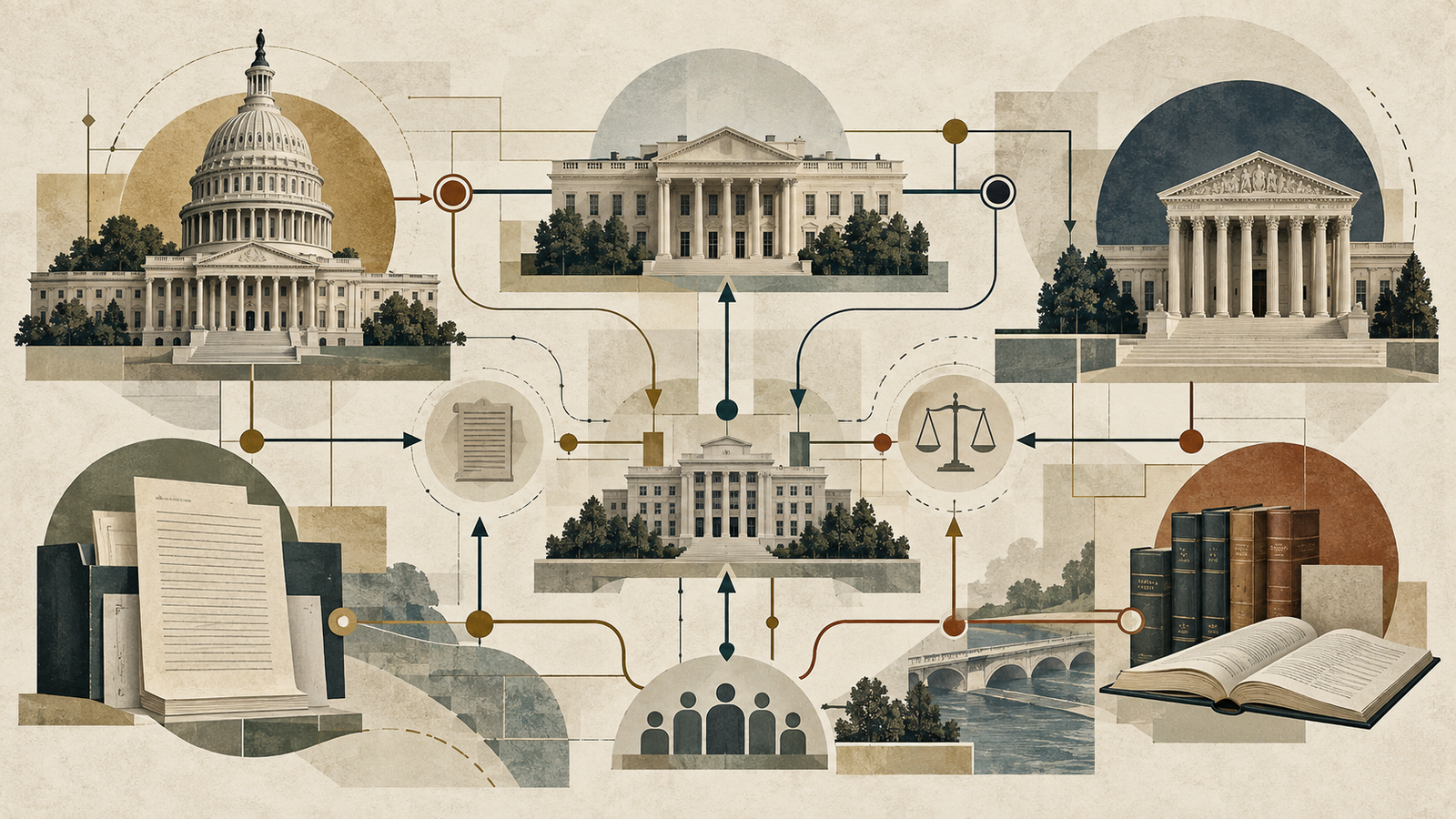
Institution → Authority → Jurisdiction → Mechanism → Limits → Review / Change
These six questions form the analytical spine of Civic Education. Because each question identifies a different part of the structure behind a public decision, the parts should be traced separately rather than collapsed into one general claim about who has power.
Civic Power Trace · Institution
Institutions: Who Is Actually Acting?
Public controversy often begins with a person: a president, mayor, governor, judge, superintendent, agency head, founder, or board chair. Institutional literacy asks a prior question: what institution is actually exercising the decision right?
Institutions That Make the Law
Institution
InstitutionDefinition Lock: The term institution refers to an organized body with defined roles, procedures, powers, and responsibilities through which decisions are made or carried out.
Public institutions are not defined only by the people who occupy them. Instead, their structure determines which roles exist, what powers attach to those roles, and which procedures govern the use of those powers.
Learn it in context: Civic Education: Institutional Literacy and Structural Power
Legislature
Institution · AuthorityDefinition Lock: In this glossary, legislature means a lawmaking institution empowered by a constitution or governing charter to enact laws within its jurisdiction.
Congress is the federal legislature. States have their own legislatures, while local governments may have councils or similar legislative bodies. Because their sources of authority differ, their powers and jurisdictions differ as well.
Learn it in context: How Constitutional Amendments Actually Work
Institutions That Interpret and Enforce the Law
Lawmaking is only one institutional function. Once rules exist, other institutions must administer, enforce, interpret, or review them.
Executive
Institution · MechanismDefinition Lock: Executive institutions carry out, administer, or enforce law within authority assigned by a constitution, statute, charter, or other valid source.
Executive power varies across systems and levels of government. Presidents, governors, and mayors operate inside different constitutional and statutory structures. As a result, similar titles do not imply identical powers.
Learn it in context: What Is an Executive Order? · Can a Mayor Override State Law?
Court
Institution · Review / ChangeDefinition Lock: Courts are judicial institutions authorized to resolve disputes and interpret or apply law within the jurisdiction assigned to them.
Judicial authority is bounded too. A court’s ability to hear a matter depends on jurisdiction, procedural requirements, the nature of the claim, and the remedy available.
Learn it in context: Can the Supreme Court Be Overruled?
Institutions That Implement and Administer Law
Not every institution primarily writes statutes or resolves cases. Much of modern governance, instead, occurs through bodies responsible for administration, implementation, enforcement, and regulation.
Administrative Agency
Institution · Authority · MechanismDefinition Lock: Administrative agencies are governmental bodies assigned responsibilities for implementing, administering, enforcing, or regulating within authority established by law.
However, agencies do not possess unlimited independent power. Their authority is ordinarily tied to statutes, constitutional structure, procedural requirements, and judicially enforceable limits.
Learn it in context: What Is Administrative Rulemaking?
Civic Power Trace · Jurisdiction
Jurisdiction: Where Does the Authority Reach?
Having authority does not mean having authority everywhere. Jurisdiction identifies the legally or institutionally defined field within which a body may act.
Authority Has Geographic and Subject-Matter Boundaries
Jurisdiction
JurisdictionDefinition Lock: Jurisdiction describes the legally defined scope within which an institution may exercise authority over a subject, territory, person, proceeding, or category of dispute.
In other words, jurisdiction answers a different question from authority. An institution may possess a type of power but still lack the jurisdiction to use it in a particular matter.
Federalism
Jurisdiction · AuthorityDefinition Lock: Federalism is the constitutional system through which governmental authority is divided and related between the national government and the states.
Rather than functioning as a simple hierarchy of federal, state, and local offices, federalism creates legally structured relationships in which different institutions possess different powers.
Learn it in context: What Is Federalism? How Government Power Is Divided
Local Authority Depends on State Structure
Local governments operate inside state-created legal frameworks. As a result, municipal authority cannot be understood by looking only at the mayor or city council.
Home Rule
Jurisdiction · AuthorityDefinition Lock: Home rule refers to a state-law framework granting local governments a measure of authority over local matters without requiring specific legislative permission for every action.
However, the scope of home rule varies substantially by state constitution, statute, local charter, and subject matter. For that reason, it should never be treated as one uniform nationwide doctrine.
Learn it in context: Can a Mayor Override State Law?
Civic Power Trace · Mechanism
Mechanisms: How Does Authority Become Action?
Authority identifies who may act. A mechanism, however, identifies the institutional process through which that authority becomes a decision, rule, payment, order, program, judgment, or other outcome.
Different Powers Require Different Instruments
Mechanism
MechanismDefinition Lock: In institutional analysis, a mechanism is the formal process or instrument through which authority is exercised.
Legislation, appropriations, executive orders, administrative rules, adjudication, appointments, contracts, and constitutional amendments are different mechanisms. Accordingly, they should not be treated as interchangeable routes to the same result.
Executive Order
Mechanism · Authority · LimitsDefinition Lock: Executive orders are official presidential directives used to manage operations of the federal government and exercise presidential authority.
Rather than serving as an independent source of unlimited presidential power, an executive order operates as a mechanism. Its validity and reach depend on the authority supporting it and the legal limits surrounding that authority.
Learn it in context: What Is an Executive Order?
Administrative and Fiscal Mechanisms
Some forms of governmental action depend on delegated administrative authority, while others depend on legislative decisions about money. In practice, policy design and policy implementation often require both.
Administrative Rulemaking
Mechanism · Authority · Review / ChangeDefinition Lock: Through administrative rulemaking, an agency uses lawfully delegated authority to issue rules within its regulatory jurisdiction.
Notice-and-comment rulemaking is an important federal pathway. However, not every agency rule is created through the same procedure.
Learn it in context: What Is Administrative Rulemaking?
Appropriation
Mechanism · AuthorityDefinition Lock: An appropriation provides legislative authority for government funds to be obligated or spent for specified purposes.
As a result, policy authorization and funding are not always the same decision. A program may exist in law while still depending on appropriations and administrative capacity for implementation.
See the distinction applied in: The Poor People’s Campaign
When Laws From Different Jurisdictions Collide
Conflict between levels of government introduces another question: not simply who acted, but which lawful rule controls within the area of overlap.
Preemption
Mechanism · Jurisdiction · LimitsDefinition Lock: Preemption occurs when valid federal law displaces state or local law within the lawful scope of federal authority.
It may be express or implied. In turn, implied preemption can arise where federal law occupies a field or where state law conflicts with federal law.
Therefore, the central question is not whether federal law is generally supreme. The question is whether valid federal law actually displaces the state or local rule at issue.
Learn it in context: What Is Preemption? · Can a State Ignore Federal Law?
Civic Power Trace · Limits
Limits: What Constrains the Exercise of Power?
Institutional power is not understood merely by identifying what an actor can do. Civic literacy also requires identifying what an institution cannot lawfully do, which procedures it must follow, and where another institution’s authority begins.
Every Grant of Power Exists Inside Boundaries
Limits
LimitsDefinition Lock: Limits are the constitutional, statutory, jurisdictional, procedural, fiscal, contractual, or institutional boundaries that constrain how authority may be exercised.
For that reason, a complete power analysis must identify both the source of authority and the boundaries around it.
Supremacy
Limits · JurisdictionDefinition Lock: Federal supremacy means that the Constitution, federal laws made pursuant to it, and treaties made under federal authority take priority over conflicting state law.
Supremacy is a rule of legal priority. It is not, however, a general grant of unlimited federal legislative authority.
Learn it in context: Can a State Ignore Federal Law?
Federalism Also Limits How Power Can Be Used
Constitutional structure constrains government not only by protecting individual rights. It also divides authority among institutions and levels of government.
Anti-Commandeering
Limits · FederalismDefinition Lock: Under the anti-commandeering principle, the federal government generally may not simply command state legislatures or state executive officials to administer or enact a federal regulatory program.
Importantly, that principle does not mean states can nullify valid federal law. Supremacy and anti-commandeering therefore answer different institutional questions.
Learn it in context: Can a State Ignore Federal Law?
Due Process
Limits · Review / ChangeDefinition Lock: Due process is a constitutional limitation requiring government to respect legally protected procedural and substantive constraints when depriving a person of life, liberty, or property.
Because the legal setting matters, the exact requirements vary by context. Accordingly, the term should not be reduced to a general synonym for fairness.
Power Is Divided Within the Federal Government Too
Even when federal authority exists, that authority is distributed among institutions rather than concentrated in one office.
Separation of Powers
Institution · LimitsDefinition Lock: Separation of powers describes the constitutional allocation of federal governmental powers among legislative, executive, and judicial institutions.
The branches are not sealed off from one another. Instead, the constitutional structure includes divided functions as well as mechanisms through which institutions check, constrain, authorize, review, or depend on one another.
Civic Power Trace · Review / Change
Review and Change: Who Can Correct, Reverse, or Alter the Outcome?
Public decisions rarely have one universal override mechanism. The lawful path for change depends on what kind of decision was made, what source of law controls it, and which institution possesses authority to review or alter it.
Review Begins With the Type of Decision
A court ruling, agency action, statute, appropriation, executive directive, and constitutional provision cannot all be altered through the same institutional process. Therefore, the first task is to identify what kind of decision exists.
Judicial Review
Review / Change · LimitsDefinition Lock: Judicial review gives courts authority, in cases properly before them, to determine whether governmental action is consistent with the Constitution and other controlling law.
In other words, judicial review does not mean courts may decide every political disagreement. Jurisdiction, standing, justiciability, remedies, and the legal question presented all matter.
Learn it in context: Can the Supreme Court Be Overruled?
Administrative Review
Review / Change · MechanismDefinition Lock: Administrative review is the process through which an agency or authorized reviewing body reconsiders, evaluates, or corrects an administrative decision under governing law and procedure.
Although distinct from judicial review, administrative review can be part of a longer chain. Agency action may later become subject to judicial review where governing law permits.
Learn it in context: What Is Administrative Rulemaking?
Changing the Rule Is Different From Reviewing the Decision
Review asks whether an existing decision can stand. Change may instead require legislation, a new rule, a new appropriation, a constitutional amendment, or another institutionally authorized mechanism.
Constitutional Amendment
Review / Change · MechanismDefinition Lock: A constitutional amendment formally changes the Constitution through the proposal and ratification procedures established by Article V.
Because an amendment changes constitutional law itself, it differs from passing an ordinary statute, issuing an executive order, or asking a court to reinterpret existing law.
Learn it in context: How Constitutional Amendments Actually Work
Accountability
Review / Change · LimitsDefinition Lock: Accountability consists of the institutional mechanisms through which decision-makers can be required to explain, defend, correct, reverse, or bear consequences for the exercise of authority.
Elections are one accountability mechanism, but they are not the only one. Courts, audits, inspectors general, legislative oversight, administrative review, removal procedures, transparency requirements, and internal governance mechanisms can also matter.
Diagnostic Distinctions
Cross-Cutting Concepts That Prevent Common Civic Errors
Some of the most useful Civic Education concepts are not institutions or doctrines. Instead, they are distinctions that prevent one kind of power from being mistaken for another.
Formal Power and Practical Power Are Not the Same Thing
Influence vs. Authority
Authority · InstitutionDefinition Lock: Influence means having the ability to shape a decision; authority means holding the recognized power to make, implement, enforce, fund, or review it.
For example, a founder, donor, activist, political leader, advisor, executive, media figure, or interest group may exercise substantial influence without holding the formal decision right.
Learn it in context: Boards vs. Founders
Implementation vs. Authorship
Institution · MechanismDefinition Lock: Authorship identifies who created or authorized a policy, while implementation identifies who administers or carries it out.
Consequently, the institution closest to the public is not necessarily the institution that created the rule it is enforcing.
Learn it in context: Who Actually Controls Public Schools?
Authority Still Requires Capacity
Even after authority and jurisdiction are identified, another problem remains. An institution or coalition may possess formal power but lack the practical resources required to use it effectively.
Capacity
Cross-Cutting ConditionDefinition Lock: Capacity describes the practical ability of an institution, organization, coalition, or person to use available authority, resources, infrastructure, knowledge, coordination, and time to produce an outcome.
Formal authority does not guarantee effective action. For instance, an institution may possess legal power while lacking the staffing, money, administrative systems, political support, organizational strength, or other capacity needed to use it effectively.
See the condition applied in: Freedom Without Capital · MLK and Guaranteed Income · The Poor People’s Campaign
Institutional Power Index
How to Use This Glossary When a Civic Dispute Appears
When a headline says an official “controls,” “blocked,” “ordered,” “overruled,” “ignored,” “forced,” or “changed” something, resist the temptation to begin with the personality. Instead, begin with the structure.
Run the Six-Part Diagnostic
Identify the Institution
Start by asking which body actually holds the relevant decision right.
Locate the Authority
Next, identify the constitution, statute, charter, rule, contract, or delegation supporting the action.
Determine Jurisdiction
Then ask whether that institution possesses authority over the subject, place, person, or dispute.
Identify the Mechanism
From there, determine whether the institution is acting through legislation, spending, rulemaking, an order, adjudication, appointment, contract, or another process.
Find the Limits
After that, identify the constitutional, statutory, procedural, jurisdictional, fiscal, or institutional boundaries that apply.
Locate Review or Change
Finally, locate the institution that can lawfully reverse, amend, review, fund, defund, replace, or otherwise change the result.
What the Diagnostic Actually Accomplishes
This method will not eliminate disagreement. Instead, it does something more useful first: it clarifies what the disagreement is actually about.
Once the institutional structure is visible, arguments about policy, responsibility, legality, accountability, and reform can begin on firmer ground.
Learn the Concepts in Context
Use the Glossary as a Reference Layer, Not a Substitute for the Lessons
The glossary owns concise definitions. The Civic Education lessons, meanwhile, own the deeper explanation, institutional context, doctrinal distinctions, examples, and premium maps.
Choose the Next Learning Route
Power Mechanics
Then examine how authority moves, overlaps, conflicts, and becomes action.
The Civic Power Trace
From there, use the analytical method behind the entire Civic Education system.
Civic Education
Finally, browse the complete Groundwork Daily system for tracing public power.
The Groundwork
Public power becomes confusing when several different questions are collapsed into one.
Who is visible is not necessarily who has authority. Likewise, the institution implementing a decision may not have authored it. A federal body may possess authority without possessing authority over every subject. Meanwhile, a government can possess formal power while lacking the capacity to produce the promised result.
Structure Comes Before Attribution
Before asking whether an official should act, first determine whether that official can act. When one level of government appears to have overridden another, identify the jurisdiction and mechanism involved before assigning responsibility.
Similarly, before assuming a policy can simply be reversed, locate the institution with authority to review or change it.
The Vocabulary Is Part of the Method
These distinctions are not technicalities added after a political argument. Rather, they are part of the architecture of the argument itself.
Institutional literacy begins when public power is traced instead of assumed.
Continue the Civic Education System
Keep Tracing the System
Build the Method First
Learn the Method
Begin with the analytical framework used throughout Civic Education.
Start With Authority
Next, learn how to identify which institution can legally act.
Then Follow Power in Motion
Power Mechanics
Follow how authority moves, overlaps, conflicts, and becomes institutional action.
Browse the Complete Series
Explore the broader Civic Education system and its applied lessons.

Groundwork Daily Newsletter
Learn to Trace Power Before Judging the Outcome.
Receive Civic Education lessons and Groundwork Daily analysis on institutions, authority, public policy, and the mechanisms that determine how power actually works.
The Principle and Condition Beneath This Reference System
The glossary is built around one core idea: freedom becomes more usable when the structures governing power are visible. At the same time, those structures only become intelligible when the boundaries around authority are clear.
Structure Builds Freedom
Public power becomes more legible when readers can identify institutions, authority, mechanisms, and pathways for review instead of relying on personalities or assumptions.
Boundaries
Authority becomes meaningful only when its boundaries are visible: where jurisdiction begins and ends, which mechanisms are available, and which legal or institutional limits constrain their use.
Receipts
Official Reference Points
These official sources support the constitutional and institutional definitions used throughout this Civic Education reference system.
Constitutional Structure and Review
- Constitution Annotated — Congress.gov — official congressional reference for constitutional structure, federalism, judicial review, Article V, the Supremacy Clause, and related doctrines.
- Constitution Annotated — Anti-Commandeering Doctrine — explains the constitutional limit on direct federal commands to state legislative and executive institutions.
- Constitution Annotated — Marbury v. Madison and Judicial Review — explains the development of judicial review in federal constitutional law.
- Constitution Annotated — Overview of Article V — explains the constitutional procedures for proposing and ratifying amendments.
Executive and Administrative Mechanisms
- National Archives — Executive Orders — describes executive orders as official presidential documents used to manage operations of the federal government.
- National Archives — The Federal Register — describes the official federal publication system for agency rules, proposed rules, notices, executive orders, proclamations, and other presidential documents.
Because glossary entries are intentionally concise, they function as canonical Civic Education definitions and diagnostic distinctions. The linked lessons, meanwhile, supply fuller legal doctrine, historical context, jurisdiction-specific caveats, and applied institutional analysis.