
The MLK economic justice argument was larger than a call to reduce poverty. In the final years of his life, Martin Luther King Jr. increasingly argued that civil rights victories would remain incomplete unless the country also confronted employment, wages, housing, economic insecurity, and the distribution of political and economic power.
King did not abandon civil rights when he turned more directly toward economic questions. Instead, he widened the problem those rights were expected to solve.
The Civil Rights Act of 1964 and Voting Rights Act of 1965 changed foundational legal structures. Yet those victories did not automatically produce better jobs, higher wages, decent housing, equal educational opportunity, or economic security.
By 1967, King was therefore asking a harder institutional question: What does freedom require after formal exclusion begins to fall?
Applied Civic Education Case
This article does not treat King’s economic philosophy as a substitute for institutional analysis. It uses his later work as an applied case: how legal rights, material capacity, organized power, public institutions, and policy mechanisms interact when a movement attempts to turn freedom into durable change.
Definition Lock
King’s later economic justice argument treated legal rights as indispensable but incomplete when people lacked the income, employment, housing, education, economic security, and organized power needed to use freedom in durable ways.
Institutional Power Index
Keep the institutional vocabulary close: this applied case depends on distinctions among authority, capacity, institutions, mechanisms, appropriations, influence, organized power, limits, and accountability. Use the Civic Education Glossary as the reference layer while tracing the difference between identifying an injustice and locating the institution capable of changing it.
The Economic Architecture
Rights ↔ Economic Capacity ↔ Organized Power ↔ Institutional Response → Durability
These are interacting dimensions rather than a universal sequence. Rights can alter access to institutions. Material capacity affects the choices people can exercise. Organized power can help secure rights, change policy, redirect resources, or force institutional response. Durability asks whether the resulting gains can survive resistance, economic pressure, political change, and time.
Start With the Record
The Structure of the MLK Economic Justice Argument
King’s 1967 address Where Do We Go from Here? provides one of the clearest records of how his thinking had developed after the major federal civil rights victories of the mid-1960s.
He described persistent disparities in housing, income, employment, education, and other measures of well-being. Yet he did not stop at documenting unequal outcomes.
King increasingly argued that the movement needed sufficient political and economic power to turn moral demands into institutional change.
The Question Had Become One of Power
In King’s formulation, power was not inherently corrupt. He treated power as the capacity to achieve a purpose and produce social, political, or economic change.
That distinction moved his argument beyond persuasion alone. Moral language could identify injustice, while institutions could still resist demands that lacked organized leverage behind them.
Consequently, the later MLK economic justice argument increasingly connected morality to capacity: who could organize, bargain, vote, demand, negotiate, and create enough leverage for institutions to respond.
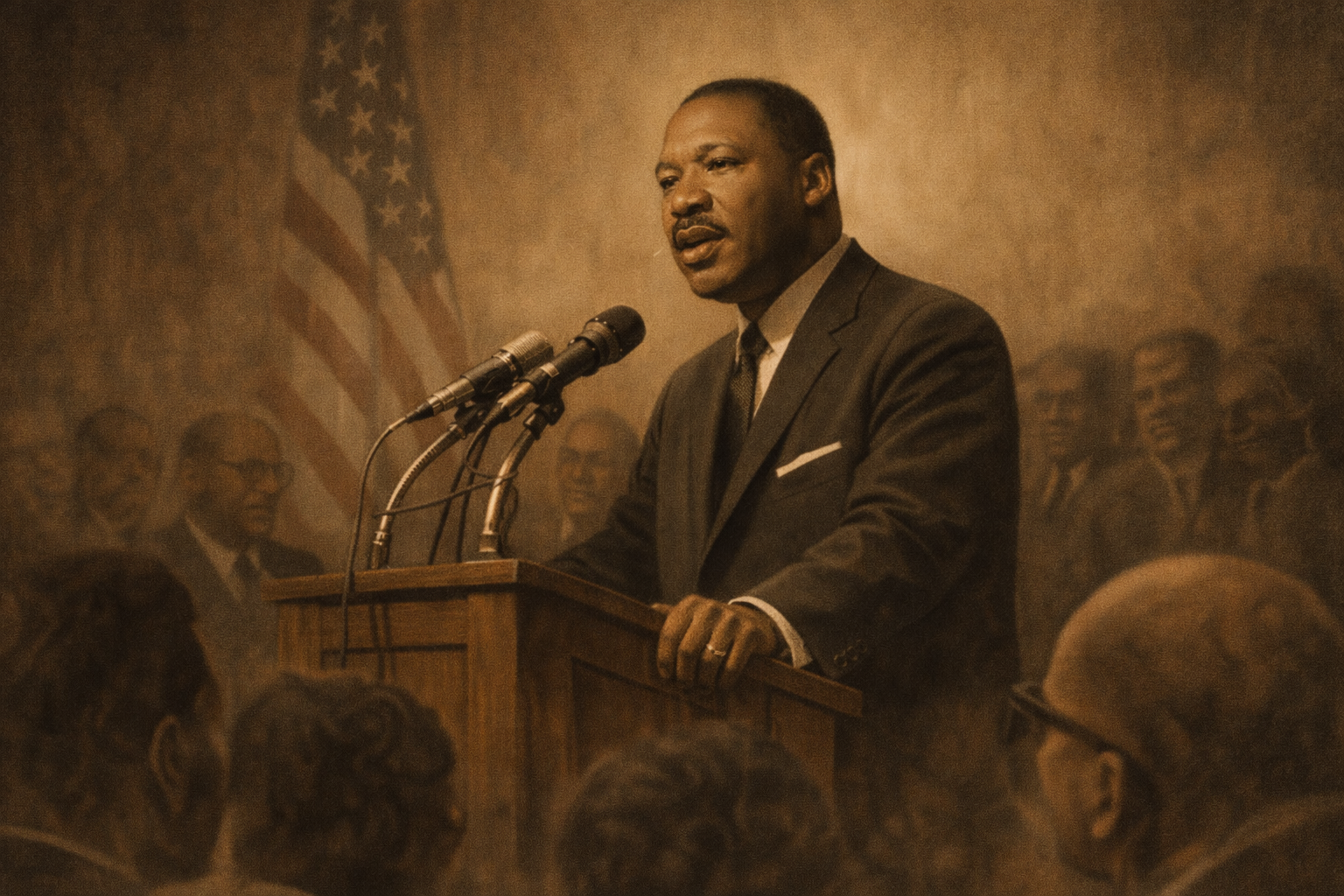
From Moral Appeal to Capacity
King Believed Moral Claims Needed Political and Economic Power
King’s later argument did not reject nonviolence or moral persuasion. Instead, he argued that moral persuasion separated from sufficient organized power could remain ineffective.
In his 1967 SCLC address, King described Black Americans as confronting a serious problem of powerlessness. From that perspective, inequality involved more than insufficient income.
It also involved limited influence over institutions shaping work, housing, education, public spending, and policy.
Power Meant the Ability to Produce Change
King used organized labor as one illustration of that logic. A union gains leverage when an employer must negotiate rather than simply decide.
Communities operate under a related institutional principle. Political organization matters when public officials, agencies, employers, or other institutions face sustained pressure to respond to organized demands.
The historical point is not that every institution operates identically. Rather, King increasingly treated organized capacity as necessary to move from a moral claim toward institutional response.
The Structural Question
King Asked Why a Wealthy Society Continued Producing Poverty
King’s later analysis became more demanding when he moved from helping poor individuals to asking why poverty persisted at large scale.
In 1967, he argued that serious examination of poverty eventually raised questions about the broader economic structure itself.
The issue was therefore larger than whether individuals could receive immediate assistance.
Relief and Structural Change Solve Different Problems
Immediate aid can reduce suffering. Structural analysis asks why the conditions producing insecurity continue.
That inquiry leads toward employment, wages, ownership, housing, education, public investment, access to capital, and political influence.
King increasingly believed those questions belonged inside—not outside—the civil rights conversation.
The Institutional Question Was What Produced the Condition
A structural analysis does not assume that every instance of poverty has one cause. Instead, it asks which public and private institutions shape the environment in which poverty becomes persistent.
That distinction is important because diagnosing a condition is different from designing a remedy. King’s later work became increasingly concerned with both: identifying structures that reproduced economic insecurity and considering policy directions capable of changing them.
Rights and Material Capacity
Why Economic Capacity Matters to Freedom
King’s economic argument can be understood through a distinction between legal freedom and material capacity.
Political and civil rights protect people from crucial forms of exclusion and domination. At the same time, employment, income, housing, education, and financial stability shape the practical choices available after formal barriers are removed.
A person may possess a legal right to move, study, organize, purchase property, participate politically, or pursue work while still confronting severe material constraints on those choices.
Freedom Can Be Legally Real and Materially Fragile
That distinction connects King’s later economic work to arguments about emancipation that he had developed earlier.
Groundwork examines related ideas in What Did Martin Luther King Jr. Mean by “Freedom to Hunger”? → and The Bootless Man Problem → .
The common structural insight is straightforward: removing a barrier does not automatically provide the resources, stability, or leverage needed after the barrier disappears.
Rights and Capacity Map
Four Different Structural Jobs
These dimensions can reinforce one another, but none should be treated as a substitute for the others.
Establish whether institutions may lawfully exclude, discriminate, restrict participation, or deny protected status.
Shapes income, stability, time, housing, ownership, and the practical room available for choice.
Affects whether communities can convert shared interests into sustained leverage on institutions and decision-makers.
Tests whether gains can hold through economic shocks, institutional resistance, political change, and time.
A Systems Perspective
The MLK Economic Justice Argument Connected Problems Usually Treated Separately
King’s later analysis increasingly connected racial inequality to employment, housing, poverty, political organization, and militarism.
That did not mean every problem had the same cause. Rather, his argument increasingly recognized that institutions and public priorities could reinforce one another.
Economic Inequality Was Harder to Isolate Than Legal Segregation
A segregated lunch counter presented a visible rule and an identifiable institution enforcing it. Economic inequality was more distributed.
Hiring practices, wages, schools, housing markets, access to capital, neighborhood conditions, public spending, and political decisions could all shape economic outcomes.
Consequently, changing one formal rule did not necessarily transform the wider institutional environment.
A More Distributed Problem Required a Broader Strategy
This helps explain why King’s final campaigns became more ambitious. A movement confronting several institutions at once needed a strategy capable of identifying where leverage actually existed.
In that sense, King’s later work provides a useful Applied Civic Education case: the more distributed the problem, the more important it becomes to distinguish institutions, mechanisms, decision rights, and change points.
One Policy Expression
Guaranteed Income Was One Part of King’s Economic Justice Argument
In his 1967 SCLC address, King explicitly called for movement toward a guaranteed annual income.
He connected stable income to dignity, security, and people’s ability to make meaningful decisions about their own lives.
Guaranteed income, however, was not the entirety of his economic agenda.
The Policy Tool Should Not Replace the Framework
King’s broader post-1965 program also addressed employment, wages, housing, education, enforcement of civil rights, economic security, and organized political power.
Reducing his later economic thought to guaranteed income alone would therefore flatten a much larger argument about capacity, power, and institutional change.
The next asset in this applied Civic Education sequence isolates that policy mechanism: MLK and Guaranteed Income: The Economic Policy King Actually Supported →
From Analysis to Organizing
The Poor People’s Campaign Turned King’s Economic Argument Into Strategy
By late 1967, King’s economic analysis was moving from speeches and books into an organized national campaign.
The Poor People’s Campaign sought to build a multiracial coalition around economic insecurity and demands including jobs, income, wages, education, and other measures intended to improve the lives of poor Americans.
The Campaign Targeted Institutions Capable of Acting
Washington was not chosen merely as a symbolic stage. King and SCLC intended to center sustained pressure on Congress and departments of the federal government.
That institutional choice followed the larger theory of power: identify the problem, organize those affected by it, and direct pressure toward institutions capable of changing law, spending, administration, or policy.
Economic Insecurity Became an Organizing Basis
The campaign attempted to convert widespread material hardship into collective political leverage.
Poverty was therefore not treated only as an individual condition. It became a basis for coalition-building intended to compel institutional response.
The third asset in this applied sequence examines that conversion from economic diagnosis to organized institutional pressure: The Poor People’s Campaign: What Martin Luther King Jr. Was Trying to Build →
Applied Institutional Literacy
Use the Civic Power Trace to Read King’s Economic Strategy
King’s economic work becomes more legible when the historical argument is connected to the institutions capable of producing change.
The goal is not to force a modern framework onto every statement King made. Rather, the Civic Power Trace helps distinguish his diagnosis of economic injustice from the institutions and mechanisms that would have been required to respond.
Civic Power Trace
Trace the Move From Moral Demand to Institutional Change
- Institution: Which institutions could affect the problem—Congress, federal agencies, state or local governments, employers, unions, housing institutions, schools, or others?
- Authority: What legal, fiscal, administrative, contractual, or organizational authority did those institutions possess?
- Jurisdiction: Which parts of employment, housing, income support, education, or public spending could each institution actually control?
- Mechanism: Would change require legislation, appropriations, administrative action, collective bargaining, enforcement, litigation, organizing, or another mechanism?
- Limits: What constitutional, political, fiscal, administrative, or institutional constraints limited the available action?
- Review / Change: Which institution or political process could alter the rule, resource allocation, policy, or institutional behavior?
Use the governed method: learn the Civic Power Trace or use the Civic Education Glossary when the distinction among institution, authority, mechanism, limits, capacity, influence, or accountability needs to be made explicit.
The Trace Clarifies Why Organized Power Mattered
King’s emphasis on power makes more sense when viewed through this institutional sequence. A moral demand could identify a problem, but the requested change still had to pass through institutions with specific authority and decision-making mechanisms.
Organization mattered because it could affect whether those institutions faced enough sustained pressure to act.
The Later King
King’s Economic Agenda Brought Him Into Conflict With More Institutions
As King’s agenda widened, so did the institutional terrain of his work.
Housing implicated markets, lenders, property owners, local government, and federal policy. Labor implicated employers, unions, wages, and bargaining power.
Poverty raised questions about congressional action, federal programs, public spending, employment, and income security. His opposition to the Vietnam War also brought military priorities and national resource allocation into the same public argument.
A Wider Analysis Created a Wider Field of Conflict
This development helps explain why King’s final years cannot be understood simply as an extension of earlier desegregation campaigns.
The moral commitments remained connected. What changed was the number of institutions, mechanisms, interests, and public priorities inside the argument.
Groundwork examines that transition in Why Martin Luther King Jr. Became More Controversial After 1965 →
Keep the History Honest
The MLK Economic Justice Argument Was Broad, but It Was Not a Finished Economic Blueprint
King’s later speeches and writings contain substantial criticism of poverty, economic exploitation, concentrated power, and institutional arrangements he believed reproduced injustice.
At the same time, it would be inaccurate to convert those arguments into a fully specified modern economic program.
King Identified Problems and Policy Directions
The historical record supports several clear areas of concern and advocacy, including employment, wages, income security, housing, education, organized political power, and guaranteed income.
It also supports his growing concern with the distribution of economic and political power.
Structural Critique Is Not the Same as a Complete Replacement System
Detailed questions about taxation, administrative design, regulatory architecture, ownership structures, financing, eligibility, and long-term program operation were not uniformly developed into one comprehensive institutional blueprint.
Recognizing that limit strengthens the historical analysis. It allows King’s documented arguments to remain substantial without attributing to him details the surviving record does not establish.
The Durable Question
Why King’s Economic Justice Argument Matters Historically
King’s later economic work matters because it challenged the assumption that formal equality, by itself, completed the work of freedom.
In his analysis, rights remained indispensable. Yet people also needed employment, income, housing, education, economic security, and sufficient organized power to influence institutions affecting their lives.
The Argument Expanded the Meaning of Civic Capacity
The question was no longer only whether discrimination was formally prohibited.
It also became whether people possessed enough practical capacity to make legal rights meaningful in everyday life and enough organized power to demand institutional response when material conditions remained weak.
Applied Civic Education Sequence
Diagnosis → Mechanism → Organized Pressure
These three assets perform different analytical jobs. Read together, they show how an economic diagnosis moves toward a specific policy mechanism and then toward a strategy for producing institutional response.
- Article 9 — Structural Diagnosis: Freedom Without Capital: King’s Economic Argument
- Article 10 — Policy Mechanism: MLK and Guaranteed Income
- Article 11 — Coalition-to-Government Strategy: The Poor People’s Campaign
The Groundwork
The narrow version of King’s economic argument says that he cared about poverty. The fuller version is more demanding.
King increasingly argued that poverty, powerlessness, weak employment, inadequate housing, unequal education, and racial inequality could not be treated as wholly separate problems.
Legal rights could remove major barriers. Economic security affected what people could do once those barriers moved. Organized power, meanwhile, influenced whether institutions changed their rules, priorities, budgets, or behavior.
That is what made the MLK economic justice argument larger than poverty relief. It connected rights to capacity, capacity to organized power, and organized power to institutional response.
Rights can remove exclusion. Durable freedom also depends on whether people possess enough capacity and organized power to use those rights and influence the institutions governing their lives.
Continue the Civic Education System
Continue the applied sequence with the policy mechanism:
MLK and Guaranteed Income: The Economic Policy King Actually Supported
— move from King’s structural diagnosis to one specific economic mechanism he explicitly endorsed.
Follow the argument into coalition-to-government strategy:
The Poor People’s Campaign: What Martin Luther King Jr. Was Trying to Build
— examine how economic grievance was organized into pressure aimed at institutions capable of acting.
Use the institutional reference layer:
Civic Education Glossary: How Public Power Works
— clarify authority, institution, mechanism, appropriations, capacity, accountability, and the difference between influence and formal power.
Return to the analytical method:
What Is Civic Education? Institutional Literacy Explained
— use the Civic Power Trace to separate diagnosis from the institution and mechanism capable of producing change.
Study the structural-power foundation:
Civic Education: Institutional Literacy and Structural Power
— connect this historical application to the series’ core explanation of how authority is distributed among institutions.
Continue into Power Mechanics:
Civic Education Power Mechanics: How Authority Moves
— examine how authority, pressure, mechanisms, and institutional response interact once power begins moving through a governing system.
Read the broader Groundwork economic framework:
Capital Before Equality
Enter the complete Civic Education system:
Civic Education: How Public Power Actually Works
Groundwork Daily Newsletter
See the Structure Behind Rights, Power, and Policy.
Receive Civic Education lessons and Groundwork Daily analysis on institutions, economic power, policy mechanisms, and the structures shaping public life.
The principle and condition beneath this article
This applied case is classified through one Groundwork Daily Core Principle and one primary Condition based on its central problem: the relationship between formal freedom and the material and organizational capacity required to make that freedom durable.
Structure Builds Freedom
Formal rights matter, but the structures surrounding employment, income, housing, education, organization, and public authority shape how usable those rights become in everyday life.
Capacity
King’s later economic argument repeatedly returns to capacity: whether people have enough income, employment, stability, leverage, and organized power to act on rights and influence institutions rather than merely possess formal legal access.
Receipts
Primary and authoritative reference points supporting the historical claims about King’s economic thinking, political strategy, guaranteed-income proposal, and Poor People’s Campaign.
- Martin Luther King, Jr. Research and Education Institute — “Where Do We Go From Here?” Address, August 16, 1967 — documents King’s discussion of political and economic power, economic inequality, movement strategy, and movement toward a guaranteed annual income.
- Martin Luther King, Jr. Research and Education Institute — Where Do We Go from Here: Chaos or Community? — provides historical context for King’s post-1965 analysis of civil rights, jobs, higher wages, housing, education, and enforcement of rights already won.
- Martin Luther King, Jr. Research and Education Institute — Poor People’s Campaign — documents the campaign’s multiracial antipoverty strategy, demands concerning jobs and economic security, and effort to pressure federal institutions.
- Martin Luther King, Jr. Research and Education Institute — The Poor People’s Campaign — records the campaign’s emphasis on jobs or income and the strategy of centering pressure on Congress and departments of the federal government.
- National Archives — Martin Luther King Jr. — provides federal archival context for King’s public life, civil rights work, later attention to poverty, and opposition to the Vietnam War.
This article distinguishes documented historical positions from later policy extrapolation. It does not treat King’s broad structural critique as a fully specified modern economic program where the surviving record does not establish that level of institutional detail.