
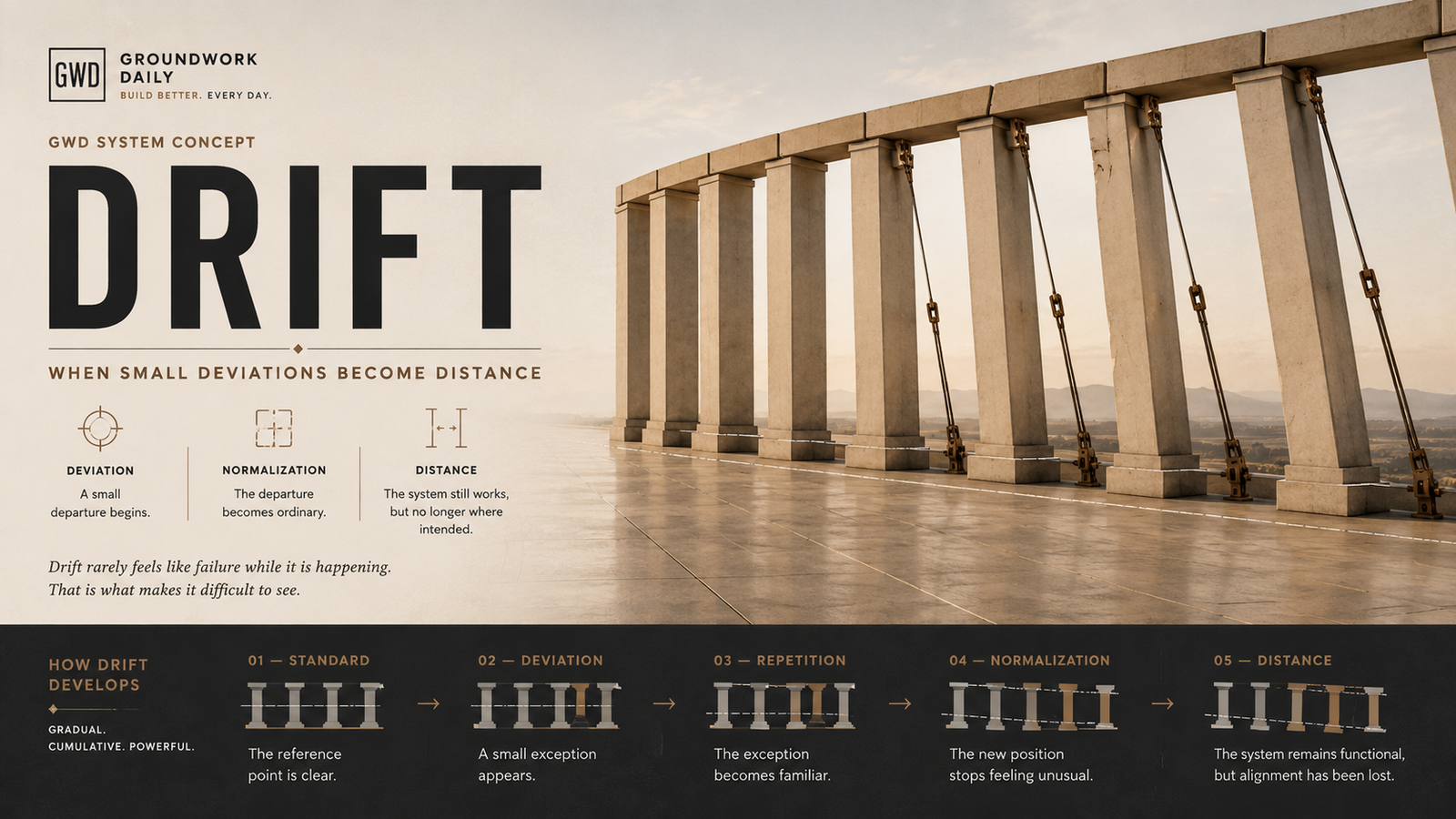
Drift is what happens when small departures stop looking like departures. In a system, relationship, institution, household, or personal routine, system drift can develop while almost everything still appears to work.
At first, the distance may be difficult to notice. A standard bends once. A responsibility shifts slightly. A maintenance cycle gets skipped. Perhaps an exception solves an immediate problem. Because nothing collapses, the system moves on.
Over time, however, yesterday’s exception can become today’s expectation. Repetition makes the departure familiar. Eventually, the system may stop comparing itself with the original standard and begin comparing itself with the most recent deviation.
Groundwork Daily Definition
Drift is the gradual movement of a person, relationship, institution, community, or system away from an established standard, intended alignment, governing purpose, or sustainable operating condition, often without a single obvious moment of failure.
Drift is not one of the thirteen Groundwork Daily Conditions. Instead, the Conditions describe structural jobs that help strong systems organize, maintain, correct, recover, and endure. Drift describes a pattern those systems may need to detect and correct.
Groundwork Guide Explore the anatomy of drift
The First Movement
Drift Usually Begins Small
Most people recognize collapse after it happens. Drift is harder to recognize because the early evidence often looks harmless.
For example, a deadline moves once. A standard is relaxed for a reasonable exception. A couple postpones a conversation they used to have. A team stops documenting a few decisions. Meanwhile, somebody spends slightly more than planned and promises to correct it next month.
None of those moments is failure by itself. The real question is what the system does next.
01 · Small
The deviation looks manageable.
Because the departure seems minor, the system absorbs it without requiring correction.
02 · Familiar
Repetition changes perception.
Once the system survives the exception repeatedly, the exception begins to feel ordinary.
03 · Distant
The reference point becomes harder to see.
Eventually, the system compares itself with yesterday’s deviation rather than the original standard.
Drift becomes powerful when the last deviation becomes the new reference point.

The farther a system travels without correction, the easier it becomes to confuse continued function with continued alignment.
The Pattern
How Drift Develops Inside a System
Drift does not follow a rigid five-step formula. Real systems are more complicated. Still, the pattern often follows a recognizable progression.
A reference point exists. The system knows what is expected, what success looks like, or what must remain true.
Behavior, performance, incentives, or practice move slightly away from the reference point.
The deviation happens again. Because the system continues to operate, the departure may begin to feel less consequential.
People stop experiencing the deviation as unusual. As a result, the operating standard begins separating from the stated standard.
Enough small movement has accumulated that the system now operates somewhere meaningfully different from where it began.
Therefore, the danger is not simply that somebody broke a rule. The deeper problem appears when the system loses the ability to recognize its original standard as the reference point.
A Necessary Distinction
Drift Is Not the Same as Change
Strong systems change. In fact, refusing to adapt can create its own structural weakness.
The important distinction is whether the change is being governed.
Intentional adaptation identifies what has changed, decides what should remain true, and updates the system deliberately. It also makes the new operating position visible. Drift requires no such decision. Instead, it can develop simply because nobody interrupts the accumulation.
| Pattern | What Happens | Structural Meaning |
|---|---|---|
| Change | The operating environment becomes different. | Neutral. Change alone does not tell us whether the system improved or weakened. |
| Adaptation | The system deliberately adjusts while protecting what still matters. | Governed change. |
| Drift | Small deviations accumulate without deliberate redefinition of the standard. | Ungoverned distance from a meaningful reference point. |
| Failure | The system can no longer perform a required function or carry an expected load. | Loss of function. Drift may contribute to failure, but it can exist long before failure arrives. |
Consequently, calling every change drift would make the concept useless. Groundwork Daily does not use drift as a complaint about things becoming different. Instead, the term describes movement that is no longer being adequately governed against a meaningful reference point.
The Difficult Part
A System Can Work and Still Be Drifting
One of the easiest mistakes in systems thinking is assuming that continued operation proves continued health.
It does not.
A workplace can keep producing while its standards deteriorate. Likewise, a relationship can continue while responsibility becomes increasingly one-sided. A household can keep paying its bills while financial margin disappears. An institution can preserve its name even as incentives move farther from its stated mission.
Function tells us that something is still happening. Alignment asks a different question: does what is happening still serve the purpose, standard, or responsibility the system was built to hold?

Something does not have to stop functioning in order to stop taking us where it was meant to go.
The Architecture Beneath It
Which Groundwork Conditions Govern Drift?
Drift is not a Condition because it does not describe a structural requirement. Instead, it describes a deviation pattern. Several Conditions matter because they establish the reference points, maintenance practices, corrective mechanisms, and continuity that make drift visible and manageable.
Discipline also matters because maintenance helps useful behavior remain aligned after motivation fades. Moreover, Repair may become necessary once accumulated drift has already damaged function.
The Diagnostic
How to Recognize Drift Before It Becomes Failure
The most useful response to drift is not panic. It is comparison.
Strong systems periodically compare what they are doing now with what they were built to do. As a result, distance can become visible before it becomes breakdown.
Look Back
What was the original standard?
If nobody can state it clearly, the system may already have lost the reference point required to detect drift.
Look Now
What actually governs behavior today?
Policies matter. However, repeated behavior often reveals the operating standard more accurately than language alone.
Measure Distance
What changed, and was it intentional?
Separate purposeful adaptation from accumulated exceptions, workarounds, weak enforcement, or forgotten maintenance.
This is where Accountability Is a Form of Strength becomes practical rather than punitive. Accountability is not merely consequence after something goes wrong. It also keeps the stated standard connected to the operating standard.
The earlier drift becomes visible, the less dramatic correction usually needs to be.
Across Groundwork Daily
Drift Changes Shape Across Different Systems
The mechanism travels even when the setting changes. For that reason, Drift can connect several areas of Groundwork Daily without becoming a category, Condition, or series of its own.
Institutional Drift
Organizations can preserve their structure on paper while standards, enforcement, incentives, and authority gradually move somewhere else.
Read: Why Institutions Fail and How Stability Prevents Drift →
Relational Drift
Relationships can drift when shared expectations remain verbally intact while contribution, communication, boundaries, or repair quietly change in practice.
Drift and Structural Freedom
Clear structure creates reference points, roles, pathways, and constraints. Those reference points make unintended movement easier to recognize.
Drift and Accountability
Once meaningful deviation is visible, accountability establishes ownership, requires correction, and verifies whether alignment has actually been restored.
Across Daily Life
Drift Can Appear Almost Anywhere
In a relationship, drift may appear when attention, responsibility, or communication becomes less reciprocal even though nobody deliberately renegotiated the partnership.
In money, drift may develop when occasional convenience spending becomes the new baseline. Meanwhile, the original savings or debt-reduction plan technically remains in place but no longer governs everyday behavior.
In an organization, drift can appear when exceptions multiply until employees learn that the written rule and the operating rule are different.
Likewise, a community institution may continue running programs while resources, incentives, and leadership attention gradually move away from the mission it still claims publicly.
Finally, personal discipline can drift when a routine weakens one small decision at a time. Eventually, a person may be living under a different pattern without ever consciously choosing one.
The surface details differ. Nevertheless, the structural pattern remains recognizable: a reference point exists, small deviations accumulate, and the distance eventually becomes meaningful.
The Groundwork
Catch Drift While Correction Is Still Small
Drift does not require villainy, incompetence, or dramatic neglect.
Sometimes reasonable decisions accumulate one at a time and still carry a system somewhere it never intended to go.
That is why strong systems need visible reference points.
Standards establish what should remain true. Discipline maintains useful behavior. Accountability recognizes deviation and requires correction. Alignment keeps moving parts connected to purpose. Finally, Continuity helps the standard survive changes in people and circumstance.
The goal is not rigidity. A durable system should adapt when reality changes.
The goal is to keep adaptation authored.
Because once a system stops asking where it intended to go, movement alone can begin to look like progress.
Continue Building
Follow the Architecture
Drift becomes easier to understand when the reference points around it are clear. Continue through the Groundwork Daily architecture.
→ Standards: The Condition That Defines the Threshold
→ Accountability: The Condition That Corrects Drift
Groundwork Architecture
Accountability Is a Form of Strength
Drift becomes governable when the distance between the stated standard and actual behavior can be seen, owned, and corrected.
Accountability
Accountability recognizes drift, assigns responsibility, and restores alignment between the operating standard and the standard the system intends to protect.
See the complete Core Principles and Conditions architecture .

Groundwork Daily Builder
Groundwork Daily Perspective
Institutional Editorial Voice · Groundwork Daily Framework
Groundwork Daily Perspective develops the principles, systems, definitions, and structural thinking that connect the publication’s categories and builders into one coherent architecture.
Its work focuses on the operating logic beneath everyday questions: what strong systems require, how they weaken, how alignment is maintained, and what allows useful structure to hold over time.