The Groundwork Conditions
The structural requirements that allow systems to organize, carry demand, correct themselves, recover, endure, and continue.
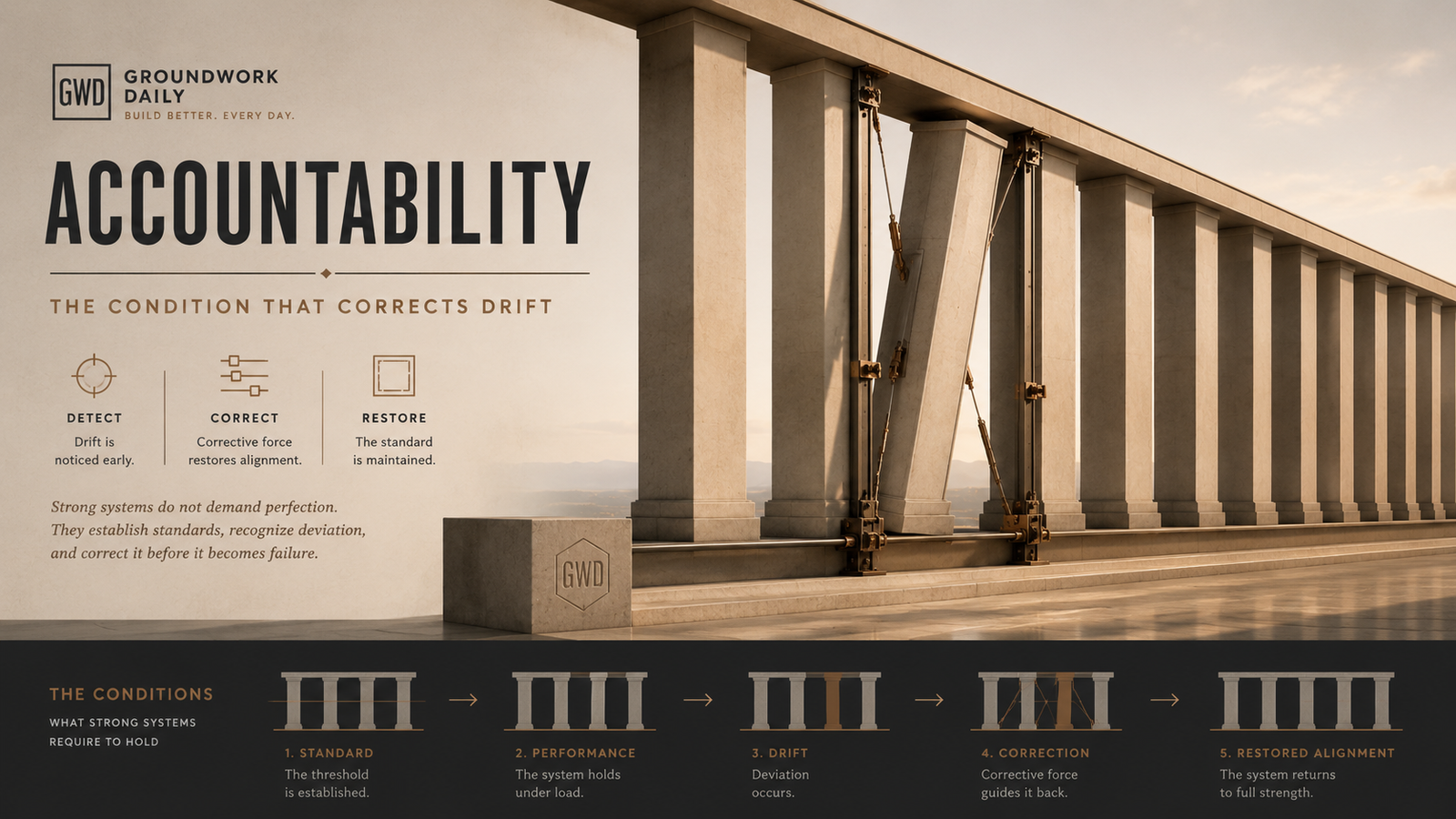
Accountability is the Condition that keeps meaningful deviation from quietly becoming the new standard. It recognizes when a person, process, relationship, institution, or system has moved away from what was supposed to hold, clarifies responsibility, requires correction, and confirms that the return actually happened.
Groundwork Daily · Canonical Condition
Accountability often gets reduced to blame, consequences, or punishment. That framing is too small.
A serious correction system asks better questions. What moved? What was the standard? Who owns the next step? What has to change? How will anybody know the problem was actually fixed?
Those questions matter in relationships, workplaces, institutions, money, leadership, governance, and private discipline because every functioning system experiences deviation.
Groundwork Daily Definition
Accountability is the structural job that compares performance with a standard, establishes responsibility for meaningful deviation, requires correction, and verifies restored alignment.
Within The Conditions, Accountability follows Capacity in the teaching architecture. Capacity tells us what a system can reliably carry. Accountability answers a different question: what happens when actual behavior or performance moves away from the standard that system is supposed to protect?
That makes Accountability a correction mechanism, not a personality trait.
Groundwork Guide Follow the architecture of correction
The Function
What Accountability Does Inside a System
Every functioning system experiences deviation. Deadlines get missed. Agreements break. Procedures get skipped. Spending exceeds a limit. A leader makes a bad call. Somebody does not carry what was assigned.
None of those moments automatically destroys the larger structure.
Uncorrected Deviation Is the Deeper Risk
The real structural problem begins when meaningful deviation produces no meaningful response.
If an expectation can be ignored repeatedly without correction, people learn that the stated threshold is not the operating threshold. Behavior then adapts to what the system actually permits.
Accountability Protects the Gap Between Intent and Reality
Strong systems compare what should have happened with what actually happened. When the difference matters, they respond before the discrepancy becomes familiar enough to disappear into normal life.
Accountability is how the system refuses to let tolerated deviation quietly rewrite the standard.
Governed System Concept
Accountability Corrects Drift, but Drift Is Not a Condition
The title of this page uses the word Drift deliberately. The distinction matters.
Drift Describes What Is Happening
Drift is the gradual movement of a person, relationship, institution, community, or system away from an established standard, intended alignment, governing purpose, or sustainable operating condition, often without one obvious moment of failure.
Under Groundwork governance, Drift is a Governed System Concept. It is not one of the thirteen Conditions.
Accountability Describes the Structural Job
Accountability is different. It is something a functioning system needs in order to detect meaningful deviation, establish ownership, require a response, and verify correction.
Put simply, Drift describes the pattern. Accountability performs the correction.
Other Conditions Help the Return Hold
Standards provide the reference point. Discernment helps determine whether a deviation actually matters. Alignment coordinates the return. Repair restores damaged function when correction alone is not enough. Continuity helps the restored standard survive transition.
Accountability has a defined job inside that larger architecture. It does not need to perform every other Condition’s work.
Structural Sequence
Accountability Is the First Explicit Correction Mechanism
The teaching sequence reaches a new kind of structural job at Accountability.
Structure
Organizes.
Standards
Defines.
Discipline
Maintains.
Margin
Protects.
Capacity
Carries.
Accountability
Corrects.
Why Correction Appears Here
A system can have clear structure, strong standards, repeated discipline, healthy reserve, and sufficient capacity. Even then, people and processes will sometimes move away from what was intended.
A durable system therefore needs a reliable way back.
The Groundwork Model
Accountability Works as a Correction Cycle
Treating accountability as one difficult conversation misses most of the mechanism.
A complete correction system has a sequence. The order matters because later steps depend on earlier ones being clear.
The Groundwork Correction Cycle
1. Establish the Standard
The system must first know what was expected. Without a usable baseline, correction becomes subjective.
2. Observe Performance
Something real happens. Work is completed, behavior occurs, a decision is made, money moves, or a responsibility is carried.
3. Compare Reality With the Standard
Actual performance is then compared with the accepted threshold.
4. Identify Meaningful Deviation
Not every difference requires intervention. Some variation is harmless. Accountability matters when the departure is significant enough to threaten the standard, outcome, trust, safety, purpose, or structure.
5. Assign Responsibility
Someone must own the response. Otherwise, concern can remain collective while correction belongs to nobody.
6. Correct the Deviation
The responsible party takes action to restore the standard, repair harm, or improve the process that allowed the failure.
7. Verify the Return
Finally, the system confirms that the promised change happened and that the result now meets the required standard.

Necessary Distinction
Accountability Is Not the Same as Punishment
Consequences can matter. Still, punishment and correction answer different questions.
Punishment
Focuses on consequence
Punishment asks what penalty should follow a violation.
Accountability
Focuses on correction
Accountability asks what moved, who owns the response, what must change, and what evidence will show that the standard has been restored.
Consequences May Still Be Necessary
Some failures require serious consequences. Fraud, abuse, negligence, safety violations, or repeated refusal to correct behavior may justify discipline, removal, or other formal action.
Even then, consequences alone do not repair a weak system.
Structural Warning
If a system can punish failure but cannot explain how the underlying problem will be corrected, it has a consequence mechanism, not a complete accountability mechanism.
Ownership
Clear Responsibility Makes Correction Possible
“We need to do better” can sound cooperative. It can also hide the most important question.
Who owns the next move?
Shared Problems Still Need Named Owners
Teams can share responsibility for an outcome. Families can contribute to the same problem. Organizations can fail collectively.
Useful follow-through still requires specific people to own specific actions.
Responsibility Must Match Authority
A system becomes distorted when somebody is held responsible for an outcome that person had no meaningful authority, information, resources, or capacity to influence.
That is why Accountability remains connected to Structure, Boundaries, and Capacity.
Ownership should sit where meaningful responsibility and meaningful control can actually meet.
Correction
Correction Is the Work, Not the Conversation
Acknowledgment matters, but acknowledgment is not enough. The same is true of apology.
A sincere apology may begin Repair, yet the system still needs changed behavior or restored function.
The Response Should Match the Deviation
A missed deadline may require a new workflow. A financial error may require reimbursement and stronger controls. A relationship problem may require repair, a boundary, and consistent behavioral change.
In governance, the right response may involve clarified authority, stronger oversight, enforcement, or a redesigned process.
Good Correction Improves the Architecture
The strongest response does more than fix the immediate result. When possible, it also makes the same failure less likely to happen again.
Verification
The Loop Is Not Closed Until the Return Is Verified
Many systems are good at naming problems and weak at confirming resolution.
A meeting happens. Everyone agrees. A plan gets written. Then attention moves somewhere else.
Intent Is Not Closure
Saying that something will change is not evidence that it changed. Verification checks whether the corrective step occurred and whether it restored the required result.
Follow-Through Creates Institutional Memory
Without verification, the same failure can return under a slightly different name. Completed correction, by contrast, becomes part of how the system learns.
Accountability is finished when there is evidence of return, not merely evidence of concern.
Another Distinction
Transparency Alone Does Not Correct Anything
Transparency makes information visible. That can matter enormously. Yet visibility does not automatically create correction.
Knowing Is Not the Same as Repairing
A system can publish data, admit a mistake, hold a hearing, release a report, and leave the underlying failure untouched.
This is why Groundwork Daily argues that Transparency Without Enforcement Is Theater.
Visibility becomes structurally useful when it can lead to ownership, correction, enforcement, repair, or some other meaningful response.
Real-World Application
Accountability Operates at Every Scale
The language changes by domain, but the structural logic remains recognizable: establish the standard, identify meaningful deviation, name ownership, correct the problem, and verify the result.
| Domain | Standard | Deviation | Correction | Verification |
|---|---|---|---|---|
| Personal | Chosen routine or commitment | Repeated avoidance or inconsistency | Restore the routine or redesign the system | Behavior returns over time |
| Relationships | Respect, honesty, reciprocity | Broken agreement or harmful behavior | Repair, boundary, changed behavior | Conduct and trust improve |
| Money | Budget, savings, approval rules | Overspending or misuse | Restore funds or change controls | Balances and practices stabilize |
| Workplace | Performance, safety, timeliness | Missed requirement | Coaching, process change, consequence | Expected performance returns |
| Governance | Authority, oversight, policy | Unapproved action or control failure | Enforcement, governance repair, authority reset | Control operates as designed |
| Institutions | Mission, rules, public obligations | Systemic deviation | Structural reform and enforcement | Performance improves beyond one person |
Failure Patterns
Why Accountability Systems Break Down
The Standard Was Never Clear
People cannot be fairly held to a threshold nobody defined.
Responsibility Is Diffused
Everyone is theoretically responsible, so nobody clearly owns the repair.
Authority and Responsibility Do Not Match
Somebody is blamed for an outcome without having meaningful control over the conditions that produced it.
Consequences Replace Correction
The system punishes an individual but leaves the underlying process untouched.
Nobody Checks Whether the Problem Was Fixed
The organization announces a solution and moves on before confirming that it worked.
Structural Warning
Without standards, correction becomes arbitrary. Without ownership, it becomes theater. Without repair, it becomes blame. Without verification, it becomes hope.
Practical Tool
The Groundwork Accountability Test
When a problem keeps returning, use these six questions to test whether a real accountability mechanism exists.
Standard
Was the expected behavior, performance, or outcome clear before the deviation occurred?
Evidence
Can the system distinguish meaningful deviation from assumption, emotion, or preference?
Responsibility
Is ownership clear, and does that party have enough authority to act?
Correction
What specifically must change to restore the expected standard?
Consequence
What happens when a responsible party repeatedly refuses or fails to correct the problem?
Verification
How will the system know that the corrective action actually worked?
What the Test Reveals
If those questions cannot be answered, the system may be relying on pressure, personality, memory, or expectation instead of a dependable correction mechanism.
Core Principle Connection
The Condition and the Core Principle Do Different Work
Groundwork Daily establishes Accountability Is a Form of Strength as one of its seven canonical Core Principles.
This page sits at a different layer.
Core Principle
Accountability Is a Form of Strength
The Principle establishes the governing position: real strength includes the ability to own, correct, and restore alignment rather than protect image at the expense of the standard.
Condition
Accountability Corrects
The Condition defines the structural job: compare reality with the standard, establish responsibility, require correction, and verify the return.
Institutional Application
Governance Needs Correction That Survives Leadership
Institutional oversight becomes fragile when correction depends entirely on one person being willing to confront problems.
Durable governance places correction inside the structure.
Authority Must Be Explicit
Boards, executives, committees, owners, and managers need clear authority boundaries so responsibility does not become guesswork.
Oversight Needs a Response Mechanism
Observing a failure is not enough. The governing body also needs a defined way to require change when the standard is not being met.
Enforcement Must Outlast Personality
Strong governance remains functional when founders leave, executives change, or relationships become uncomfortable.
Explore the Governance Structure Hub for the larger architecture around authority, ownership, enforcement, succession, and continuity.
External Context
Strong Control Systems Need Monitoring and Corrective Action
Groundwork’s Accountability framework is its own editorial model. Still, the broader logic of monitoring performance, identifying deficiencies, assigning responsibility, and correcting problems also appears in formal control and governance systems.
The U.S. Government Accountability Office’s internal-control framework emphasizes defined objectives, risk management, monitoring, and remediation of deficiencies.
COSO’s internal-control work similarly treats ongoing evaluation and corrective response as part of maintaining an effective control environment.
The language differs from Groundwork’s architecture, but the structural point is familiar: a standard becomes far more useful when actual performance can be compared against it and deficiencies can trigger a response.
The Groundwork
Strong Systems Correct Before Deviation Becomes Culture
Every system experiences missed expectations, weak judgment, changing conditions, and human error.
The difference between a strong system and a weak one is not the complete absence of deviation.
Strong systems make the standard clear enough to compare with reality. They make responsibility specific enough for somebody to own the next move. When damage exists, they connect correction to Repair. Then they check whether the promised return actually happened.
Weak systems do something else. They normalize deviation, personalize conflict, perform concern, postpone correction, or accept a promise as proof.
Accountability is not punishment. It is the architecture of return.
Continue Building
Follow Accountability Into the Larger Architecture
Accountability performs one structural job inside a much larger system. Continue into the doctrine, adjacent Conditions, and Governed System Concept that help explain what correction is responding to and what makes the return hold.
→ Condition: Standards
→ Next Condition: Discernment
→ Core Principle: Accountability Is a Form of Strength
→ Governed System Concept: Drift
→ Structural Hub: The Conditions
Groundwork Architecture
Accountability Is a Form of Strength
The Core Principle establishes the governing position that ownership, correction, and restored alignment are expressions of strength rather than weakness.
Accountability
Accountability corrects. It compares reality with the standard, establishes responsibility, requires response, and verifies return.

Groundwork Daily Builder
Groundwork Daily Perspective
Institutional Editorial Voice · Groundwork Daily Architecture
Groundwork Daily Perspective develops the principles, definitions, systems, and structural thinking that connect the publication’s categories and Builders into one coherent architecture.
Its focus sits underneath everyday outcomes: what strong systems require, how they weaken, how correction works, and what lets useful structure hold over time.