What is the attention economy? It is the competitive system that forms when more information exists than people have attention available to give it.
Every day, platforms, publishers, advertisers, creators, brands, entertainment companies, institutions, and political actors compete for portions of the same limited human capacity.
First, they compete to be noticed. Next, they compete to hold attention. Finally, many attempt to convert that attention into another outcome.
That outcome might be a click, a view, a purchase, a subscription, a share, a belief, a habit, or a return visit.
Because the supply of information exceeds what anyone can consume, attention becomes a filter through which visibility is distributed. As a result, what captures attention can gain reach, while what holds attention can gain influence.
Understanding the attention economy therefore requires more than talking about screen time or social media. It requires understanding the system underneath them.
Groundwork Definition
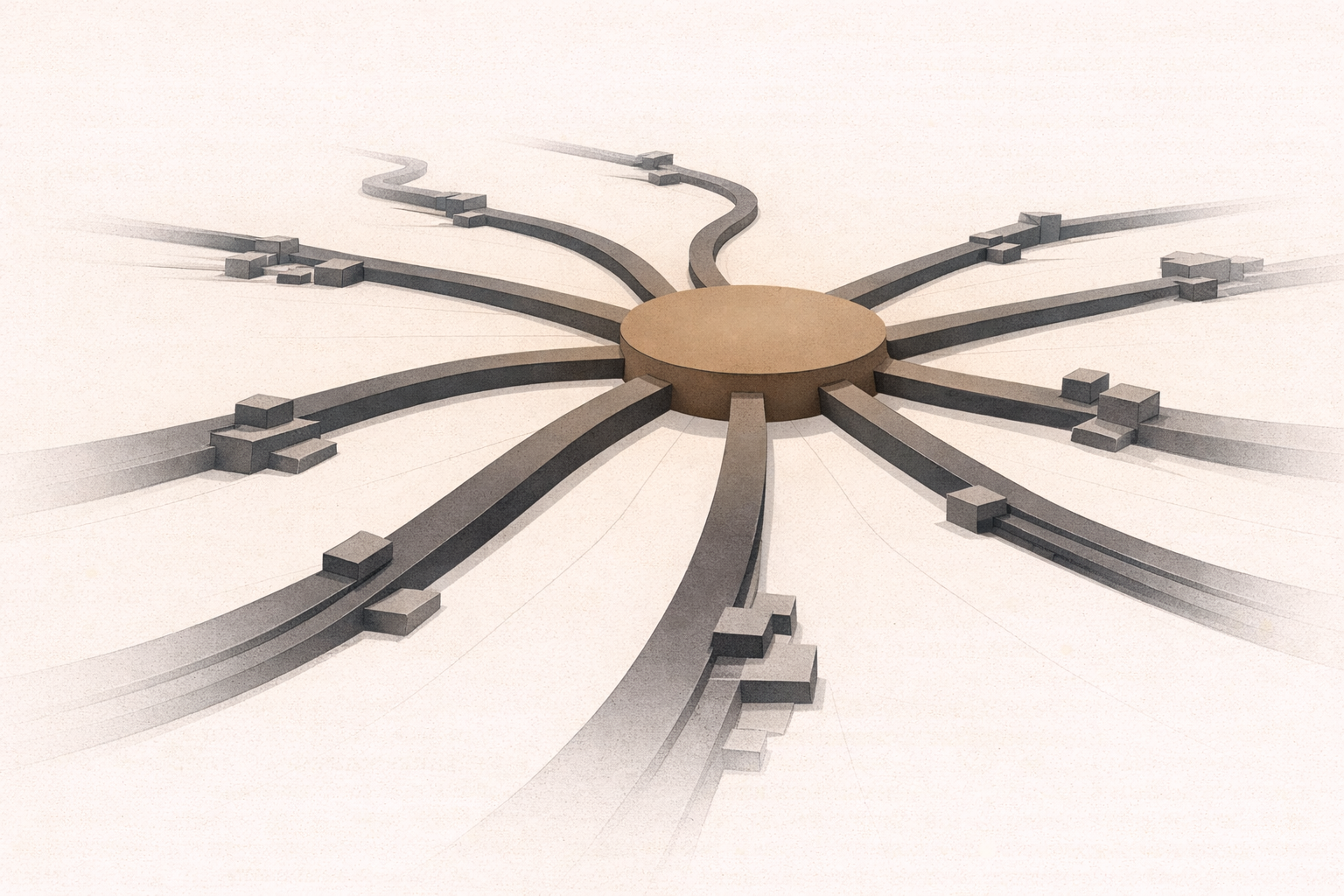
The attention economy is the competitive environment created when abundant information meets limited human attention. Within that environment, attention becomes valuable because gaining, holding, and directing it can produce visibility, influence, behavioral data, engagement, and economic return.
Groundwork Topic Hub
This page maps the territory. The related Groundwork explainers examine specific mechanisms, while the system model explains how competition, capture, engagement, measurement, and reinforcement operate together.
What Is the Attention Economy and Why Does It Matter?
Attention matters because visibility is uneven.
Thousands of messages can exist at the same time, yet only a small number will reach any individual person. Therefore, systems need mechanisms for determining what appears first, what receives additional distribution, and what disappears into the background.
Attention Can Become Leverage
Once something receives attention, additional opportunities become possible. For example, a creator can gain an audience, a company can sell a product, or a publisher can sell advertising.
Likewise, a political message can spread and a platform can learn more about user behavior.
Attention is not identical to power. However, it can become an input into power because visibility creates opportunities to influence what happens next.
Attention creates access. Access creates the possibility of influence. Influence can then be converted into economic, cultural, social, or political value.
Start with the explainer: Read the plain-language introduction .
How the Attention Economy Works as a System
The territory becomes easier to understand when its parts are treated as one operating structure rather than a collection of unrelated problems.
The Operating Sequence
Abundance → Competition → Capture → Engagement → Measurement → Reinforcement
Abundance Creates Competition
The system begins with more information than people can reasonably process. Consequently, competition for limited attention becomes more intense as supply expands.
Capture Creates the Opportunity
A headline, notification, thumbnail, recommendation, emotional trigger, or familiar source can win the first moment of attention.
From there, the system needs to convert that first glance into continued engagement.
Engagement Creates Information
Once people interact, their behavior can become measurable. Views, clicks, watch time, shares, comments, and other signals provide information about what successfully held attention.
Measurement Creates Reinforcement
High-performing patterns can receive more distribution, investment, imitation, or repetition.
Therefore, the system can reinforce what is effective at producing response, even when that material is not the most useful or important thing available.
Groundwork System
Go deeper into capture, engagement, measurement, reinforcement, attention drift, and the structures that protect deliberate focus.
How the Attention Economy Shapes Behavior
The system does more than distribute information. It also creates feedback.
When particular behavior produces visibility, the result can encourage more of that behavior.
Feedback Changes What Gets Produced
Creators learn which topics perform. Publishers learn which headlines generate clicks. Meanwhile, platforms learn what keeps people engaged.
Individuals can learn which versions of themselves receive visible response. As a result, measurement may influence future choices.
If outrage consistently outperforms nuance, outrage becomes easier to justify. Similarly, if extreme claims outperform qualified ones, certainty gains an incentive.
The system does not need to issue an instruction. Instead, the reward structure can teach the lesson.
Go deeper: Examine the behavioral pull behind repeated engagement .
Why Negative Content Can Gain an Attention Advantage
Not every piece of information produces the same response.
Material that triggers fear, anger, conflict, surprise, or outrage can generate rapid emotional engagement. That response matters inside systems that measure interaction.
Intensity Is Easier to Measure Than Importance
A thoughtful argument may require several minutes of attention before its value becomes clear. By contrast, an inflammatory claim can produce a reaction almost immediately.
Consequently, systems optimized around measurable engagement can create an advantage for content capable of producing fast response.
What produces the strongest reaction is not automatically what deserves the greatest attention.
Go deeper: Examine why emotionally negative material can travel quickly .
How Algorithms Shape Visibility in the Attention Economy
Nobody sees everything available online. Something has to filter the supply.
Recommendation and ranking systems help perform that function by selecting which material receives placement and which remains less visible.
A Feed Is a Constructed Environment
Selection can depend on signals such as relevance, prior behavior, relationships, recency, and predicted engagement.
Therefore, a feed is not a neutral window into everything that exists. It is a ranked environment shaped by selection rules.
Go deeper: See how ranking systems influence what reaches the screen .
Why the Attention Economy Is Hard to Escape
Many traditional forms of media contained obvious stopping points. A newspaper ended, a program finished, and a book reached the end of a chapter.
Digital environments can remove those boundaries. Feeds continue, videos advance, recommendations appear, and notifications create new reasons to return.
Continuation Can Become the Default
When another piece of content appears automatically, continuing requires almost no additional decision. Stopping, however, requires one.
That difference is small in a single moment. Nevertheless, it becomes consequential when repeated hundreds of times.
Go deeper: Examine why digital continuation can become difficult to interrupt .
Why People Chase Attention Online
Attention has another property that makes it powerful: it is often visible.
Likes, views, shares, comments, followers, and other metrics transform social response into numbers. Consequently, those numbers can begin to function as signals of relevance or status.
Measurement Can Change the Performer
Once people can see which behavior receives attention, they can adapt. That adaptation may be intentional, or it may happen gradually.
Either way, the risk is similar. Behavior can begin optimizing for what gets noticed instead of what remains aligned with a person’s actual work, values, or purpose.
Go deeper: Examine why visible feedback becomes socially powerful .
How to Take Back Control of Your Attention
The attention economy is unlikely to become less competitive because individual users feel overwhelmed.
Therefore, waiting for the environment to become easier is a weak strategy. Control has to be built.
Reduce Unnecessary Access
Not every system needs immediate permission to interrupt you. Notifications, device placement, application access, and physical environment can all change how easily competing inputs reach attention.
Create Deliberate Stopping Points
When a system removes natural endings, deliberate boundaries can restore them. For example, defined sessions, device-free spaces, and intentional transitions can create an exit where the platform provides none.
Use Structure Instead of Constant Resistance
This is where the topic connects directly to The Discipline System. The objective is not to spend every hour fighting distraction.
Instead, better architecture should reduce how often the fight has to happen.
Build Boundaries
Build limits around continuous access
Design boundaries around systems that benefit from holding your attention.
Applied Practice
Put attention control into practice
Move from understanding attention capture into practical control.
Research Context: Attention Is Limited and Selective
Groundwork Daily’s attention architecture is an editorial system model, not a clinical diagnosis. However, established psychological research gives useful context to its starting premise.
Human Attention Does Not Process Everything Equally
The American Psychological Association’s overview of perception and attention describes attention as the selective focusing of cognitive resources on some information while other inputs are filtered.
In other words, attention involves selection. Therefore, an environment with more competing signals creates more things seeking access to a limited process.
Digital Distraction Can Compete With Presence
The American Psychological Association’s review of digital distraction summarizes research examining how persistent digital connectivity can interfere with attention and presence during everyday activity.
For a broader research treatment, the APA volume Human Capacity in the Attention Economy examines limited human information-processing capacity inside a far larger technological information environment.
These resources do not prove the Groundwork framework. Rather, they support the narrower foundation beneath it: attention is selective and limited, while digital environments can create substantial competition for that capacity.
The Groundwork Attention Economy Map
Each article in this cluster answers a different question. Together, they form a larger body of work.
Understand the basic concept:
Read the plain-language introduction
Understand the machinery:
Explore the operating system
Understand the behavioral pull:
Examine repeated digital engagement
Understand emotional distribution:
Examine why negative material travels
Understand ranking:
Examine algorithmic content selection
Understand continuation:
Examine why stopping can become difficult
Separate reach from value:
Test the meaning of virality
Understand social attention:
Examine why people seek visible response
Build control:
Apply practical attention controls
Attention Is Also a Groundwork Problem
Understanding the market for attention is only half the work. The other half is building enough structure to remain deliberate inside it.
System
Build repeatable behavior that does not depend on winning the same attention battle every day.
Core Principle
Create enough distance from a stimulus to decide whether it deserves a response.
Core Principle
Accountability Is a Form of Strength
Make attention drift visible and restore alignment before distraction becomes the operating standard.
Frequently Asked Questions About the Attention Economy
What is the attention economy in simple terms?
It is a system in which information is abundant but human attention is limited. Platforms, publishers, advertisers, creators, and other organizations therefore compete to capture and hold that limited attention.
Why is attention so valuable?
Attention creates an opportunity to influence what happens next. For example, it can lead to engagement, purchases, subscriptions, advertising revenue, behavioral data, or social influence.
Is the attention economy just social media?
No. Social media is one major part of the system, but the broader environment also includes advertising, news, entertainment, search, streaming, publishing, gaming, political communication, creator platforms, and other systems competing for limited human attention.
How do algorithms affect what receives attention?
Algorithms can rank and recommend content using signals such as relevance, prior behavior, relationships, recency, and predicted engagement. Therefore, they influence which parts of the available information supply receive visibility.
Why can negative content spread quickly?
Negative or emotionally intense material can generate fast reactions. In environments where interaction influences distribution, rapid engagement can create an advantage for content that reliably triggers response.
Can you control your attention?
Complete control is unrealistic. However, attention can be governed more deliberately through boundaries, fewer interruptions, intentional stopping points, environmental design, and disciplined routines.
Keep Building
Understand what is competing for your attention before deciding what deserves it.
Join the Groundwork List for systems, frameworks, Core Principles, and practical ideas for protecting attention, strengthening judgment, and building with greater intention.
The Groundwork
The Attention Economy Is Not Slowing Down
When attention becomes valuable, systems become better at competing for it. Understanding that competition is the first step toward deciding how much access those systems should receive.
The incentives are strong, and the technology will continue improving.
Meanwhile, more information will arrive and the systems distributing it will become increasingly sophisticated.
Therefore, the useful question is not whether the attention economy exists. It does.
The useful question is whether you understand the machinery well enough to decide what gets access to you.