The Groundwork Conditions
The structural requirements that allow systems to function, adapt, and endure.
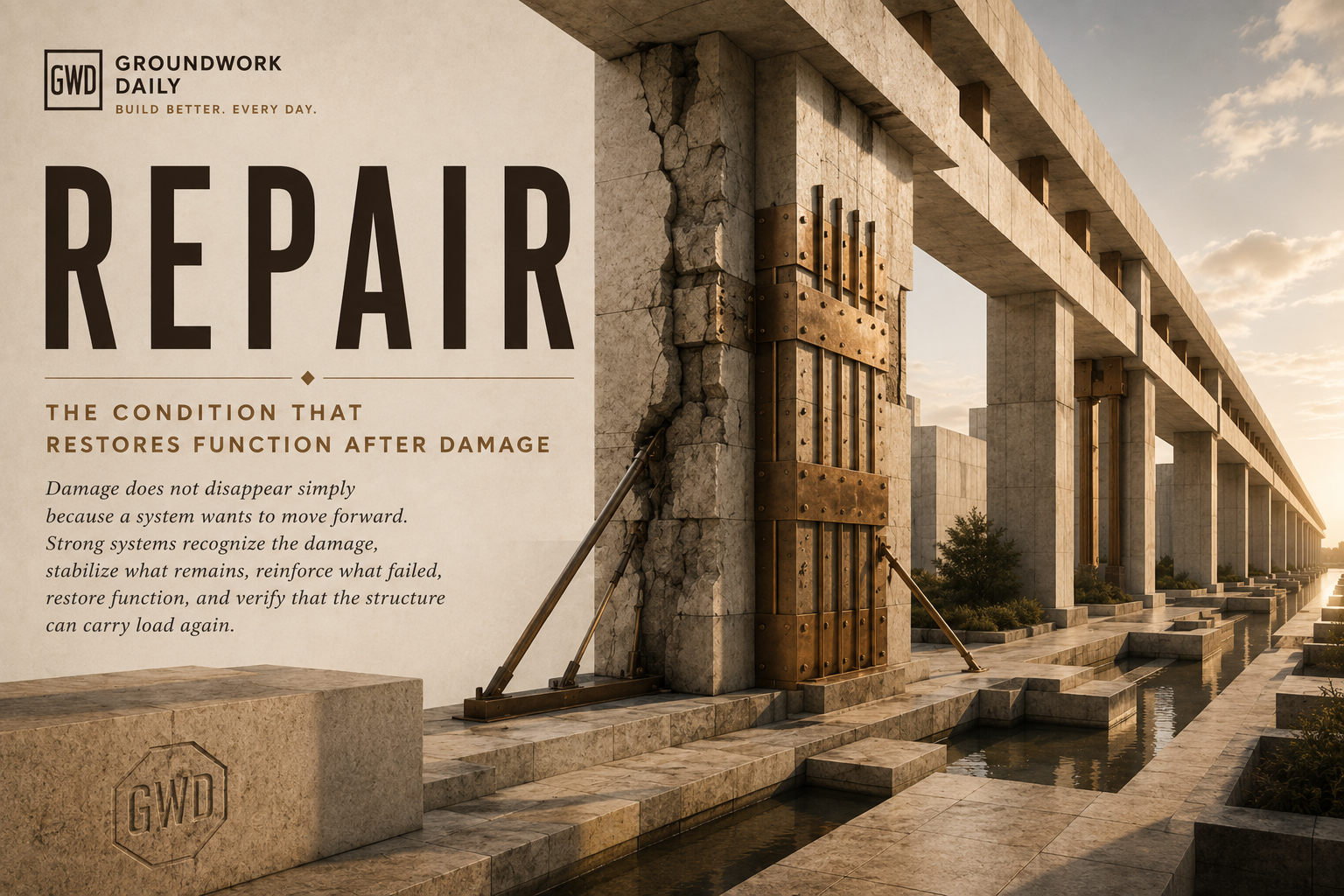
Repair is the condition that restores function after damage. It stabilizes what remains, identifies what failed, reinforces the weak point, restores the load path, and verifies that the system can carry responsibility again.
Repair is not the same as pretending nothing happened.
Damage leaves information.
A broken process reveals a weak control. A damaged relationship reveals where trust, behavior, or expectations failed. A financial setback exposes the limits of reserve. An institutional failure shows where authority, oversight, or continuity was insufficient.
Strong systems use that information.
Groundwork Definition
Repair is the deliberate restoration of function after damage through stabilization, assessment, reinforcement, corrective action, and verification that the system can hold again.
Within The Groundwork Conditions, Repair follows Boundaries. Boundaries define what the system protects. Repair begins when something inside that protected structure has already been damaged.
The Function
Repair Keeps Damage From Becoming Permanent Weakness
Every system eventually experiences damage.
People make mistakes. Processes fail. Trust breaks. Equipment wears down. Money gets lost. Institutions inherit decisions that no longer serve them.
Damage itself does not determine the future of the system.
Untreated Damage Changes the Load Path
When one part weakens, another part usually compensates.
A coworker absorbs extra work. A partner carries more emotional load. Savings cover a recurring deficit. A workaround replaces a broken process.
For a while, the system may still appear functional.
However, the burden has moved rather than disappeared.
Real Repair Restores Function
A patch that makes the problem less visible is not enough.
Repair should restore the system’s ability to carry the function that was damaged.
Structural Sequence
The Conditions Now Move From Containment Into Restoration
Structure organizes. Standards define. Discipline maintains. Margin protects. Capacity carries.
Accountability corrects drift. Discernment weighs. Alignment coordinates. Boundaries contain.
Repair begins after damage has already entered the structure.
Why Repair Comes After Boundaries
Boundaries help prevent uncontrolled transfer and protect important conditions.
Yet no boundary system can guarantee that damage will never occur.
Once something important is harmed, the architecture needs a way to restore function.
The Groundwork Repair Model
Repair Is a Sequence, Not a Cosmetic Fix
Strong repair follows an order.
Skipping that order often creates prettier failure rather than restored function.
The Groundwork Repair Model
Damage Makes the Failure Visible
Something important no longer performs as intended.
Stabilization Prevents Further Loss
Before rebuilding, the system first stops the damage from spreading.
Assessment Identifies What Actually Failed
The visible break may not be the root problem.
Reinforcement Strengthens the Weak Point
The repair must address the mechanism that allowed the damage.
Restoration Returns Usable Function
The repaired system should again perform the role it exists to carry.
Verification Confirms the Repair Holds
The process is not complete until the restored system can be tested under meaningful conditions.
Necessary Distinction
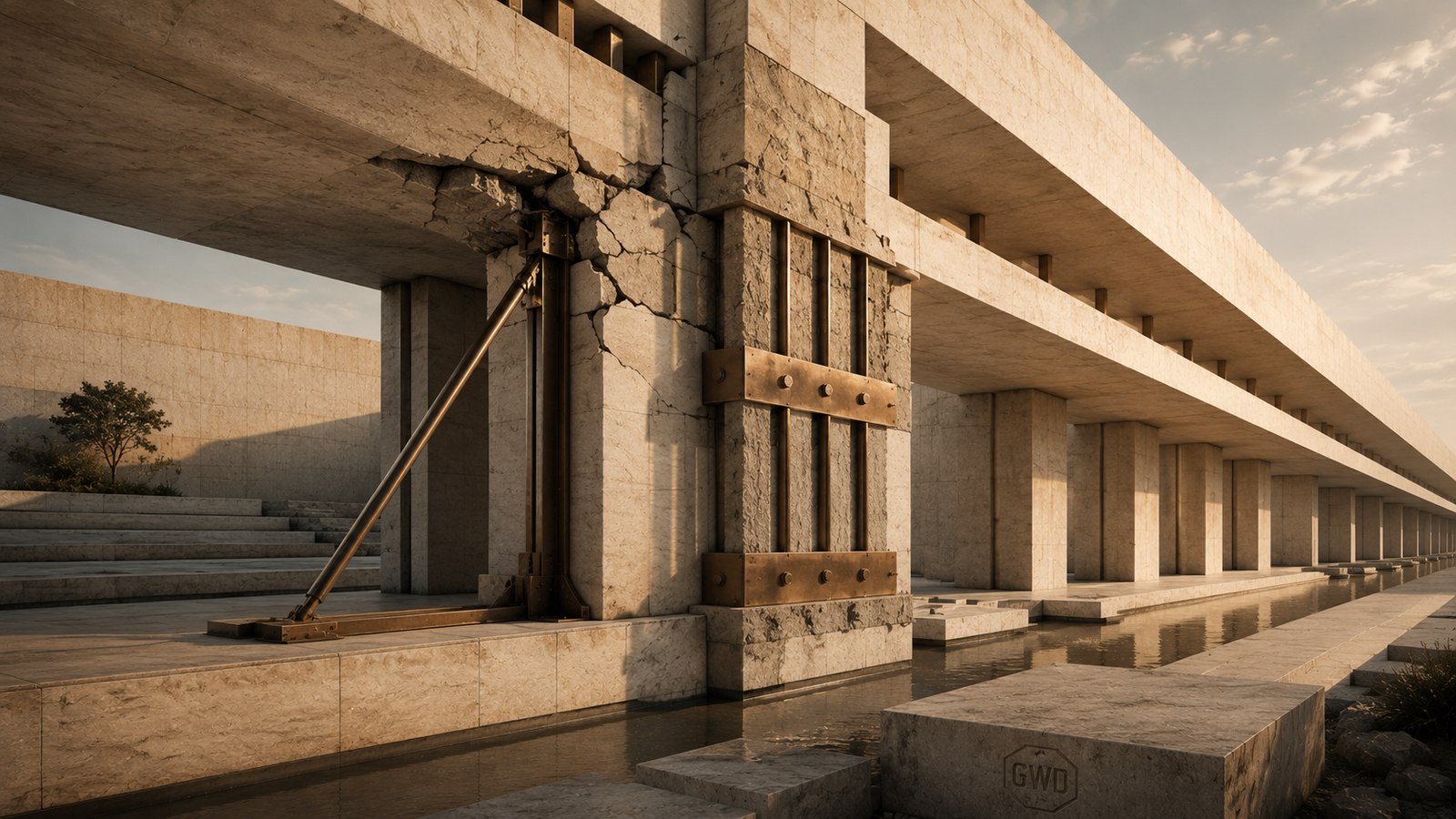
Repair Is Not the Same as Making Damage Less Visible
Systems often prefer appearance because appearance is faster.
A new policy gets announced. An apology is issued. Money is shifted. A damaged process receives another workaround.
The surface looks better.
The load path may still be broken.
Cosmetic Fix
Makes the damage less visible
Symptoms are reduced while the underlying weakness remains.
Structural Repair
Restores the function
The weak point is stabilized, understood, reinforced, and tested.
Stabilization
Stabilize Before You Rebuild
When damage is active, the first job is not improvement.
The first job is containment.
Stop the Additional Loss
If money is leaking, stop the leak. If a process is creating repeated errors, pause the failing step. If conflict is escalating, stop the interaction from causing more harm.
Protect the Remaining Structure
Damage often becomes much harder to repair when healthy parts are forced to compensate indefinitely.
Stabilization creates enough safety and time to understand what happened.
Groundwork Rule
Do not ask the damaged system to keep carrying full load while you are still figuring out why it failed.
Assessment
Repair the Failure Mechanism, Not Just the Symptom
The most visible damage can distract from the deeper cause.
Ask What Actually Failed
Was the standard unclear? Did the load exceed Capacity? Was Margin too small?
Did Accountability fail to correct drift early? Were Boundaries repeatedly crossed?
Look Behind the Immediate Event
One failure may be an event.
Repeated failure may indicate weak architecture.
That difference matters because the repair should match the scale of the problem.
Reinforcement
Strong Repair Changes the Structure That Allowed the Damage
Restoring the old condition may not be enough.
If the old condition created the failure, rebuilding it exactly as it was simply prepares the system to fail again.
Reinforcement Can Mean More Support
A team may need additional staffing. A household may need more reserve. A relationship may need clearer expectations or different access.
Reinforcement Can Mean Better Controls
Financial errors may require approval thresholds. Governance failures may require clearer authority, documentation, or oversight.
Reinforcement Can Mean Less Load
Sometimes the strongest repair is not strengthening the damaged part.
It is removing work the system should never have been carrying.
Restoration
Restoration Means Useful Function Returns
Repair has a practical standard.
Can the system perform again?
A Relationship Repair Must Restore Trust-Bearing Behavior
Words alone cannot carry that load.
Behavior, consistency, honesty, boundaries, and time must support the repair.
An Operational Repair Must Restore Reliable Execution
A revised process should reduce the failure rather than merely generate more documentation around it.
A Financial Repair Must Restore Stability
Moving money once may solve an immediate shortage.
Real repair changes the structure that repeatedly produced the shortage.
Verification
A Repair Must Be Tested Under Load
A repaired system may look stable while conditions remain easy.
The real test comes when ordinary load returns.
Verification Requires Evidence
Did the same error return? Did the process hold? Did the boundary survive pressure? Did the relationship behavior actually change?
Testing Should Match the Function
A financial repair should survive another unexpected expense. An operational repair should survive a normal high-demand period.
Likewise, a governance repair should remain functional when personalities, leadership, or pressure change.
Verification Standard
A repair is credible when the restored system can carry normal load without depending on the same workaround that hid the original damage.
Correction and Restoration
Accountability Corrects Drift. Repair Restores Damage.
These Conditions touch the same problem from different points in time.
Accountability
Correct before damage deepens
Accountability notices deviation, assigns responsibility, requires correction, and verifies a return to the standard.
Repair
Restore after damage has occurred
Repair stabilizes what remains, diagnoses the failure, reinforces the system, and restores function.
Early Accountability Can Reduce the Need for Major Repair
Small drift is cheaper to correct than structural damage.
That is one reason strong systems do not postpone difficult corrections indefinitely.
Protection After Damage
Repair Often Requires New Boundaries
Damage changes what a system can safely tolerate.
Temporary Boundaries Can Protect the Repair
A recovering system may need reduced load, restricted access, slower growth, or tighter controls while function returns.
Permanent Boundaries May Need to Change
If the old boundary repeatedly allowed harmful transfer, the repair may require a stronger edge.
That can mean different permissions, roles, financial rules, relationship terms, or governance authority.
Repair Should Not Restore the Conditions That Caused the Damage
Returning to the old normal is not always success.
Sometimes the old normal was the failure mechanism.
Application
Repair Operates at Every Scale
The materials change. The structural function remains the same: stabilize, understand the failure, reinforce what needs support, restore function, and verify the result.
| Domain | Damage | Stabilize | Repair | Verify |
|---|---|---|---|---|
| Personal | Burnout, lost routine, financial setback | Reduce active load | Restore systems, recovery, and priorities | Normal life no longer recreates the breakdown |
| Relationships | Broken trust or harmful behavior | Stop additional harm | Repair behavior, boundaries, and expectations | Trust-bearing behavior remains consistent |
| Households | Overload, financial strain, unequal labor | Reduce immediate pressure | Redistribute responsibilities and rebuild reserve | Normal demand is carried more evenly |
| Workplaces | Process failure, staffing breakdown, safety issue | Stop the failing activity | Redesign process, staffing, controls, or training | The process performs under normal demand |
| Organizations | Operational, financial, cultural, or governance failure | Protect critical functions | Rebuild controls, roles, systems, and capacity | Performance stabilizes beyond one intervention |
| Institutions | Loss of trust, leadership failure, control breakdown | Contain exposure | Reform governance and operating architecture | The institution functions after leadership transition |
Failure Patterns
How Repair Fails
The System Rushes Past Stabilization
It keeps operating at full load while the damage is still active.
The Symptom Gets Repaired Instead of the Cause
The visible problem disappears, but the failure mechanism remains.
Restoration Means Returning to the Old Normal
Nothing changes about the conditions that produced the damage.
The Repair Depends on Heroic Effort
One person becomes responsible for permanently compensating for the weak point.
Nobody Verifies the Result
The system assumes repair worked because the immediate crisis ended.
Structural Warning
A repair that depends on permanent compensation is not a restored system. It is a damaged system with a new load-bearing volunteer.
Practical Tool
The Groundwork Repair Audit
Use this audit when something important has failed and the pressure to “move on” is stronger than the evidence that the system has actually recovered.
What function was damaged?
Has the system been stabilized, or is damage still accumulating?
What actually failed beneath the visible symptom?
Was the failure caused by overload, weak structure, poor boundaries, missing accountability, insufficient margin, or something else?
What needs reinforcement rather than simple replacement?
Which part of the old operating model should not be restored?
What usable function must return before the repair can be considered complete?
How will the repaired system be tested under normal load?
What did the damage teach that should remain visible in the new structure?
What the Audit Reveals
Good repair leaves evidence of learning.
The system should not merely look whole again. It should understand why the fracture happened and operate differently because of what it learned.
Institutional Application
Institutional Repair Must Outlast the People Who Led It
Organizations often respond to failure through personality.
A strong executive intervenes. A board chair imposes order. One skilled employee creates a workaround.
That may stabilize the institution.
It does not necessarily repair it.
Institutional Repair Requires Structural Change
Governance failures may require better authority mapping, clearer oversight, stronger controls, documented decision rights, or succession architecture.
Institutional Memory Should Preserve the Lesson
If the repaired system forgets why the control exists, future leaders may eventually remove the very reinforcement that restored stability.
Verification Requires Leadership Transition
One of the strongest tests of institutional repair is whether the improved system still works when the people who designed the repair are no longer present.
Explore the Governance Structure Hub for the larger architecture around oversight, authority, succession, accountability, and continuity.
The Groundwork
Strong Systems Do Not Waste the Information Inside a Fracture
Damage is costly.
It can also be revealing.
Failure Shows Where Load Exceeded Support
The fracture may reveal insufficient capacity, poor boundaries, weak controls, or a bad assumption about what the system could carry.
Repair Should Preserve the Lesson
A repaired system does not have to remain visibly wounded.
Still, the architecture should remember what happened.
Restoration Creates Future Function
Repair exists so the system can continue carrying what matters.
The Larger Architecture
Repair Works Inside a Larger System
Repair cannot substitute for good structure, viable standards, enough margin, sufficient capacity, meaningful accountability, sound judgment, alignment, or boundaries.
Its job is restoration after damage.
Structure
Organizes.
Standards
Define.
Discipline
Maintains.
Margin
Protects.
Capacity
Carries.
Accountability
Corrects.
Discernment
Weighs.
Alignment
Coordinates.
Boundaries
Contain.
Repair
Restores.
Resilience
Recovers.
Durability
Holds.
Continuity
Carries forward.
Explore the complete architecture: The Conditions: What Strong Systems Require to Hold .
Next
Resilience: The Condition That Allows the System to Recover
Repair restores damaged function. Resilience asks what happens after disruption: whether the larger system can absorb the shock, recover usable capacity, adapt, and continue operating without requiring every disturbance to become a rebuilding project.
The Groundwork
The Fracture Should Change the Architecture
Damage creates a temptation to return quickly to normal.
Sometimes that is exactly the wrong goal.
If the old normal created the damage, restoring it is not repair.
Strong systems stabilize first, examine the failure honestly, reinforce what needs support, restore usable function, and then test whether the new structure can carry real load.
The fracture does not have to disappear from memory.
It should become part of what the system now knows.
Repair is not returning to what was.
It is restoring what must still be able to hold.
Build better. Every day.