The Groundwork Conditions
The structural requirements that allow systems to function, adapt, and endure.
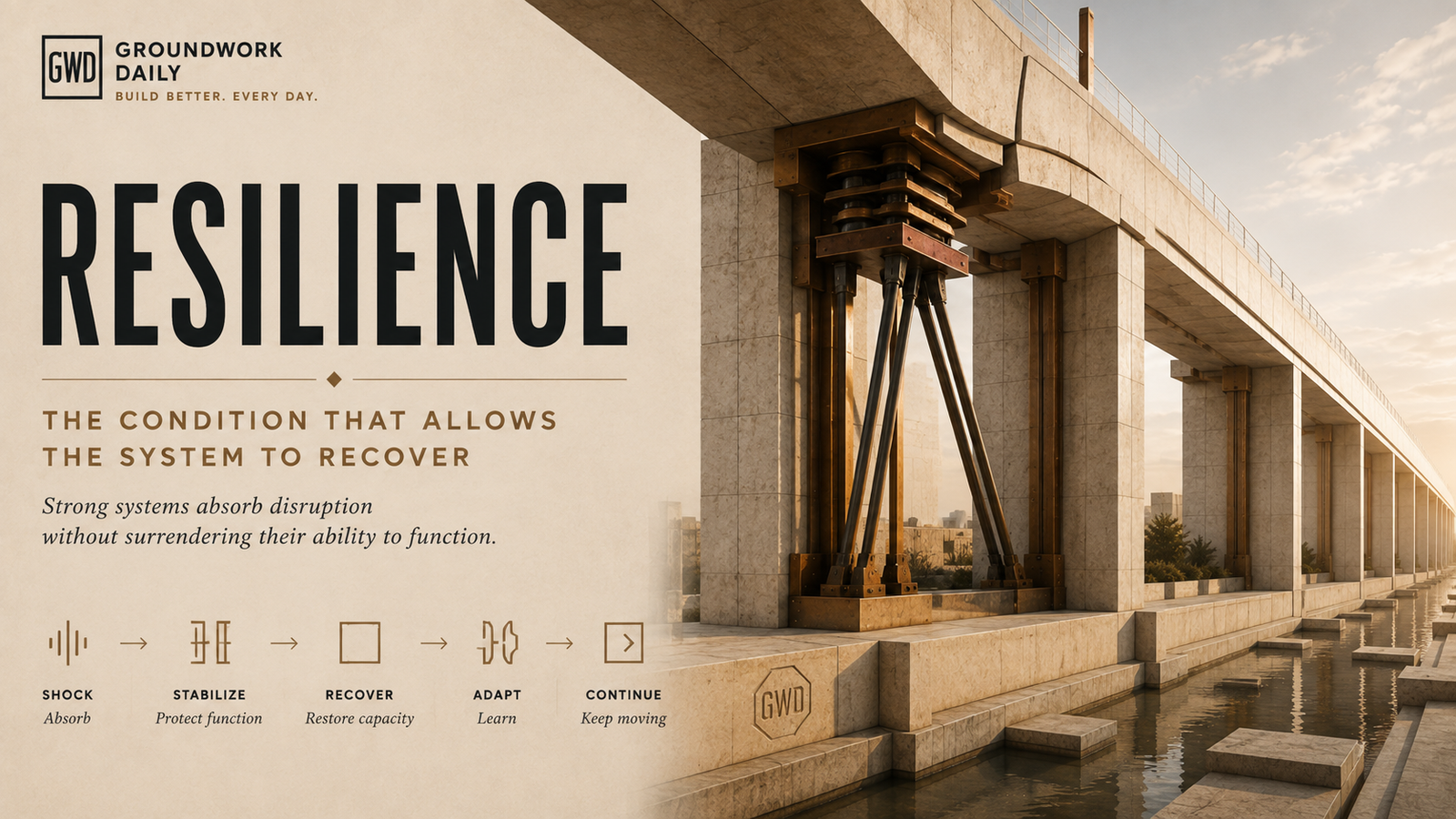
Resilience is the condition that allows a system to absorb disruption, preserve critical function, recover usable capacity, adapt, and continue. It does not require the system to remain untouched. It requires the system to remain capable of returning.
That distinction matters.
Too often, resilience gets reduced to toughness.
A person keeps going. A team works through the crisis. A family absorbs another setback. An institution survives another disruption.
Survival may be evidence of strength.
However, survival alone does not prove resilience.
Groundwork Definition
Resilience is the capacity of a system to absorb disruption, preserve essential function, recover usable capacity, adapt to what the disruption revealed, and continue without permanent dependence on emergency conditions.
Within The Groundwork Conditions, Resilience follows Repair. Repair restores damaged function. Resilience determines whether the larger system can absorb disruption, recover, adapt, and keep moving.
The Function
Resilience Keeps Disruption From Becoming Permanent Failure
Disruption is normal.
A strong system should expect some conditions to change.
People get sick. Markets move. Staff leave. Equipment fails. Families face emergencies. Institutions encounter leadership transitions, financial pressure, public scrutiny, and unexpected operational demands.
Stability Does Not Mean Nothing Moves
A rigid system can look stable until conditions change.
Then the very features that once created consistency can become points of failure.
Resilience allows enough movement for the system to survive pressure without losing its core function.
Recovery Is Part of Performance
A system that can perform only before disruption is incomplete.
Strength also includes what happens afterward.
Structural Sequence
The Conditions Now Move From Restoration Into Recovery
Structure organizes. Standards define. Discipline maintains. Margin protects. Capacity carries.
Accountability corrects. Discernment weighs. Alignment coordinates. Boundaries contain. Repair restores.
Resilience asks whether the system can recover after disruption and continue functioning without living permanently in crisis mode.
Why Resilience Comes After Repair
Repair focuses on a damaged function.
Resilience looks at the larger system.
It asks whether disruption can be absorbed, whether essential operations can continue, and whether the system can regain usable capacity without every disturbance becoming a full rebuilding project.
The Groundwork Resilience Model
Resilience Works Through a Recovery Sequence
Resilience becomes easier to understand when we stop treating recovery as one moment.
It is a sequence.
The Groundwork Resilience Model
Shock Changes the Operating Environment
Something arrives that the system did not plan to carry under ordinary conditions.
Absorption Prevents Immediate Collapse
Margin, redundancy, reserves, flexible structure, and distributed capacity take part of the load.
Stabilization Protects Critical Function
The system decides what must continue and what can temporarily slow, pause, or change.
Recovery Restores Usable Capacity
Resources, attention, staffing, cash, trust, energy, or operational ability begin returning.
Adaptation Changes the System
The disruption provides information that should shape future structure, reserves, controls, or response.
Continuation Returns the System to Forward Motion
Recovery is not complete when the crisis ends.
It is complete when useful forward movement becomes possible again.
Necessary Distinction
Resilience Is Not the Same as Toughness
Toughness describes how much strain something can tolerate.
Resilience asks a different question.
Toughness
How much can the system withstand?
Toughness emphasizes resistance and tolerance under pressure.
Resilience
Can the system recover after pressure?
Resilience emphasizes absorption, restored function, adaptation, and continued operation.
Endurance Can Hide Depletion
A person may keep performing while sleep collapses.
A team may keep delivering while turnover rises. A family may keep functioning while one person absorbs all the disruption.
Continued activity does not prove the system is recovering.
Shock
Resilience Begins With an Honest View of Disruption
Systems often fail the resilience test because they underestimate the shock.
They continue behaving as though normal conditions still exist.
Shock Can Be Sudden
An emergency expense arrives. A key employee leaves. A health event interrupts the household. A critical supplier fails.
Shock Can Also Accumulate
Rising costs, repeated staffing gaps, caregiving pressure, deferred maintenance, and unresolved conflict can create disruption gradually.
Naming the Shock Helps the System Respond
If the system treats unusual conditions as ordinary conditions, it may continue using the wrong operating assumptions.
Resilience starts by recognizing that the load has changed.
Absorption
Strong Systems Have Somewhere for the Shock to Go
Disruption becomes dangerous when every part of the system is already operating at its limit.
Margin Absorbs Part of the Shock
Margin creates reserve between normal load and maximum available capacity.
That reserve can absorb unexpected demand before the system immediately begins breaking.
Capacity Determines How Much Additional Load Can Be Carried
Capacity defines what the system can reliably carry.
Structure Determines How Load Moves
Good Structure prevents every disruption from traveling through the same person, process, or point of failure.
Shock Absorption
Resilience improves when disruption can be distributed instead of concentrated at one weak point.
Stabilization
Protect Critical Function Before Trying to Restore Everything
Under disruption, every function does not deserve equal priority.
Critical Functions Come First
Safety, housing, cash flow, essential operations, communication, caregiving, and core service may need protection before less essential activity resumes.
Some Functions Can Temporarily Slow
Strong resilience includes the ability to reduce noncritical demand while essential capacity recovers.
Prioritization Requires Discernment
Discernment determines which functions deserve the most weight under changed conditions.
Groundwork Rule
A resilient system does not preserve every activity during disruption. It preserves what matters enough to make recovery possible.
Recovery
Recovery Means Usable Capacity Returns
The end of the immediate shock is not the end of the resilience cycle.
The system may still be depleted.
Recovery Restores What Was Consumed
Savings may need rebuilding. Staff may need rest. Equipment may need maintenance. Trust may need time.
Recovery Should Reduce Emergency Dependence
If the system remains dependent on overtime, borrowed money, temporary staffing, heroic caregiving, or constant improvisation, usable capacity has not fully returned.
Recovery Has a Baseline
The system should eventually regain enough strength to manage normal demand without crisis-level effort.
Adaptation
Resilience Should Change the System
Recovery without learning wastes the information inside the disruption.
Ask What the Shock Revealed
Did one employee hold too much knowledge? Was the household reserve too small? Did the process depend on one vendor?
Did the family have no backup caregiving plan? Did leadership authority become unclear under pressure?
Adaptation Changes Future Exposure
The answer may be more reserve, distributed knowledge, better documentation, additional staffing, stronger boundaries, different insurance, broader suppliers, or clearer succession planning.
Returning Unchanged Can Be a Failure
If the system rebuilds the exact conditions that made the shock unnecessarily destructive, it has recovered output without improving resilience.
Groundwork Rule
The goal is not to return unchanged. The goal is to return capable, informed, and less fragile.
Redundancy
Resilience Often Depends on Having More Than One Way to Hold
Efficiency tends to remove duplication.
Resilience sometimes needs it.
One Point of Failure Is Cheap Until It Fails
One supplier, one expert, one revenue source, one caregiver, one approval path, or one database may seem efficient.
It can also concentrate risk.
Redundancy Creates Alternate Paths
Another person can perform the task. Another reserve can absorb the cost. Another vendor can supply the need.
Another communication pathway can keep the system functioning.
Redundancy Should Be Deliberate
Not every function requires duplication.
However, systems should identify the functions whose failure would create disproportionate damage.
Restoration and Recovery
Repair and Resilience Do Different Work
These Conditions belong beside each other, but collapsing them weakens both.
Repair
What must be restored?
Repair focuses on damaged function. It stabilizes, assesses, reinforces, restores, and verifies.
Resilience
Can the system recover and continue?
Resilience focuses on the broader system’s ability to absorb disruption, restore usable capacity, adapt, and keep operating.
A System Can Need Repair Without Being Resilient
One damaged component may be fixed while the larger system remains vulnerable to the next shock.
A Resilient System Can Reduce the Scale of Repair
Margin, redundancy, distributed capacity, good boundaries, and fast stabilization can prevent local failure from becoming system-wide damage.
Two Different Questions
Recovery Architecture
Margin and Capacity Make Resilience Possible
Resilience does not appear from willpower.
It depends on architecture.
Margin
What reserve exists?
Margin gives the system room to absorb disruption without immediately reaching its outer limit.
Capacity
What can still be carried?
Capacity determines how much useful load the system can continue handling during and after disruption.
Resilience
Can function return?
Resilience connects absorption, recovery, adaptation, and continued operation.
Without margin, every shock reaches capacity faster.
Without capacity, the system cannot carry the work of recovery.
Without resilience, restored capacity may never become forward movement.
Application
Resilience Operates at Every Scale
The shock changes by domain. The structural work remains familiar: absorb, protect critical function, recover capacity, adapt, and continue.
| Domain | Disruption | Absorption | Recovery | Adaptation |
|---|---|---|---|---|
| Personal | Illness, loss, overload, interruption | Reduce demand and protect essentials | Restore energy, routine, and usable attention | Change commitments, systems, or expectations |
| Financial | Income loss or unexpected expense | Use reserves and reduce discretionary load | Restore cash flow and reserves | Change fixed costs, savings, insurance, or income structure |
| Household | Caregiving emergency or schedule disruption | Redistribute essential responsibilities | Return labor and routines to sustainable levels | Create backup roles and clearer contingency plans |
| Relationships | Conflict, loss, transition, breach of trust | Prevent additional damage | Restore communication and trust-bearing behavior | Change boundaries, expectations, or repair practices |
| Organizations | Staffing loss, outage, revenue shock, disruption | Protect critical operations | Restore staffing, cash, systems, and workflow | Add redundancy, documentation, controls, or reserves |
| Institutions | Leadership crisis, public failure, governance disruption | Preserve mission-critical functions | Restore authority, trust, and operating continuity | Strengthen succession, governance, and institutional memory |
Failure Patterns
How Resilience Breaks Down
The System Has No Margin
Ordinary conditions already consume nearly everything available.
Critical Functions Depend on One Point
One person, process, vendor, funding source, or piece of infrastructure carries too much.
Emergency Effort Becomes the Recovery Plan
People are expected to work harder indefinitely instead of restoring capacity.
Recovery Is Confused With Resumed Output
The system starts producing again while reserves, staffing, trust, or maintenance remain depleted.
Nothing Changes After the Shock
The disruption teaches the system exactly where it is fragile, but the architecture remains unchanged.
Structural Warning
A system that survives every disruption by exhausting the same people is not resilient. It is repeatedly spending human capacity to hide structural fragility.
Practical Tool
The Groundwork Resilience Audit
Use this audit before disruption if possible. If the shock has already arrived, use it to understand why recovery is proving difficult.
Which functions must continue even when conditions change?
What reserve exists to absorb an unexpected shock?
Where does the system have a single point of failure?
Who or what currently carries too much irreplaceable knowledge, authority, responsibility, or load?
Which activities can slow or stop temporarily so critical functions survive?
How does the system restore depleted capacity after disruption?
What backup path exists if the primary path becomes unavailable?
What did the last disruption reveal that has not yet changed the architecture?
How will we know recovery is complete rather than merely less urgent?
What the Audit Reveals
Resilience problems often hide inside concentrated responsibility, exhausted reserves, missing backup paths, and recovery plans that depend on extraordinary effort.
The audit makes those weaknesses visible before the next disruption tests them.
Institutional Application
Institutional Resilience Is Built Before the Crisis
Institutions often discover fragility during transitions.
A leader leaves. Funding changes. A public failure occurs. A critical system goes offline.
Succession Is a Resilience Mechanism
When authority, relationships, knowledge, and decision pathways live inside one person, transition becomes a system shock.
Documentation Creates Redundancy
Institutional memory should live in processes, records, policies, systems, and multiple people rather than private knowledge alone.
Governance Creates Recovery Authority
Crises become harder when nobody knows who can make unusual decisions, release reserves, change priorities, or temporarily alter operating rules.
Reserve Capacity Protects Continuity
Cash, staffing, vendor options, leadership depth, technology redundancy, and operational flexibility all create recovery room.
Explore the Governance Structure Hub for the larger architecture around authority, succession, accountability, continuity, and institutional durability.
The Groundwork
Strong Systems Expect to Be Disturbed
Resilience begins with a realistic view of life.
Something will change.
A plan will fail. A person will become unavailable. A cost will rise. A process will break. A relationship will be tested.
Fragility Assumes Normal Conditions Will Continue
It optimizes the system so tightly that any variation becomes destabilizing.
Resilience Builds for Variation
It protects some margin, distributes some knowledge, keeps alternate paths available, and recognizes which functions matter most.
Recovery Restores Movement
The goal is not merely to survive the disturbance.
The system must regain enough function to move forward again.
Core Principle Connection
Resilience Is Part of Building What Holds
Groundwork Daily Core Principle
Build What Holds
A structure does not prove its durability only under ideal conditions.
It proves itself when pressure arrives.
Build What Holds asks whether a system can carry load, absorb disruption, receive repair, recover usable capacity, and remain useful over time.
External Context
Resilience Is Already an Infrastructure Discipline
Engineers, emergency planners, public agencies, and infrastructure systems already treat resilience as more than endurance.
The broader field considers how systems prepare for disruption, withstand changing conditions, recover function, and adapt after stress.
The Larger Architecture
Resilience Works Inside a Larger System
Resilience cannot compensate for poor structure, undefined standards, exhausted capacity, absent boundaries, weak repair, or chronic misalignment.
Its job is recovery after disruption.
Structure
Organizes.
Standards
Define.
Discipline
Maintains.
Margin
Protects.
Capacity
Carries.
Accountability
Corrects.
Discernment
Weighs.
Alignment
Coordinates.
Boundaries
Contain.
Repair
Restores.
Resilience
Recovers.
Durability
Holds.
Continuity
Carries forward.
Explore the complete architecture: The Conditions: What Strong Systems Require to Hold .
Next
Durability: The Condition That Keeps the System Holding Over Time
Resilience determines whether the system can recover after disruption. Durability asks a longer question: whether the system can continue carrying pressure, maintenance, use, change, and repeated cycles of stress without losing the qualities that make it dependable.
The Groundwork
Recovery Is Part of Strength
Pressure will come.
The architecture should assume that.
A resilient system leaves some room, distributes some load, protects critical function, and keeps more than one path available where failure would be costly.
Then, when disruption arrives, the system has somewhere for the shock to go.
It absorbs what it can. It stabilizes what matters. It restores what was consumed. It learns from what failed.
Then it moves again.
Resilience is not remaining unchanged.
It is remaining capable of returning.
Build better. Every day.