System Updates
Structures of Response. A missing-person report begins with incomplete information. This System Update examines what happens when institutions must turn that uncertainty into a risk assessment, an investigative response, and, when the criteria fit, public notification.
Missing person classification can shape what happens after a disappearance is reported, but the label is only one part of the system. Investigators still have to gather facts, evaluate risk, enter information into applicable systems, pursue leads, and determine which investigative or public-notification tools fit the circumstances.
Terminology and procedures differ across jurisdictions. That makes one distinction especially important: a description of how someone may have disappeared is not automatically a finding about how safe that person is now.
That distinction becomes easy to lose in cases involving young people who may have left voluntarily. The word runaway can sound like an explanation and a risk judgment at the same time. It is not necessarily either. The National Center for Missing & Exploited Children uses the term Endangered Runaway for a child under 18 who is missing on their own accord and whose whereabouts are unknown to a parent or legal guardian. Voluntary departure and endangerment can therefore exist in the same case.
The stronger model separates three questions: What evidence explains the disappearance? What danger exists now? Which response tools do the known facts support? Those questions overlap, but they should not collapse into one another. A reliable system must also be able to answer them again when the evidence changes.
Short Answer
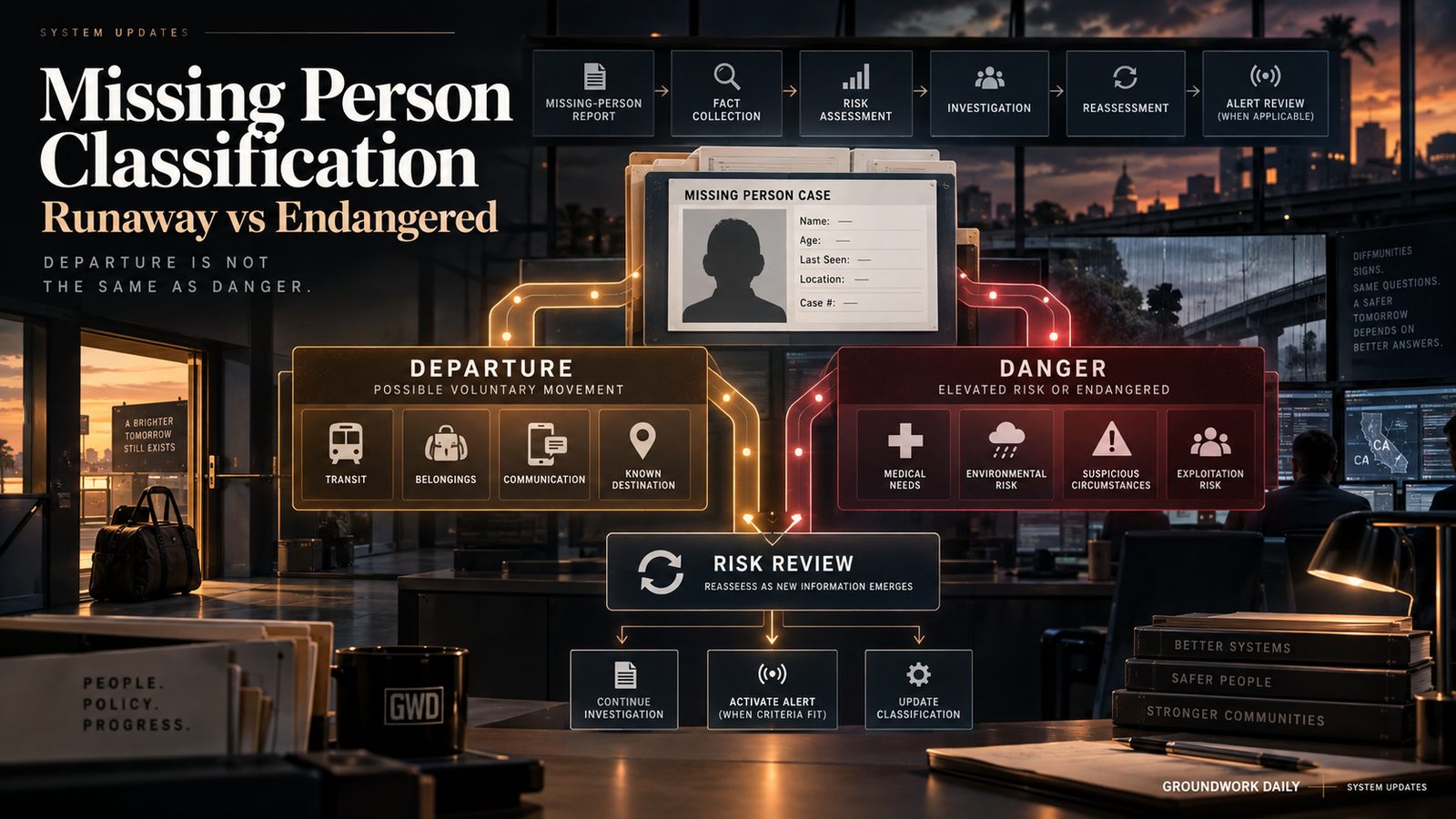
Missing person classification helps organize known facts and risk, but no single label should substitute for continuing investigation. A young person may leave voluntarily and still be endangered. An endangered person may receive an elevated investigative response without qualifying for AMBER Alert, Ebony Alert, or another public-notification program because those programs use separate eligibility criteria. The important institutional capability is reassessment: new evidence must be able to change the working model.
How Missing Person Classification Works
Missing-person response begins with the information available when the report is made. Agencies may consider age, medical needs, disability, developmental vulnerability, recent communications, last confirmed location, known destinations, suspicious activity, possible coercion, environmental exposure, transportation information, and whether the disappearance differs sharply from the person’s normal behavior. Local policy determines the terminology and the operational categories used.
That variation matters because there is no single national vocabulary that turns every missing-person case into the same set of labels. One agency may use language such as endangered, critically missing, involuntary, voluntary, or runaway. Another may structure the same risk questions differently.
Readers should therefore focus less on finding a universal label and more on understanding what evidence the agency is using to assess vulnerability and danger.
Relevant information can include:
- Age and developmental vulnerability
- Medical conditions and medication needs
- Cognitive, developmental, or physical disability
- Immediate mental-health or safety concerns
- Last confirmed location and time seen
- Recent phone, text, online, or in-person communication
- Known associates, relationships, or possible destinations
- Evidence suggesting voluntary departure
- Possible coercion, exploitation, trafficking, violence, or abduction
- Weather and environmental exposure
- Vehicle, rideshare, transit, or other transportation information
- Behavior that is unusual for the missing person
The First Theory Is a Working Theory
Early information is often incomplete. A friend may provide new context. Location information may contradict a planned destination. A medical need may become more urgent as time passes. A conversation that initially appeared ordinary may look different after investigators learn who was on the other end.
None of those developments automatically proves a crime, but each can alter the risk picture.
That is why the first assessment should remain revisable. An institution can make a reasonable initial judgment and still fail later if its process becomes resistant to contrary evidence. The quality of the system is measured not only by how quickly it classifies uncertainty, but by how readily it updates when the uncertainty begins to resolve.
Critical Distinction
Voluntary departure is not a safety finding. A person can choose to leave and later face exploitation, violence, trafficking, homelessness, exposure, medical danger, coercion, or another serious threat. The circumstances of departure and the person’s current risk should inform one another without being mistaken for the same conclusion.
What Does “Runaway” Mean in a Missing-Person Case?
In cases involving minors, investigators may receive evidence suggesting that a young person left voluntarily. A recent disagreement, communication about leaving, a known destination, belongings taken from the home, previous episodes of leaving, or the absence of immediate evidence of force may all contribute to that theory.
What those facts can help explain is the departure. They do not establish what happened afterward.
The National Center for Missing & Exploited Children makes that distinction unusually clear by using the category Endangered Runaways . NCMEC describes these children as highly vulnerable and identifies risk factors that can include family conflict, abuse, mental-health struggles, online enticement, gang activity, and child sex trafficking. Leaving voluntarily is therefore compatible with serious vulnerability.
Why “They Ran Away” Cannot End the Analysis
A young person may leave because of ordinary conflict, but the same outward behavior can also appear in circumstances involving abuse, manipulation, exploitation, fear, online grooming, peer pressure, or a dangerous relationship.
Investigators may not know which explanation fits when the report is made. That uncertainty is precisely why continued fact collection matters.
The operational error is converting evidence of voluntary departure into a presumption of continuing safety. A stronger system asks whether the known destination was reached, whether communication remains consistent with the person’s behavior, whether new threats have emerged, and whether vulnerability is increasing as time passes.
Language Should Organize the Case, Not Close It
Families should be able to supply new information without fighting the inertia of an early label. Investigators should be able to revise their assessment without treating reclassification as an admission that the original decision was improper.
In a healthy system, changing the model when the evidence changes is evidence of functioning judgment.
What Does Endangered Risk Mean?
An endangered or similarly elevated-risk designation generally communicates that the circumstances create a credible safety concern. The precise definitions belong to the jurisdiction, agency, database, or alert program involved. A generic internet checklist should never be mistaken for a nationwide legal standard.
Depending on the applicable policy, relevant considerations may include age, medical dependency, cognitive impairment, developmental disability, severe weather, suicidal behavior, suspicious circumstances, possible exploitation, coercion, evidence of violence, the presence of a dangerous person, or a disappearance that sharply conflicts with normal behavior.
Endangered Does Not Automatically Mean Public Alert
This is where public understanding often breaks down. A person can face serious danger without satisfying the requirements of a specific public-alert system.
AMBER Alert, for example, is designed around qualifying child-abduction cases. The U.S. Department of Justice recommends criteria that include a reasonable belief that an abduction occurred, imminent danger of serious bodily injury or death, sufficient descriptive information, a child age 17 or younger, and entry of critical information into the National Crime Information Center.
States administer their own AMBER plans, and other alert programs have their own statutes and administrative rules. Risk assessment and alert eligibility should therefore be treated as connected decisions, not interchangeable labels.
Runaway vs Endangered: What Is the Actual Difference?
The cleanest distinction is between departure circumstances and current risk. Evidence that someone left voluntarily can help explain how the disappearance began. Evidence of danger helps establish what risks surround the person now. One dimension does not cancel the other.
A young person can leave voluntarily and become endangered. A person can also appear endangered during the first hours of uncertainty before later evidence establishes that they left safely by choice.
The analytical discipline is to avoid asking one label to answer questions it was never designed to answer.
| Question | What It Helps Establish |
|---|---|
| Did the person appear to leave voluntarily? | Circumstances of departure |
| What vulnerabilities or threats exist now? | Current risk |
| What has changed since the report? | Need for reassessment |
| Which investigative or alert requirements are satisfied? | Available response tools |
Classification works best when it reduces confusion without hiding uncertainty. Its job is to organize information so decisions can be made. Once a label begins preventing contrary evidence from being taken seriously, it has stopped serving that purpose.
Adults and Minors Move Through Different Legal Contexts
Adults generally have the legal freedom to leave a home, relationship, workplace, or community without obtaining permission or telling other people where they are going. An adult’s absence, standing alone, therefore does not establish that a crime occurred or that the person is endangered.
The analysis changes when other facts create a credible safety concern. Medical vulnerability, cognitive impairment, suicidal behavior, domestic violence, coercion, environmental danger, suspicious circumstances, or evidence that the disappearance is inconsistent with the person’s established behavior can all matter.
The point is not that every unexplained absence signals danger. It is that voluntary mobility and vulnerability can coexist.
Minors occupy a different legal and developmental context. A young person’s apparent decision to leave may help explain what happened, but it does not erase age-related vulnerability or the possibility that another person influenced, exploited, or endangered the child. The response system must be capable of holding both facts at once.
How Missing Person Classification Can Shape the Response
Classification can influence which questions receive immediate attention and which escalation pathways are considered, but it should not be described as a universal switch controlling investigative effort.
Agency policies, resources, jurisdiction, available evidence, case circumstances, supervisory practices, and specialized capabilities all affect what happens next.
Depending on the case, the response can include patrol activity, interviews, database entry, records review, digital investigation, search operations, supervisory review, specialized units, coordination with other agencies, public information efforts, and evaluation for an alert or advisory. Some of those actions may happen without becoming visible to the public.
Alert Status Is Not the Same as Investigative Priority
A case that does not qualify for a public alert can still receive substantial investigative attention. Likewise, a highly visible alert does not prove that every useful investigative action has occurred behind the scenes. Public notification is one tool inside a larger system.
That distinction matters for accountability. If the only performance measure is the number of alerts issued, the public sees the most visible output while learning almost nothing about the decisions that preceded it.
Structural Response Map
Missing-Person Report
↓
Fact Collection
↓
Risk Assessment
↓
Investigation and Database Actions
↓
Escalation and Alert Review
↓
Public Notification When Criteria Fit
↓
Continued Investigation and Reassessment
This is an analytical model, not a universal law-enforcement workflow. Exact procedures differ by jurisdiction and program.
Missing Person Classification and Public Alert Eligibility
Public-alert programs operate downstream from the missing-person report. They use defined eligibility rules because each alert system is designed for a particular problem and because excessive or poorly targeted alerts can reduce their effectiveness.
Concern about a missing person and legal eligibility for a particular broadcast mechanism are therefore different questions.
The U.S. Department of Justice AMBER Alert guidance provides the clearest national example. DOJ recommends a reasonable belief that an abduction occurred, imminent danger of serious bodily injury or death, sufficient descriptive information to assist recovery, a child age 17 or younger, and entry of critical case information into NCIC. Individual state AMBER plans establish and administer their own activation criteria.
Other programs address different populations and risks. California, for example, operates AMBER, Silver, Feather, Ebony, and other missing-person alert or advisory mechanisms. The existence of several tools is itself evidence that endangered is not one universal alert category.
Families and Alert Programs Can Experience the Same Case Differently
A family can reasonably view a disappearance as an emergency while an alert coordinator determines that a particular statutory or administrative threshold has not been met. Those positions are not automatically contradictory.
One question concerns the person’s safety. The other concerns whether a defined public-broadcast tool is authorized and useful under the facts available.
The institutional question is whether the threshold is clear, consistently applied, promptly reconsidered when the facts change, and documented well enough for the system’s performance to be reviewed later.
What Information Can Help a Missing-Person Risk Assessment?
Families do not need to determine the legal category before reporting a person missing. They are more useful to the process when they provide specific, verifiable facts.
For missing children, the U.S. Department of Justice’s 2025 family survival guide emphasizes that there is no waiting period for parents to report a child missing or for police to act on the report.
Depending on the circumstances, useful information can include:
- A recent, clear photograph
- Full name, age, and physical description
- Last confirmed location and time seen
- Last confirmed phone, text, online, or in-person communication
- Clothing, bags, identification, medication, and other belongings taken or left behind
- Medical conditions and medication requirements
- Known phone numbers and social-media accounts
- Friends, associates, relationships, or possible destinations
- Recent threats, conflict, unusual contact, or concerning behavior
- Vehicle, rideshare, public transit, or other transportation information
- Prior episodes of going missing and how the present case differs
- Evidence suggesting coercion, exploitation, trafficking, violence, or immediate danger
Accuracy matters more than volume. One concrete fact showing that the current disappearance differs sharply from previous behavior can be more valuable than a long chain of speculation.
Families should distinguish what they know from what they fear, while making sure investigators understand facts that materially change the risk picture.
When Missing Person Classification Should Be Reassessed
Reassessment matters whenever the evidence supporting the original risk picture changes. That does not mean every new fact should produce a new label. It means the new fact should be evaluated on its own weight rather than forced to fit the original explanation.
A missed medication schedule, unexpected loss of communication, a credible threat, suspicious contact, worsening weather, contradictory location information, an unexpected transaction, evidence of coercion, or a witness account may materially alter vulnerability.
Time itself can also change risk. Conditions that were tolerable during the first hours of an absence may become dangerous later.
Reclassification Is Not Automatically Evidence of Failure
Investigations develop. New information arrives. A changed assessment therefore does not prove that the first decision was negligent, biased, or malicious. Systems should be expected to update as the evidence improves.
The failure appears when the first explanation becomes harder to change than the evidence justifies. At that point, classification no longer helps investigators organize uncertainty. It begins filtering out the very information that should be changing the response.
What Would Make Missing Person Classification Auditable?
Alert counts reveal what happened near the visible end of the response chain. They reveal much less about the decisions made before a case reached alert review.
A serious accountability system would therefore measure more of the upstream process while protecting investigative integrity and personal privacy.
Useful aggregate measures could include:
- Cases grouped by initial circumstance or risk assessment
- Cases whose risk assessment changed after new evidence
- Time between the initial report and documented reassessment
- Cases reviewed for public-alert eligibility
- Documented reasons an alert request was approved or declined
- Time to public notification when notification occurred
- Recovery outcomes by relevant case characteristics
- Variation among comparable jurisdictions or agencies
- Demographic disparities where lawful, methodologically sound, and relevant
The objective would not be to force identical outcomes from unlike cases. Different facts should produce different decisions. The value of measurement is that it can expose unexplained variation, bottlenecks, delayed reassessment, inconsistent thresholds, or patterns that deserve closer examination.
Measure the Decisions Before the Alert
A jurisdiction could increase the number of alerts it issues without improving the quality of the decisions that precede those alerts. Another jurisdiction could improve initial investigation, data entry, supervisory review, or reassessment without producing a dramatic increase in public notifications. Alert volume alone cannot tell those systems apart.
The better performance question is whether credible risk becomes visible to the institution quickly enough for the appropriate investigative and notification tools to be considered.
Why Missing Person Classification Matters for Ebony Alert Policy
California established the Ebony Alert through Senate Bill 673 in 2023. The program was designed around concern for missing Black youth and has since been amended.
Under the current California Highway Patrol criteria , an Ebony Alert can apply to a missing Black person from 12 through 25 years of age, inclusive, when the investigating agency has used available local resources and the required suspicious, unexplained, trafficking, danger, or peril circumstances are present.
That precision matters because Ebony Alert is not simply a synonym for missing Black person or endangered missing person. The investigating law-enforcement agency evaluates the circumstances and can request activation. California Highway Patrol, as the state coordinator, reviews the request against the applicable criteria and determines the appropriate geographical activation when the requirements are satisfied.
The Alert Is Visible. The Gatekeeping Process Is Less Visible.
The public can see an Ebony Alert once it is distributed through official channels, media, signs, websites, or other notification systems. The public cannot usually see every decision that occurred before the alert request. That creates an accountability gap if researchers evaluate the program only by counting alerts.
A stronger impact audit would examine which qualifying or potentially qualifying cases reached eligibility review, how quickly agencies reassessed changing risk, why requests were approved or declined, and whether comparable cases received comparable treatment.
That does not presume discrimination or failure. It creates the evidence needed to distinguish performance from assumption.
This is where classification matters most to the policy analysis. If the initial working theory influences whether later risk evidence reaches the alert-review stage, then the effectiveness of Ebony Alert depends partly on decisions made before the program itself becomes visible.
Recognition Skill: Separate Departure From Danger
The useful skill is learning to recognize when an explanation of departure is being used as a substitute for a safety assessment. Evidence that someone left voluntarily can matter. It simply cannot answer every question that follows.
When evaluating a missing-person case or an argument about alert policy, ask: What evidence explains the disappearance? What evidence describes the person’s current risk? What would cause the institution to update its assessment? Which response tool actually fits the facts?
Those questions move the analysis away from labels and toward the quality of the decision system.
Frequently Asked Questions About Missing Person Classification
Does a runaway designation mean a missing child is safe?
No. Evidence that a child left voluntarily does not establish continuing safety. NCMEC itself uses the term Endangered Runaway and identifies risks that can include homelessness, abuse, exploitation, online enticement, gang involvement, and trafficking.
Can someone leave voluntarily and later become endangered?
Yes. Departure circumstances and current risk are separate dimensions. Environmental exposure, exploitation, medical needs, violence, coercion, loss of communication, or other changing circumstances can increase danger after a voluntary departure.
Do all endangered missing-person cases trigger an AMBER Alert?
No. AMBER Alert is designed for qualifying child-abduction cases and uses program-specific criteria. A child can be missing or endangered without meeting the requirements for an AMBER Alert.
Is there a waiting period before reporting a missing child?
No. U.S. Department of Justice guidance for families states that there is no waiting period for parents to report a missing child or for police to act on the report. A missing child should be reported immediately.
Does every missing Black person in California qualify for an Ebony Alert?
No. California’s current Ebony Alert criteria include an age range of 12 through 25 and specified investigative and risk conditions. The investigating agency and California Highway Patrol evaluate the case under the statutory and administrative requirements.
Can an adult missing-person case involve serious danger?
Yes. Adults generally have the right to leave voluntarily, but medical vulnerability, cognitive impairment, suicidal behavior, domestic violence, coercion, suspicious circumstances, environmental threats, or other evidence can create serious safety concerns.
Why might police investigate a case even when no public alert is issued?
Public alerts are only one response tool. A case can involve interviews, searches, records work, database actions, digital investigation, coordination, supervisory review, or other investigative activity without meeting the requirements for a public alert.
The Groundwork
Missing-person systems have to make decisions before they possess complete information. Classification is one way institutions make that uncertainty manageable, and that function is necessary. The mistake is expecting the first classification to carry more certainty than the evidence can support.
A person can leave voluntarily and still be endangered. A person can be endangered without qualifying for a particular public alert. A case can receive significant investigative work without public notification, and an alert can create visibility without telling us whether every upstream decision worked as it should.
The durable standard is therefore not whether an institution found the perfect label immediately. It is whether the institution keeps weighing the evidence, recognizes when the risk picture has changed, and allows new information to change what happens next.
Classification should organize the response, not imprison it.
The System: Updated.
Previous model: a person is reported missing, receives a classification, and either qualifies for an alert or does not.
Updated model: the system is report → facts → risk assessment → investigation → reassessment → alert review when applicable → continued investigation. The label is a working tool inside that process. It is not the process itself.

Put the Principle to Work
Structure Is Mercy
Good structure does not eliminate uncertainty. It prevents uncertainty from becoming neglect. In a missing-person system, that means creating a process in which an early theory can be tested, challenged, and changed before a mistaken assumption carries more weight than the evidence.
Join the Groundwork List
Build Better. Every Day.
Get selected Groundwork Daily essays, systems analysis, institutional literacy, and practical frameworks for understanding what happens when policy, authority, and institutions meet the real world.
Continue Building
Follow the missing-person response system from classification into alert design, outcome measurement, and the larger institutional-literacy framework.
Go Deeper:
What Is an Ebony Alert?
Understand the program’s history, criteria, and relationship to AMBER Alert.
Application:
Ebony Alert Impact Audit: Does the Policy Change Outcomes?
Move from program design to the harder question of measurable performance.
Related Pattern:
When a Disappearance Is Called a Runaway
Examine the recurring classification problem at the case level.
Foundation:
Building Institutional Literacy
Learn how to trace authority, procedures, incentives, and accountability
through public institutions.
Meet the Builder

Langston Reed
Builder, Civic Power & Policy
Langston Reed examines institutions, governance, public policy, incentives, and infrastructure by tracing how authority and rules behave after they meet real conditions. His work develops institutional literacy so readers can evaluate systems by their mechanisms and outcomes, not only by their stated intentions.
Continue through System Updates, Building Institutional Literacy, or Civic Power & Policy.
Receipts
Missing-person terminology and procedures vary by jurisdiction. These sources support the national guidance and California-specific claims used in this analysis.
Missing Children and Runaway Youth
- National Center for Missing & Exploited Children: Endangered Runaways – Defines NCMEC’s Endangered Runaway category and identifies vulnerabilities and risk factors affecting missing youth who leave on their own accord.
- U.S. Department of Justice, OJJDP: When Your Child Is Missing, Fifth Edition, 2025 – Provides current family guidance on reporting missing children, law enforcement response, NCIC entry, media, searches, and the first stages of a missing-child case.
Public Alert Criteria
- U.S. Department of Justice: AMBER Alert Frequently Asked Questions – Provides DOJ’s recommended AMBER Alert criteria and explains that state plans maintain their own activation requirements.
- California Highway Patrol: Ebony Alert – Provides current California Ebony Alert eligibility criteria and public program guidance.
- California Highway Patrol: State of California Missing Person Alert Plan – Explains CHP’s statewide coordination role and the general activation process for California missing-person alerts.
Source availability: These resources were reviewed for this update in September 2026. Laws, administrative criteria, agency guidance, and web addresses can change. Readers dealing with an active case should rely on the responsible law enforcement agency and current official guidance.
External links were live and accessible when this article was published or last substantively updated. Third-party pages may change, move, or be removed over time.