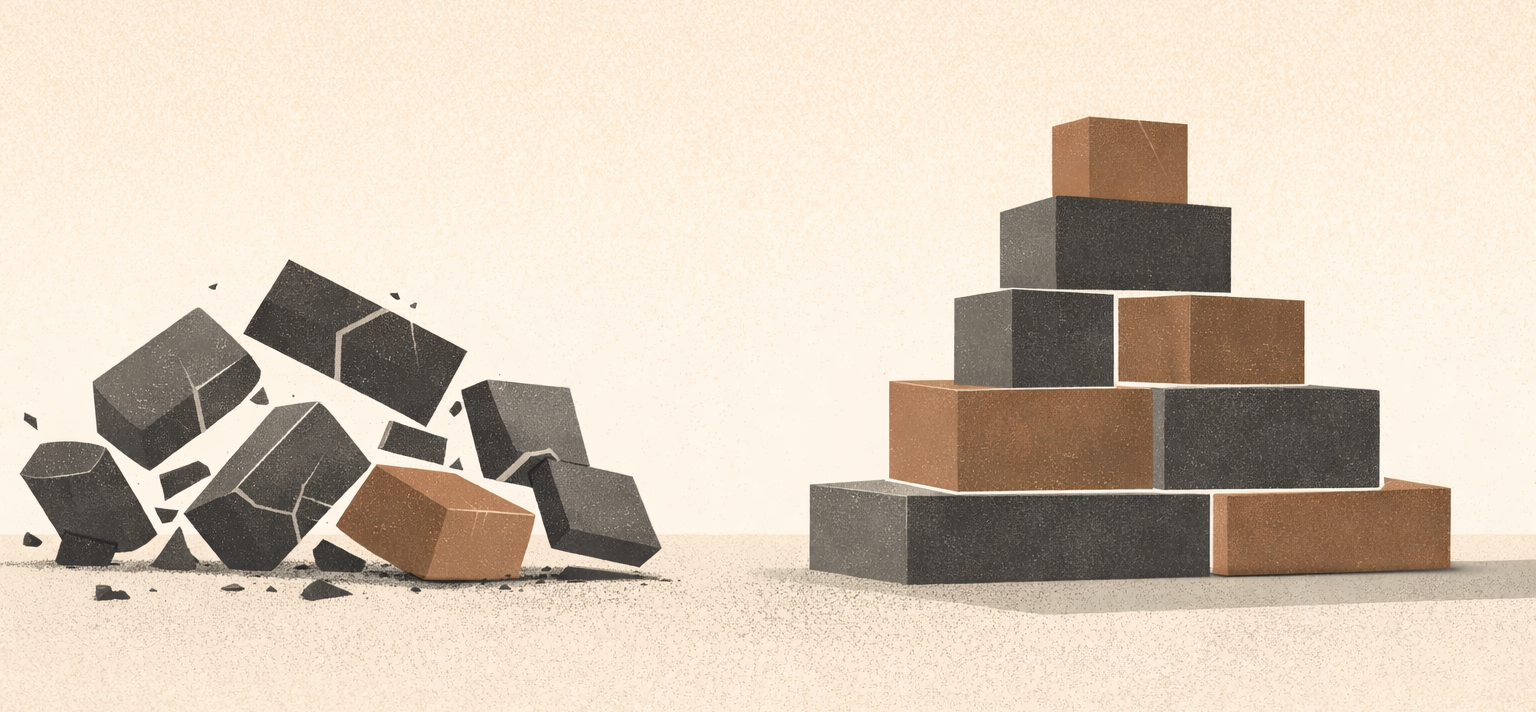
Most habits fail because they are built on motivation instead of structure.
That is the uncomfortable truth beneath most failed routines. People do not usually quit because they are weak. They quit because the system around the habit was never designed to survive stress, fatigue, interruption, boredom, or real life.
Motivation feels powerful at the beginning. It creates urgency. It makes the future feel close. For a few days, the plan seems obvious. Wake up earlier. Eat better. move more. Spend less. Read more. Be more focused. Cut every bad habit at once.
Then the pressure arrives.
Sleep gets worse. Work gets heavier. The house gets loud. The calendar fills up. Stress rises. The old environment stays the same. At that point, the habit is no longer being carried by inspiration. It has to be carried by design.
Most habits fail at that exact moment.
Why habits fail under pressure
Traditional habit advice often starts too high. It asks for a total life overhaul before the nervous system has stabilized. That sounds ambitious, but it is usually bad architecture.
A person who is already tired does not need ten new rules. A person who is already overwhelmed does not need a complicated morning routine. A person who is already reactive does not need another identity statement taped to the mirror.
They need a lower-friction system.
Why habits fail is not a mystery when the pattern is examined honestly. The plan is usually too big, too emotional, too dependent on perfect conditions, and too disconnected from the actual environment where the behavior has to happen.
Motivation can start a habit. It cannot protect it.
That is why the strongest habit systems begin with regulation, not intensity. They lower the cost of repetition. They reduce the number of decisions required. They make the right action easier to begin and harder to avoid.
Groundwork replaces the fantasy of willpower with a practical system: stabilize first, structure second, expand last.
The real reason motivation is a weak strategy
Motivation changes by the hour. It rises after a good conversation, a strong article, a disappointing moment, or a vision of who you want to become. However, motivation also falls after poor sleep, conflict, hunger, stress, distraction, and decision fatigue.
That makes motivation unreliable as the foundation for behavior change.
A better system does not ask, “How motivated do I feel today?”
It asks:
- What cue will trigger the habit?
- What friction can be removed?
- What version of this habit is small enough to repeat under stress?
- What environment makes the better choice easier?
- What review process helps the system improve without shame?
This is the difference between a wish and a structure.
A wish depends on mood. A structure changes the conditions.
The two principles behind habits that last
There are two principles that make habits more stable: keystone habits and environmental cues. They are simple, but they work because they address the system beneath behavior.
1. Keystone habits reduce internal chaos
Keystone habits are small foundational actions that make other actions easier. They do not need to be dramatic. In fact, the best keystone habits are usually quiet.
Regulated breathing. Five minutes of movement. A consistent wind-down routine. A short body scan. A glass of water placed where it will be seen. These actions seem small because they are small. That is the point.
Small does not mean weak.
Small means repeatable.
When a keystone habit lowers stress, improves awareness, or creates a sense of order, it changes the conditions around every other habit. Better breathing supports better self-control. Better sleep supports better focus. Better movement supports better mood. Better environmental cues reduce the need for constant decision-making.
Groundwork Daily explores this same discipline logic in Discipline Before Dollars, where structure and consistency are treated as the foundation of long-term progress.
2. Environmental cues make consistency easier
Your environment is already training you.
The phone on the nightstand trains you to scroll. The snacks on the counter train you to graze. The shoes buried in the closet train you to skip movement. The cluttered desk trains you to delay focused work.
That is not a moral failure. It is design failure.
Environmental cues work because they reduce the distance between intention and action. If the book is on the pillow, reading becomes easier to remember. If the water bottle is filled at night, hydration becomes easier in the morning. If walking shoes are visible, movement becomes more likely.
In practice, design beats desire.
The 7-day habit reset
This 7-day habit reset is not a challenge. Challenges usually create short bursts and then collapse. This is a stabilization protocol. The goal is not to prove toughness. The goal is to build a system that can be repeated.
Each day adds one small layer of structure. The sequence begins with the body, then moves into movement, nutrition, awareness, recovery, environment, and review.
That order matters.
Day 1: Cortisol reset breathing
Practice six deep diaphragmatic breaths immediately upon waking. Keep it simple. Inhale slowly through the nose. Let the belly expand. Exhale slowly. Repeat six times.
This gives the day a regulated beginning before messages, meetings, noise, and obligations take over.
Do not turn this into a performance. Six breaths are enough. The purpose is to create a reliable morning cue that tells the body, “We start with order.”
Research on stress regulation and breathing techniques has shown measurable improvements in how the body responds to stress. You can review an overview from Harvard Health Publishing.
Day 2: Movement habit stacking
Commit to five minutes of low impact movement. Not 45 minutes. Not a full workout plan. Five minutes.
The point is to build the identity of daily movement without overwhelming the system. Stretch while coffee brews. Balance on one leg while brushing your teeth. Walk around the block. Do wall pushups. Keep the bar low enough that the habit survives a bad day.
A habit that survives a bad day is more valuable than a perfect routine that only works when life is calm.
Day 3: Nutrition baseline for stable energy
Add one serving of whole grains or vegetables. Do not begin by banning everything. That creates resistance. Start by adding structure.
Fiber, whole foods, and steadier meals help support more stable energy. When energy is more stable, decision-making becomes easier. When decision-making becomes easier, habits become less fragile.
This is why “crowding out” works better than punishment. Add the stabilizing choice first. Let the better structure gradually reduce the need for the weaker one.
Day 4: Body scan and positive reinforcement
Perform a 90-second body scan. Notice the jaw. Notice the shoulders. Notice the chest. Notice the lower back. Notice the hands.
Tension is information.
Most people do not realize they are stressed until they react. A body scan creates earlier detection. It gives you a chance to release pressure before pressure becomes behavior.
At the end of the day, name one successful moment. Not ten. One. This matters because the brain needs proof, not speeches. Every named success becomes evidence that the system is working.
Day 5: Sleep hygiene to reduce burnout
Increase sleep by five minutes. That sounds almost too small to matter. Good. That is why it is repeatable.
Most sleep advice fails because it asks tired people to rebuild their entire evening. Instead, begin with one small adjustment. Disconnect from screens 30 minutes before bed. Place the phone outside arm’s reach. Dim the room. Prepare tomorrow’s first cue before sleep.
Recovery is not a luxury. It is infrastructure.
Without recovery, discipline becomes expensive. Every good choice costs more energy than it should.
Day 6: Environment design for better habits
Place visual cues in your direct line of sight. Gym shoes by the bed. A book on the pillow. A water bottle on the desk. A notebook next to the laptop. A prepared breakfast item at eye level in the refrigerator.
Then remove one cue that triggers the wrong behavior.
This is the part most people avoid. They want better habits while keeping the same environment that trained the old ones. That is weak strategy.
The room has a vote.
Design the space so it votes for the person you are trying to become.
Day 7: Performance audit and iteration
Review the week without judgment. Shame is not a strategy. It creates avoidance, and avoidance destroys visibility.
Use three questions:
- What worked?
- What slipped?
- What needs less friction?
This is where resilience forms. Not through perfection. Through review.
A failed day is not a failed system. It is data. Adjust the cue. Lower the bar. Move the object. Change the time. Reduce the decision. Then continue.
Symptom vs. system
Most habit failure comes with signals. The mistake is treating those signals as personal flaws instead of system alerts.
| If you feel | Adjust this groundwork |
|---|---|
| Distracted or scattered | Return to Day 4 body scan and Day 6 space cues |
| Low energy or burnout | Return to Day 5 sleep hygiene and Day 2 movement |
| High stress or reactive | Return to Day 1 breathwork and Day 7 reflection |
| Inconsistent or discouraged | Lower the habit size and strengthen the visual cue |
| Overwhelmed by too many goals | Choose one keystone habit and pause expansion |
How to build habits that last beyond seven days
Seven days creates awareness. It does not create identity by itself. Identity forms when evidence repeats.
After the first week, the next move is not to add ten more habits. That is how people sabotage progress. The next move is to repeat the protocol long enough for the baseline to become familiar.
Use this progression:
- Days 1–30: Regulation. Keep the system simple. Protect breathing, movement, sleep, and review.
- Days 31–60: Structure. Add a weekly planning block, an environment reset, and one administrative task routine.
- Days 61–90: Expansion. Add one performance habit only. Not three. One.
This is where discipline becomes more than effort. It becomes architecture.
Most people expand too early. They get one good week and immediately build a fantasy calendar. That is ego wearing a planner.
Do not expand until the base can hold the weight.
Applied groundwork at work and at home
The same pattern applies outside personal health. Relationships, teams, families, finances, and workplaces all fail when rewards are pursued before order is established.
In relationships, a keystone habit might be a five-minute daily check-in. Not a dramatic conversation. Not a weekly argument disguised as honesty. A simple point of contact that keeps the emotional climate visible.
At work, a keystone habit might be a 15-minute administrative reset before the day begins. Clear the urgent loose ends. Confirm the next action. Remove the hidden friction before it becomes a missed deadline.
In money, a keystone habit might be checking the account before spending, automating one small transfer, or reviewing one recurring expense every week.
The principle is the same everywhere:
Order before rewards. Stability before scale.
- Interpersonal stability: Use shared keystone moments like a five-minute walk or brief check-in to regulate the emotional climate of a partnership.
- Professional discipline: Complete the administrative and foundational tasks before chasing high visibility wins.
- Financial consistency: Automate small behaviors before depending on big promises.
- Personal growth: Build the environment before demanding a new identity.
Why this habit reset works
This reset works because it does not start with ambition. It starts with capacity.
Capacity is the missing layer in most self-improvement advice. People are told to do more without asking whether the system can carry more. That is reckless.
A stronger approach begins with the body, then the room, then the routine, then the review. Each layer supports the next. Breathing lowers stress. Movement creates proof. Food supports steadier energy. Body scans increase awareness. Sleep restores capacity. Environmental cues reduce friction. Weekly review turns failure into adjustment.
That is not hype.
That is structure.
Habits do not fail because discipline is absent. They fail because structure is missing. Build the environment, reduce the friction, and let consistency become easier to repeat.
Frequently asked questions about habit failure
Why do most habits fail?
Most habits fail because they depend on motivation rather than systems. When stress rises, motivation drops and the habit collapses. Systems make behavior easier to repeat.
What is the best way to build habits that last?
The best way to build habits that last is to start small, connect the habit to an existing cue, reduce environmental friction, and review progress weekly without shame.
How long does it take to reset habits?
A short stabilization routine can begin resetting habit patterns within a week, especially when environmental cues and keystone habits are introduced. Deeper identity change usually requires repeated evidence over time.
What is a keystone habit?
A keystone habit is a small behavior that improves the conditions for other behaviors. Examples include breathing practice, sleep hygiene, daily movement, and weekly reflection.
Why is environment design important for habits?
Environment design matters because behavior follows cues. When the right action is visible and easy, consistency improves. When the wrong cue is always nearby, old habits stay powerful.
→ Discipline Before Dollars
→ Structure Builds Freedom
→ Stillness Is Strategy