
System Updates
Langston Reed examines the systems beneath familiar outcomes: the institutions, incentives, infrastructure, rules, capacity, and constraints that determine what people ultimately experience.
Why grocery prices rise becomes easier to understand once the grocery shelf stops being treated as the beginning of the story. By the time a shopper sees a higher price on eggs, bread, meat, produce, or cereal, the system behind that product has already absorbed months of decisions, expenses, and physical movement.
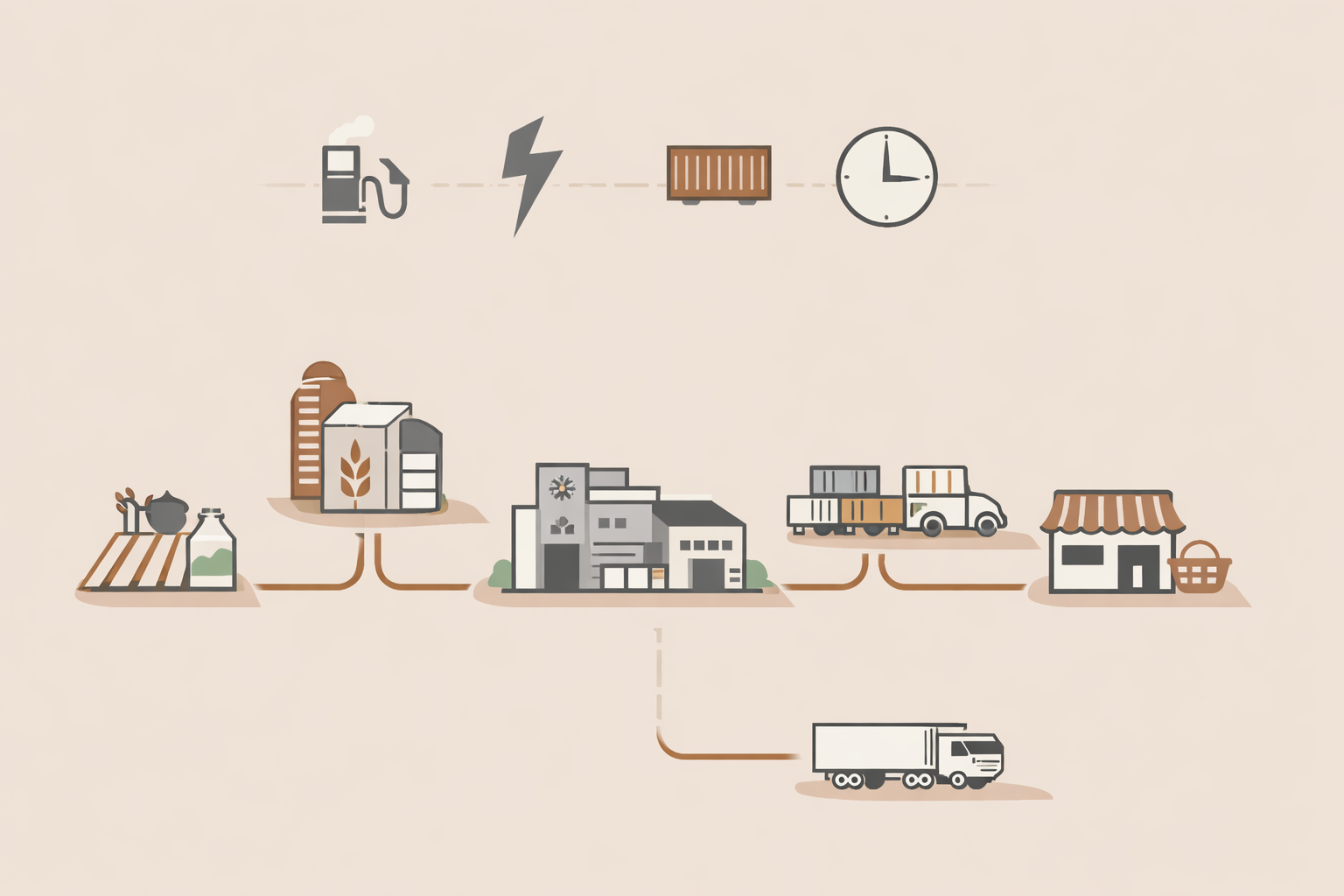
Food has to be grown or raised, processed, packaged, stored, transported, distributed, stocked, and protected from spoilage. Each stage requires labor, equipment, energy, infrastructure, financing, and time. Pressure that builds across several of those stages can eventually reach the household at checkout.
That does not mean every price increase is unavoidable or that every additional dollar reflects higher operating costs. Businesses still make decisions about margins, package sizes, promotions, sourcing, and how much pressure to pass forward. Understanding why grocery prices rise therefore requires following both the physical movement of food and the financial decisions made along the way.
Short Answer
Why grocery prices rise usually comes down to several pressures interacting at once. Farm inputs, commodity supply, labor, processing, packaging, energy, refrigeration, transportation, storage, retail costs, and competition all matter. The shelf price is the final number produced by that larger system, not simply the price of the food leaving the farm.
Why Grocery Prices Rise Beyond the Farm
One of the easiest mistakes is to assume that grocery prices mostly reflect what farmers receive for raw food. Agriculture is foundational, but the farm is only the first major stage. Most food still has to be processed, transported, stored, packaged, marketed, distributed, and sold before a household can use it.
USDA’s Food Dollar Series exists to make that structure visible. It separates the share associated with farm production from the larger network of post-farm activity required to bring food to consumers.
The post-farm share should not be confused with profit. It contains wages, equipment, transportation, energy, manufacturing, refrigeration, wholesale services, retail operations, rent, packaging, financing, taxes, and other expenses. Buying food therefore also means paying for the infrastructure that makes modern food distribution possible.
The Raw Commodity Is Only One Part of the Price
Consider bread. Wheat matters, but a loaf also requires milling, ingredients, mixing, baking, packaging, factory labor, equipment, sanitation, distribution, freight, shelf space, and retail labor. A decline in wheat prices therefore does not automatically produce an equal decline in the price of bread.
Similar logic applies across the store. Products requiring more transformation, packaging, temperature control, transportation, and preparation depend more heavily on costs beyond the farm. That is one major reason why grocery prices rise even when the agricultural story appears relatively stable.
How Higher Costs Actually Reach Grocery Prices
Supply-chain pressure does not move instantly from one business to the next. Contracts, inventories, competition, procurement schedules, and financial margin can slow the process. One company may absorb an increase for several months, while another passes it forward sooner because it has less room to maneuver.
Manufacturers facing higher costs also have several options. They can increase wholesale prices, reduce package size, change ingredients, switch suppliers, reduce promotional spending, accept a lower margin, or combine several of those strategies. Retailers then make another decision about how much of the pressure should reach the shelf.
Economists often describe this movement as price transmission. The term matters because the same upstream shock can create different consumer outcomes. A cost increase must pass through several decision points before it becomes the number printed below a product.
The price transmission chain
Input pressure → producer or manufacturer absorbs some of it → inventory and contracts influence timing → price, package, sourcing, or margin changes → distributor and retailer respond → the household sees the final result.
Higher Prices and Higher Inflation Are Not the Same Thing
One distinction matters throughout this discussion. A high price level and a high inflation rate are not the same thing. Inflation describes how quickly prices are changing, while the price level describes what households are actually paying.
Grocery inflation can slow after a period of sharp increases without returning prices to their earlier level. That is why official inflation can improve while a household still feels that food is expensive. The rate of increase may have changed even though the higher price remains.
Farm Costs Help Explain Why Grocery Prices Rise
Food still has to begin somewhere. Crops and livestock require labor, equipment, land, water, feed, seed, fertilizer, fuel, insurance, financing, maintenance, and other inputs. When those costs rise or production falls, processors begin with a more expensive or less abundant commodity.
Agricultural problems are often highly specific. Drought can damage one crop while leaving another relatively untouched. Disease can reduce livestock or poultry supply, while poor harvests can tighten fruit, grain, cocoa, coffee, or vegetable markets. Those differences help explain why one section of a grocery store can experience sharp inflation while another barely moves.
Supply Matters as Much as Cost
A product can become more expensive even when the cost of producing each unit has not changed dramatically. If supply falls while demand remains strong, buyers compete for fewer available goods. The resulting pressure can move from commodity markets into processing contracts and eventually into retail prices.
Broad claims about “food inflation” can therefore hide more than they reveal. Beef, eggs, coffee, produce, dairy, and packaged foods do not share one production system. Each category has its own bottlenecks and exposure.
Groundwork Daily follows one important upstream dependency in The Fertilizer Factor: Why Agriculture Depends on Energy .
Processing Adds Work Before Food Reaches the Shelf
Most grocery products are not sold in the form in which agriculture produces them. Wheat becomes flour and bread. Milk becomes cheese, butter, yogurt, and frozen desserts. Livestock moves through processing and packaging, while produce may be washed, cut, frozen, canned, sorted, or prepared before reaching a store.
Every transformation requires infrastructure. Plants need workers, sanitation, equipment, electricity, maintenance, quality-control systems, food-safety procedures, water, insurance, and capital. Those requirements exist whether a shopper notices them or not.
Packaging Is Part of the Supply Chain
Packaging may appear cosmetic, but it performs practical work. It protects food, carries labeling information, limits contamination, supports transport, extends usable shelf life, and allows automated production systems to handle products efficiently.
Paper, cardboard, plastics, glass, aluminum, labels, inks, adhesives, and packaging machinery therefore influence food costs. Rising input prices force manufacturers to decide whether to absorb the increase, redesign the package, change quantity, or eventually charge more.
Cost Pressure Can Change the Product Itself
Price is not the only variable manufacturers can adjust. Companies may respond to sustained cost pressure through sourcing changes, package reductions, ingredient substitutions, product tiers, or reformulation. Those choices can alter the consumer experience without appearing as a straightforward price increase.
Groundwork Daily examines that separate mechanism in Fake Food in America: How Reformulation Changes Familiar Products .
Fuel and Energy Are Hidden Drivers of Grocery Prices
Energy touches nearly every major stage of the food system. Fuel powers farm equipment and freight vehicles. Electricity runs processing plants, warehouses, refrigerators, freezers, distribution centers, and grocery stores. Important agricultural and industrial inputs can also depend on energy before food ever begins moving toward the consumer.
Higher energy costs can create pressure in several places at once. Farms become more expensive to operate, factories face larger utility bills, refrigerated storage becomes more costly, and transportation companies spend more moving the same load.
Fuel Prices Do Not Move Grocery Prices One-for-One
The relationship is real, but it is not immediate. Transportation companies may operate under contracts, manufacturers may hold inventory purchased under earlier conditions, and some businesses hedge energy costs. Others may temporarily accept smaller margins before changing prices.
Falling fuel costs also do not guarantee an immediate decline at the grocery store. Wages, packaging, rent, insurance, equipment, financing, and other expenses may still be elevated. Energy explains one part of why grocery prices rise, not the whole system by itself.
Storage and Refrigeration Turn Time Into Money
Food creates a logistical problem that many other consumer goods do not: it can deteriorate while the supply chain is still moving it. Meat, dairy, seafood, frozen foods, and many kinds of produce must remain within controlled conditions while traveling through processors, warehouses, trucks, distribution centers, and retail stores.
That refrigerated network is known as the cold chain. When it works, consumers barely notice it. They simply find milk cold, vegetables fresh, meat properly stored, and frozen food still frozen.
Cold Storage Has a Cost Even When Nothing Goes Wrong
Refrigerated facilities require electricity, monitoring systems, insulated buildings, maintenance, backup equipment, and staff. Temperature-controlled trucks add another layer of expense because cooling has to continue while the product is moving.
Those costs are part of the price long before a failure occurs. The cold chain is valuable precisely because it prevents spoilage and protects usable inventory across long distances.
Failure Creates Waste and Emergency Costs
Refrigeration problems, warehouse delays, missed deliveries, and transportation disruptions can shorten usable shelf life or destroy inventory altogether. A retailer may then have to replace stock quickly, use a more expensive supplier, accept empty shelves, or write off spoiled goods.
Strong systems maintain enough capacity to absorb some disruption before it becomes a consumer problem. Fragile systems have fewer options. When storage, transportation, or inventory is already stretched, even a modest shock can become expensive quickly.
Transportation Helps Explain Why Grocery Prices Rise
Food transportation is not one truck driving from a farm to a supermarket. Agricultural inputs travel toward farms, commodities move toward processors, and finished food travels to warehouses and distribution centers. Retail shipments are then consolidated, scheduled, routed, and delivered to individual stores.
Imported food can add ports, ocean freight, customs processes, rail transport, inspections, and additional storage. Every handoff creates another point where delay, labor shortages, equipment problems, congestion, or higher operating costs can enter the system.
Freight Costs Include More Than Fuel
Transportation companies also pay drivers, insurance, maintenance, equipment, tolls, financing, and administrative costs. Refrigerated freight introduces another layer because the product must remain within a controlled temperature range during transit.
Geography changes exposure as well. Regions with several distributors and strong transportation infrastructure have more options when one route fails. Remote areas or markets dependent on fewer suppliers may have less room to reroute around a disruption.
Distance Can Become a Form of Vulnerability
A community farther from major distribution corridors may depend on longer routes, fewer deliveries, or a smaller number of suppliers. That does not guarantee higher prices, but it can reduce the number of alternatives available when transportation becomes more expensive or unreliable.
Infrastructure therefore affects more than convenience. It can influence how easily retailers replace supply, how quickly inventory moves, and how much transportation pressure ultimately reaches households.
Retailers Add Costs—and Make Pricing Decisions
The supermarket is not simply receiving food and placing it on a shelf. Retailers pay for buildings, refrigeration, utilities, employees, security, technology, inventory, waste, insurance, maintenance, payment systems, distribution, and other operating expenses. Those costs help determine how much revenue a store must generate.
Retail pricing also involves strategy. Stores use promotions, private labels, loyalty programs, category margins, loss leaders, and competitive pricing to influence where customers shop and what they buy. One product may carry a small margin while another helps make the overall category profitable.
Retail Strategy Changes What the Shopper Sees
A retailer does not have to treat every product the same way. Some items may be priced aggressively to attract customers, while others carry more margin. Stores can also reduce promotions, alter loyalty discounts, emphasize private-label products, or change assortment before raising every shelf price.
Those decisions make retail pricing more complex than a simple markup over wholesale cost. The number on the shelf reflects operating economics and the retailer’s competitive strategy.
Costs and Pricing Power Are Different Questions
Understanding supply-chain costs should not become an excuse to assume that every price increase is unavoidable. Businesses still make decisions about margins and pass-through. Competition affects how much freedom they have to raise prices without losing customers.
A stronger analysis holds two ideas together. Higher operating costs can put real pressure on grocery prices, while market structure and pricing decisions still influence how much of that pressure households ultimately absorb.
Why Grocery Prices Rise Unevenly Across the Store
“Grocery prices” sounds like one category, but the supermarket contains many different economic systems. Meat does not share the same production cycle as cereal. Fresh berries do not have the same storage requirements as canned beans, and coffee does not face the same growing conditions as dairy.
Each category has its own exposure to weather, disease, imports, labor, refrigeration, commodity markets, transportation, processing, and competition. Grocery inflation can therefore become concentrated in a few important foods even when the overall index looks moderate.
Your Grocery Basket May Not Match the National Average
Households experience inflation through what they actually buy. A family purchasing heavily from a category experiencing a major supply shock may face much more pressure than the headline grocery index suggests.
Dietary needs can increase that difference. Households that depend on specific proteins, infant foods, specialty products, allergy-safe foods, or fresh produce may have fewer practical substitutes when one category becomes expensive.
Why Higher Grocery Prices Hit Some Households Harder
The same price increase does not create the same consequence for every household. Income, family size, transportation, dietary needs, neighborhood retail access, available storage, cooking time, and existing financial obligations all shape how much flexibility a household has when food becomes more expensive.
Households with financial margin may switch retailers, substitute products, buy in larger quantities, stock up during promotions, or absorb the increase without changing another part of the budget. A household already operating close to its limit may have to choose between food, utilities, transportation, medicine, childcare, or debt payments.
Access Changes the Meaning of Choice
Advice to “shop around” assumes competing stores are realistically available. A shopper with several supermarkets, reliable transportation, warehouse clubs, and delivery options has more leverage than someone dependent on one neighborhood retailer.
Grocery affordability therefore intersects with transportation, infrastructure, market competition, and household margin. The problem is not only what food costs. It is also how many realistic alternatives a household has when the price changes.
Financial Margin Changes the Consequence
Two households can face the same percentage increase and experience completely different outcomes. One may adjust the grocery budget without disrupting anything else. Another may have no unused income available to absorb even a modest change.
That is why grocery inflation is not merely an economic statistic. It becomes a question of household capacity: how much additional pressure can the budget carry before another obligation has to give?
Why Grocery Prices Can Stay High After Inflation Slows
Falling inflation does not mean prices return to an earlier level. Inflation measures the rate at which prices are changing. If food prices rise sharply one year and then rise slowly the next, households are still paying from the higher starting point unless actual price declines occur.
Supply-chain timing can also keep prices elevated. Companies may still be working through higher-cost inventory or contracts negotiated during a more expensive period. Wages, rent, equipment, insurance, packaging, and financing may remain costly even after a particular commodity or fuel price declines.
Lower Input Costs Create Room, Not a Guarantee
When an important input becomes cheaper, businesses may eventually reduce prices, increase promotions, rebuild margins, or use the savings elsewhere. The eventual outcome depends partly on competition and market conditions.
This helps explain both why grocery prices rise and why they can be slow to fall. The path upward and the path downward are not necessarily mirror images of one another.
What Consumers Can Actually Do About Grocery Prices
Household leverage is real but limited. Comparing unit prices, using private-label products where they meet household needs, reducing food waste, substituting within categories, planning around promotions, and comparing retailers can create savings. Those practices matter because they create more room inside a budget.
Consumers cannot individually repair a weak regional supply chain, end an agricultural disease outbreak, expand cold-storage capacity, increase supermarket competition, or reduce transportation bottlenecks. Those problems operate at market, infrastructure, business, or policy levels.
Use Household Leverage Where It Exists
A useful response begins by identifying which items are actually driving the household increase. Unit-price comparisons can expose package changes, private labels can provide alternatives, and planned substitutions can reduce dependence on one unusually expensive category.
Those choices do not eliminate grocery inflation, but they can protect margin and reduce unnecessary exposure. Household strategy works best when it is specific rather than built around a vague instruction to “spend less.”
Structural Problems Require Structural Solutions
The practical lesson is to separate household agency from structural responsibility. People should build margin where they have control while remaining clear about the systems that require larger solutions.
Personal discipline is useful, but it cannot substitute for functioning infrastructure, competitive markets, reliable food distribution, or sufficient regional capacity.
What to Watch When Grocery Prices Are Moving
Start with the category that is actually becoming more expensive. Weather, disease, crop conditions, livestock supply, imports, and commodity markets can explain why a specific food is moving before broader inflation measures reveal much.
Watch the Costs Around the Commodity
Energy, transportation, packaging, wages, processing capacity, storage, financing, and wholesale prices help show whether pressure is likely to remain upstream or move toward consumers. Several of those indicators moving together can reveal more than one headline price.
A commodity price may also improve while other costs remain elevated. Looking at the surrounding system helps explain why relief at one stage may not immediately appear at the grocery shelf.
Watch Capacity, Not Only Price
Supplier diversity, transportation alternatives, storage, inventory, processing capability, and competitive retail access determine how well the system can respond to disruption. Capacity provides room to reroute, substitute, store, or delay before a problem reaches the consumer.
When those buffers disappear, smaller shocks can create larger consequences. A price change is therefore more useful when read alongside the system’s ability to carry pressure.
FAQ: Why Grocery Prices Rise
Why do grocery prices rise?
Grocery prices rise when higher costs, tighter supply, or other pressures move through farms, processors, manufacturers, storage systems, transportation networks, distributors, and retailers. The final price also depends on how much of that pressure businesses absorb and how much they pass to consumers.
Are farmers responsible for most grocery price increases?
No. Farm production is essential, but processing, packaging, transportation, storage, distribution, labor, retail operations, and other post-farm activities make up a substantial part of consumer food spending. The importance of each component varies by product.
Why do grocery prices rise when fuel costs increase?
Fuel affects farm equipment and freight, while energy also powers processing, refrigeration, warehouses, and stores. Grocery prices do not move one-for-one with fuel because contracts, inventory, competition, and other costs influence how quickly energy pressure reaches consumers.
Why do some grocery prices rise faster than others?
Different foods face different weather risks, production cycles, diseases, commodity markets, processing requirements, import exposure, storage needs, and transportation costs. Inflation can therefore be severe in one grocery category while another remains stable.
Why do grocery prices stay high after inflation slows?
Slower inflation means prices are rising more slowly, not necessarily falling. Businesses may also still face higher wages, rent, packaging, financing, inventory, or contract costs even after one source of pressure begins to ease.
Can shoppers reduce the impact of grocery inflation?
Households can compare unit prices, use competing retailers where available, reduce food waste, substitute products, plan around promotions, and consider private-label alternatives. Those choices can improve household margin, but they cannot solve larger supply-chain or market problems.
Receipts
These sources provide the federal price data and food-system research underlying this analysis.
Consumer Food Prices
- U.S. Bureau of Labor Statistics — Consumer Price Index — tracks consumer price changes, including food-at-home categories.
- USDA Economic Research Service — Food Price Outlook — tracks food inflation and provides category-level analysis and forecasts.
Food Supply Chain
- USDA Economic Research Service — Food Dollar Series — shows how consumer food spending is distributed across farm production and post-farm industries.
- USDA Economic Research Service — Price Spreads From Farm to Consumer — compares retail food values with corresponding agricultural commodity values.
The Groundwork
The answer to why grocery prices rise is not hiding in one villain, one commodity, or one fuel price. The grocery shelf is the end point of a system that has already grown the food, transformed it, packaged it, protected it, moved it, stored it, financed it, staffed it, and placed it within reach of the consumer.
Strong systems have room to absorb disruption. They have supplier options, transportation alternatives, storage capacity, inventory, competition, and financial margin. Fragile systems have fewer buffers, so relatively small disruptions can travel farther and cost households more.
That is the larger lesson. A grocery price is not merely a number attached to a product. It is a signal about the system that delivered it.
Read the shelf closely enough, and it starts telling you where the pressure is.
The System: Updated.
What looked like the problem: The grocery store raised the price of food.
What the system reveals: The shelf price reflects pressure moving through production, processing, packaging, energy, storage, transportation, distribution, competition, and retail operations. The updated model is input pressure → system capacity → absorption or pass-through → retail price → household consequence.
Put the Principle to Work
Structure Builds Freedom
Households cannot control global commodity markets or freight networks, but they can build more room around costs they do not control. Know which foods are driving your own spending, compare unit prices, maintain practical substitutes, reduce waste, and protect enough budget margin that every price movement does not become an immediate household emergency.
Join the Groundwork List
Get systems analysis, institutional literacy, and practical frameworks built to remain useful after the headline moves on.
Continue Building
Continue through the food-system cluster based on the mechanism you want to understand next.
Upstream Pressure —
The Fertilizer Factor: Why Agriculture Depends on Energy
Follow the energy and industrial inputs affecting agriculture before food reaches
the processor.
Supply Capacity —
Why Food Shortages Happen Even When Farms Produce Enough
See why agricultural production alone cannot guarantee that food reliably reaches
households.
Product Response —
Food Quality Decline Under Cost Pressure
Examine how companies may respond through sourcing, package size, formulation,
and product design.
Household Structure —
Discipline Before Dollars
Build stronger household resource systems around costs you cannot completely
control.
Meet the Builder

Langston Reed
Builder, Civic Power & Policy
Langston Reed helps readers understand how institutions, governance, public policy, incentives, and infrastructure shape everyday life. His work develops institutional literacy by translating complex systems into practical frameworks that remain useful after the immediate news cycle has moved on.
Continue through System Updates, Building Institutional Literacy, or The Sovereign Ledger.