

The Fertilizer Factor
Modern agriculture begins with biology, but reliable production at modern scale also depends on energy, chemistry, manufacturing, transportation, and trade. Nitrogen fertilizer makes that hidden infrastructure unusually easy to see.
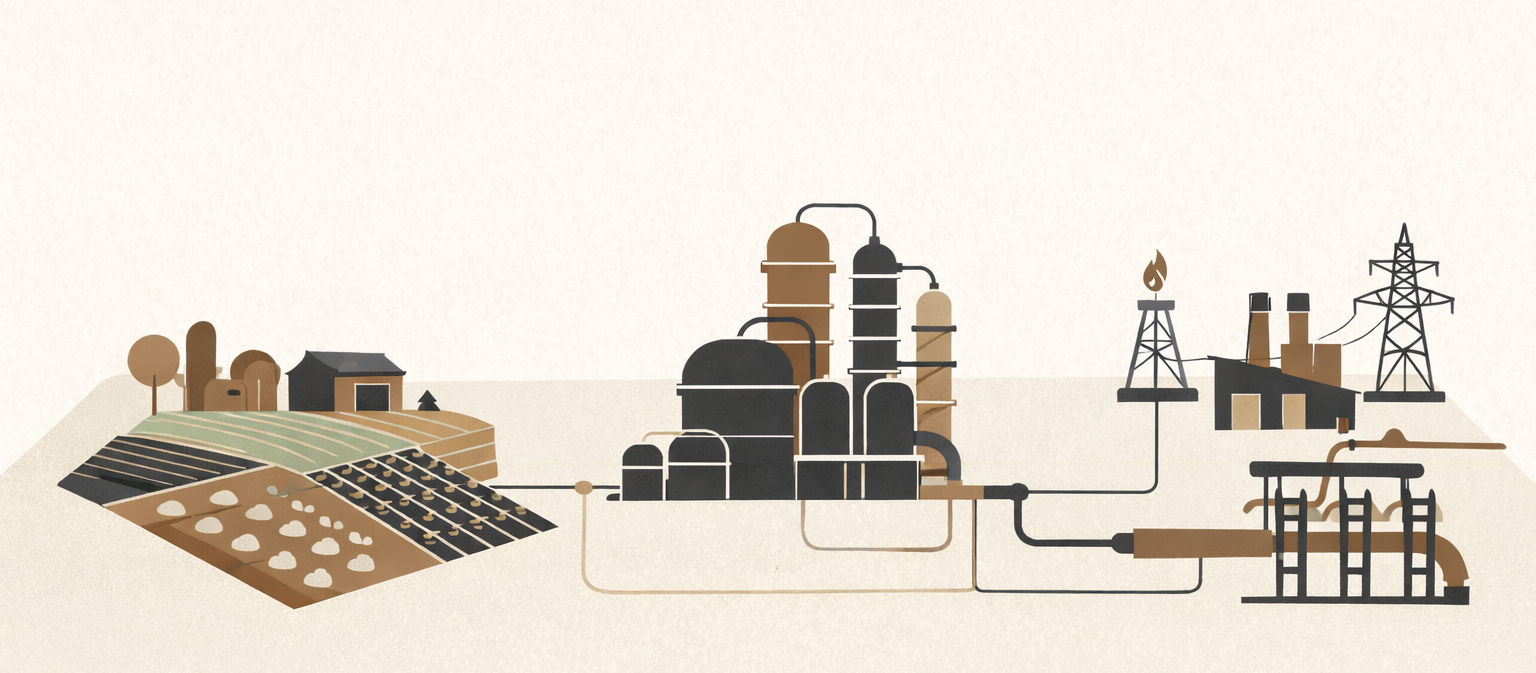
Why agriculture depends on energy becomes clearer once fertilizer enters the picture. A field still depends on soil, water, sunlight, labor, weather, and biological processes. Yet much of modern agriculture also relies on chemical plants, natural-gas supplies, electricity, fuel, transportation networks, storage systems, and global commodity markets.
Nitrogen fertilizer creates one of the strongest connections. Ammonia is the starting point for mineral nitrogen fertilizers, and producing ammonia requires substantial amounts of energy. Conventional production also needs a source of hydrogen. Across much of the world, manufacturers obtain that hydrogen from natural gas.
The International Energy Agency estimates that ammonia production accounts for about 2 percent of global final energy consumption. Around 70 percent of ammonia is used for fertilizer, and just over 70 percent of global ammonia production has relied on natural-gas-based steam reforming. The precise production mix varies by country. Coal remains important in some markets, while lower-emissions pathways are developing.
Agriculture therefore does not simply consume energy on the farm. Energy enters the food system before fertilizer ever arrives there. Once that upstream dependency becomes visible, fertilizer prices, farm costs, crop decisions, trade exposure, and food-system resilience begin to look like parts of the same operating system.
The System Beneath the Field
Energy → Ammonia → Nitrogen Fertilizer → Farm Decisions → Crop Production → Food System
This is a pathway, not a fixed formula. Inventories, weather, crop prices, trade, transportation, farmer decisions, processing costs, and retail conditions can absorb or amplify pressure at every stage.
Why Agriculture Depends on Energy Before the Farm
Plants need nitrogen. Farms can obtain it through manure, legumes, crop rotations, organic material, biological fixation, and other nutrient sources. Modern commercial agriculture also uses large quantities of manufactured nitrogen fertilizer because it allows farmers to supply nutrients at the timing and scale required by many production systems.
Industrial nitrogen fertilizer begins largely with ammonia. The Haber-Bosch process combines nitrogen from the atmosphere with hydrogen under high temperature and pressure. Ammonia can then be used directly or converted into products such as urea, ammonium nitrate, and other nitrogen fertilizers.
This is where energy becomes structurally important. The plant requires process energy to generate heat, maintain pressure, and run industrial equipment. It also requires hydrogen. In conventional natural-gas-based production, methane provides the hydrogen through steam methane reforming.
Natural Gas Is Both Energy and Raw Material
Calling natural gas merely a fuel understates its role. In many ammonia plants it performs two jobs. Part of the gas supports the energy requirements of production, while another part serves as chemical feedstock from which hydrogen is produced.
That distinction explains why nitrogen fertilizer can be especially exposed to natural-gas conditions. A fertilizer producer cannot necessarily respond to expensive gas in the same way a business responds to a higher electric bill. The gas may sit inside the chemistry of the product itself.
The relationship is particularly clear in the United States. The U.S. Geological Survey reports that natural gas remains the dominant domestic ammonia feedstock. In 2025, about 88 percent of U.S. ammonia production was used for fertilizer purposes.
Why Fertilizer Prices Can Respond to Energy Pressure
When natural-gas prices rise sharply, ammonia producers can face higher production costs. Depending on market conditions, plants may accept lower margins, increase selling prices, reduce output, delay production, or temporarily shut down capacity that has become uneconomic.
Historical experience supports that connection. The U.S. Energy Information Administration has documented ammonia price increases associated with higher international natural-gas prices. USDA has likewise observed periods when fertilizer prices rose alongside natural gas, including the sharp fertilizer-market escalation surrounding 2021 and 2022.
Still, saying that fertilizer prices simply follow natural-gas prices would be too crude. Fertilizer is a global commodity market. Plant outages, shipping costs, inventories, import dependence, export restrictions, sanctions, currency movements, seasonal demand, transportation constraints, and production capacity all matter.
Energy therefore creates a major cost channel, not a deterministic price formula. A gas shock becomes more consequential when other sources of flexibility are already weak.
How the Energy Shock Reaches the Farm
Fertilizer becomes a farm problem when the producer must decide whether the new price still fits the production plan. For nitrogen-intensive field crops, that decision can involve a substantial share of operating expenses.
USDA’s Economic Research Service reports that fertilizer accounted for roughly 33 to 44 percent of corn operating costs and 34 to 45 percent of wheat operating costs from 2020 onward. Those percentages are not universal farm economics. Exposure differs across crops, years, regions, soil conditions, nutrient requirements, and management systems.
The numbers nevertheless explain why fertilizer markets get farmers’ attention. A large increase in an input that represents a major share of operating costs can quickly change expected margins.
The Farmer Still Has Decisions to Make
Farmers can respond in several ways. They may adjust purchasing schedules, nutrient rates, application timing, crop choice, acreage, or other production decisions. Some operations can make greater use of manure, legumes, soil testing, variable-rate application, or other nutrient-management strategies.
Those options are not interchangeable. Nutrient needs depend on the crop and field. Organic nutrient supplies may be unavailable at sufficient scale. Equipment, labor, weather, land tenure, soil conditions, and timing can limit what can change during a particular season.
The useful question is therefore not simply, “Did fertilizer get more expensive?” The systems question is, “Which decisions does that price force, how much pressure can the farm absorb, and where does the remaining pressure move?”
Fertilizer Prices Can Become a Capacity Problem
Fertilizer does more than affect the expense side of a farm ledger. Nutrient availability can affect productive capacity. If farmers cannot obtain the fertilizer they planned to use, cannot afford the intended application, or substantially change nutrient practices, yield potential may fall under some conditions.
That does not mean a fertilizer shortage automatically becomes a food shortage. Agriculture has buffers. Farmers adapt. Inventories create time. Trade redirects products. Higher crop prices can change planting incentives. Different regions experience different weather and production conditions.
Those buffers matter because systems rarely fail from one variable alone. Fertilizer pressure becomes more dangerous when it overlaps with drought, war, export restrictions, low inventories, shipping failures, extreme weather, or disruptions in major producing regions.
The risk grows when several independent buffers begin disappearing at once. That is the distinction between an expensive input and a resilience problem.
Higher Fertilizer Costs Do Not Translate Directly Into Grocery Prices
This is where explanations about fertilizer often become too simple. Consumers generally do not buy raw farm commodities. Between the farm and the final purchase sit processors, manufacturers, storage facilities, transportation firms, wholesalers, retailers, restaurants, labor, packaging, property costs, energy, contracts, taxes, and margins.
USDA’s revised Food Dollar estimates make the distinction visible. In 2024, farm establishments received about 11.8 cents of the average dollar U.S. consumers spent on domestically produced food. The remaining 88.2 cents represented the marketing share associated with the rest of the supply chain.
Even that average hides large differences. USDA found that farms received about 18.5 cents of a food-at-home dollar in 2024 but only 7.1 cents of a food-away-from-home dollar. A raw commodity therefore has very different influence over the final price of fresh produce, packaged cereal, cheese, prepared food, or a restaurant meal.
Fertilizer still matters. Persistent input pressure can compress farm margins, change nutrient decisions, affect acreage, or reinforce other production problems. But the final retail effect depends on the product and on what happens elsewhere in the supply chain.
Groundwork Daily examines that distinction more directly in Why Food Shortages Happen Even When Farms Produce Enough. Production and distribution are connected, but they are not the same system.
Fertilizer Is a Global Infrastructure System
The fertilizer system also extends beyond nitrogen and beyond natural gas. The three primary crop nutrients are nitrogen, phosphorus, and potassium. Their industrial pathways differ, which means their vulnerabilities differ as well.
Nitrogen fertilizer depends heavily on ammonia production. Phosphate fertilizers depend on phosphate-rock mining and chemical processing. Potash fertilizers depend largely on concentrated mineral deposits and mining. Energy matters throughout the system, but it does not enter every fertilizer through the same mechanism.
Production and trade are international. USDA’s 2025 review of fertilizer markets emphasizes that U.S. production and consumption operate inside a global fertilizer market. That creates advantages through trade and supplier diversity, but it also allows distant disruptions to reach domestic producers.
A plant outage in one region, an export restriction elsewhere, a shipping problem at a major port, or a sudden increase in natural-gas costs can alter availability and price far from the original disruption. The precise effect depends on inventories, alternative suppliers, logistics, contracts, and how quickly production elsewhere can respond.
Domestic Production Helps, but It Is Not Immunity
Domestic capacity can reduce some forms of dependence. It can shorten portions of the supply chain and provide additional production options during global disruption. The United States remains a major ammonia producer, with production concentrated partly in natural-gas-rich states.
Domestic production still carries its own vulnerabilities. Plants can face gas-price spikes, hurricanes, maintenance failures, equipment outages, rail or river constraints, labor problems, and local infrastructure disruptions.
Resilience therefore should not be confused with complete self-sufficiency. A stronger system has enough capacity, supplier diversity, inventories, logistics, substitution possibilities, and recovery options to continue functioning when one pathway becomes unreliable.
Energy Is Embedded Throughout Modern Agriculture
Fertilizer makes the dependency visible because the chemical connection is unusually direct. Yet agriculture uses energy throughout the operating chain. Tractors and combines require fuel. Irrigation can require electricity or diesel. Livestock buildings may need heating, ventilation, pumping, and cooling.
The dependency continues after harvest. Grain must be dried and stored. Perishable products need refrigeration. Food is processed, packaged, warehoused, transported, displayed, prepared, and sold. Each stage has its own energy profile.
USDA describes gasoline, diesel, electricity, fertilizer, and other energy-related inputs as a substantial part of nonfarm-origin farm expenses. The wider food economy then adds another layer of transportation, processing, and retail energy demand.
Modern abundance is therefore biological production supported by industrial infrastructure. That does not make agriculture unnatural. It makes its dependencies easier to identify.
Efficiency Can Reduce Exposure, but It Cannot Eliminate the Nutrient Requirement
Better nutrient management can reduce waste and improve the amount of crop output supported by each unit of fertilizer. Soil testing, improved timing, more precise placement, appropriate application rates, crop rotations, legumes, manure, and precision technology can all play roles where conditions support them.
The objective should not be confused with simply using less fertilizer in every situation. Too little nutrient can reduce productivity, while excessive or poorly timed application wastes money and can create environmental damage. The stronger operating standard is efficient nutrient use matched to crop need and field conditions.
New production pathways may also change the energy relationship over time. Conventional ammonia depends heavily on fossil fuels, but hydrogen can be produced through other routes, including electrolysis powered by low-emissions electricity. Those technologies may diversify future fertilizer supply, although economics, infrastructure, electricity availability, and scale remain important constraints.
Resilience is not the elimination of dependency. It is knowing which dependencies exist, reducing unnecessary exposure, and creating enough alternatives that one disruption does not control the whole system.
Fertilizer Production Is Food Infrastructure
Infrastructure usually brings roads, bridges, ports, pipelines, power plants, and water systems to mind. Fertilizer manufacturing belongs in the same conversation because it converts energy and raw materials into agricultural inputs used at enormous scale.
The infrastructure does not end at the plant. Storage terminals, pipelines, railroads, barges, ports, trucks, dealers, and farm storage determine whether fertilizer reaches the right field at the right time. Producing enough material at the national level does not guarantee that every local market can access it when demand peaks.
Financing also matters. Farmers often purchase inputs before they receive revenue from the crop those inputs will help produce. Interest rates, credit conditions, contracts, crop prices, insurance, and expected margins therefore interact with the physical supply system.
The visible outcome is a crop. The operating architecture includes chemistry, energy, capital, manufacturing, storage, logistics, trade, farm management, weather, and biology.
Why This Matters Beyond the Farm
Households cannot build ammonia plants, reopen ports, lower wholesale natural-gas prices, or expand rail capacity. Those are institutional and market-scale problems. Treating them as questions of individual consumer discipline would mistake the level at which the system operates.
Understanding the pathway still creates value. It allows readers to distinguish an upstream production shock from a retail pricing issue, a transportation failure, a weather problem, or a policy decision. Different disruptions enter the food system through different doors.
Better questions follow. Which input became scarce? Where did the disruption begin? Is the pressure coming from energy, manufacturing, transportation, trade, weather, finance, or several systems at once? How much inventory exists? Which institutions or firms actually have the capacity to respond?
That is institutional literacy in practice. The nearest visible symptom is not necessarily the place where the problem began.
What a More Resilient Agricultural Energy System Requires
A resilient fertilizer system needs more than inexpensive energy during normal conditions. It needs enough production capacity, reliable transportation, functioning trade, inventory, financing, supplier diversity, and nutrient efficiency to continue operating when normal conditions disappear.
Redundancy matters because optimization and resilience are not identical goals. A system designed entirely around the cheapest normal pathway may become fragile when that pathway fails. Additional suppliers, reserve capacity, storage, alternative transportation routes, or alternative nutrient sources can look inefficient until disruption reveals what those options were buying.
Technology can strengthen the system as well. More efficient ammonia plants reduce energy exposure. Precision agriculture can improve nutrient use. Low-emissions hydrogen may eventually diversify ammonia production. Better data can help producers align purchases and application more closely with real need.
None of those measures removes uncertainty. They change how much pressure the system can absorb before farmers and consumers are forced to absorb it instead.
2026 Stress Test
The fertilizer-energy connection is not theoretical. The International Energy Agency reported in 2026 that disruptions to natural-gas supplies and trade in hydrogen-based products were contributing to fertilizer shortages and price volatility in multiple markets.
The useful lesson is broader than any one geopolitical episode. Concentrated production, energy dependence, trade routes, and limited short-term substitution can turn a regional disruption into a wider agricultural input problem.
Receipts
The analysis above draws primarily from public agricultural, energy, and mineral-production data. These sources document the ammonia-energy relationship, fertilizer-market economics, U.S. farm-cost exposure, and the distinction between farm-level costs and retail food prices.
- International Energy Agency, Ammonia Technology Roadmap , on ammonia’s role in mineral nitrogen fertilizer, global energy consumption, feedstocks, and production pathways.
- U.S. Energy Information Administration, U.S. ammonia prices rise in response to higher international natural gas prices , on natural gas as both feedstock and fuel in nitrogen-fertilizer production.
- USDA Economic Research Service, Fertilizer prices stable at onset of 2025 planting season , on fertilizer’s share of corn and wheat operating costs and recent fertilizer-price history.
- USDA Economic Research Service, Drivers of Fertilizer Markets: Supply, Demand, and Prices , on U.S. fertilizer production, consumption, trade, and global market exposure.
- USDA Economic Research Service, Food Dollar: Summary Findings , on farm and marketing shares of U.S. consumer food spending.
- U.S. Geological Survey, Mineral Commodity Summaries 2026 , on U.S. ammonia production, feedstocks, capacity, and fertilizer use.
- International Energy Agency, Global Hydrogen Review 2026 , for current fertilizer-market exposure to gas-supply and international trade disruptions.
Source availability and data may change after publication. Groundwork Daily periodically reviews analytical articles when newer authoritative evidence materially changes the operating picture.
The Groundwork
Food may begin in soil, but modern agricultural capacity is supported by systems most consumers never see. Nitrogen fertilizer connects farms to natural gas, chemical manufacturing, transportation, finance, and global trade. The dependency does not mean every energy shock becomes a food crisis. It means agricultural resilience depends partly on whether those upstream systems have enough capacity, diversity, efficiency, and recovery options to keep carrying the load when normal conditions fail.
The System: Updated.
Previous model: Farms grow food. Energy mainly powers the machinery.
Updated model: Modern agriculture begins upstream. Energy helps produce a core agricultural input, fertilizer, before that input reaches the field. A stronger food system therefore depends not only on farms, but on the resilience of the industrial systems underneath them.

Put the Principle to Work
Build What Holds
When evaluating an essential system, do not ask only whether it works under ordinary conditions. Ask what happens when its cheapest supplier fails, its primary route closes, its input price spikes, or its normal reserve disappears. What keeps carrying the load then?
Follow the structure beneath the headline.
Join the Groundwork List for selected essays, new frameworks, System Updates, and the work worth carrying forward.
Continue Building
This article explains one upstream dependency. Continue through the food, infrastructure, and institutional-literacy layers.
Related System: Why Food Shortages Happen Even When Farms Produce Enough
Foundation: Building Institutional Literacy
Principle: Build What Holds
Series: Explore System Updates
Meet the Builder

Langston Reed
Builder, Civic Power & Policy
Langston Reed helps readers understand how institutions, governance, public policy, and infrastructure shape everyday life. His work develops institutional literacy by tracing visible outcomes back to the systems, incentives, resources, constraints, and authorities underneath them.
“Institutions reveal themselves not through what they promise, but through the incentives they create and the outcomes they consistently produce.”
Continue Learning