

Culture, Media & Leadership
How perception is engineered becomes easier to see when the pattern is broken into parts. Incentives decide what gets pushed. Repetition decides what feels familiar. Visibility decides what looks credible. Trends decide what gets followed. Attention decides what gets copied. Together, those forces shape belief, behavior, and culture.
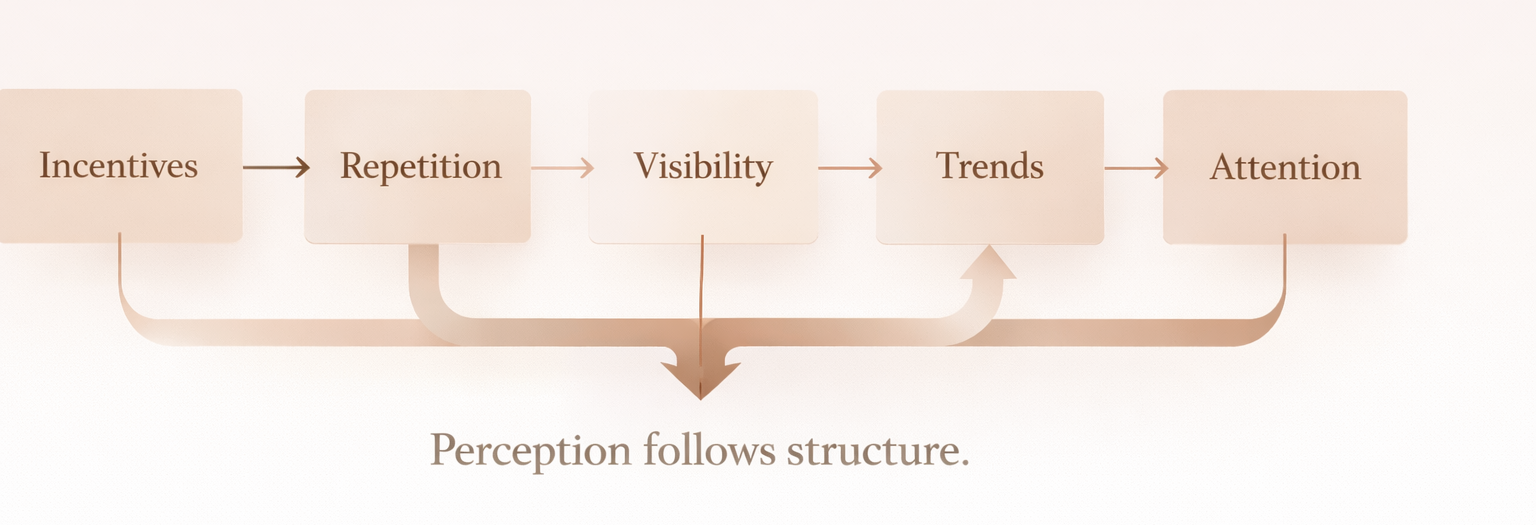
Most people talk about perception as if it forms on its own. It does not. Perception follows structure. It moves through a sequence of reinforcement points that shape what people notice, trust, repeat, and eventually embody.
In other words, what we call public opinion often begins long before anyone states an opinion out loud. First, a signal gets rewarded. Then it gets repeated. After that, it gains visibility. Once it starts trending, people treat it like a shared reality. Finally, attention turns it into behavior.
Incentives Decide What Gets Pushed
Every system rewards something. Platforms reward engagement. Audiences reward stimulation. Media companies reward whatever keeps people watching, clicking, and returning.
As a result, the first filter is never truth. It is incentive alignment. If a message drives reaction, the system pushes it forward. If it slows people down, the system usually buries it.
That is why incentives matter first. They decide which signals even get a chance to compete.
Repetition Decides What Feels Real
After a signal gets pushed, repetition does the deeper work. People trust what they recognize faster than what they verify. Familiarity lowers resistance.
Because of that, repeated exposure can make a weak signal feel stable. It can also make a narrow pattern feel representative. Over time, recognition starts masquerading as truth.
So repetition does not simply reinforce a message. It conditions the audience to accept it as normal.
Visibility Decides What Looks Credible
Next, visibility adds force. What people see most often starts to look most legitimate. Exposure creates a visual authority that many people mistake for proof.
However, visibility is not validation. A message does not become credible because it circulates widely. It becomes visible because the system keeps surfacing it.
That distinction matters. Otherwise, distribution starts replacing judgment.
How Perception Is Engineered Through Trends
Once something becomes visible enough, trends accelerate it. Trends create urgency. They give movement the appearance of importance. They make temporary interest feel like public consensus.
Yet what trends is not always what matters. In fact, fast-moving signals often outrun careful evaluation. People follow motion because motion feels decisive.
Therefore, trends act as an acceleration layer. They do not create substance. They amplify direction.
Attention Decides What Gets Copied
Finally, attention turns perception into behavior. People copy what they see repeatedly rewarded. They imitate what receives energy, reach, and response.
Consequently, attention does more than highlight behavior. It gives behavior a model to spread. What gets noticed gets repeated in tone, posture, priorities, and performance.
That is how culture travels. Not only through ideas, but through imitation.
Further Reading
For broader research on digital life, media exposure, and audience behavior, review Pew Research Center’s reporting on social media and digital life .
Related Groundwork
Structure decides what rises. Repetition decides what sticks. Attention decides what spreads.
The System in Motion
Perception does not drift into place. Systems build it. Incentives push signals forward. Repetition makes them familiar. Visibility makes them look credible. Trends make them feel urgent. Attention turns them into behavior.
Once that sequence becomes visible, the spell weakens. Then people can question what they are seeing, who benefits from its spread, and whether the signal deserves trust at all.
That is the real value of seeing how perception is engineered. It restores judgment.
