
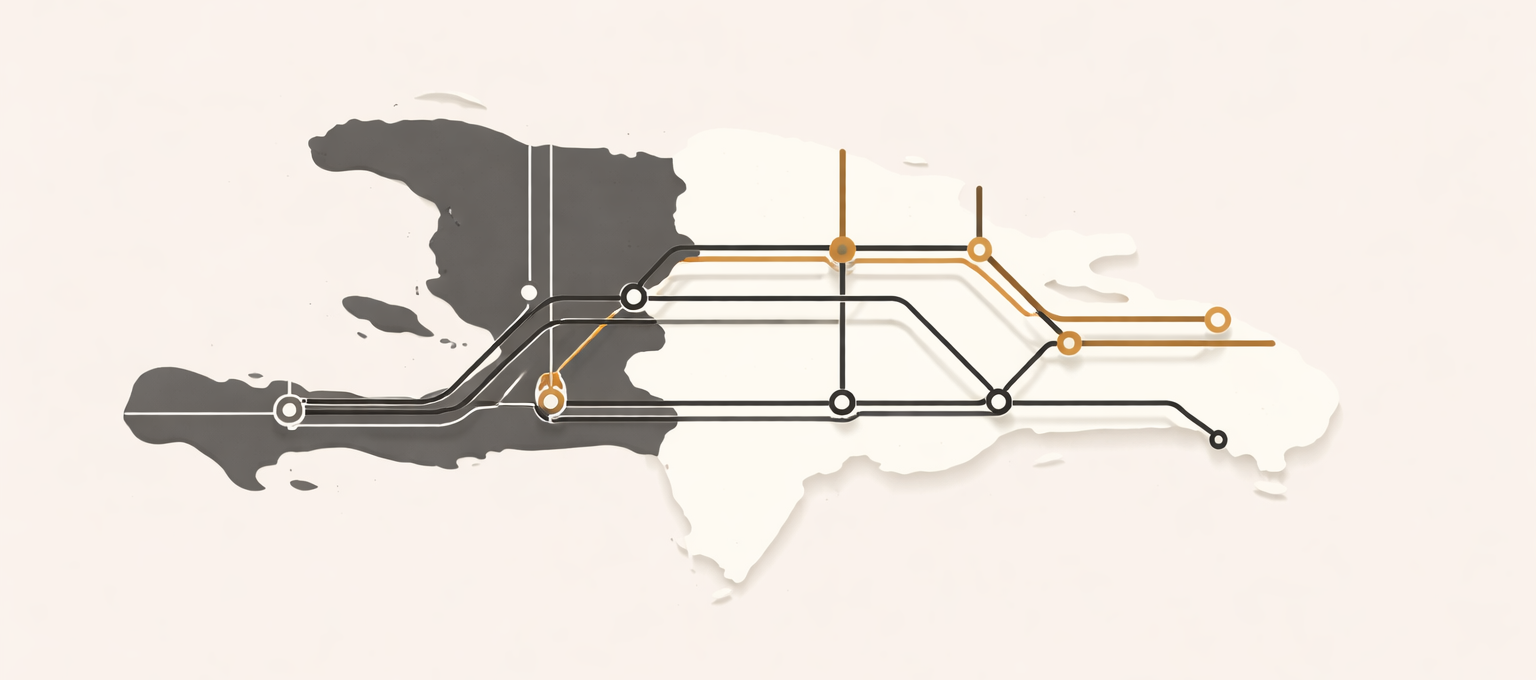
The governance problem of Hispaniola begins with a fixed condition: Haiti and the Dominican Republic share one island while operating as separate sovereign states.
Their laws, institutions, economies, national identities, and political histories are distinct. Geography, however, keeps connecting consequences. Migration crosses systems, labor markets interact, and environmental damage moves through shared ecosystems.
Therefore, the central problem is not national difference. The harder question is how two independent systems manage shared pressure without surrendering sovereignty or allowing every point of contact to become a crisis.
Public debate often moves quickly toward identity, blame, or historical grievance. Those issues matter, but they do not replace institutional analysis.
A stronger approach asks where the systems touch, what moves through those contact points, and whether the governing structures on either side can manage the resulting pressure.
Put simply, one island contains two states but not two separate environments.
The Governance Problem of Hispaniola Starts With One Island
Hispaniola creates a structural constraint that neither government can remove: two countries occupy one continuous landmass.
Political borders separate legal authority. Geography, by contrast, keeps connecting systems. Decisions made in one country can therefore create effects that appear in the other.
This reality does not make Haiti and the Dominican Republic one political system. Nor does it weaken the legitimacy of separate sovereignty.
Instead, shared geography creates places where independent governments must manage consequences that do not follow jurisdiction as neatly as law does.
Why Geography Keeps the Two Systems Connected
Law can define citizenship, while governments establish border procedures and institutions assign authority.
Storms still cross the island. Rivers and watersheds continue through political boundaries. Meanwhile, economic pressure influences labor movement, and disease or environmental damage can move through shared space.
Consequently, separation resolves the question of political authority without eliminating every shared system.
Authority
Two Sovereign States
Separate governments, laws, institutions, and national identities.
Constraint
One Geography
Shared land, ecosystems, border systems, and environmental exposure.
Pressure
Unequal Capacity
Different institutions carry different levels of economic and social strain.
Requirement
Selective Coordination
Shared consequences require structured cooperation where systems meet.
History Shaped the Governance Problem of Hispaniola
Haiti and the Dominican Republic emerged through different political histories.
Haiti declared independence in 1804 after a revolution against French colonial slavery. The eastern side of Hispaniola followed another path through Spanish colonial rule, political transition, Haitian rule beginning in 1822, and Dominican independence in 1844.
Because those political sequences differed, institutions, national narratives, and ideas about sovereignty developed differently as well.
Different Histories Do Not Create Separate Geography
Historical difference matters. However, it should not be confused with geographic independence.
Each state can preserve its own political identity while still confronting shared environmental, economic, health, labor, and migration pressures.
Therefore, historical distinction and practical interdependence can exist at the same time.
For the Dominican side of this history, continue with Dominican Independence in 1844: Sovereignty After Separation .
Haiti’s different path is examined in The Haitian Revolution System: Freedom Under Pressure .
Boundaries Inside the Governance Problem of Hispaniola
The border between Haiti and the Dominican Republic performs an essential governing function. It identifies where one state’s authority ends and another begins.
That distinction matters for citizenship, public security, taxation, commerce, immigration, land administration, and political accountability.
In other words, boundaries are not inherently the problem. Functional boundaries help systems assign responsibility.
When Boundaries Carry Too Much Pressure
Problems grow when the systems around a boundary lack enough capacity or coordination.
Informal labor can expand when lawful labor frameworks are weak. Likewise, irregular migration may increase when movement pressure rises while formal pathways remain limited.
Smuggling and informal trade can also grow where official systems create excessive friction. As a result, the border may end up carrying problems that began somewhere else.
Unequal Capacity Deepens the Governance Problem of Hispaniola
The two states do not enter every shared challenge with equal institutional, fiscal, or economic capacity.
That difference matters because pressure often moves toward systems that appear more stable, more accessible, or better able to absorb demand.
Haiti has faced deep institutional strain, political instability, economic weakness, disaster exposure, and recurring humanitarian pressure. The Dominican Republic, meanwhile, operates with a different level of state capacity and economic performance.
Those realities are not interchangeable. Still, their interaction shapes the wider island system.
How Capacity Gaps Transfer Pressure
When one system struggles to carry basic demand, pressure does not always remain inside it.
People may move, informal markets may expand, and aid systems may become more important. Employers can respond to available labor at the same time that border institutions face additional enforcement pressure.
Therefore, differences in capacity can become cross-border governance issues even when the original weakness began inside one country.
Why the Governance Problem of Hispaniola Transfers Pressure
Pressure rarely disappears because a government defines a border.
Instead, it often changes form. Economic weakness can become migration pressure, while migration pressure can become labor-market pressure. Labor dependence may then create political tension.
Environmental damage follows a similar pattern. Degradation can become agricultural strain, public-health pressure, or greater displacement risk.
Pressure Changes Which Institution Must Respond
Every transfer moves responsibility.
A migration increase may first reach border agencies. Later, employers, schools, hospitals, housing systems, or local governments may carry part of the demand.
Consequently, the visible institution is not always where the original pressure began.
Reactive Governance Makes Pressure More Expensive
When coordination starts only after a crisis becomes visible, both systems lose options.
Emergency enforcement costs more than predictable administration. Likewise, humanitarian crises are harder to manage than orderly processes, while environmental repair becomes more expensive after damage spreads.
Weak coordination therefore creates a recurring cycle: governments manage symptoms after the system has already transferred the pressure.
Migration and the Governance Problem of Hispaniola
Migration is one of the most visible ways that pressure moves across the island.
Yet migration is not the entire system. Economic conditions, political stability, family networks, labor demand, border policy, enforcement, and receiving-system capacity all shape movement.
For that reason, a border-only analysis remains incomplete.
Labor Demand Changes the Migration System
Labor markets create incentives that enforcement alone cannot erase.
Where employers depend on workers who move through formal or informal channels, economic demand becomes part of the migration system. Meanwhile, weak documentation or inconsistent enforcement can increase vulnerability and informality.
A durable framework must therefore address both movement and the economic systems that create demand for movement.
Why Migration Requires a Systems View
The broader Migration Systems Framework separates origin pressure, pathways, networks, institutional capacity, and public narrative.
That framework matters here because movement between Haiti and the Dominican Republic cannot be understood from the border alone.
For the search-entry question, continue with What Causes Migration? .
Environmental Pressure Crosses Hispaniola Too
Geography creates shared environmental systems whether governments coordinate or not.
Watersheds, forests, soil conditions, coastlines, storms, and ecosystems can produce consequences across jurisdictional lines. Therefore, environmental management cannot always succeed through isolated national action.
One government may control policy within its own territory. However, it cannot independently control every upstream or downstream effect.
Disaster Risk Exposes the Same Governance Gap
Hurricanes, flooding, earthquakes, drought, and other hazards can stress both countries even when damage is uneven.
Weak infrastructure or institutional capacity on one side may also increase humanitarian pressure. Later, that pressure can affect movement, trade, public health, or regional assistance.
Better preparedness therefore depends on coordination before the emergency begins.
The Governance Problem of Hispaniola Requires Selective Coordination
Coordination does not require political unity.
Haiti and the Dominican Republic can remain separate sovereign states while building clearer operating frameworks where their systems interact.
In fact, selective coordination can strengthen sovereignty because it reduces unmanaged pressure and clarifies responsibility.
Where Coordination Creates Practical Value
- lawful labor and migration administration
- border procedures and customs coordination
- environmental and watershed management
- public-health information and emergency response
- disaster preparedness and humanitarian planning
- trade systems and formal economic exchange
- institution-to-institution communication
These areas do not require shared government. Instead, they are places where separate governments face shared operating conditions.
Good Coordination Still Needs Boundaries
Cooperation should not mean unlimited access or blurred authority.
Each government still needs clear obligations, lawful processes, defined authority, and enforceable limits. The Groundwork Condition of Boundaries matters because responsibility weakens when authority becomes vague.
Effective cooperation should therefore clarify who does what rather than dissolve political responsibility.
Alignment Turns Cooperation Into an Operating System
The deeper Groundwork Condition is Alignment.
Policies, institutions, incentives, budgets, authority, and action need to point in compatible directions. Otherwise, one agency may encourage behavior that another agency is expected to contain.
Better alignment does not eliminate disagreement. However, it can prevent disagreement from becoming institutional chaos.
Why the Governance Problem of Hispaniola Still Matters
The central issue is not whether Haiti and the Dominican Republic should become more alike.
They are separate nations, and their histories matter. The stronger question is whether their institutions can manage the points where separate sovereignty meets shared consequence.
That challenge appears in migration, labor, environmental policy, disaster response, public health, commerce, and border administration.
Identity Cannot Carry the Whole Policy Debate
National identity matters, especially on an island shaped by colonialism, revolution, occupation, independence, intervention, and repeated political pressure.
Identity alone, however, cannot design a labor system, manage a watershed, process migration, prepare for a hurricane, or administer lawful trade.
For that reason, mature governance has to move from symbolic argument toward institutional design.
Stable Coexistence Requires Designed Systems
The practical goal is stable coexistence.
Neither state needs to surrender its history or sovereignty to pursue that goal. Instead, each government needs enough structure to manage its own responsibilities and enough coordination to handle consequences that cross the border.
That is the institutional middle ground between forced unity and permanent reaction.
The Groundwork
The Governance Problem of Hispaniola Is Shared Consequence
Hispaniola contains two sovereign states, not one political system. Yet the island also contains shared environmental, economic, labor, migration, health, and disaster pressures.
That is the governing tension.
Boundaries define authority, while Capacity determines what each state can carry. Alignment then determines whether separate institutions can manage the places where consequences cross.
Sovereignty does not require isolation. Likewise, coordination does not require unity.
The island does not separate every outcome. It connects consequences.
Continue Building
Continue through the history and movement systems that shape the wider Hispaniola framework.
→ Migration Framework: The Migration Systems Framework
→ Dominican History: Dominican Independence in 1844
→ Haitian History: The Haitian Revolution System
→ Migration Entry Point: What Causes Migration?
Groundwork Architecture
The Structure Under This Article
The governance problem of Hispaniola is fundamentally an alignment problem. Two sovereign systems retain separate authority while managing consequences produced by shared geography, unequal capacity, and cross-border pressure.
Core Principle
Durable systems must carry pressure, survive strain, and remain useful over time.
Primary Condition
Alignment coordinates authority, incentives, resources, priorities, and action across a system.
Supporting Conditions
Capacity determines what institutions can carry. Boundaries clarify responsibility, authority, access, and consequence.
Meet the Builder

Langston Reed
Builder · Civic Power & Policy
Langston Reed helps readers understand how institutions, governance, public policy, and civic systems shape everyday outcomes. His work looks beneath visible events to examine the structures that made them possible, the incentives moving through them, and the institutional patterns that remain after public attention shifts.
“Headlines describe movement. Systems explain movement.”
Reader Promise: Move past the visible event and understand the system underneath it.