Migration narratives system reality marks the point where public understanding often breaks down. People do not only respond to migration itself. They also respond to the story told about it. When narrative replaces structure, analysis weakens. When analysis weakens, diagnosis fails.
That failure matters. Migration already operates as a layered systems issue shaped by pressure, policy, and institutional capacity. However, public discourse often reduces it to outrage, sympathy, blame, or spectacle. As a result, the real mechanics become harder to see. People then argue about symbols while the structure producing the outcome stays in place.
How Migration Narratives System Reality Distorts Understanding
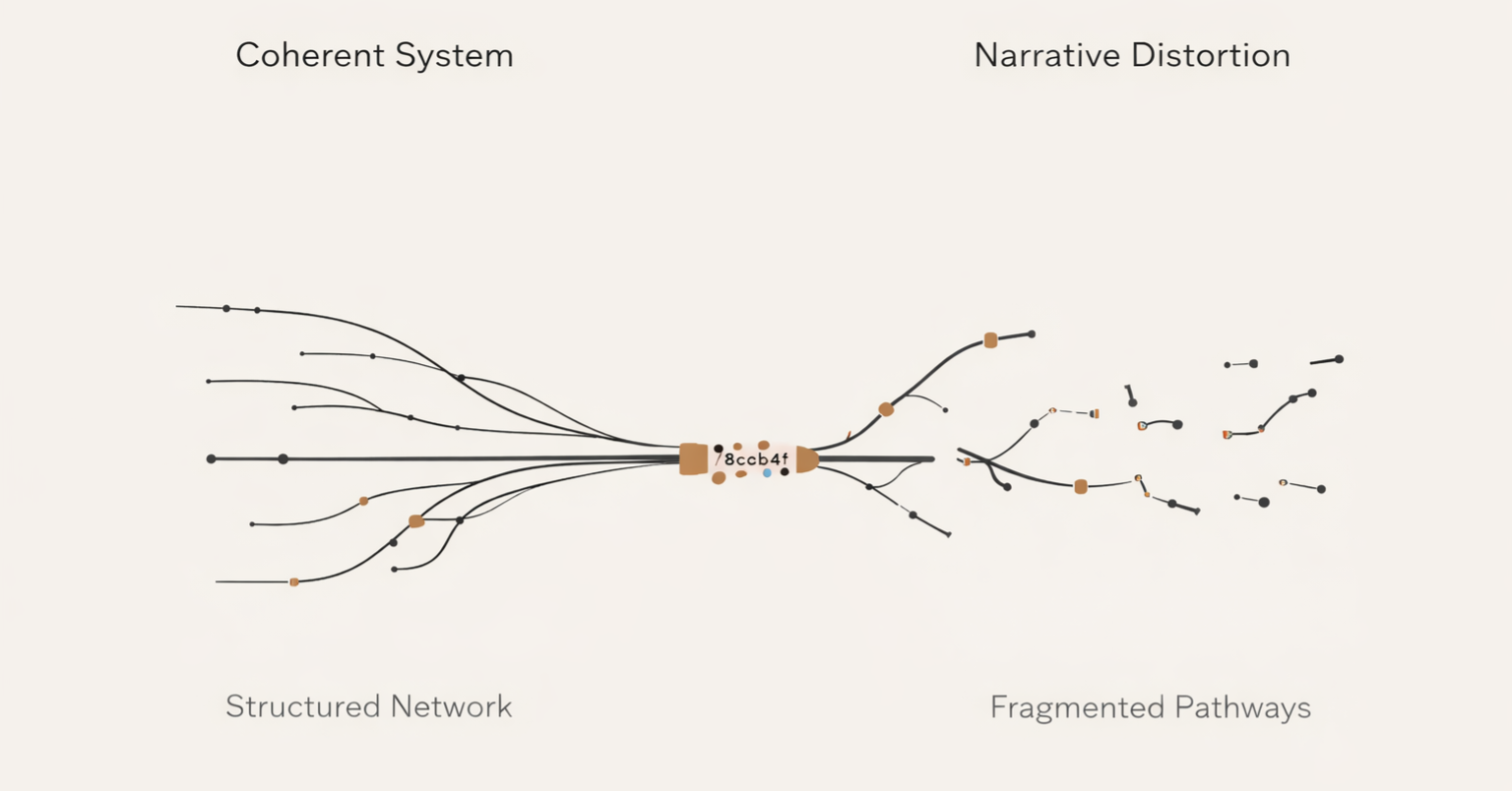
Most narratives simplify. That is their function. They compress complicated conditions into emotionally legible stories. Yet migration does not behave like a simple story. It behaves like a system. It reflects pressure at the source, incentives along the path, and limits inside receiving institutions.
Once public framing ignores those layers, distortion begins. One image stands in for the whole problem. One event gets mistaken for the pattern. One moral argument gets used to explain structural behavior.
That is not clarity. It is compression without explanation.
Why Narrative Distortion Weakens Diagnosis
Narrative matters because it shapes public attention. Nevertheless, attention is not the same as understanding. If narrative selects only the most dramatic slice of reality, the public receives emotion without mechanism.
That creates several problems:
- pressure looks spontaneous instead of structural
- policy signals look accidental instead of designed
- capacity failure looks isolated instead of systemic
- structural incentives disappear behind symbolic debate
In each case, the system becomes harder to read. Therefore, solutions become reactive instead of structural.
The Migration Systems Framework explains the full sequence. This post focuses on the interpretive layer. It shows how public storytelling can interrupt serious understanding of migration as a systems problem.
Migration Narratives System Reality and Public Perception
Public perception rarely forms from raw data. Instead, it forms from repeated framing. Media outlets, political actors, and digital platforms all influence which angles get amplified. Some emphasize threat. Others emphasize suffering. Still others emphasize conflict because conflict holds attention longer.
That incentive structure matters. The economics of attention often reward distortion over depth. In turn, the public sees a charged fragment instead of a full systems map.
Research from the International Organization for Migration and reporting frameworks used by the UNHCR repeatedly shows that migration outcomes depend on layered institutional and economic conditions, not isolated headlines. Narrative only preserves that broader structure when it does not erase it.
The Groundwork
Migration narratives system reality should never be confused with migration reality itself. Narrative may shape reaction, but structure still shapes outcomes. If public understanding stays trapped at the level of image, emotion, and symbolic conflict, the real drivers remain untouched.
For the upstream system pressures, return to Economic Pressure Drives Migration Flow. For the institutional layer, continue with Institutional Capacity Limits Migration Absorption. Both show that narrative alone cannot explain migration.