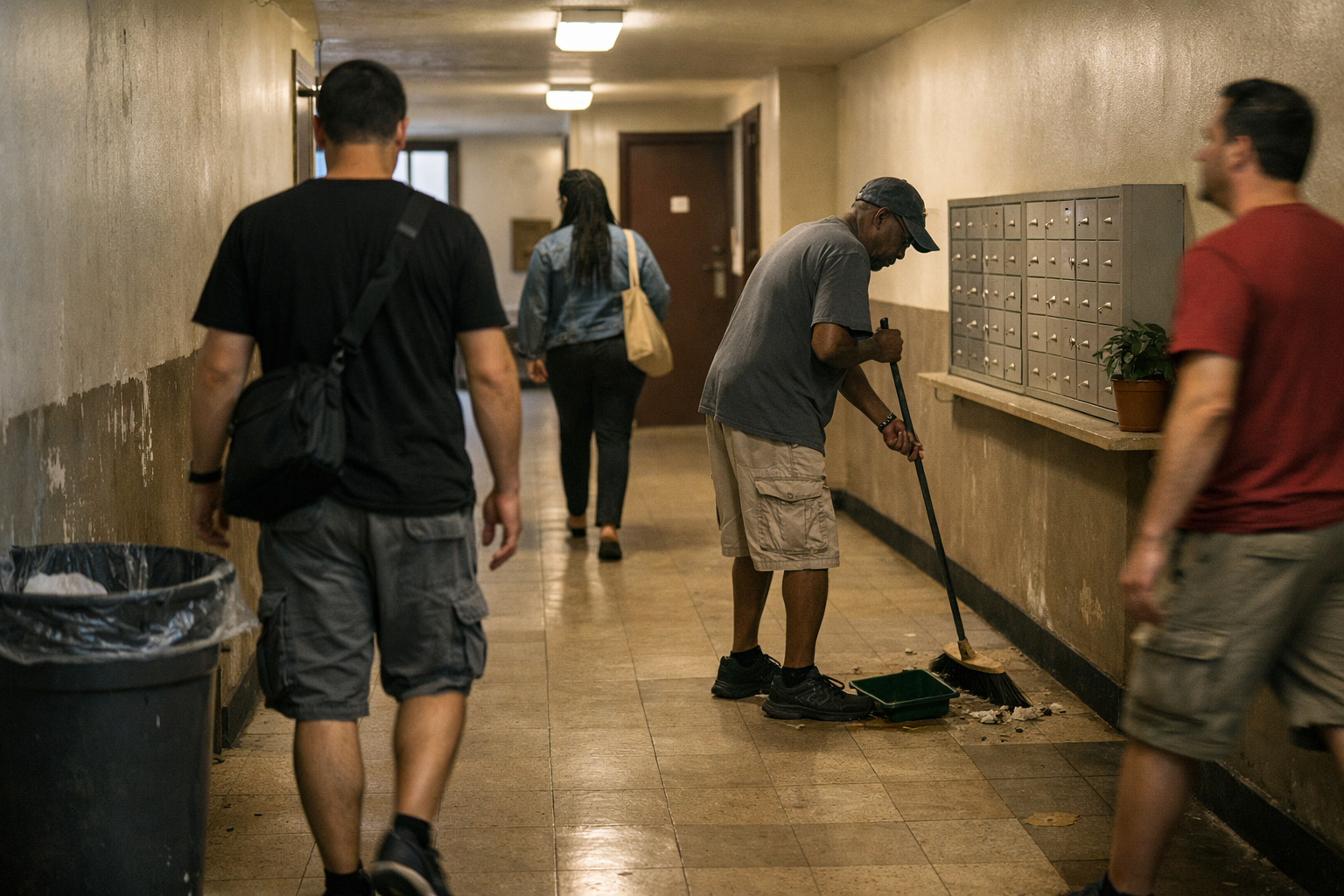
Community participation failure rarely begins with open conflict.
One person maintains the space.
Everyone else uses it.
The hallway tells the truth quietly. Order exists, but only where someone chooses to carry it.
That is the problem.
Communities often look stable long after participation has already weakened. The floor is still clean. The trash still gets removed. The meeting still happens. The shared space still functions.
However, the system is no longer healthy.
It is being held together by fewer people than anyone wants to admit.
Community participation failure begins when responsibility becomes disconnected from belonging. People still use the system, but fewer people help sustain it.
That imbalance does not look like collapse at first.
It looks like normal life.
The Hallway Problem
The hallway problem is simple.
Everyone benefits from a maintained space, but not everyone participates in maintaining it.
One resident sweeps the floor.
One employee refills the supplies.
One parent organizes the school event.
One neighbor reports the broken light.
One volunteer stays late to reset the room.
The system keeps functioning, so most people assume the system is fine.
That assumption is weak thinking.
A maintained system is not always a healthy system. Sometimes it is just a burdened system with one reliable person absorbing the imbalance.
This is how responsibility becomes invisible.
When people stop seeing the work, they stop valuing the work. When they stop valuing the work, they stop feeling responsible for the outcome.
That is where participation starts to break down.
Maintenance Creates the Illusion of Health
Shared systems can hide their own weakness.
An apartment building can look orderly because one tenant keeps reporting issues.
A workplace can feel organized because one operations person quietly fixes what everyone else ignores.
A church committee can appear strong because the same three people carry every program.
A neighborhood block can look stable because one household keeps watching, cleaning, calling, and correcting.
From the outside, the system appears functional.
Inside the system, the labor is concentrated.
That concentration matters.
When too much responsibility sits on too few people, the system becomes fragile. It may still look polished. It may still perform well. It may still produce results.
But the foundation is thinning.
All it takes is one contributor stepping back for the real condition to appear.
The Stairwell Test
There is a simple way to test whether a shared system is healthy.
Ask what happens if the most responsible person disappears for thirty days.
If the stairwell gets dirty, the trash piles up, the calendar breaks, the meeting stops, the supplies run out, or the group falls apart, the system was not stable.
It was dependent.
That difference is critical.
Real stability is distributed. Fragile stability is concentrated.
In a workplace, one reliable employee may handle the quiet infrastructure:
- ordering supplies,
- resetting rooms,
- updating shared documents,
- checking details,
- and catching mistakes before they become visible.
When that person stops compensating, everyone suddenly notices the gaps.
But the gaps were already there.
The contributor was covering them.
The same pattern appears in apartment buildings, families, volunteer groups, churches, group chats, school communities, and neighborhood blocks.
One person becomes the unofficial maintenance department.
Everyone else calls it community.
That is not community.
That is extraction wearing a friendly shirt.
Optional Responsibility Creates Extraction
Every shared system contains contributors and consumers.
Healthy systems keep those roles reasonably balanced.
Weak systems allow consumption to outrun contribution.
Once people realize they can benefit from a space without helping maintain it, behavior adjusts.
Some people reduce effort quietly.
Some stop volunteering.
Some only help when praised.
Some remain present but emotionally withdraw.
Others continue benefiting while acting as if the system maintains itself.
This is not always malicious.
Often, it is learned behavior.
People observe what the system permits. If the system permits uneven responsibility, uneven responsibility becomes normal.
That is how extraction spreads.
Not through speeches.
Through permission.
The Broken Windows Effect Is Really About Signals
Visible neglect sends a message.
A full trash can says nobody is responsible.
Dishes left in the office sink say standards are optional.
A broken hallway light says delay is acceptable.
Abandoned shopping carts say the shared environment is someone else’s problem.
A cluttered shared drive says disorder has no owner.
These signals teach behavior.
People do not only respond to rules. They respond to what the environment repeatedly allows.
If care is visible, contribution becomes easier to copy.
If neglect is visible, disengagement becomes easier to justify.
This is why community participation failure can spread without anyone announcing it.
The environment becomes the teacher.
And weak systems teach people to lower their standards.
Invisible Labor Weakens Reciprocity
Most communities depend on small acts that rarely get public credit.
Someone arrives early.
Someone resets the chairs.
Someone checks on the elderly neighbor.
Someone reminds the group about the deadline.
Someone cleans what they did not dirty.
Someone notices what others walk past.
That labor is not glamorous.
It is infrastructure.
When infrastructure becomes invisible, people start treating it as automatic. They stop seeing the human effort behind the stable environment.
That damages reciprocity.
People begin to see themselves as users of the system instead of participants in the system.
Once that shift happens, responsibility becomes optional.
And optional responsibility always creates uneven burden.
When Contribution Stops Feeling Fair, Contributors Exit
The most dangerous moment in a shared system is not when careless people act carelessly.
That was predictable.
The dangerous moment is when responsible people decide the system no longer deserves their effort.
Contributor withdrawal usually happens in three stages.
Silent Exit
The person stops volunteering.
They do not complain. They simply stop raising their hand.
Minimum Exit
The person does only what is required.
No extra correction. No quiet cleanup. No emotional investment.
Emotional Exit
The person remains physically present but mentally checks out.
They still attend. They still respond. They still appear cooperative.
But they no longer carry the system.
By the time this happens, leadership usually notices the decline too late.
The contributor did not fail the system.
The system consumed the contributor.
Real-World Examples Are Everywhere
This pattern is not limited to neighborhoods.
It shows up anywhere people share benefits without sharing responsibility.
The Office Kitchen
Everyone uses the kitchen.
One person wipes the counter. One person restocks the cups. One person empties the trash when it overflows.
Eventually, that person stops.
Suddenly, the room reveals the real culture.
The Apartment Building
Everyone wants clean hallways, working lights, and quiet nights.
But only a few residents submit maintenance requests, attend meetings, or challenge disorder.
The building may still function, but accountability is uneven.
The School Community
Everyone wants strong events, safe trips, good communication, and engaged families.
But the same parents plan, fund, call, email, and clean up.
Eventually, those parents burn out.
Then everyone asks why the culture changed.
The Neighborhood Block
One neighbor shovels snow.
One neighbor picks up loose trash.
One neighbor watches packages.
One neighbor checks on seniors.
The block feels stable because a few people treat the block as a shared responsibility.
If they stop, the block changes quickly.
The Digital Community
Online spaces have the same problem.
One moderator enforces standards. One person welcomes newcomers. One person keeps the conversation useful.
When that person leaves, the culture decays fast.
Digital disorder is still disorder.
The platform changes, but the participation problem remains.
Different Places Use Different Incentives
Some cities and communities manage shared responsibility better because expectations are visible and reinforced.
Tokyo is often discussed for its strong public cleanliness norms. The lesson is not that one culture is morally superior. The lesson is that repeated social expectations shape public behavior.
Singapore uses a different model: strong enforcement, clear rules, and visible consequences. That structure communicates that public space is not optional space.
New York City shows the block-by-block version of the same truth. One block can feel cared for while the next feels abandoned. The difference is often not money alone. It is maintenance density, enforcement, participation, and local expectation.
The deeper point is simple.
Shared spaces do not maintain themselves.
They are shaped by incentives, norms, enforcement, and visible contribution.
When those structures weaken, participation weakens with them.
Strong Communities Protect Contributors
Strong communities do not rely endlessly on sacrifice.
That is not strategy.
That is slow extraction.
Healthy systems protect contributors by making responsibility visible and shared.
They recognize maintenance labor.
They rotate responsibility.
They correct imbalance early.
They discourage passive consumption.
They name the work required to keep the system stable.
This matters because contribution survives when people believe their effort still matters.
Without that belief, disengagement becomes rational behavior.
People protect their energy when systems stop protecting their contribution.
The Groundwork
Community participation failure begins long before collapse becomes visible.
It starts when responsibility concentrates around fewer people while everyone else continues receiving the benefits.
That is the quiet collapse.
The space may still look clean.
The meeting may still happen.
The block may still feel stable.
The family may still function.
The workplace may still produce.
But if the system depends on invisible labor from the same few people, it is already under stress.
Communities do not survive because good people endlessly sacrifice.
They survive because systems make contribution visible, shared, and protected.
The question is rarely whether people care.
The better question is:
Who is carrying this place right now?
And what happens if they stop?
Continue Building
Community Systems Fail When Contribution Stops
The Free Rider Problem at Work: When Reliability Becomes Infrastructure
Contribution Must Be Visible or It Disappears
Structure Builds Freedom
Accountability Is a Form of Strength
The Family Stability Framework
Receipts
Collective Action Problems — Stanford Encyclopedia of Philosophy
Tragedy of the Commons — Britannica
Broken Windows Theory — Britannica