
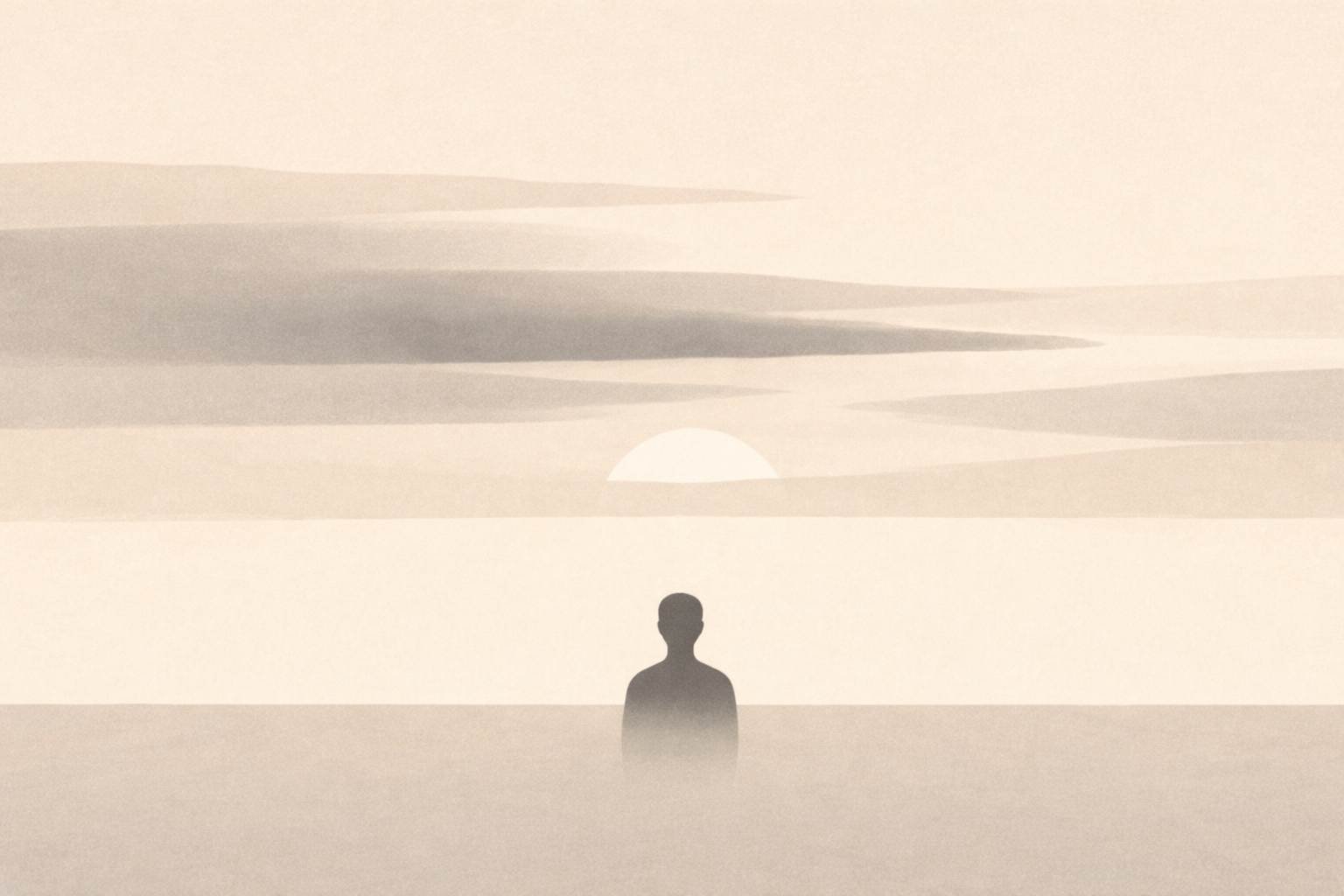
Delayed emotional response happens when the feeling arrives after the moment that produced it.
The meeting ends.
The difficult conversation is over. The deadline passes. Everyone goes home.
You handled it.
Maybe you handled it remarkably well.
Then, hours later, something changes.
Irritation rises in a quiet kitchen. Sadness appears during the drive home. Your mind starts replaying a conversation you thought you had already left behind.
Nothing new happened.
Yet something new is being felt.
Within The Soul Weather Report, this is Delayed Weather: an internal response that becomes available to awareness after the event or pressure that helped produce it has already passed.
The distinction matters because the timing of an emotion is not necessarily the timing of its cause.
Current Reading
Delayed Weather
The original moment has passed, but its internal signal is only now becoming clear enough to register.
What Is a Delayed Emotional Response?
A delayed emotional response is a feeling or reaction that becomes noticeable after the event associated with it has ended.
In ordinary life, attention sometimes has another job first.
You may need to finish the presentation.
You may need to get everyone home safely. You may need to remain composed during a difficult conversation or keep moving through a demanding day.
There may simply be no useful room to stop and understand everything while it is happening.
So awareness comes later.
The feeling is not necessarily false because it is late.
It may simply belong to an earlier moment.
Auden Field Note
Sometimes the heart waits until the room is quiet enough to finish a sentence the day interrupted.
Why Feelings Sometimes Arrive Late
Human attention is finite.
During a demanding moment, immediate function can take priority over interpretation.
There is work to finish.
A decision has to be made. Someone needs an answer. The situation may require composure before reflection.
In those moments, the internal system can still register that something matters without giving that signal full conscious attention.
Later, when demand decreases, the signal becomes easier to hear.
Space Can Reveal What Activity Concealed
This is why delayed weather often appears during transitions.
The commute home.
The shower after a long day.
The first quiet Saturday after a difficult week.
The evening after a major project ends.
The silence does not necessarily create the feeling.
Sometimes silence simply makes the feeling audible.
Delayed Weather Is Not the Same as Residual Pressure
These conditions can overlap, but they describe different problems.
Residual Pressure describes strain that remains after the main pressure has decreased.
Delayed Weather describes a response that becomes perceptible later.
One is about what remains.
The other is about when the signal becomes readable.
That distinction protects the framework from treating every post-pressure experience as the same weather.
The Biggest Risk Is Blaming the Wrong Moment
Late weather can be confusing because human beings naturally search nearby for explanations.
If irritation appears tonight, tonight becomes the suspect.
If sadness appears Sunday morning, Sunday morning can seem like the cause.
If exhaustion hits after the deadline, the quiet day afterward may feel strangely heavy.
But proximity is not proof.
The feeling may have roots several hours or several days behind the moment in which it finally became visible.
Misattribution Creates Secondary Weather
This is where a delayed signal can become more disruptive than it needed to be.
You snap at someone who had nothing to do with the original pressure.
You question a relationship because an unrelated difficult conversation is still echoing.
You assume your motivation disappeared when the system may simply be registering the cost of what it just carried.
The original weather was one thing.
Misreading it can create another.
Reading Rule
Before assigning a late feeling to the present, ask whether it belongs to something that happened earlier.
What Delayed Weather Can Look Like
Delayed emotional response does not have one emotional signature.
It can arrive as sadness, anger, fatigue, relief, tenderness, mental replay, or an unexpected need for quiet.
The more useful clue is timing.
Not Every Late Feeling Is Delayed Weather
Timing alone does not establish the source.
A difficult mood on Tuesday is not automatically evidence of something that happened Monday.
New conditions may be developing.
Sleep may be poor. Current pressure may be rising. Several demands may be converging at once.
The framework should not become a machine for manufacturing explanations.
Delayed Weather is a hypothesis to test, not a story to force.
Look for a Plausible Trail
Ask whether there is an earlier moment that reasonably matches the response.
Did something require unusual composure?
Was there little room to process what happened?
Did the feeling appear soon after external demand decreased?
Does the content of the reaction point backward?
Good observation should narrow uncertainty.
It should not invent certainty where none exists.
Functioning Well Does Not Mean Nothing Registered
This is one of the more important distinctions in the reading.
People often use performance as evidence that an experience did not affect them.
The presentation went well.
The conversation stayed civil.
The work got done.
Therefore, the assumption goes, everything must have been fine.
But function and interpretation are not identical.
A person can meet the demands of a moment before fully understanding what the moment required of them.
Sometimes competence carries you through the weather.
Awareness catches up later.
Applied Reading
Consider someone leading an important presentation after weeks of preparation.
A senior colleague challenges the work sharply in front of the room.
The presenter responds calmly.
Questions get answered. The meeting ends. Everyone moves on.
Nothing dramatic happens afterward.
That evening, however, the presenter becomes unusually irritated during an ordinary conversation at home.
The temptation is to treat the evening as the problem.
A more accurate reading asks whether the emotional clock is running behind the event clock.
The feeling is happening now. Its source may not be.
Why Pause Matters Before Interpretation
A late signal can feel urgent because it arrives with fresh intensity.
Fresh intensity does not necessarily mean fresh cause.
That is why Delayed Weather benefits from a pause between noticing and assigning meaning.
The pause is not avoidance.
It is investigative space.
It allows the reader to compare the feeling with the present environment before deciding what the feeling means.
Ask Where the Weather Began
Instead of asking only, Why do I feel this way right now?, widen the window.
Ask what happened before the feeling became visible.
What required effort?
What did you move through quickly?
Where were you functional but not reflective?
What changed when the environment finally became quiet?
Sometimes the answer is in the room you are standing in.
Sometimes it is several rooms behind you.
Do Not Let Late Weather Make an Immediate Decision
Delayed emotion can contain useful information.
That does not mean its first interpretation is automatically correct.
If the emotional response belongs partly to an earlier event, a major decision made in the present may solve the wrong problem.
A difficult evening does not automatically mean the relationship is failing.
A heavy Sunday does not automatically mean Monday’s work is the problem.
Irritation after a demanding day does not automatically mean the person in front of you caused it.
First place the weather.
Then decide what, if anything, needs a response.
Delayed Weather Can Produce Overcorrection
Timing errors often create response errors.
If yesterday’s pressure becomes visible today, the reader may impose a strong correction on today’s conditions.
That is one pathway into Overcorrection .
The present gets restricted because the past finally became audible.
This does not mean the late response should be ignored.
It means the response should be placed accurately before action follows.
Today’s Practice
Trace the Weather Backward
When an emotion seems larger than the present moment explains, do not immediately argue with it or obey it.
Trace it.
- Notice: What am I actually feeling?
- Compare: Does the present moment reasonably explain this intensity?
- Look Back: What happened earlier that required effort, composure, restraint, or speed?
- Locate: When did the feeling first become noticeable?
- Attribute: What does this response most plausibly belong to?
- Respond: Does anything need action now, or does the experience first need acknowledgment?
The goal is not to make the feeling disappear. The goal is to stop asking the wrong moment to explain it.
The Delayed Weather Forecast
Current conditions favor patience with timing.
The weather may feel immediate even when its origin is not.
If the signal can be traced accurately, the present regains proportion.
The person in front of you does not have to carry the weight of a conversation they were never part of.
A quiet day does not have to be blamed for exhaustion created by a demanding week.
And a feeling does not have to be dismissed simply because it arrived after everyone else went home.
If the Weather Belongs to the Past
Give it the dignity of accurate placement.
Perhaps something still needs to be said.
Perhaps a boundary needs review. Maybe the system simply needs enough quiet to finish processing what happened.
The appropriate response depends on the actual source.
If the Weather Belongs to the Present
That is useful information too.
The backward check has done its job.
You have reduced one possible source of confusion and can read current conditions more cleanly.
Observation is valuable even when it disproves the first hypothesis.
Receipts
The Soul Weather Report is an original Groundwork Daily editorial framework. “Delayed Weather” is Groundwork Daily’s non-clinical language for the experience of an internal response becoming noticeable after the event or pressure associated with it has passed.
The framework should not be read as claiming that every delayed feeling has a single identifiable cause. Stress responses, appraisal, memory, attention, and emotional awareness are more complex than a single editorial model can capture.
For general background on stress and its effects on functioning, see the American Psychological Association’s resources on stress .
A Note on Scope
The Soul Weather Report is an editorial framework for observation, reflection, and practical self-awareness.
It is not therapy, diagnosis, crisis intervention, personality typing, or a substitute for qualified medical or mental health care.
Persistent distress, substantial changes in daily functioning, safety concerns, or other serious symptoms may require appropriate professional support.
Where Delayed Weather Fits in the Soul Weather System
Delayed Weather is fundamentally a timing reading.
It teaches the reader not to assume that internal experience and external events move on identical clocks.
Within the Soul Weather Framework , that matters because accurate response depends on more than identifying what is being felt.
The reader also has to ask when the condition began, what preceded it, and whether the present moment is actually carrying the pressure now being experienced.
Demand occurs → function takes priority → awareness lags → external pressure decreases → the signal becomes readable → attribution determines the quality of the response.
That sequence gives Delayed Weather a distinct job in the larger system.
It is not primarily about intensity.
It is about chronology.
Closing Observation
We like our inner lives to be punctual.
Something happens.
We feel it.
We understand it.
We move on.
Human beings are rarely that tidy.
Sometimes responsibility speaks first.
Sometimes composure does.
Sometimes there are groceries to carry, people to answer, trains to catch, children to settle, reports to finish, or simply no room yet for the whole truth of a moment.
So the weather waits.
Then a quieter hour comes.
And what could not be heard earlier finally reaches the surface.
There is no wisdom in blaming the quiet hour for what it revealed.
Read backward.
Find the front that moved through earlier.
Give the feeling its proper place in time.
The weather is arriving now. That does not mean it began here.
Further Groundwork
→
The Soul Weather Framework
→
Stillness Is Strategy
→
The Soul Weather Report: Residual Pressure
→
The Soul Weather Report: Recovery vs. Avoidance

Meet the Builder
Auden Larke
Builder · The Soul Weather Report
Auden Larke builds language for the weather people carry but do not always know how to name.
Through The Soul Weather Report, Auden explores attention, pressure, timing, recovery, perception, and the quiet gap that can exist between living through a moment and finally understanding what that moment carried.
The work is grounded in a simple discipline: notice the condition without turning it into identity, locate the weather before reacting to it, and leave enough room for human experience to arrive on its own clock.
“Sometimes the heart waits until the room is quiet enough to finish a sentence the day interrupted.”
Meet Auden Larke • The Soul Weather Report • Framework Guide • Stillness & Soul